
The biggest myth about internal medicine residency applications is that committees thoughtfully “review every file.” They don’t. The computer kills most ERAS applications before a human ever sees your name.
Let me walk you through how that actually works.
The Reality: Big IM Programs Run on Filters, Not Feelings
At any large academic internal medicine program—think 20+ categorical spots, 4,000–7,000 applications—manual review of every ERAS file is physically impossible. So they do what every rational overworked PD does.
They build a funnel with hard screens at the top.
Those smiling “holistic review” slides they show on interview day? That’s for the survivors. The holistic part starts after you pass a series of cold, binary filters that happen in an ERAS export, an in‑house database, or a piece of custom software.
Here’s the usual flow at a big IM program:

| Step | Description |
|---|---|
| Step 1 | All ERAS applications |
| Step 2 | Automated import and scoring |
| Step 3 | Auto screen out |
| Step 4 | Preliminary numeric rank |
| Step 5 | Flag for review despite weaker metrics |
| Step 6 | Standard review pool |
| Step 7 | Human file review |
| Step 8 | Interview offers list |
| Step 9 | Fails any hard filter |
| Step 10 | In program mission group? |
You’re thinking: fine, what are those “hard filters” and how bad are they?
Let’s open the black box.
Step 1: The First Chop – Scores, Attempts, and Completion Status
Program directors rarely say this explicitly to students, but they say it to each other in PD meetings all the time:
“We start with the fail list. Anyone who failed Step or has multiple attempts is out unless someone specifically advocates for them.”
For USMLE/COMLEX, most big IM programs do some version of this.
| Filter Type | Common Threshold |
|---|---|
| USMLE Step 1 | Pass on first attempt (post‑numeric era) |
| USMLE Step 2 CK | 220–230+ for categorical; 210–215+ for prelim |
| Attempts | Any fail often auto‑screened, sometimes 2+ only |
| COMLEX Level 1/2 | Pass on first attempt |
| Visa Status | J‑1 only or no visas at some programs |
| Graduation Year | Within 3–5 years of med school graduation |
How they implement this:
ERAS exports data into an Excel or Access file, or a proprietary dashboard. A coordinator or APD runs filters:
- Show only applicants with Step 1 = Pass, Step 2 CK ≥ X
- Exclude any with “Fail” or “Incomplete” anywhere
- Exclude graduation year older than Y
On a 5,000‑application pile, this can remove 40–70% of applicants in seconds.
Here’s the uncomfortable truth: the initial screen is often done by the coordinator, not the PD. Using rules the PD/APD agreed on months before. Once you’re filtered out at this stage, nobody is going back manually through that rejection bin unless there’s a compelling personal tip email from a trusted faculty member. And even then, not always.
Step 1 vs Step 2 in the Pass/Fail Era
In IM, Step 1 going pass/fail shifted the weight heavily onto Step 2 CK. At big university IM programs, here’s roughly what’s happening behind closed doors:
- Step 2 CK ≥ 250: auto‑flagged as “high stat,” often sorted to the top of the review list.
- 235–249: considered solid/competitive for academic IM.
- 220–234: fine for many mid‑tier university programs and strong community programs; borderline for the top few places unless something else is exceptional.
- <220: many large academic programs set filters above this and will never see you. A few will review if you’re home students, underrepresented, or have strong research/letters.
They do not say these cutoffs out loud. They absolutely use them internally.
Here’s the pattern I’ve actually seen at a large university IM program: the APD sat with a coordinator and said, “Let’s start with everyone ≥ 230 on Step 2. Below that, only review if US grad or flagged by X, Y, Z.” That was thousands of applications reduced to ~1,500 in an afternoon.
Step 2: The “Soft Hard” Filters – Year, Citizenship, and School
Once you clear exam filters, the next layer hits: things they pretend are “context,” but in practice behave like more screens.
Year of Graduation
Most big IM programs have a quiet rule: no more than 3–5 years since medical school graduation.
Why? Because older grads are statistically more likely to struggle with exams, systems, and inpatient tempo. Yes, there are exceptions. They are rare.
So they’ll often set a filter like:
- US grads: up to 5 years out
- IMGs: 3–4 years out, unless in continuous clinical practice with strong letters
I’ve literally watched a PD say, “Just filter out more than 5 years since grad; if somebody amazing gets caught, a faculty member will yell at me.” Translation: if no one inside advocates for you specifically, you’re gone.
Citizenship and Visa Status
This part is more brutal than anyone publicly admits.
Programs will commonly do one of the following:
- No visas at all (they won’t say this publicly; they just screen you out).
- J‑1 only; no H‑1B (because HR and legal headaches).
- Cap the number of IMGs/visa holders to some informal target.
The coordinator will literally click a filter: include only “US citizen or permanent resident” when they’re overrun with applications. That’s it. You could have a 260. If they’ve already filled their mental “visa quota,” you’re just gone.
Medical School Type and “Baskets”
Almost every big IM program uses some version of a “bucket” or “basket” system. It looks like this, whether they admit it or not:
| Bucket | Typical Treatment |
|---|---|
| US MD home school | Reviewed almost automatically |
| US MD same region/top tier | High priority, usually full review |
| US DO with strong scores | Reviewed, often with separate DO filter |
| Caribbean / offshore | Harder filter; need stronger scores |
| IMG with ties or strong rec | Selected subset reviewed |
The filter logic is often nested. For example:
- If US MD or DO: lower score cutoff, more likely to be read.
- If Caribbean: Step 2 cutoff raised by ~10 points.
- If IMG: need Step 2 super‑strong and visa status acceptable and YOG recent.
This is why you’ll hear two people with the same score tell completely different stories. A US MD with 228 might get 20+ IM invites. An IMG with 238 might get 2 interviews total. That’s not randomness; that’s rule‑based screening.
Step 3: Numeric Scoring and Rank‑Sorting Before Human Eyes
Once the obvious no’s are gone, the remaining pile is too big to read carefully. So programs start assigning numeric weights to whatever’s left.
They typically build some kind of composite score. It’s rarely sophisticated, but it’s consistent within the program. Think:
- Step 2 CK numeric score
- Type of school (US MD vs DO vs IMG)
- Class rank / AOA / honors
- Research count / pubs
- Maybe a crude “fit” flag (home student, geographic tie)
I’ve seen spreadsheets with columns like:
- “USMD = 3, DO = 2, IMG = 1”
- “Research: 0–3 points based on number of pubs/abstracts”
- “Letters: 0–2 based on writer reputation if known”
Then they’ll create a composite:
Total score = (Step 2 CK / 10) + school_score + research_score + letter_score (+/- bonus for home/URiM/dual applicant)
The specifics vary, but the behavior is the same: sort descending, start reviewing from the top until they hit their target number of interviews.
Where “Holistic Review” Actually Starts
This is the part applicants misunderstand.
Holistic review isn’t used to decide which of 5,000 applications gets read. It’s used after filters and numeric sorting to distinguish among the ~600–1,000 that survive.
So yes, once you’re in that smaller pile:
- A great personal statement matters.
- Unique experiences stand out.
- Strong, specific letters can override a mediocre score.
But if you never made it into that reduced pool because of Step 2 = 219 or graduation year 2016 with no champion, no one ever got the chance to be impressed by your “non‑traditional journey.”
Step 4: Hidden Priority Lanes – Home Students, Feeder Schools, and “Friends of the Program”
There are parallel tracks happening that students suspect but don’t quite see.
At almost every decent sized IM program, three groups get special handling:
- Home medical students
- Feeder schools
- Personally referred or “called about” applicants
Home Students
If you’re a student at the home medical school, your odds of getting filtered out early are close to zero, unless you have fails or something truly catastrophic.
I’ve watched PDs say to coordinators: “Pull all of our own students into a separate list. We’ll discuss each one.” That’s regardless of step score, to a point.
Feeder Schools
Programs quietly develop “feeder relationships” with certain med schools whose grads perform well.
So they’ll tell the coordinator: “Anyone from X, Y, Z schools gets reviewed down to a lower Step 2 threshold.” Translation: if previous residents from that school did well, you get extra life.
Referral Lane
This one is more uncomfortable but very real.
A PD gets an email from a chair or a well‑known colleague: “Can you take a close look at this applicant?” That applicant gets tagged. Sometimes literally, in the tracking spreadsheet.
I have seen this override the filter system. A referred IMG with a fail on Step 1 was manually added back into the review pool at a solid academic IM program because a respected faculty member picked up the phone. No fairy tale: they still needed a strong story and excellent interview, but the only reason their file got opened was that connection.
If you’re completely outside all three lanes—no home connection, no feeder school, nobody to email on your behalf—you are relying almost entirely on the filters and numbers.
Step 5: Program “Personality” and How It Warps Filtering
Not all big IM programs filter the same way. Their insecurities and priorities shape the rules.
Let me give you three typical archetypes.
1. The Prestige‑Chasing Academic Flagship
Think big‑name university, lots of subspecialty fellowships, NIH‑heavy.
Their filters:
- Aggressive Step 2 thresholds. 235+ is where serious consideration starts, 250+ is comfort zone.
- Strong bias for US MD, research‑heavy applicants.
- Caribbean/IMG applicants need near‑perfect stats and often research at US institutions.
Their risks: They over‑weight metrics and under‑weight work ethic and service orientation. You can be a mediocre team player with a 255 and still get in.
2. The Large Community‑University Hybrid
Think big community hospital affiliated with a med school, strong teaching, moderate research.
Their filters:
- Step 2 thresholds closer to 220–230.
- More willing to consider DOs and strong IMGs.
- Visa policies driven more by GME funding and prior experiences than pure prejudice.
Their behavior: They talk more honestly about using cutoffs. But they still do it.
3. The High‑Volume Community Workhorse
Think 20–30 IM spots, hundreds of residents overall, insane admit volume, maybe looser academics.
Their filters:
- Flexible on Step 2 (215–220 may be fine).
- More open to older grads and IMGs, as long as there’s proof of recent clinical work.
- Very sensitive to visa logistics and GME caps.
These programs are more likely to actually, genuinely read your unique story—if you clear basic competency and licensure hurdles. But they still start with “no fails, recent grad, workable visa.”
How This Changes Your Strategy (If You’re Paying Attention)
You cannot “personal statement” your way around being auto‑screened. So you stop treating all programs the same and start thinking like they do.
Know Which Pile You’re In
Roughly:
- Step 2 CK ≥ 245 and US MD: you’ll survive first‑pass filters at almost any IM program, barring other red flags.
- 230–244: many academic IM programs still in play, but top‑tier places may be tougher.
- 220–229: realistic core targets are mid‑tier university and strong community programs; choose your list wisely.
- <220 or exam fails: you must be strategic, volume‑heavy, and realistic, and you should identify programs known to be friendlier to your profile.
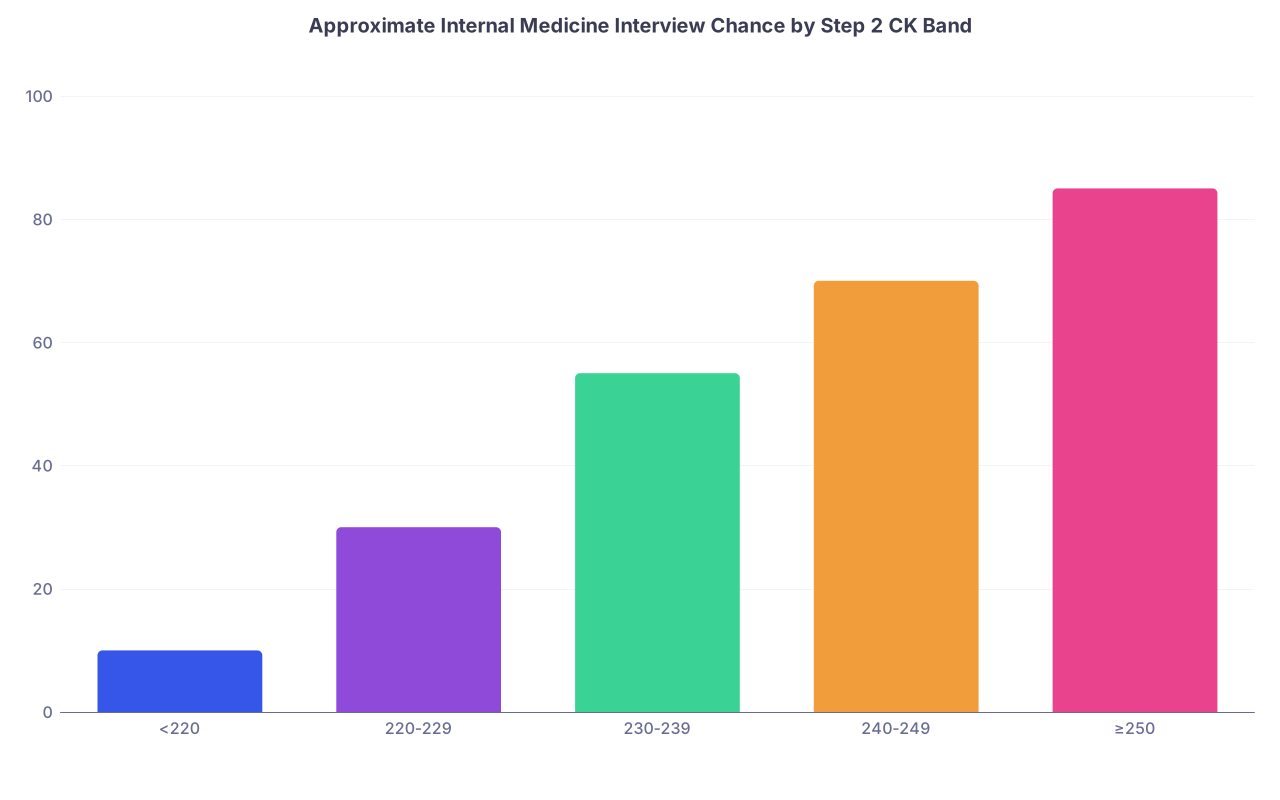
| Category | Value |
|---|---|
| <220 | 10 |
| 220-229 | 30 |
| 230-239 | 55 |
| 240-249 | 70 |
| ≥250 | 85 |
These percentages aren’t official, but they’re in the ballpark for large IM programs when you combine filters plus real‑world behavior.
Shape Your Application to the Filters
You cannot rewrite your past, but you can control what shows up cleanly in the fields that get exported and filtered.
That means:
- Get Step 2 CK in early if you’re relying on it to offset a weaker Step 1 or school background. Many programs won’t review you without it.
- Make sure there are no unexplained gaps in your medical education or post‑grad timeline. Breaks without explanation make coordinators nervous and can push you into the “skip” pile.
- Clarify US clinical experience if you’re an IMG. Many programs add extra points for recent, solid USCE in their numeric scheme.
And yes, if you have a Step failure or older YOG, you should assume a significant percentage of big academic IM programs will auto‑filter you out and not waste 50 applications pretending otherwise.
Use the Parallel Lanes If You Can
No, not everyone has a famous chair ready to send emails. But I’ll be blunt: if you do have someone with legitimate standing willing to advocate, use them wisely.
That means:
- Choose a small list of programs where you’re already roughly in range.
- Ask for a targeted note: “Can you signal to the PD at X and Y that you know me and believe I’d be a good fit?”
- Don’t shotgun “please email everyone” requests. That’s how faculty stop doing it at all.
Even more basic: do not neglect the home program. That’s your single best odds of bypassing aggressive filters.
The Ugly Part: Things That Quietly Kill Applications
There are a few silent killers that you won’t see on any official slide deck.
- Unexplained Step timing – Very delayed Step 2 without a reason looks like you were hiding a bad score or struggling. Programs interpret that pattern, even if they don’t say it.
- Too many programs on your ERAS list from their region – I’ve heard APDs say: “If they applied to every single IM program in this city, they probably don’t care specifically about us.” It doesn’t auto‑kill you, but it colors interpretation.
- Overstuffed experience section with fluff – When they export your data to a spreadsheet, a long list of meaningless clubs and “co‑founder of small project” entries can make you look unfocused. The humans who actually read will be more skeptical, not more impressed.
- Vague or generic letters – When a letter from the same hospital says “one of our many good students” and the other says “top 5% I’ve worked with in 10 years,” they notice. The first doesn’t technically filter you out, but it lowers your “letters score” when they rank.
FAQ (Exactly 4 Questions)
1. If a program says they don’t use score cutoffs, are they lying?
Sometimes they’re technically telling the truth while functionally misleading you. Many programs won’t have a published numeric cutoff, but they’ll still: sort by Step 2 score, start reviewing at the top, and run out of time long before they reach the bottom of the list. From your perspective, that behaves exactly like a cutoff.
2. Can an amazing personal statement overcome a low Step 2 score in IM?
Not at the initial filter stage. The personal statement is barely glanced at until you’ve survived multiple rounds of automated or semi‑automated screening. Once you’re in the smaller, human‑reviewed pool, a powerful story can nudge you up relative to peers with similar stats—but it will not resurrect you from the auto‑screen bin at most big programs.
3. I’m an IMG with a 245 Step 2 and recent graduation. Why am I still getting few IM interviews?
Because your competition is not just “other IMGs with 245.” You’re in a bucket where programs may cap IMG or visa numbers, raise the functional score threshold, and strongly prefer US clinical experience and trusted letters. On top of that, you’re being compared to US MD and DO grads with slightly lower scores who still get read first. The answer is not that you’re “unqualified”; it’s that the filter system is stacked.
4. Is there any way to know a program’s actual Step 2 cutoff?
Not precisely, but you can triangulate. Look at their current residents’ reported Step scores if available, ask recent applicants, talk to your Dean’s office, and, most telling, watch who from your school matched there with what numbers. PDs rarely say, “We use 230,” but they absolutely say, “We’re focusing more on strong Step 2 performance this year,” while quietly telling their coordinator: “Filter to 225+ and US grads for first pass.”
If you remember nothing else:
Most big internal medicine programs auto‑screen aggressively, and “holistic review” starts only after you’ve cleared brutal, impersonal filters. Your Step 2 score, graduation year, school type, and visa status decide whether anyone ever reads your beautiful story. And the game is not fair—but if you understand how they actually filter ERAS, you can stop playing dumb and start building an application list and strategy that fits the real, not the advertised, rules.