
Your home institution matters in primary care matching—but not in the way most students think, and not equally for everyone.
I’ve watched internal medicine, family medicine, and pediatrics program directors argue over this in rank meetings. I’ve seen chairs quietly push “our kids” up the list. I’ve also seen home students get buried because the department knew them too well—and not in a good way.
You’re told, “Primary care is less competitive, so it doesn’t really matter.” That line is wrong. Lazy. And it can get you blindsided.
Let me walk you through how your home institution actually plays on the inside—for better and for worse.
How Much Does Your Home Institution Really Matter?
Here’s the simple truth: in primary care, your home institution usually gives you an advantage—but only if three things are true:
- Your department actually knows you
- You are at least “solid” on paper
- You’re not on their informal blacklist
If you’re at a mid-tier MD school with a decent IM or peds department and you’ve shown up, done the work, and not set anything on fire, your home program is often your single highest-probability match.
But that doesn’t mean “automatic.” And it definitely doesn’t mean “they’ll save you no matter what.”
What most students do not realize is that there are two separate home-institution effects:
- The formal one: “We value our students. We like to keep our own.”
- The informal one: the whispered reputations that never hit your MSPE.
You only hear about the first. The second is what decides things in the rank meeting.
The “We Take Our Own” Myth (and When It’s Actually True)
Let’s talk about the soft preference for home students. Every primary care PD I know has some version of: “We want to take care of our own.”
In practice, that looks like this:
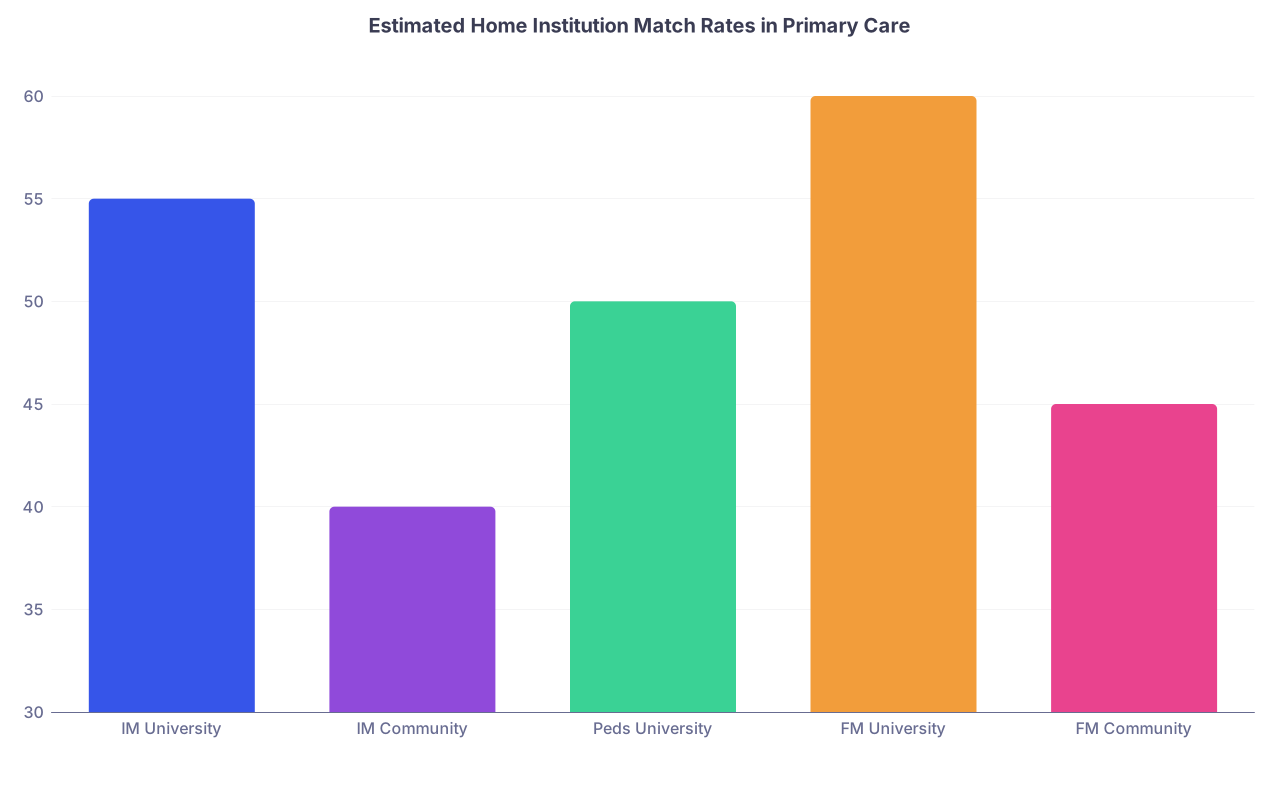
- In internal medicine at a big university: they might aim to take 4–10 home students every year, depending on class and program size.
- In peds: 2–5 is common.
- In family medicine: the number is smaller, but the preference is even stronger because word-of-mouth is everything.
| Category | Value |
|---|---|
| IM University | 55 |
| IM Community | 40 |
| Peds University | 50 |
| FM University | 60 |
| FM Community | 45 |
Those percentages are not published anywhere. They come from what people say in resident selection meetings:
- “We should at least interview all of our own.”
- “We know what it takes to survive clerkships here, so that’s a plus.”
- “If we do not take care of our students, what message does that send?”
Here’s the part no one prints on the website:
When a home student and an equally strong away student are head-to-head for that last rank slot, in primary care, the home student usually wins.
Not because of some deep merit analysis. Because:
- The PD can vouch for the ecosystem that produced you
- The chair and clerkship directors have already had conversations about you
- It’s politically clean to “take our own” compared with passing on you for an unknown
But you only benefit from this if you’re in the “safe” or “good” bucket. If you’re in the “concern” bucket, the home effect reverses and becomes a weight pulling you down.
How Program Directors Actually Talk About Home Students
I’ve sat in rank meetings where the spreadsheet is sorted by “School,” and they literally go through: “Where are our own?” and tag them.
Then you hear the real commentary.
- “She’s one of ours. Pulled great evals on wards. Medicine liked her. I’d be happy with her.”
- “Good Step 2, strong work ethic. Known quantity.”
- “He’s nice, but his senior residents constantly had to push him. I’d be cautious.”
- “Look, we just struggled with him all year. I’m not signing up for three more years.”
None of that nuance is visible to you. You only see the email: “We were very impressed with your application but are unable to offer an interview…”
Here’s the translation:
If you were a solid home student with:
- No major professionalism issues
- Reasonable step scores (or passing with strong clinicals in the Step 1 pass era)
- Letters from people the PD trusts
you got a bump.
If you were a borderline home student, they used their inside information to sort you below equally borderline external applicants. There’s no charity in residency slots. They have to live with their decision for three years.
Home Institution Advantage by Specialty: IM vs FM vs Peds
The weight of your home school is not the same in every primary care field. Let’s break this down.
| Specialty | Home Advantage Strength | Typical Home Match Pattern |
|---|---|---|
| Internal Medicine | Moderate-Strong | 4–10 home students per year |
| Pediatrics | Moderate | 2–5 home students per year |
| Family Medicine | Strong (if present) | 1–4 home students per year |
Internal Medicine
IM programs are usually bigger, more academic, more numbers-driven. Here’s how they think about you as a home student:
- “We know exactly what an Honors on our medicine clerkship means.”
- “We know which attendings write sugar-coated letters and which ones are stingy with praise.”
- “We know our own grade inflation or deflation.”
A 240+ Step 2 (or strong pass + glowing clinicals) from a home student at a mid or upper-tier program gets respect. If you did a sub-I in medicine there and didn’t burn bridges, that’s real currency.
Where IM gets harsh:
- If you underperformed on their own medicine wards
- If you annoyed the wrong senior or attending
- If your sub-I evals say “needs close supervision” or “limited initiative”
Then the conversation becomes: “If our own team struggled with them for 4 weeks, why would we invest 3 years?”
Pediatrics
Peds is softer on the surface, not softer in the rank room.
Peds PDs heavily, heavily weight:
- How you treated nurses and families during your peds rotation
- Whether you showed genuine interest in kids or just “tolerated” them
- Emotional maturity. They’re very good at sensing acting.
Your home peds program knows exactly how you behaved at 2 a.m. on call when the ED dumped three kids on you. That either earns you advocacy—or quietly tanks you.
I’ve heard exactly this in meetings:
- “On paper she’s fine, but bedside vibe with families wasn’t great. I’d pass.”
- “He’s not flashy, but nurses loved him. Take him. He’ll be a great resident.”
You won’t read that in any rubric, but that’s the real rubric.
Family Medicine
Family medicine is the most relationship-driven of the three.
If your med school has an FM residency, they know you personally if you made even a minimal effort:
- You came to noon conferences occasionally
- You did an FM elective
- You showed up in clinic and didn’t vanish
FM PDs are more likely to explicitly say: “We like to keep our medical students here” because they know exactly what they’re getting. The flip side: if you were openly dismissive of primary care, or visibly “I’m just here because I need a rotation,” they remember.
In a lot of mid-sized FM programs, if you’re:
- Reasonably competent
- Interested in FM for real
- Not a professionalism problem
your home program is almost a “safety” as long as you rank them high.
Unless. You’re on the wrong side of the whisper network.
When Your Home Institution Hurts You
Here’s the part students really hate hearing: sometimes you’d be better off as an “unknown” at another program than a marginal known quantity at home.
Situations where your home institution becomes an anchor:
Chronic underperformance on core rotations at that hospital
If your own internal medicine department considered you unreliable, that carries far more weight than a 10-point bump on Step 2 or a pretty personal statement.Professionalism flags that never make the MSPE headline
The official letter says “no adverse academic actions.” Inside the department, they know you had three quiet conversations about being late, disappearing, or being difficult on the team.Toxic reputation with residents
Residents have terrifying influence in some programs. If the PD asks, “What about Alex?” and three seniors roll their eyes simultaneously, you’re done.Obvious specialty shopping
If you spent 3rd year loudly gunning for derm or ortho, then missed that train and pivoted late to primary care, everyone remembers. Some programs do not care. Others absolutely do.
In those cases, some PDs will explicitly say:
- “Honestly, I’d rather take a solid unknown from State U than sign up for someone we’ve already struggled with here.”
You never see that line, but I’ve heard it almost verbatim.
Community vs Academic: Does Your School’s “Brand” Matter in Primary Care?
Students obsess over “name-brand” schools for competitive specialties. For primary care, the calculus is different.
Here’s the part people don’t admit publicly: many primary care programs actually like getting applicants from less flashy schools, because those students are often:
- More clinically seasoned
- More comfortable with bread-and-butter pathology
- Less entitled in day-to-day work
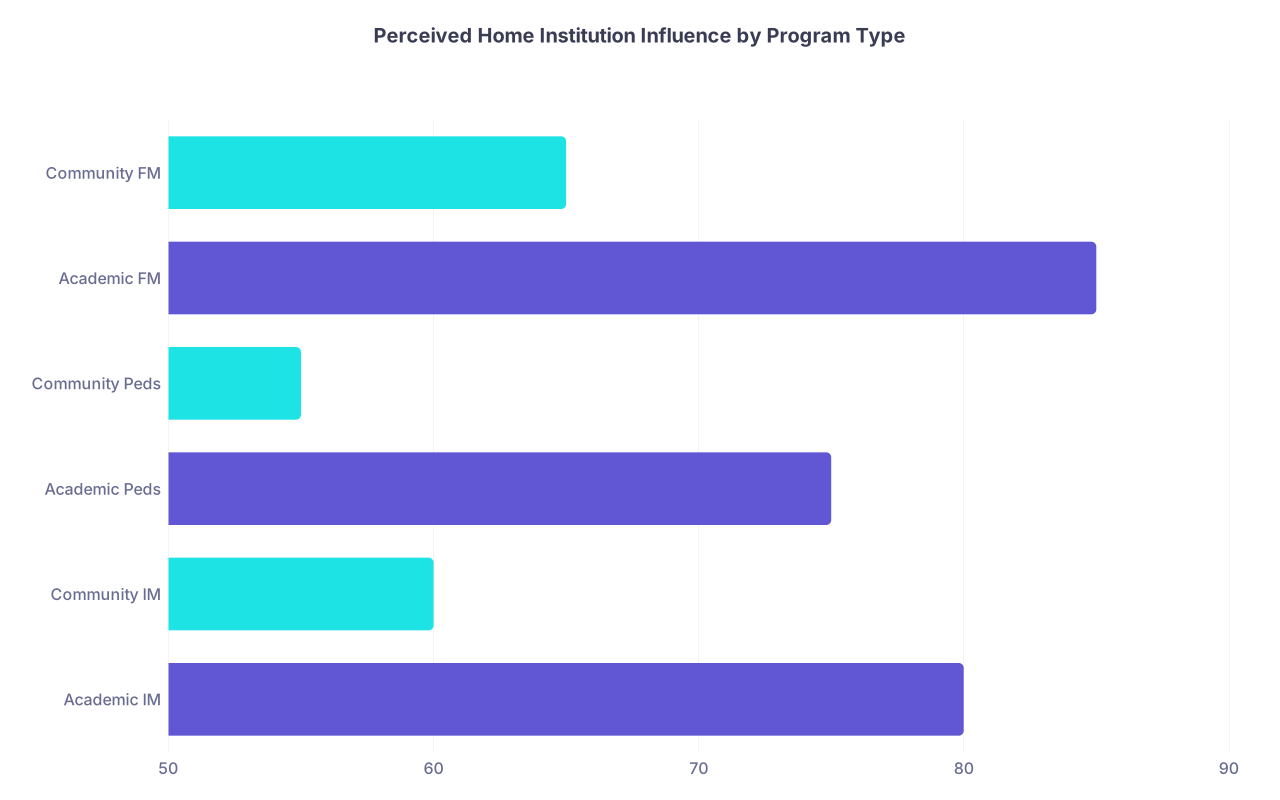
But your home-institution weight shifts with the environment.
| Category | Value |
|---|---|
| Academic IM | 80 |
| Community IM | 60 |
| Academic Peds | 75 |
| Community Peds | 55 |
| Academic FM | 85 |
| Community FM | 65 |
In academic IM and peds:
- Being a home student from a solid academic center gives you a strong signal: “we know this training pipeline.”
- They can calibrate your grades against reality very precisely.
In community programs:
- They often don’t have a huge pipeline of their own med students.
- “Home” might just mean “you rotated here for a month and weren’t a disaster.”
- The real weight there is your clinical performance with them, not your parent institution’s brand.
Family medicine is different again:
- Academic FM at a university: strong preference for their own medical students who actually like FM.
- Community FM: they care more about whether you “fit” the clinic culture than whether you came from a top-20 school.
If you’re at a modest, non-name MD or DO school and your goal is primary care, your home program might be your strongest single asset. Don’t underestimate that.
Away Rotations vs Home: What Actually Counts More?
There’s a persistent myth: “Away rotations matter more than home.”
Not in primary care. Not most of the time.
Here’s the dirty secret: PDs trust their own faculty’s opinions more than some visiting student eval from a hospital two states away that they’ve never set foot in.
I’ve literally watched this play out:
- Applicant A: Home student. B+ kind of person. Known, stable, no drama.
- Applicant B: Away rotator from another school. Looked great for 4 weeks. Lovey-dovey eval from an attending we don’t know.
When they choose, nine times out of ten in primary care they go with Applicant A unless Applicant B is obviously superior across the board.
The one time the away rotation beats the home effect is when:
- The home student is clearly marginal or has some negative history
- The away student has clear, well-documented excellence, and someone the PD trusts calls and advocates.
So if you’re a home student trying to match at your own place in IM/FM/Peds, your internal medicine sub-I, your peds acting internship, your family medicine senior elective—at your own institution—matter more than some random away in Denver or Phoenix unless you’re trying to leave.
Away rotations are escape hatches and audition plays for specific programs, not substitutes for a good reputation at home.
The Hidden Politics: Chairs, PDs, and “Taking Care of Our Own”
Here’s what students do not see: the politics behind the “home advantage.”
A few realities:
- Department chairs like being able to say, “We retain our graduates.” It’s a metric they brag about to deans.
- PDs are not completely free agents. If the chair or vice chair strongly wants particular home students, that matters.
- Some schools have explicit or implicit quotas: “We’d like to keep at least 4–5 of our best students each year.”
I’ve watched chairs walk into rank meetings and say things like:
- “I want us to make a serious effort to keep these three. They’re the future of our department.”
- “We hurt ourselves if every strong student leaves for the coasts.”
But here’s the twist: this only protects the top tier of home students. Not everyone.
If you’re in the bottom half of your class and gunning for your home IM program at a big academic center, you’re not who the chair is thinking of when they say “keep our best.”
You may still match there, but it won’t be because of high-level politics. It will be because the PD looked at the pile and decided you were reliable enough, knew the system, and fit their needs.
DO vs MD, and the Home Factor in Primary Care
Osteopathic students live in a different reality. I’ve heard DO students say, “If I can just get my home FM or IM program to like me, that’s my lifeline.”
They’re not wrong.
For DO students, especially in IM and FM, the home institution factor can be the difference between a chaotic, nationwide scramble and a stable match.
At many DO-heavy community programs, the conversation looks like:
- “We know this student. They trained here. They understand our system.”
- “We’d rather fill with people who already know our hospital over strangers from far away.”
The flip side: if you screw up at your DO home institution, you don’t just lose one program. You can lose your anchor in the market.
In pediatrics, DO vs MD still matters in some academic places, but home DO programs often go out of their way to keep their own. That’s one of the biggest hidden advantages you have.
What You Should Actually Do With All This
Let’s turn this from gossip into strategy.
If you’re aiming for primary care and you’d be happy at your home institution, then:
- Treat your home core rotations like high-stakes auditions, especially medicine, peds, and FM. Residents and attendings will remember.
- Do a sub-I or senior elective in that department at your institution. They cannot advocate for the ghost they never really saw.
- Do not assume “they know me.” They don’t. A few do. Make sure the right few know you.
- Avoid being the student everyone remembers for the wrong reason: drama, lateness, arrogance, passive-aggressive behavior.
If your home institution is toxic, disorganized, or clearly not where you want to be, you still need to avoid the negative reputation that follows you in letters and phone calls. But your priority becomes:
- Getting strong letters from faculty who can speak to your work ethic despite local dysfunction
- Doing aways or sub-Is at places you’d actually want to train, to show what you can do outside your home chaos
And if you’re that student who quietly struggled 3rd year and is now pivoting to primary care hoping your home program will “take care of you”—you need to be clear-eyed. You may have to look outward. Harder. Broader. Earlier.
Bottom Line: The Real Weight of Your Home Institution
Three things to walk away with:
- Your home institution usually gives you a real, measurable advantage in primary care matching—if you are a solid, known, reasonably well-liked entity.
- The same inside knowledge that helps good home students hurts the marginal ones; a bad reputation at home is heavier than a weak impression away.
- In primary care, your best bet is to treat your home IM/peds/FM departments as your primary audition stage—because when rank lists are built, those are the voices program directors trust the most.