
What do you do when the residents keep saying “it’s fine” on interview day, but nobody actually looks fine?
If you are interviewing for Family Medicine or Internal Medicine, you are at very high risk of ignoring warning signs. These specialties sell “we are a family,” “we are chill,” “we value work–life balance.” Sometimes that is true. Often, that slogan is exactly what programs use to cover up serious problems.
Let’s go through the common red flags I see applicants walk right past on FM and IM interview days—and how not to be that person who realizes the truth six months into intern year at 3 a.m. on night float.
1. The “Nice” Program That Cannot Answer Basic Questions
FM and IM applicants desperately want a supportive, non-toxic environment. Programs know this. So they lean hard on “we’re really nice here,” and applicants stop asking the hard questions.
Here is the trap: “Nice” is not a substitute for structure, staffing, or education.
Red flags I have seen repeatedly:
- The PD or APD cannot give specifics on:
- Average daily census for interns
- Admission caps
- Typical call schedules
- Protected didactic time (how often, who covers the floors)
- Residents give vague answers like:
- “It varies a lot.”
- “It depends on the day.”
- “Some months are brutal, but it’s okay.”
- They talk culture and community but dodge anything that looks like hard data.
If you ask, “How many patients does an intern carry on general medicine?” and nobody can answer with a number, you have a problem. FM and IM are workhorse specialties. If they don’t know the load, they are either not tracking it, or it is bad enough they are trained not to say.
Do not accept:
- “We try to keep it reasonable.”
- “We don’t like hard caps; it depends on your growth.”
- “We’re working on improving that.”
That last line—“we’re working on it”—is the most overused distraction tactic on interview days.
Push for numbers:
- “On average, how many patients per intern on wards?”
- “What’s the most you’ve personally had to carry?”
- “What time do you leave on a typical non-call day on wards?”
If you get dodges instead of data, that is a red flag.
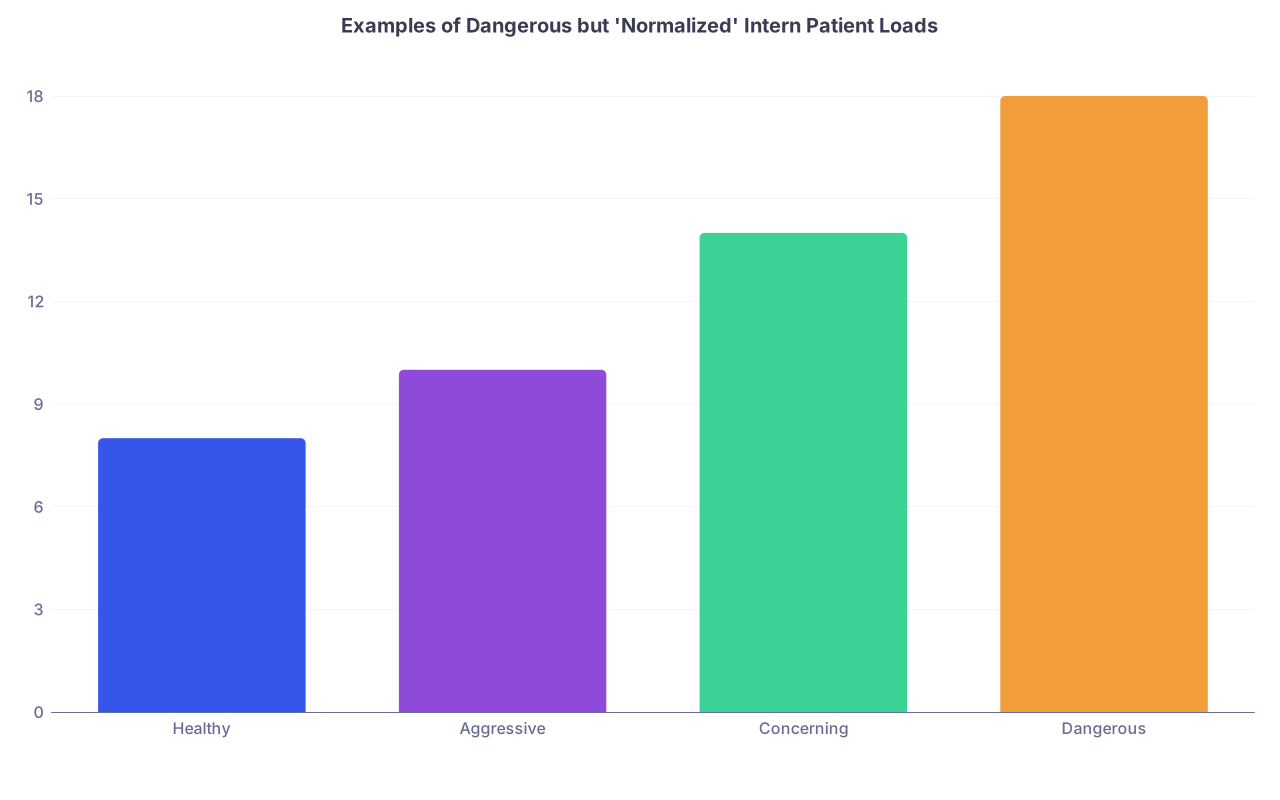
| Category | Value |
|---|---|
| Healthy | 8 |
| Aggressive | 10 |
| Concerning | 14 |
| Dangerous | 18 |
Reality check:
- 6–8: Healthy at most academic programs
- 10–12: Aggressive but survivable with good support
14 consistently: Dangerous unless there is huge ancillary support (unlikely)
2. Overworked, Under-Supported Residents Who Keep Saying “We’re a Family”
This one is classic in both FM and IM.
You see:
- Residents smiling
- Someone brings donuts
- The PD says, “We are like a family here”
But then, if you pay attention, the residents look exhausted. Their eyes give them away. They joke about “the scut list.” They slip in lines like:
- “You just put your head down and grind through PGY-1.”
- “We are basically the social work team, too.”
- “We do all our own blood draws on nights.”
FM and IM are especially vulnerable to the “we are the glue of the hospital” mindset. That becomes code for:
- You do everything no one else wants to do
- You cover the gaps of poorly staffed nursing, case management, or ancillary services
- You are the path of least resistance for every consult problem
Ask directly:
- “Who typically draws bloods if phlebotomy is busy?”
- “Who calls families with updates?”
- “Who handles discharge arrangements—nursing, case management, or you?”
- “Do you ever have to transport your own patients?”
If the answer is “usually us” for all of these, that is not “we are a family.” That is “we are exploited.”
Big warning sign: Residents joke about unsafe conditions. That is usually how they cope. Gallows humor like:
- “You will get so fast at notes because you will have to finish 30 before noon.”
- “Yeah, you will get your steps in; our hospital is gigantic, and we cover all four floors.”
- “LOL, we are the night float, rapid response, and cross-cover team all in one.”
If people are joking about how bad it is, it is probably worse than they are admitting.
3. “We See Everything” = Code for “We Have No Boundaries”
FM and IM programs love to brag:
- “We see everything.”
- “Our residents are extremely comfortable managing complex patients.”
- “We are the workhorse service.”
Sometimes that is genuinely good exposure. Sometimes it is just code for no caps, no boundaries, and unsafe workloads.
Specific warning signs:
- No clear ICU triage rules; residents say things like:
- “Yeah, we sometimes keep people on high-flow on the floor for a while.”
- “We’re really aggressive with floor management.”
- FM residents covering very sick ICU-level cases with minimal backup
- IM residents running “step-down” or “intermediate” units that are, in reality, ICUs without the staffing or structure
Ask:
- “What types of patients are kept on the floor vs transferred to ICU?”
- “Is there a step-down unit? Who runs it? How many patients per resident there?”
- “Do you feel you have appropriate backup at night with decompensating patients?”
Programs that pride themselves on taking care of “super sick” patients but cannot describe clear escalation protocols are setting you up to be the human safety net. That will be you, alone at 3 a.m., deciding how long to “ride it out” on the floor.
4. Red Flags Hidden in the Schedule and Rotations
The schedule is where FM and IM programs hide the bodies.
Common mistakes applicants make:
- Glancing at the rotation grid without asking follow-up questions
- Ignoring how many weekends, nights, and ICU months actually add up
- Being distracted by “cool” electives while missing the core-service grind
Watch for:
- Heavy ICU and night float blocks with no clear recovery time
- “Clinic half-days” stacked on top of brutal inpatient rotations
- “Didactics” scheduled at times that obviously conflict with peak work hours
| Pattern | Why It Is Concerning |
|---|---|
| 4+ ICU months PGY-1 | High burnout risk, less floor + clinic balance |
| >3 consecutive months inpatient | No real recovery, cumulative fatigue |
| No true ambulatory blocks | Weak outpatient skills, rushed clinic visits |
| Night float > 4 weeks straight | Circadian disaster, mental health risk |
Ask very concrete questions:
- “How many weekends off per month, on average, across the year?”
- “How many weeks of nights total per year?”
- “On ICU months, do you still have clinic? How often? Who covers your patients?”
- “If you are post-call, do you have clinic that afternoon?”
If they say things like:
- “You will figure out how to make it work.”
- “Clinic is technically protected, but sometimes you still need to round.”
- “We try not to post-call people, but sometimes it happens.”
Those are red flags. “Sometimes” always means “often enough that you should worry.”
5. Toxic Microculture Hiding Under Polite Answers
You are not just evaluating the program. You are evaluating the microculture of:
- Chiefs
- Senior residents
- Coordinators
- The PD and APDs
FM and IM often aspire to be warm, holistic, supportive. That aspiration can make people extremely defensive when anything threatens the brand.
Pay attention to:
How they talk about struggling residents
Red flag phrases:
- “Not everyone is cut out for this.”
- “We hold people to a very high standard.”
- “We had to let some people go, but that is because they could not meet expectations.”
- “We are not a hand-holding program.”
If you ask, “How do you support residents who are struggling clinically or personally?” and the answer is mostly about remediation, discipline, or “standards,” that is not support. That is judgment dressed up nicely.
How they talk about nurses and consultants
Listen for:
- Residents rolling their eyes about nursing
- Complaints about “consults that never help”
- Blaming ED or ICU teams constantly
That kind of blame culture will suck you in. FM and IM require collaboration more than almost any other specialties. If the tone is “everyone else is the problem,” that will be your daily environment.
How they respond to questions about wellness and mental health
If the answer is:
- Wellness committee
- Pizza
- Yoga once a quarter
- A “resiliency curriculum”
…but no one can describe an actual resident who:
- Took a leave and came back successfully
- Got real accommodations during a crisis
- Switched schedules after a major life event
Then the wellness culture is branding, not reality.

6. Chaotic, Unsafe Systems Brushed Off as “Busy But Good Learning”
FM and IM are where system-level dysfunction lands on residents’ shoulders.
On interview day, watch for:
Disorganized tours
- Nobody knows where you are supposed to be
- Residents are being pulled away to handle pages constantly
- No one can show you the call rooms or resident workrooms because they are “being used”
No clear coverage during conferences
- Residents answering pages non-stop during “protected” noon conference
- People leaving constantly to see patients
- Faculty shrugging and saying, “That’s real life”
Poor EHR and order support
- Residents complaining that everything is manual
- No order sets for common diagnoses
- Different hospitals with different EHRs but no added educational value
Ask explicitly:
- “Is conference truly protected? Who covers the floors?”
- “How many sites do you rotate at? How far apart are they? Do you switch mid-block?”
- “Do you have a night float system or 24-hour call? How often?”
If the systems look chaotic on interview day, imagine them at 2 a.m. in July when three new interns have just started and someone is crumping on the floor.
7. Primary Care in Name Only: Weak Outpatient Training
For FM and IM applicants who care about outpatient medicine (and you should), many programs massively overpromise their primary care training.
Red flags:
- Clinic is always “in the afternoon after wards”
- Residents look panicked when you ask about longitudinal relationships with patients
- No mention of:
- Behavioral health integration
- Chronic disease management infrastructure
- Panel management
- Population health or QI projects tied to clinic
FM-specific red flags:
- Heavy inpatient hospitalist-style months
- Very little true continuity clinic
- No strong OB experience if they claim “full-scope family medicine”
- Preceptors who are mostly urgent care/walk-in oriented
IM-specific red flags:
- “Clinic is technically one half-day per week, but it gets canceled a lot”
- No subspecialty or focused outpatient electives
- Residents not knowing their own panel size
Ask:
- “How many patients do you see in a half-day clinic, on average, by PGY-3?”
- “What is your continuity clinic like? Same preceptor? Same site?”
- “Have you felt prepared managing bread-and-butter outpatient issues independently by PGY-2?”
If a senior FM or IM resident cannot confidently say “yes” with specifics, that program is not serious about outpatient training.
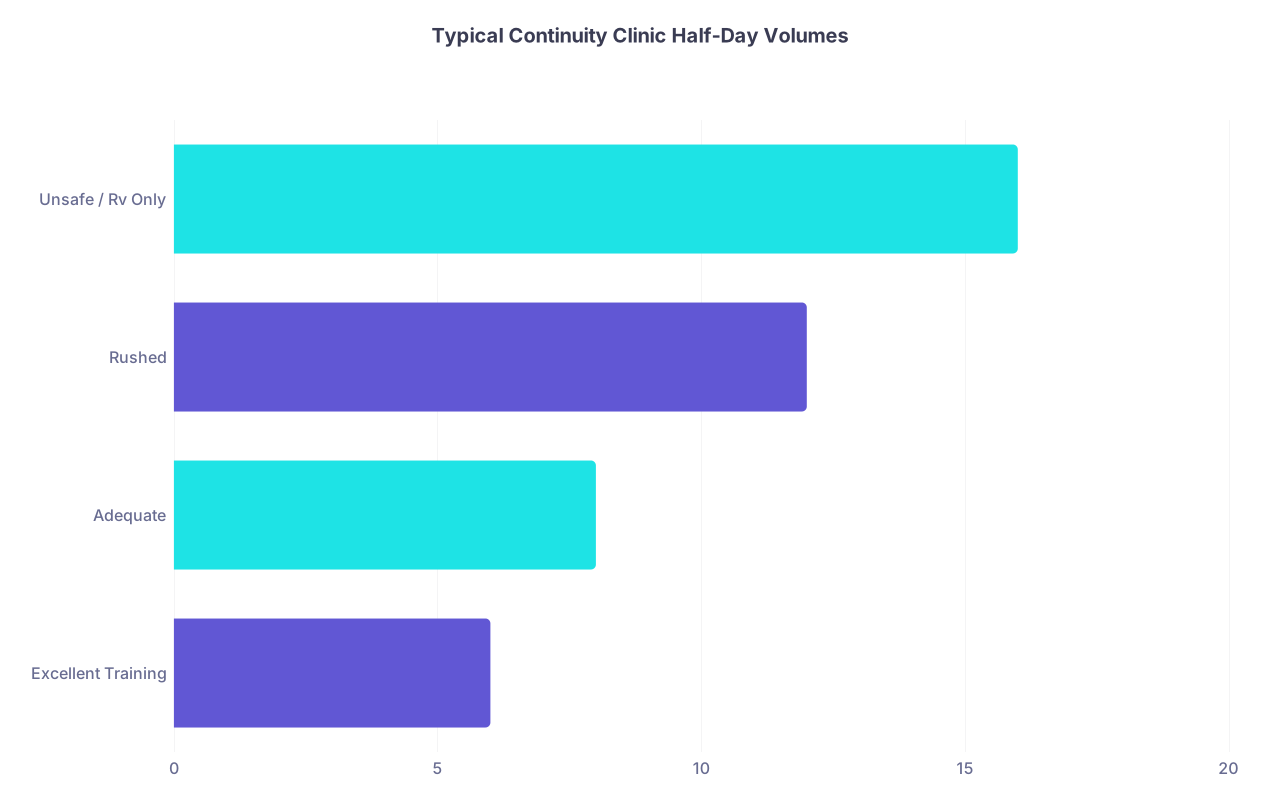
| Category | Value |
|---|---|
| Excellent Training | 6 |
| Adequate | 8 |
| Rushed | 12 |
| Unsafe / Rv Only | 16 |
8. Turnover, Attrition, and the “We Don’t Really Talk About That” Zone
Here is one of the biggest red flags almost nobody asks about directly: attrition.
FM and IM residencies are large. People leave. That is not always a problem. The problem is when:
- Residents hint that “some people have left” but cannot or will not say why
- There are multiple PGY-2 or PGY-3 slots unfilled and everyone shrugs
- They blame departed residents as “not a good fit” without acknowledging program responsibility
Ask, very plainly:
- “Has anyone left the program in the last 3 years? For what reasons?”
- “Were those people able to match elsewhere or transition successfully?”
- “Have there been any major leadership changes recently?”
And then watch body language.
Defensive answers. Quick subject changes. Discomfort when you bring up prior class sizes. Those are all signals.

| Step | Description |
|---|---|
| Step 1 | Hear small concern |
| Step 2 | Ask 1-2 follow up questions |
| Step 3 | Ask specifics from multiple residents |
| Step 4 | High risk - downgrade program |
| Step 5 | Very high risk - avoid |
| Step 6 | One time or pattern? |
| Step 7 | Consistent answers? |
FM and IM programs that are unstable will always have a story. “New leadership, rebuilding, exciting changes.” That can be real. It can also mean you are about to be the test cohort for a half-baked redesign.
9. The Virtual Interview Trap: Sanitized, Scripted, and Misleading
For many FM and IM programs, a large portion of interviews are virtual now. That makes it much easier for programs to hide dysfunction.
What you miss on virtual days:
- Hallway interactions between residents and nurses
- Real resident workrooms
- Who looks miserable at 11 a.m. on a random weekday
- Whether anyone appears to have eaten, sat down, or had coffee
Programs will give you:
- Carefully selected residents on Zoom
- Polished slide decks
- Pre-recorded hospital tours
You have to counter this by asking sharper questions and, if you are serious about a program, doing your own recon.
Ask on virtual days:
- “If I asked your interns off-camera what the hardest part of this program is, what would they say?”
- “What is one thing you wish leadership would change, but has not yet?”
- “What surprised you the most once you actually started here?”
If every answer is unnaturally positive, that is almost worse than open negativity. Real residents always have at least one complaint.
Then, if you are considering ranking a place highly:
- Reach out to alumni from your med school who matched there
- Ask for a brief phone call with a resident not on the official panel
- Search social media and review sites with a skeptical eye (but do not rely on them exclusively)

10. How to Run Your Own “Red Flag Audit” on Interview Day
You need a deliberate system. Otherwise, you will get swept up in “they were so nice” and “lunch was good” and forget the serious problems.
Here is a simple structure I suggest you use for every FM and IM interview:
A. Before the Interview
Write down:
- 3 non-negotiables (for example: max patient load, true clinic training, supportive culture)
- 3 major concerns you want to test (for example: nights, ICU burden, wellness reality)
B. During the Interview
For each category, look for evidence, not vibes:
Workload and Safety
- Specific patient caps
- Number of night weeks
- ICU exposure structure
Culture and Support
- How they talk about struggling residents
- Examples of real support during crises
- PD/leadership transparency
Outpatient Training (especially for FM and IM with primary care focus)
- Continuity clinic structure
- Faculty presence and feedback
- Grad outcomes in primary care
C. After the Interview
Right after you log off or leave the hospital, write down:
- 3 things that felt off, even if you cannot articulate them completely
- Any evasive answers you heard, word for word
- Concrete numbers they gave you (patient loads, nights, etc.)
Compare programs with your eyes open, not based on vague vibes.

2–3 Things You Must Not Forget
Vague answers are not acceptable
If a program cannot give you specific numbers on workload, nights, and clinic, they either are not tracking it or do not want you to know. Both are bad.Watch what residents do, not what they say
Forced positivity, constant “it’s fine,” and exhaustion hiding under smiles are major red flags. Especially when paired with “we are a family.”FM and IM are where system problems land on you
Any hint of chaotic systems, lack of support, or “we see everything” without guardrails means you will be the buffer between dysfunction and patient harm. Do not ignore that because the PD seems nice.
Do not let a donut, a friendly chief, or a pretty slide deck talk you into three years of regret.