
It is January of your MS4 year. You are on your second internal medicine sub‑I. One attending spends half the day in clinic, chatting with long‑time patients about grandkids and A1c trends. The other rounds with you on the hospitalist service, flips through a list of 18 admissions, and shrugs, “We just fix them up and ship them out.”
You like both. Or at least you think you do. ERAS is in. You ranked “categorical IM” everywhere. But your PD just asked you, “Have you thought about a primary care track or are you leaning hospitalist?”
You nodded like you had a plan. You do not.
This is where people make quiet, career‑shaping mistakes. Not by picking primary care or hospitalist medicine. But by picking for the wrong reasons, with the wrong expectations, based on totally distorted pictures of what either job actually is.
Let’s walk through the traps I see MS4s (and interns) walk straight into, and how to sidestep them before you lock yourself into a path that does not actually fit how you want to live or practice.
Trap #1: Confusing “What I See on My Rotation” with “What the Job Is”
Your MS4 experience of primary care and hospitalist medicine is biased. Severely.
On your:
- IM inpatient rotation – you are on teaching teams, capped lists, lots of time at the computer, constant supervision, less billing pressure.
- Outpatient clinic rotation – you are shielded from no‑shows, documentation fights, and financial metrics; you get the 20–30 min “student slots” and the “interesting” chronic disease patients.
Then you extrapolate: “I loved inpatient → I must be a hospitalist.” Or “Clinic was relaxed → outpatient is less stressful.”
This is wrong. Very wrong.
Real practice looks different:
Hospitalists
- Real‑world average censuses: 15–20+ patients alone, no residents.
- Night shifts, cross‑coverage, admits at 2 a.m. on three drips, no one double‑checking your orders.
- Intense throughput pressure: “Can this be discharged today?” every day, for everyone.
Primary Care
- 15–25 patients per day, every day. Some clinics push 25–30.
- 15‑minute visits where you are somehow managing diabetes, depression, three new meds from specialists, and a 7‑page discharge summary.
- Constant inbox: MyChart messages, refills, prior auths, forms, labs, follow‑up questions, all unpaid time if not structured well.
Mistake to avoid: Deciding based on the “student version” of the job.
What to do instead:
- Ask attendings bluntly:
- “How many patients do you see per day?”
- “What is your inbox like?”
- “What is your average census / number of admits on a busy day?”
- “What are your hours on a typical week?”
- Shadow on a non‑teaching hospitalist shift if possible.
- Spend time with a busy community primary care doc, not just academic half‑day clinics.
You want the unvarnished version, not the teaching hospital museum exhibit.
Trap #2: Treating Lifestyle as a Single Variable
Students love to say: “Hospitalists have great lifestyle. Seven on / seven off. Done.” Or, “Primary care is nine to five, weekends off. Perfect.”
That is brochure thinking. And it gets people in trouble.
Let’s break down what “lifestyle” actually means, because each path trades off different pieces.
| Feature | Primary Care IM | Hospitalist IM |
|---|---|---|
| Schedule pattern | Weekday clinic | Blocked (7on/7off etc.) |
| Nights | Rare/none | Frequent (nights admit) |
| Weekends | Occasional | Built into blocks |
| Daily intensity | Moderate, constant | High, variable |
| Inbox/admin | Heavy, ongoing | Less inbox, more crises |
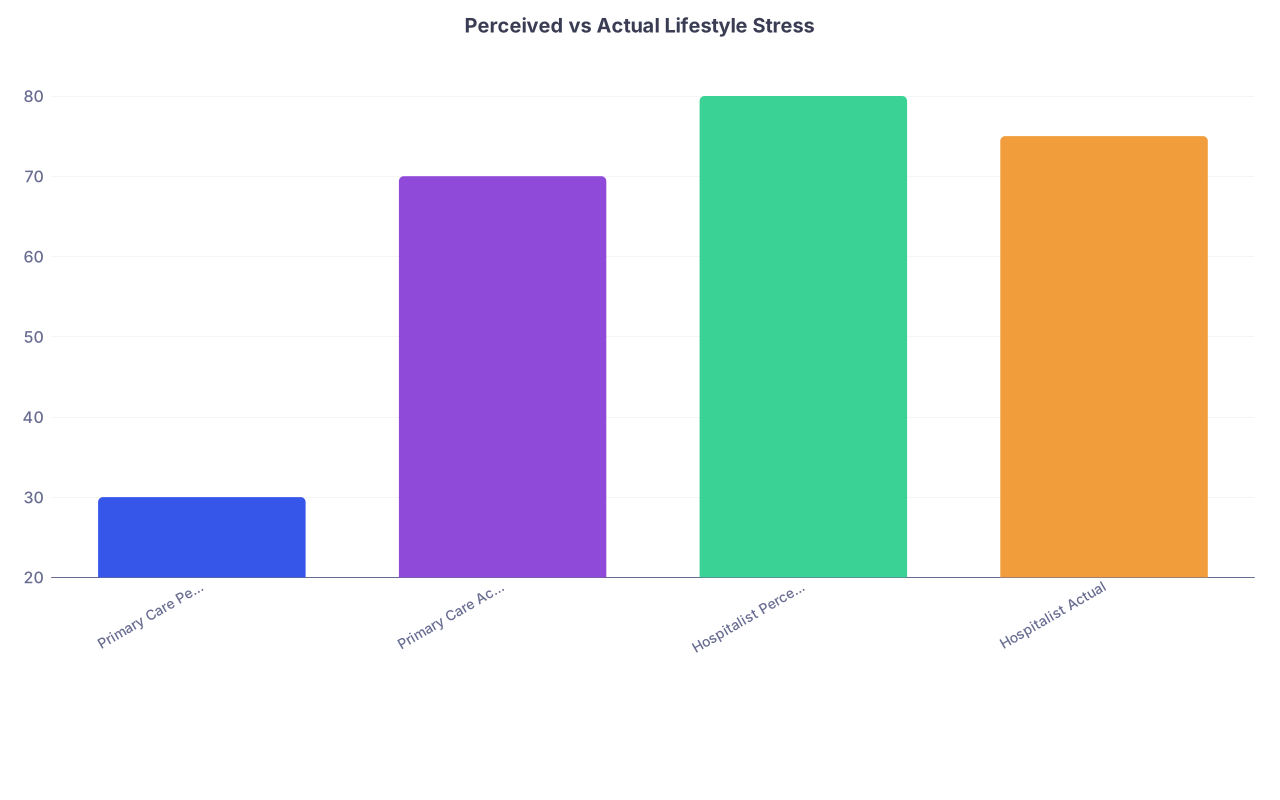
| Category | Value |
|---|---|
| Primary Care Perceived | 30 |
| Primary Care Actual | 70 |
| Hospitalist Perceived | 80 |
| Hospitalist Actual | 75 |
The common lies people tell themselves:
Lie 1: “Seven on / seven off means I work half the year.”
Reality:- Those seven days can be 12–14 hour shifts.
- You will be wiped on the first “off” day and ramping up anxiety on the last.
- Nights, holidays, random Tuesdays off while your friends have weekends.
If you hate nights, hate missing holidays, and crumble under circadian chaos, hospitalist life can eat you alive.
Lie 2: “Primary care is easy hours: 8–5, done.”
Reality:- Many PCPs chart at home at night. “Just finishing a few notes” becomes two extra hours.
- Inbox messages show up on days off unless your system has strong coverage.
- You may feel mentally “on” all the time: same patient over years, long‑term responsibility.
The trap is reducing lifestyle to one feature (shift work vs clinic hours) instead of asking:
- Do I tolerate night shifts?
- Do I care more about predictable days or uninterrupted weeks off?
- Do I want my stress in acute bursts (call nights, high census) or chronic low‑grade (emails, forms, longitudinal responsibility)?
Neither path is “better lifestyle” in a vacuum. They are different stress profiles. Misjudging which one you can actually live with is a huge, common mistake.
Trap #3: Ignoring How You Actually Like to Think
Do you like patterns over years or puzzles in hours?
This sounds philosophical. It is not. It should decide a big part of your direction.
Primary care thinking style:
- Longitudinal: “What will reduce your risk over the next 5–10 years?”
- Preventive: guidelines, risk calculators, lifestyle, adherence.
- Integrative: you reconcile the cardiologist’s note, the rheumatologist’s plan, the surgeon’s recommendations, plus the patient’s financial / social constraints.
- Comfortable with uncertainty and slow progress. CPAP adherence that takes months. A1c that inches down over years.
Hospitalist thinking style:
- Acute: “What can kill you in the next 24–72 hours?”
- Triage: who is sick, who can go home, what can wait.
- Protocol‑driven: sepsis bundles, stroke alerts, anticoagulation reversals.
- Clearer endpoints: “Stable for floor,” “Ready for discharge,” “Needs ICU.”
Mistake to avoid: Choosing based on “I like medicine in general” without asking how you like using your brain.
Examples I have watched:
The “code‑chasing” intern:
- Loves ICU, loves acute decisions, hates routine med recs and refill requests.
- Goes into primary care for the “no nights” promise.
- Two years in: feels bored, resents preventive visits, misses the adrenaline. Starts doing more urgent care or hospitalist moonlighting “for fun.”
The “relationship builder”:
- Knows the names of all their continuity clinic patients as an intern.
- Feels empty discharging patients they actually care about after three days.
- Chooses hospitalist because “the pay is better and the schedule is clean.”
- Ends up burned out by the constant turnover and lack of continuity.
Ask yourself ruthlessly:
- Does it energize you to follow someone’s story over years?
- Or do you prefer solving a complex acute problem and then handing it off?
Pick the job that matches that. Not the one your classmates are hyping.
Trap #4: Underestimating How Much the System Will Fight You
Primary care and hospitalist roles live in different parts of the machine. Both are under pressure. Just in different directions.
In Primary Care
You will fight:
- Volume expectations – 15–20+ patients per day.
- Metrics – A1c control, BP goals, screening rates, patient satisfaction.
- Non‑visit work – prior authorizations, disability forms, FMLA, refill protocols, portals.
You are at the mercy of:
- How your clinic structures inbox time.
- Whether you get protected admin time.
- Whether leadership values quality vs raw RVUs.
In Hospitalist Medicine
You will fight:
- Length‑of‑stay pressure – “Can this patient go today?” on loop.
- Throughput – ED boarding, surge capacity days, “flex” beds.
- Cross‑coverage load – dozens of cross‑cover pages at night for patients you did not admit.
You are at the mercy of:
- The hospital’s staffing model.
- Whether there are nocturnists vs day docs taking night call.
- Use of APPs, residents, and case managers.

| Step | Description |
|---|---|
| Step 1 | System Pressures |
| Step 2 | Primary Care |
| Step 3 | Hospitalist |
| Step 4 | Volume and Metrics |
| Step 5 | Inbox and Paperwork |
| Step 6 | Throughput and LOS |
| Step 7 | Nights and Cross Coverage |
Mistake to avoid: Assuming your personal “work ethic” can overcome a badly structured system.
I have seen excellent, resilient residents crushed not because they lacked grit, but because:
- They joined a primary care practice that gave zero admin time and expected 20+ patients per day plus full inbox coverage.
- Or they joined a hospitalist group with chronically understaffed nights where one person admits 18 patients, cross‑covers 80, and has no backup.
You must evaluate not just “primary care vs hospitalist,” but practice models within each:
- Academic vs community
- Employed vs independent / group
- Resident teaching vs pure service
- Use of APPs vs physician‑heavy
The specialty is not the whole story. The structure matters just as much for burnout risk.
Trap #5: Fixating on Salary Without Looking at the Full Trade
Let me be blunt: chasing the extra hospitalist pay without understanding everything that comes with it is one of the most common MS4 errors I see.
Yes, in many markets:
- Hospitalists earn more than academic primary care.
- In some areas, outpatient primary care can catch up, especially with value‑based contracts, but that is not most new grads’ first job.
But raw salary is not the only variable:
- Shift work vs salaried clinic time.
- Nights / weekends vs mostly weekday.
- Paid vs unpaid admin time.
- Geographic flexibility (many hospitalist jobs in smaller cities / rural hospitals vs primary care often in more diverse locations).

| Category | Value |
|---|---|
| Academic Primary Care | 190 |
| Community Primary Care | 230 |
| Academic Hospitalist | 230 |
| Community Hospitalist | 280 |
(Ranges are ballpark and vary by region, but the pattern holds.)
The salary trap:
- A resident sees a $260–300k hospitalist offer vs $190–220k primary care.
- They are already in debt, exhausted, and understandably drawn to the larger number.
- They downplay how much they hate nights and how much they enjoy continuity.
Money matters. Debt is real. But be honest about the cost:
Those extra dollars may be paying for:
- Rotating nights and holidays.
- Limited ability to pick your days.
- Commuting to less desirable areas.
The lower salary may be buying:
- No nights.
- Predictable Monday–Friday routine.
- The ability to coach your kid’s team, consistently have weekend plans, or be mentally present outside of work.
Mistake to avoid: Pretending the only rational choice is the higher paying one. It might be rational for you. It is not automatically rational for everyone.
Calculate:
- What income do you actually need to service your loans and live your version of a good life?
- How much are you willing to pay (or give up) for specific lifestyle features?
Do the math. Then decide consciously, not reflexively.
Trap #6: Forgetting You Can Design Hybrid or Transitional Careers
Another rigid thinking error: “I must pick one forever – primary care or hospitalist.”
Wrong. You actually have more levers than most MS4s realize.
Common Hybrid/Transitional Models
- Primary care with some inpatient
- Traditional community internist models: clinic plus small inpatient census.
- More rare in big academic centers, still common in smaller towns and some health systems.
- Hospitalist early, primary care later
- Start with higher‑pay, higher‑intensity hospitalist role to pay down loans.
- Transition to outpatient once loans are manageable and you are clearer on lifestyle priorities.
- Primary care with specialty focus
- Complex care, HIV clinics, addiction medicine, obesity medicine, etc.
- Can scratch the “complex puzzle” itch without full inpatient life.
- Mixed roles
- 0.7 FTE primary care + 0.3 FTE teaching hospitalist.
- Quality improvement / admin plus either clinical model.

| Step | Description |
|---|---|
| Step 1 | IM Residency |
| Step 2 | Full Time Primary Care |
| Step 3 | Full Time Hospitalist |
| Step 4 | Hybrid Outpatient and Inpatient |
| Step 5 | Later Transition to Primary Care |
| Step 6 | Primary Care with Specialty Focus |
Mistake to avoid: Locking into a mental model that says, “If I choose hospitalist now, I can never do clinic,” or “If I start in primary care, I can never go back to hospital medicine.”
Real caveats:
- The longer you are out of inpatient, the harder it is to jump back. Skills atrophy. Credentialing committees will question recency of experience.
- Switching from hospitalist to primary care later can be tricky if you have no outpatient panel‑building history, but it is feasible, especially within the same health system.
So do not rely on “I will just switch if I hate it” as a plan. That is another trap. But do use the knowledge that careers can evolve to take some pressure off the “one perfect choice” illusion.
Trap #7: Letting Prestige and Peer Pressure Steer You
In a lot of academic centers, the hierarchy is quiet but obvious:
- Cards, GI, heme/onc, ICU → “prestige”
- Hospitalist → “high acuity, legit”
- Primary care → “nice” but often subtly devalued
You hear residents say:
- “I am just doing primary care” (as if managing the health of 2,000 people is trivial).
- Or, “If nothing else, I will just do hospitalist for a while” (like it is a default track with no identity).
If you let that culture seep into your brain, you can easily:
- Avoid primary care because you unconsciously absorb that it is “less impressive.”
- Gravitate toward hospitalist work because it feels more in line with the “serious” medicine image you have of yourself.
This is a stupid way to choose.
Ask yourself:
- Whose opinion are you trying to impress? Your co‑residents on rounds… or your future self at 40?
- Would you still feel “less than” doing primary care if your residency culture actually celebrated it?
Let me tell you something blunt: the primary care docs who are good at their job are some of the most critical people in the system. They keep people out of the hospital you would otherwise be admitting. That matters more than your future IM friends’ bragging rights.
Do not let ambient culture shame you away from a career that actually matches who you are.
Trap #8: Ignoring Your Tolerance for Emotional Weight and Continuity
This one rarely gets discussed honestly.
Primary care emotional load:
- You accumulate stories—and they do not leave.
- You are there when the newly diagnosed cancer patient first hears it, when their spouse calls after the oncologist appointment, when finances fall apart.
- You deal with long‑term mental health issues, chronic pain, family conflict.
- You will grieve patients you have known for years when they die.
Hospitalist emotional load:
- Intense family meetings. Goals‑of‑care in the ICU. Code blues.
- But then: new list in a week. New names. Different families.
- Less long‑term responsibility. More acute crises in compressed time.
Neither is “lighter.” They are just different flavors.
Some people are drained by carrying the same families’ burdens year after year. Others are haunted by high‑intensity, episodic trauma and prefer the slow deep relationships.
Mistake to avoid: Assuming your reaction to emotional weight will match your co‑residents’. It might not.
Reflect on your rotations:
- Did continuity clinic relationships energize you or exhaust you?
- Did you find inpatient deaths harder or easier because you did not know the patient long?
- Did you like being “the doctor” for families, or did that long‑term closeness feel like too much?
Be honest. Your emotional bandwidth is not infinite, and mismatching it to the job is a quiet path to burnout.
Trap #9: Deciding Before You Have Enough Real Data… and Then Doubling Down
Here is a pattern I have seen too often:
- MS3 falls in love with inpatient IM.
- Decides in their mind: “I am going hospitalist.”
- Builds an identity around being “the inpatient person.”
- Half‑heartedly experiences outpatient, assumes it is not for them.
- Fast‑forwards to PGY3, signs hospitalist contract mostly because that is what they told everyone for three years.
The opposite happens too: someone hears “primary care is better lifestyle” and locks in early, without ever giving hospital medicine a serious try.
Then cognitive dissonance kicks in. Once we say out loud what we are doing, we resist changing course, even when new data says we should.
Avoid this by:
- Treating MS4 and early residency as information‑gathering, not commitment‑signaling.
- Writing down your actual reactions on different rotations before they get blurred by your own narrative.
A simple reality‑check exercise:
After each block (inpatient, clinic, night float, etc.), score these from 1–10:
- How mentally engaged was I?
- How drained was I at the end of the day?
- How much did I dread coming in?
- Could I imagine doing this for 10 years?
Look for patterns, not one‑off good or bad weeks.
Trap #10: Forgetting That the Decision Is “What to Try First,” Not “Who You Are Forever”
You are an MS4, not a Supreme Court justice. You are making a best‑guess choice about what to do in your first 5 years after residency, not engraving an identity on stone.
You can:
- Start hospitalist, reassess every 1–2 years.
- Start primary care, adjust your FTE, add teaching, telemedicine, urgent care shifts.
- Move from academic to community, urban to rural, high volume to lower volume.
The real trap is the fatalism I hear from some graduating residents: “I picked X, so I guess this is my life.” That is rarely true, and thinking that way makes you tolerate situations you should probably leave.
Quick Reality‑Check Table: Who Typically Thrives Where
Not rigid rules. But patterns I see repeatedly.
| You Tend To… | Often Fits Better As… |
|---|---|
| Love long-term relationships | Primary care |
| Enjoy acute problem-solving bursts | Hospitalist |
| Hate nights and holidays | Primary care |
| Prefer big chunks of time off | Hospitalist |
| Tolerate admin and inbox work | Primary care |
| Prefer defined shifts, no inbox | Hospitalist |
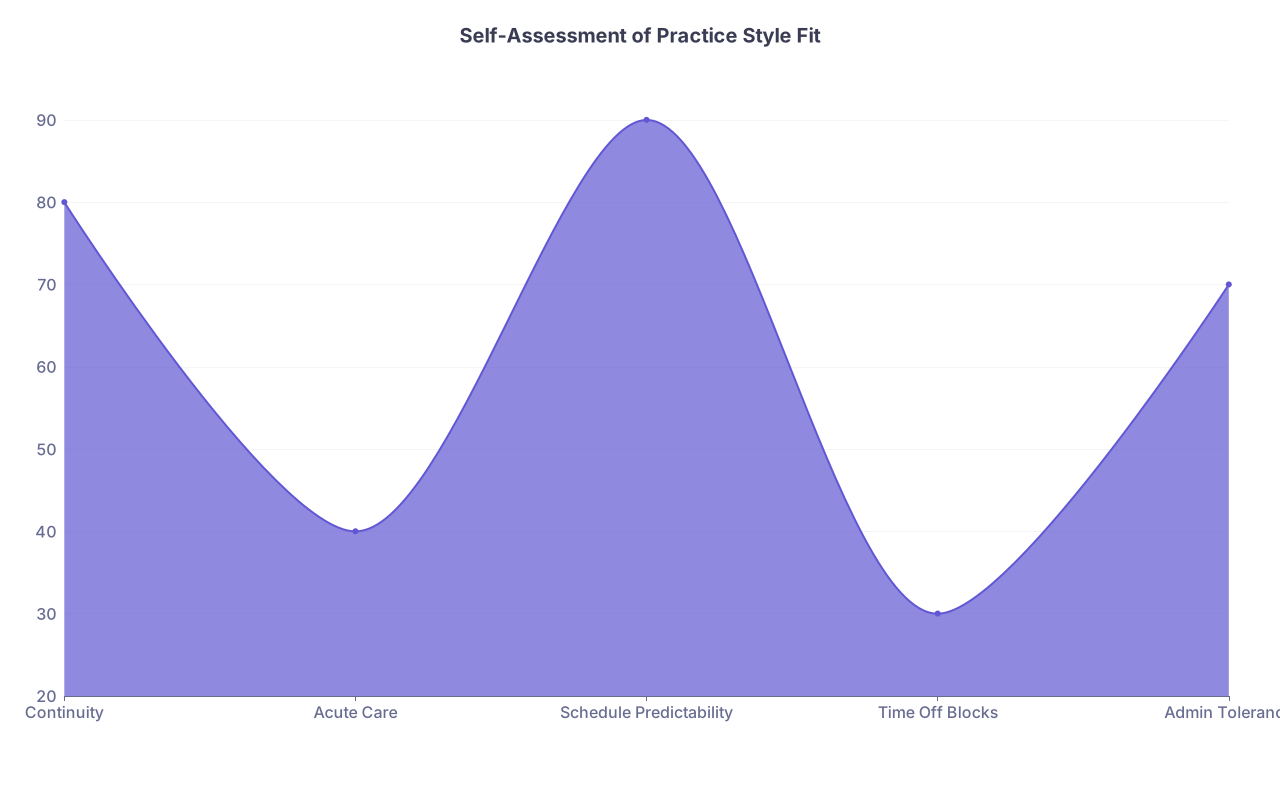
| Category | Value |
|---|---|
| Continuity | 80 |
| Acute Care | 40 |
| Schedule Predictability | 90 |
| Time Off Blocks | 30 |
| Admin Tolerance | 70 |
Use something like this as a mirror, not a law.
What You Should Actually Do As an MS4 (and Early Resident)
Practical, protective steps:
Get non‑glamour exposure.
- Shadow a community PCP seeing 20+ patients in a day.
- Shadow a non‑teaching hospitalist on a busy census day or night shift.
-
- “How many hours do you work per week, actually?”
- “How much work do you do at home?”
- “What would make you quit your job?”
- “If you could redesign your job from scratch, what would you change?”
Be honest about your body and brain.
- If nights destroy you during residency, they will not magically become tolerable at 35.
- If clinic days fly by for you, stop apologizing for liking them.
Do not pick purely by pay or prestige.
- Factor money in. But do not let it erase everything else you know about yourself.
Hold your decision lightly at first.
- Tell yourself: “I am choosing what to start with, not swearing eternal loyalty.”
Final Takeaways
Three things I want you to walk away with:
- Do not mistake the student‑version of primary care or hospitalist work for the real job. Get unfiltered exposure before deciding.
- Stop collapsing “lifestyle” and “salary” into single numbers. You are trading different kinds of stress, responsibility, and freedom in each path.
- Choose based on how you actually like to think and live, not on peer pressure or salary FOMO. You are the one who has to wake up in that job for the next decade, not your co‑residents.