
Choosing residency for the city instead of the training is how strong medical careers quietly stall.
Not always. But often enough that I have lost count of versions of this story:
“Yeah, I matched in [amazing city], loved living there… but honestly I came out undertrained and I have been playing catch-up ever since.”
Let me be blunt. Prioritizing lifestyle and zip code over clinical rigor is one of the most common, most predictable, and most preventable residency mistakes.
You are not just picking where you will live for 3–7 years. You are picking:
- Who will shape your clinical instincts.
- What you will actually be competent at for decades.
- Which doors will open—or stay shut—for fellowships and jobs.
And those tradeoffs do not feel real when you are 26, tired of moving, and seduced by “finally living somewhere fun.” But they show up later. On call. In ORs. In fellowship interviews. In job offers that never come.
Let’s walk through the specific ways people get burned by choosing location over training, and how to avoid being one of them.
The Most Expensive Illusion: “I’ll Be Happy If I Love the City”
The biggest myth is that living in your dream city will compensate for weaker training.
No, it will not. Here is what actually happens in real life:
You match at a chill, low-volume program in a coastal city you love. First 6 months? Great. New restaurants, nice weather, friends nearby, maybe a partner’s job. You post skyline pics and beach days on your golden weekends.
Then PGY-2 hits.
Your friends at more rigorous programs start talking about things they are doing that you are… not:
- They are staffed on complex cases you have never seen.
- They are doing procedures that you have only read about.
- Their attendings are pushing them; yours are signing things off for you.
Suddenly, the city is not enough to quiet that creeping realization: your training is softer.
This is where regret usually starts. Quietly. On the inside. You will not put it on Instagram.

The uncomfortable truth:
Happiness in residency is much more tightly linked to:
- Feeling competent and progressing.
- Being trusted by attendings and nurses.
- Knowing that your future options are expanding, not shrinking.
Location matters. But training quality has a much longer half-life.
If you bet on city over training, you are gambling that a few easier years now are worth living with whatever skill set and reputation that program gives you forever. Many people, looking back, would absolutely not make that trade again.
Where “Location First” Hurts You the Most
The damage is not abstract. It is very specific and very predictable, especially in certain specialties.
1. Procedural Specialties: Undertrained Hands, Limited Options
If you are going into surgery, OB/GYN, EM, anesthesia, interventional anything, or even hospital-heavy internal medicine—volume matters. Case mix matters. Acuity matters.
Here is the mistake pattern I see over and over:
You rank a “lifestyle” program in a great city above a more intense, more respected one elsewhere. On paper, both are ACGME-accredited, both “fulfill minimums.”
You tell yourself: “Training is what you make of it. I’ll hustle anywhere.”
Except:
- You cannot “hustle” your way into cases that are not there.
- You cannot conjure trauma or complex pathology in a low-volume, low-acuity hospital.
- You cannot make attendings teach things they do not do themselves.
You graduate with:
- Barely adequate case numbers.
- Less comfort with sick patients.
- A narrower procedural skill set than peers.
Now you apply for fellowship. You are up against residents from:
- Busy county programs with crazy trauma.
- Big-name university hospitals with huge subspecialty breadth.
- Strong community programs where residents basically run the place.
You cannot “nice city” your way past that.
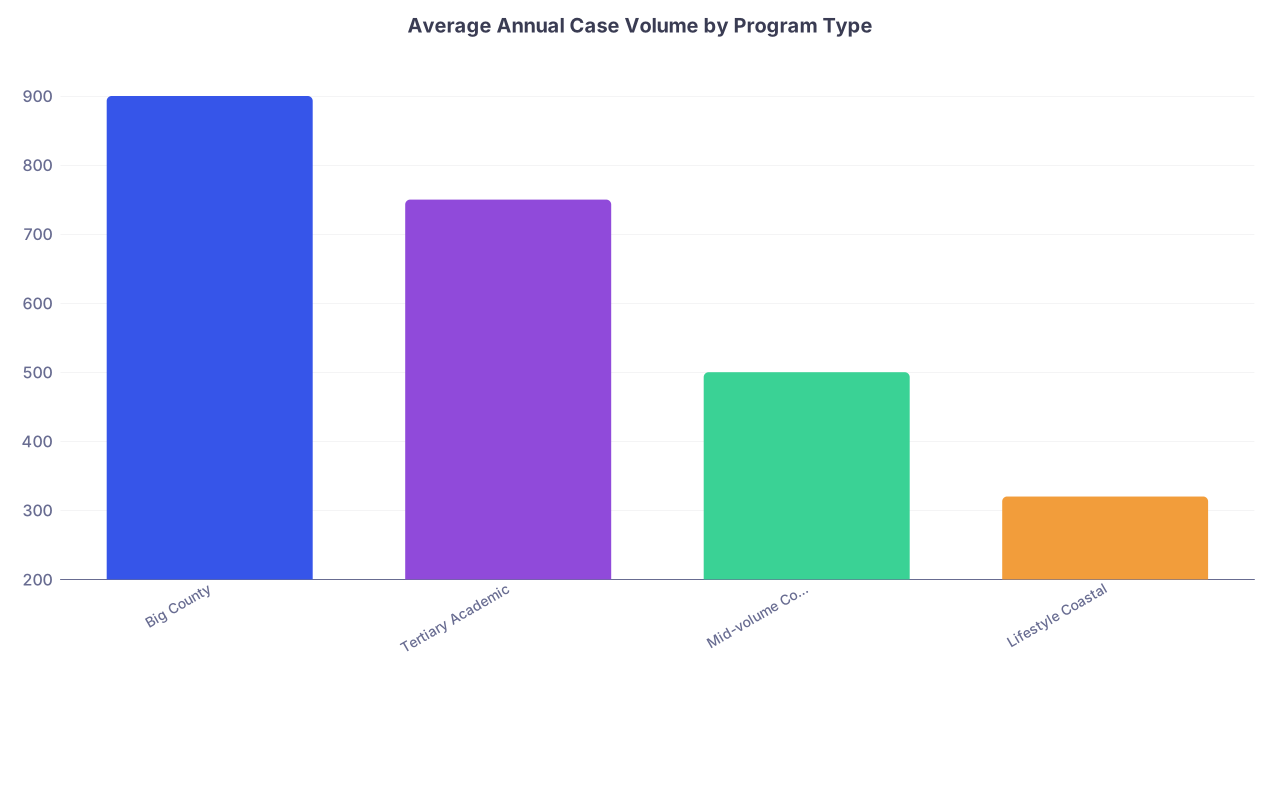
| Category | Value |
|---|---|
| Big County | 900 |
| Tertiary Academic | 750 |
| Mid-volume Community | 500 |
| Lifestyle Coastal | 320 |
Those numbers are not exact, but the pattern is real. The “lifestyle” place in the cool city often comes with a cost: fewer reps, simpler cases, and less stress… until it is very stressful that you do not feel ready.
2. Competitive Fellowships: Name and Letters Actually Matter
People love to pretend program reputation is elitist and overrated. It is not everything, but it is far from nothing.
If you want:
- GI, cards, Heme/Onc, PCCM from IM
- MFM, Gyn Onc, REI from OB/GYN
- Critical care, peds EM, ultrasound, toxicology from EM
- Or any competitive fellowship at all…
Then choosing a weaker program because you wanted to be close to family or live in a coastal city can put you at an immediate and permanent disadvantage.
Fellowship PDs actually say this out loud:
- “We like taking people from X, Y, Z programs; we know what their training looks like.”
- “I do not know that program. Let me look them up…”
- “Their letters are vague… not sure how hard they were really pushed.”
What they never say: “But at least they trained in a fun city.”
You want:
- Strong, specific letters from well-known faculty.
- Institutional reputation that means something outside that zip code.
- Proof that you have handled high acuity, high volume, real responsibility.
Location-first decisions often quietly kill that before you even apply.
| Program Type | Training Rigor | Location Appeal | Long-term Career Leverage |
|---|---|---|---|
| Big County in Unpopular City | Very High | Low | Very High |
| Major Academic in Mid City | High | Moderate | High |
| Solid Community in Suburbs | Moderate | Moderate | Moderate |
| Lifestyle Coastal Program | Low–Moderate | Very High | Low–Moderate |
Look at that last row and ask yourself if that trade is really worth making.
3. Autonomy and Confidence: The Quietest Regret
Residents who chased location and landed in cushy programs often say this after graduation:
“I wish someone had made me uncomfortable earlier.”
They mean:
- More nights managing sick patients instead of watching.
- More primary-operator cases instead of retracting in the corner.
- More attendings who pushed, questioned, and forced growth.
When you are in it, cushy feels good. When you finish, cushy feels like a setup.
Residency is the one protected time in your career when you are supposed to be pushed to the edge of your ability. That is the point. If your main selling point for a program is “they seem really chill and everyone is happy,” you should be nervous.
The Red Flags When You Are Seduced by Location
Programs in great cities know exactly what they are selling. Some are fantastic despite that. Some lean on location to distract you from weak training.
Here are the red flags I pay attention to when a program is in a high-demand city:
Residents repeatedly talk about how “nice” life is but give vague answers about training:
- “We have good work–life balance, people are really happy.”
- “Yeah, we do a decent amount of procedures, I guess?”
- “We definitely meet our numbers.”
Faculty name recognition is thin:
- No one you have ever heard of in your field.
- Minimal national presence, few fellows matched to strong places.
- Conference posters but no serious publications or leadership.
The ICU/trauma/ED or core rotations feel… quiet:
- Residents describe night float as “chill most of the time.”
- Low trauma level or limited subspecialties on-site.
- Many complex cases transferred out.
Graduates stay local in small jobs you have never heard of:
- Very few go to academic or top-tier fellowships.
- Careers seem to plateau at “comfortable community doc nearby.”
None of that is inherently “bad.” But if your long-term goals are ambitious, those are not the patterns you want.
When Location Really Does Matter (And How Not to Fool Yourself)
There are legitimate reasons to prioritize location. You just need to be honest about what you are giving up.
Real reasons to prioritize location:
- You are the primary support for sick or aging parents.
- Your partner’s career is geographically constrained and you are not willing to do long distance.
- You have kids in school and are not moving them across the country again.
- You have already decided on a non-competitive career path (e.g., community primary care in that region) and do not need a powerhouse name.
In those cases, sometimes a “weaker” program in the right city is the correct choice. But be clear:
You are choosing family stability or relationship preservation over prestige or maximal rigor. That is defensible. Mature, even.
The mistake is pretending you can have:
- Top-tier training
- In the most desirable locations
- With the least call, most money, happiest residents
All at once.
You cannot. There is usually a tradeoff somewhere. Your job is to see it clearly instead of hiding it under “but I will be happier there” without examining what that actually means in practice.
A Simple Framework: How Much Are You Really Willing to Trade?
Here is a blunt way to think about your rank list. Split it into three axes:
- Training Rigor / Reputation
- Location / Personal Life
- Lifestyle / Workload
Now, for each program, actually score these 1–5 in your head. Then ask: what are you optimizing?
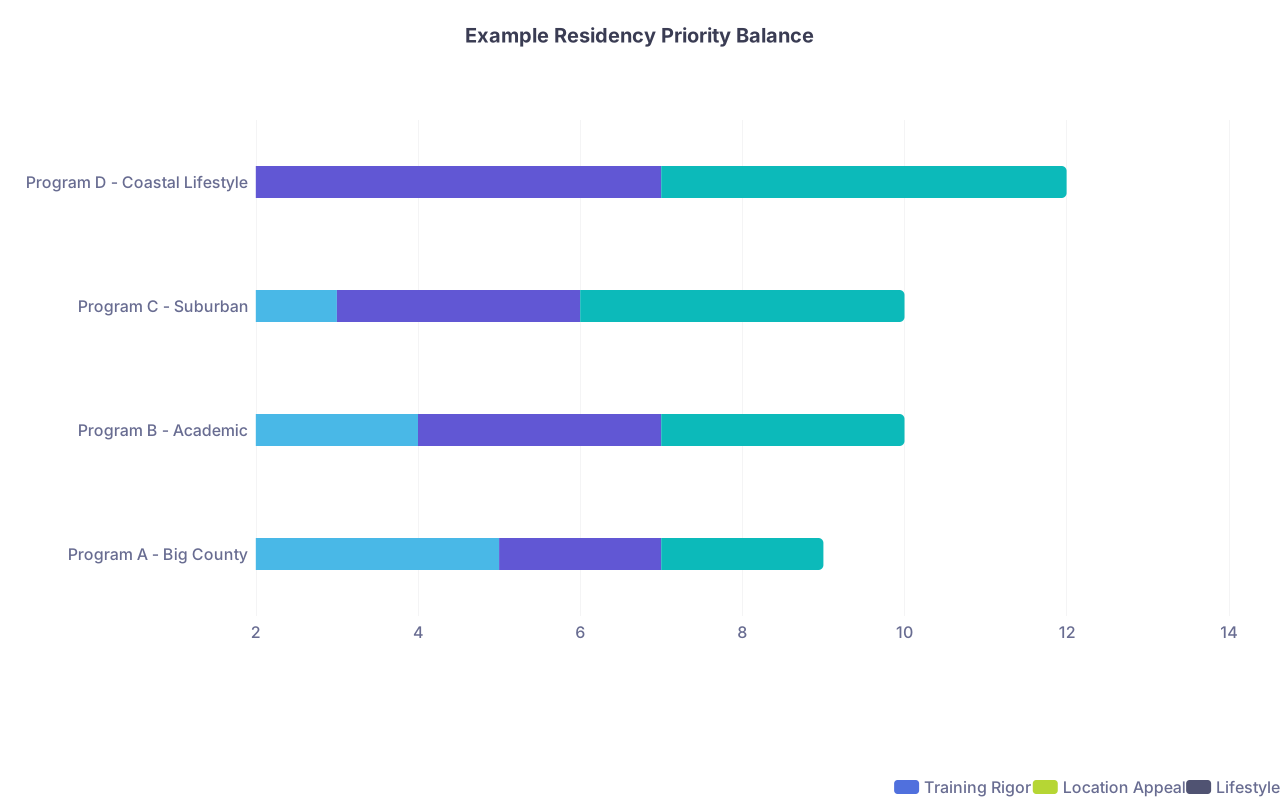
| Category | Training Rigor | Location Appeal | Lifestyle |
|---|---|---|---|
| Program A - Big County | 5 | 2 | 2 |
| Program B - Academic | 4 | 3 | 3 |
| Program C - Suburban | 3 | 3 | 4 |
| Program D - Coastal Lifestyle | 2 | 5 | 5 |
If your rank list ends up with:
- Top: Programs with Location 5, Training 2–3, Lifestyle 4–5
- Bottom: Programs with Training 4–5, Location 1–2
Then be honest with yourself: “I am choosing to optimize my 20s lifestyle over maximal clinical rigor and career optionality.”
If you are genuinely at peace with that, fine. Most people, in hindsight, are not.
Specialty-Specific Landmines
Some specialties are much less forgiving of choosing location over training. Others, you can get away with it more easily.
High-Risk if You Undervalue Training
Neurosurgery, Ortho, ENT, Urology, General Surgery, Vascular, CT:
Volume, complexity, and quality of mentorship are everything. Lifestyle programs in big cities here are almost always a trap unless they are still heavy on volume and complexity.OB/GYN:
If you want MFM, Gyn Onc, REI, or MIGS, you cannot afford a program that does not push you hard or has weak subspecialty exposure.Emergency Medicine:
Training at a low-acuity community ED because you wanted a beach nearby is one of the fastest ways to feel unsafe as an attending in the wrong job later.Internal Medicine (if you want fellowship):
GI, cards, Hem/Onc, PCCM all care about where you trained, who wrote your letters, and what you have seen. A soft program in a cool city will straight up close doors.
More Forgiving (But Still Not Free)
- Psychiatry, Family Medicine, Pediatrics, PM&R:
You have more flexibility, and a great life in residency is not unreasonable. But there are still big differences between a strong training environment and a coasting one, especially if you ever want academic roles or niche fellowships.
The point: the more procedural, competitive, or high-acuity your specialty, the more reckless it is to let location drive your rank list.
Avoiding the Trap on Interview Day
You will be tired, flattered, and a little dazzled on interview days, especially in cool cities. Programs know this. They curate the experience.
You avoid mistakes by ruthlessly asking the questions that cut through the marketing.
When you talk to residents, do not ask: “Are you happy here?” Everyone will say yes. They matched there; what else can they say?
Ask instead:
- “What are you worried you are not getting enough of by training here?”
- “Who is the best clinician here? How often do you get to work directly with them?”
- “When you rotate externally or at conferences, do you feel ahead, behind, or about the same as peers?”
- “If you could change one thing about the training, what would it be—and why has it not been fixed?”
And one of my favorites:
- “Which residents here are struggling the most, and why?”
The answers to those questions tell you far more about the true training environment than free food, modern lounges, or rooftop happy hour.
The Brutal Long View: What Your Future Self Actually Cares About
Fast-forward 10–15 years. Residency is a blip. You will barely remember which bar you went to on your rare free Fridays.
You will remember:
- The first time you were alone with a crashing patient and felt ready instead of terrified.
- The mentors who fought for you when you applied for that job or fellowship.
- The reputation that preceded you when you walked into a new institution.
Your future self will not say: “I wish my residency had been in a cooler city.” They will say one of two things:
- “I am so glad I went somewhere that trained me hard; I can handle anything.”
- Or: “I wish I had taken training more seriously when I chose where to spend those years.”
You get to pick which sentence becomes yours.
Three Things to Remember Before You Rank
Residency is temporary. Your skill set and reputation are permanent. Do not sacrifice decades of competence for a three-year zip code.
A slightly less exciting city with strong training beats a perfect city with mediocre training almost every time, especially in procedural and competitive fields.
If you must prioritize location for family or personal reasons, do it consciously. Call the trade by its real name, and work twice as hard on the training you do get.
Do not let “I just want to live somewhere nice” be the quiet reason your career options shrink before they even start.