
The bravest residents I know are the ones who quietly admit, “I’m scared I’ll burn out in this specialty.”
If that’s you, you’re not weak. You’re paying attention.
You’re trying to pick between Internal Medicine, Pediatrics, Psychiatry, and Neurology, and your brain is running disaster scenarios on loop: “What if I choose wrong? What if I can’t handle the emotional weight? What if I become that bitter attending everyone whispers about?”
Let’s walk through this like someone who’s actually been on the wards at 3 a.m., not like a brochure.
The honest truth: every one of these specialties can burn you out
Not “might.” Can.
Not because you’re not strong enough. Because the system is brutal, volumes are high, and people are suffering in very different ways.
But the flavor of emotional load is not the same in IM, Peds, Psych, and Neuro. The kind of pain you’re exposed to all day matters. The specific things that will haunt you at night are different.
Before I get into each one, here’s a rough emotional comparison, since I know your brain wants something concrete to latch onto:
| Specialty | Typical Emotional Load Style |
|---|---|
| Internal Medicine | Chronic complexity, moral distress, slow decline |
| Pediatrics | Family distress, rare tragedies, emotional whiplash |
| Psychiatry | Emotional absorption, suicidality, boundary fatigue |
| Neurology | Prognostic heaviness, loss of function, uncertainty |
Does this capture everything? Of course not. But it gives you a frame so you’re not just spiraling.
Internal Medicine: the slow, grinding emotional drip
Internal Medicine doesn’t usually break you with one horrific moment. It wears you down a milliliter at a time.
Think: 68-year-old with CHF, COPD, CKD, diabetes, and no social support, admitted for the fifth time this year. You stabilize them, you optimize their meds, you call case management, you do all the “right” things… and you discharge them knowing you’ll see them again in three weeks. Sicker.
That’s the emotional pattern in IM: chronic complexity, moral distress, and a constant low-grade sense of “this system is failing them and I’m just patching holes.”
Typical emotional hits in IM:
- Watching slow decline despite aggressive care
- Conflicts about goals of care with families who say “do everything” when “everything” means suffering
- Feeling like you’re managing the fallout of poverty, addiction, and broken systems more than diseases
- Being the primary communicator for bad news. A lot.
And then there’s the pager. The hallway consults. The code blues where you know, in your bones, this isn’t going to change the outcome, but you shock and compress and push epi anyway.
Burnout in IM often looks like:
- Cynicism creeping into how you talk about “train wreck” patients
- Emotional numbness during family meetings because you’ve had the same heartbreaking conversation twelve times this month
- Feeling like your decisions don’t actually matter because social determinants are steamrolling everything
But here’s the weird thing: a lot of people don’t burn out in IM because they’re wired for this exact chaos. They love the complexity, they find meaning in incremental wins, and they lean heavily on teams (palliative, social work, case management) to carry some of the emotional weight.
If your fear is “I’ll crumble every time someone gets bad news,” IM might actually be okay long-term. You will get used to hard conversations. The bigger risk is emotional erosion from endless, system-level futility.
Pediatrics: joy, guilt, and the “what if I can’t handle sick kids” spiral
Peds is the specialty people either romanticize to death or say “I could never do that; sick kids would destroy me.”
Both are incomplete.
Here’s the reality: a huge chunk of peds is runny noses, rashes, and vaccines. Kids bounce back fast. You get a lot of visible wins. A febrile kid who looks half-dead at triage is sprinting down the hallway after two IV fluid boluses and some ceftriaxone. That’s incredibly emotionally protective.
But.
The lows in pediatrics are lower than almost anywhere else. Because when something goes wrong with a child, it feels fundamentally unfair in a way adult medicine doesn’t.
Emotional triggers in Peds:
- Parents’ faces when you say words like “cancer,” “ICU,” “intubation”
- Cases of neglect or abuse where you’re both the doctor and a mandated reporter
- Chronic, life-limiting illnesses in very young kids (CF, complex congenital heart disease, metabolic disorders)
- The first time you do CPR on a toddler and it doesn’t work
The emotional whiplash is real: your morning is stickers, bubbles, and reassuring anxious first-time parents; your afternoon is a new leukemia diagnosis and a social work call to Child Protective Services.
Burnout in Peds can look like:
- Deep, almost parental grief that you carry home with you
- Rage at the unfairness of it all, especially when social factors are involved (no seatbelts, no vaccines, preventable trauma)
- Compassion fatigue toward overanxious parents because you’re quietly running on fumes
If your brain is screaming “I can’t handle kids dying,” here’s the harsh but honest truth: children die in peds less often than adults die in IM or Neuro. The frequency of death is lower. The impact of each one is higher.
Some residents cope by leaning into the joy: silly ties, themed socks, dancing on rounds, letting themselves fully enjoy the kids who get better. Others intentionally avoid the most intense settings (e.g., they choose outpatient peds or general wards over PICU/onc long-term).
If your biggest fear is occasional deep emotional trauma, peds will hit that fear hard. If your fear is constant background sadness and futility, peds might actually be lighter than you think.
Psychiatry: the emotional sponge specialty
Psych is the one everyone confidently says, “Oh I could never; I’d take it all home.” And they’re not totally wrong.
Psych burnout isn’t usually about bodily fluids, codes, or huge families crying in the hallway. It’s about the relentless proximity to raw, unfiltered human suffering that you can’t fix with a drug and a procedure.
Psych’s emotional load lives in:
- Suicidal patients you discharge with safety plans you know aren’t perfect
- The heavy silence after a patient says, “If you discharge me, I will kill myself”
- Patients with personality disorders who attack you verbally, idealize you, then devalue you, over and over
- Violence risk: being hyperaware that someone could throw a chair or swing a fist when agitated
Burnout in Psych tends to look like:
- Emotional exhaustion from holding other people’s pain all day
- Boundary fatigue: feeling guilty for saying no, for leaving on time, for not answering every after-hours email from distressed patients
- A creeping nihilism about whether people can actually change
And here’s the messed up part: a lot of psych residents came into the field with their own history of anxiety, depression, or trauma. That can be a superpower for empathy. It can also be an accelerant for burnout if you’re not careful.
But it’s not all suicidal ideation and trauma disclosures. There are incredible wins:
- First time a severely depressed patient smiles and says, “I actually feel hopeful”
- Someone with schizophrenia gets stabilized, housed, and connected to long-term support
- Therapy patients who gradually recognize patterns and break them
For many, the decision is: can you learn to set hard emotional boundaries? Not fake ones. Real ones. “I care a lot about you, and when I go home, I have a life that doesn’t revolve around your suffering.”
If your nightmare is being emotionally drained by everyone else’s pain because you already do that with friends and family, Psych may be a minefield unless you commit early to therapy, supervision, and ruthless boundaries.
Neurology: the quiet, heavy weight of “this won’t get better”
Neurology is subtle. On paper, it seems intellectual and detached. Brisk reflexes, upgoing Babinski, cute localization puzzles, MRI findings. Your preclinical brain loves this.
Clinically? The emotional load can be heavier than you expect.
Because so much of neuro is about loss.
Loss of movement. Speech. Memory. Personality. Independence. And often, you’re the one who confirms, in detail, what’s not coming back.
Typical emotional stresses in Neuro:
- Breaking the news that this stroke has left someone permanently disabled
- Telling a family their loved one has ALS, FTD, or an aggressive brain tumor
- The relentless progression of diseases like Parkinson’s, MS, dementia
- Watching previously high-functioning people become dependent, confused, or trapped in bodies that don’t work
Neurology residents I’ve known carry a specific grief: patients remember you over time. They know you. You become the face associated with their decline.
Burnout in Neuro can look like:
- Emotional heaviness from constant bad-news conversations
- Hopelessness when you feel like you’re never giving anyone a “cure,” just managing deterioration
- Intellectual overcompensation: burying yourself in MRIs, EEGs, and exam findings to avoid feeling the human reality
There are wins, but they’re more scattered:
- tPA/mechanical thrombectomy success stories where the patient returns to baseline
- Seizure control that gives people back their ability to drive or work
- Reversible causes you catch: B12 deficiency, normal pressure hydrocephalus, autoimmune encephalitis
If your fear is “I won’t survive a specialty where most stories end badly,” Neuro could be emotionally rough unless you really love the diagnostic challenge enough that it sustains you. Because you’ll need that fuel.
How these specialties differ in burnout patterns, not just intensity
Let me put this in a slightly more structured way, since your brain is probably trying to rank things by “how bad is it really?”
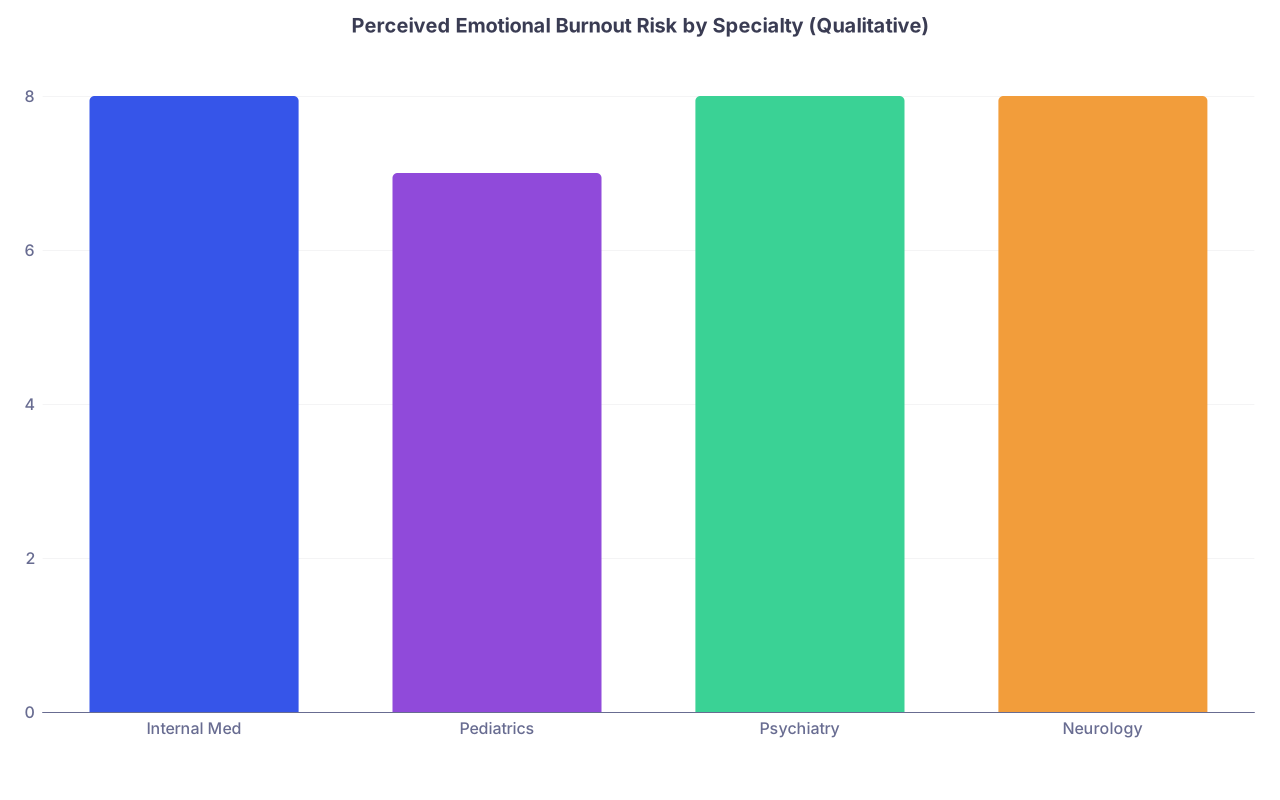
| Category | Value |
|---|---|
| Internal Med | 8 |
| Pediatrics | 7 |
| Psychiatry | 8 |
| Neurology | 8 |
On a made-up, but experience-based, 1–10 scale, I’d put them all around 7–8. Different reasons, similar total load.
Another way to look at it:
| Specialty | Main Emotional Stressor |
|---|---|
| IM | System failure, chronic decline, moral distress |
| Peds | Rare but intense tragedy, family pain |
| Psych | Absorbing emotional trauma, suicidality |
| Neuro | Poor prognosis, progressive loss |
You’re not choosing between “safe from burnout” and “doomed.” You’re choosing your type of hard.
What kind of emotional pain are you actually better at handling?
This is the question no one asks you on the trail, but they should.
Not “what do you like?” Not “what are your strengths?” But: what sort of emotional weight can you carry without breaking?
Ask yourself, honestly:
Are you more troubled by suffering you can’t stop (systemic issues, slow decline)
→ IM/Neuro might hit that nerve hard.Are you more shaken by rare, catastrophic events (a child dying, abuse cases)
→ Peds might be rough, especially inpatient/PICU/onc.Are you more drained by emotional intensity and being everyone’s therapist
→ Psych might eat at you unless you’re great with boundaries.Are you unnerved by watching people lose themselves (memory, speech, identity)
→ Neuro may feel uniquely heavy.
This isn’t about being “strong enough.” It’s about fit. Endurance in medicine is not about white-knuckling it; it’s about aligning your psyche with the kind of difficulty you can live with.
Concrete ways to protect yourself, no matter what you choose
I’m not going to give you useless “self-care” platitudes. You already know you should sleep and exercise.
These are the things I’ve seen actually buffer burnout in residents across these specialties:
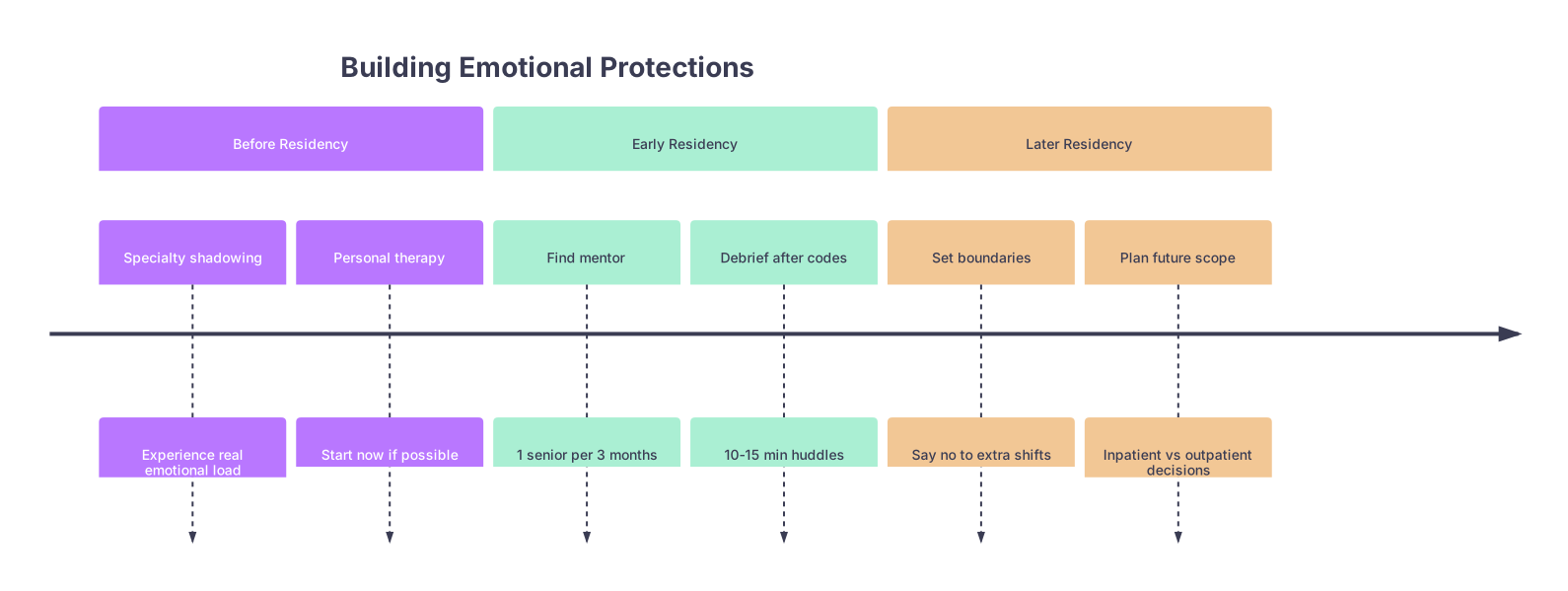
| Period | Event |
|---|---|
| Before Residency - Specialty shadowing | Experience real emotional load |
| Before Residency - Personal therapy | Start now if possible |
| Early Residency - Find mentor | 1 senior per 3 months |
| Early Residency - Debrief after codes | 10-15 min huddles |
| Later Residency - Set boundaries | Say no to extra shifts |
| Later Residency - Plan future scope | Inpatient vs outpatient decisions |
See the real thing before you commit.
Not med school rotations where you’re shielded and everything feels like a tour. I mean: shadow a night float in IM, a PICU attending, an inpatient psych team, a stroke service. Listen for what actually sticks with them emotionally.Talk to burned-out and non–burned-out residents in that field.
Literally ask: “What are the cases that keep you up at night?” If they say, “Nothing, you get used to it,” walk away. That’s denial talking. Look for people who can say, “Yeah, this specific type of case hurts, but this is how I deal with it.”Notice what already haunts you from med school.
Was it that one peds code? That patient with advanced dementia who kept asking for a husband who’d died years ago? The patient who OD’d and was back a week later? Your reaction pattern is data.Plan early for long-term scope.
Internal med doesn’t have to be hospitalist forever. Peds doesn’t have to be PICU. Psych doesn’t have to be inpatient. Neuro doesn’t have to be neuro-ICU. The heaviest emotional load is often at the sickest end of the spectrum. You get some control later.Normalize therapy like you normalize handwashing.
A lot of residents wait until they’re shredded before they see someone. That’s like waiting until septic shock to start fluids. If you’re already an anxious, worst-case thinker (hi), having a therapist on board as you enter residency is… not optional. It’s armor.Give yourself permission to change.
People switch out of Psych to IM. Out of Peds to Anesthesia. Out of IM to Psych. It happens. Quietly, more often than you think. Starting in the “wrong” place isn’t career-ending. It’s painful and messy, but not fatal.
Quick visual: how often you face “big” emotional events
This is obviously rough and program-dependent, but it might help your brain organize things:
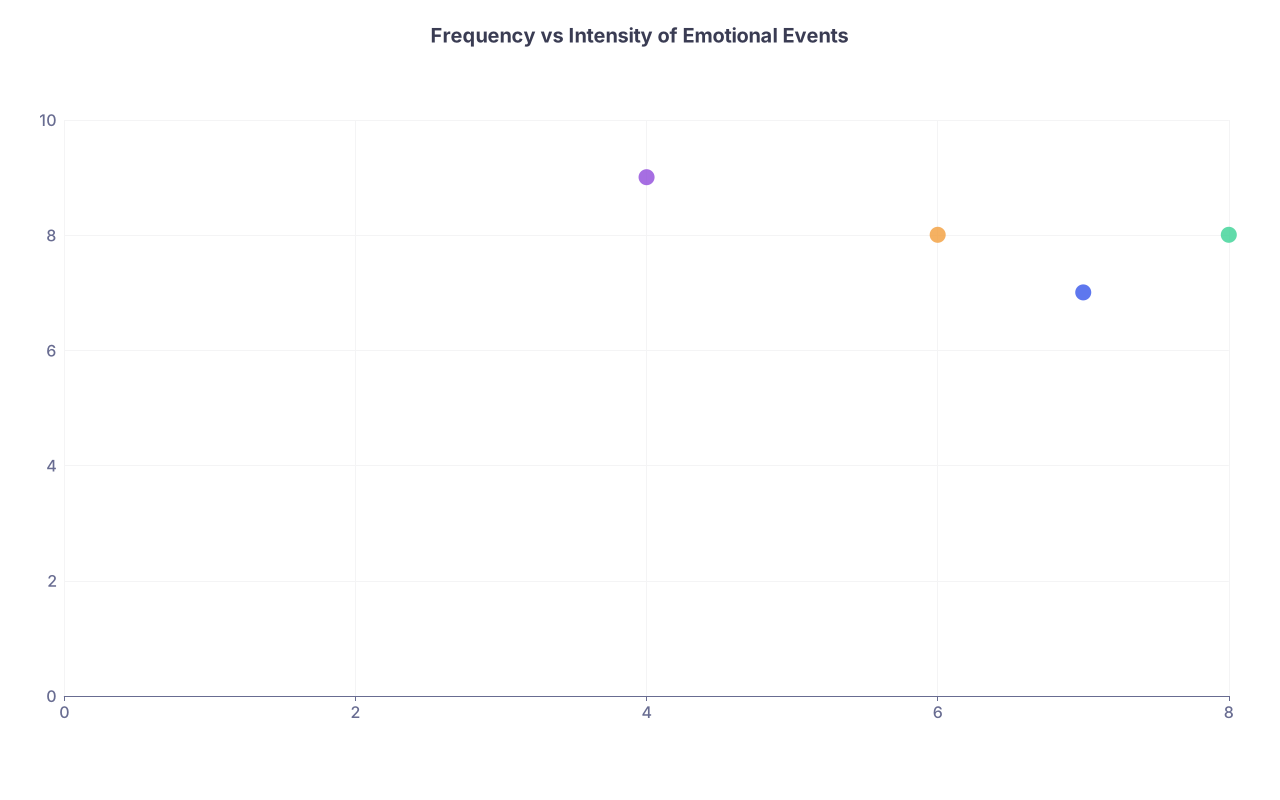
| Category | Value |
|---|---|
| IM | 7,7 |
| Peds | 4,9 |
| Psych | 8,8 |
| Neuro | 6,8 |
Think of the x-axis as “frequency of emotional hits” and the y-axis as “intensity when they happen,” both 1–10.
- IM: frequent, moderately intense
- Peds: less frequent, very intense
- Psych: frequent, quite intense
- Neuro: moderate frequency, high intensity
You can survive any of these if you’re honest with yourself about which quadrant you function best in.
The part you don’t want to hear but need to
You will not find a specialty where you walk away untouched.
If you go into IM, you’ll remember faces from family meetings.
If you go into Peds, you’ll remember the first child you lost.
If you go into Psych, you’ll remember your first suicide attempt after discharge.
If you go into Neuro, you’ll remember the first young patient with a devastating diagnosis.
The goal is not to avoid that. The goal is to make sure those memories don’t crush you, but shape you into the version of yourself you can live with.
You’re already ahead of the game because you’re asking, up front, “What will this do to me?” The residents who scare me the most are the ones who never ask that.
FAQ (exactly 6 questions)
1. Is there a “least depressing” choice among IM, Peds, Psych, and Neuro?
Not in any absolute sense. Peds feels less depressing day-to-day because kids bounce back and there’s a lot more laughter and visible joy. IM feels heaviest in terms of systemic failure and chronic decline. Psych feels heaviest in terms of emotional intensity and suicidality. Neuro feels heaviest in terms of prognosis and chronic loss. The “least depressing” one for you is the one where the inevitable pain matches the type you’re able to process without shutting down.
2. I cry easily. Does that mean I shouldn’t choose a heavy specialty?
No. I’ve seen some of the healthiest attendings in Peds and IM cry quietly in family meetings and then function completely fine afterwards. The red flag isn’t tears; it’s being unable to recover. If you ruminate for days, can’t sleep, or feel nonfunctional after a hard case, that’s more concerning. And even that is modifiable with therapy, supervision, better support, and time. Being moved by suffering is not disqualifying.
3. Which of these specialties has the “best” lifestyle to prevent burnout?
All of them can be awful during residency. Period. Post-residency, outpatient Psych and outpatient Neuro often have more predictable hours. Outpatient IM and Peds can also be very livable depending on practice setup. But lifestyle alone doesn’t immunize you to burnout. I’ve seen outpatient psychiatrists fried from nonstop emotional work in 20–30 minute visits. You need both sustainable hours and emotional fit with the work.
4. What if I choose Psych and it makes my own anxiety or depression worse?
That’s a real risk. Some people find that understanding mental illness helps them feel less alone and actually improves their symptoms. Others get triggered constantly by cases similar to their own history. The difference is usually how much support they have and how seriously they take their own treatment. If you’re considering Psych and you already struggle with mental health, I’d say: have your own therapist before you start residency, loop them in, and be willing to change paths if you notice you’re decompensating.
5. Does doing a prelim year in IM before another specialty increase burnout risk?
It can. A rough IM prelim year can absolutely chew you up, especially if you already know you don’t want to live in that inpatient chaos long-term. But I’ve also seen people come out of prelim years with more confidence and resilience, and then feel their advanced specialty (Neuro, Anesthesia, etc.) is emotionally easier by comparison. If you go that route, go in eyes open, maximize support, and remind yourself the worst of it has an end date.
6. How do I actually test my emotional fit before I commit to a specialty?
Do targeted, honest shadowing. Not just the fun clinic days. Ask to sit in on family meetings in IM, new cancer diagnoses in Peds, involuntary hold hearings in Psych, and stroke/ALS discussions in Neuro. After each, write down how you felt that night and the next day. Could you sleep? Were you dreading going back? Or did it feel heavy but meaningful? Treat this like data collection on yourself, not some vague “I think I could handle it.” Your reactions in those moments are the best predictor of your future emotional fit.
Open your notes app right now and write one sentence that starts, “The kind of emotional pain I can live with is…”
Don’t overthink it. Just write. Then build your specialty choice around that truth, not around fear alone.