
You’re post-call, sitting in a half-empty hospital cafeteria with cold coffee and a half-eaten muffin. Your phone is open to ERAS. Under “Specialty” you keep flipping between Internal Medicine and Psychiatry like it’s a life-or-death Tinder swipe.
You’ve got mentors in both. You actually liked both rotations. And now the clock is ticking and your brain is screaming: “If I pick wrong I’m going to be miserable for the rest of my life.”
Let me just say the quiet part out loud: you’re not crazy for feeling paralyzed. This is one of the big, identity-level decisions of training. And it’s very easy to feel like there’s one magically correct answer that everyone else has found except you.
There isn’t. But there is a smart way to handle this without nuking your future.
First: You’re Not Predicting Forever (Even If It Feels Like You Are)
The fear here is usually, “If I choose IM and hate it, I’m stuck doing hospitalist work forever,” or, “If I choose psych and miss medicine, I’ve thrown away years of medical training.”
Reality is messier and less final than your brain is telling you.
People:
- Switch from IM to Psych during or after intern year
- Do combined residencies (Med-Psych)
- End up in psychosomatic medicine / consult-liaison psych after IM
- Do primary care–ish stuff in psych-heavy populations, or psych-heavy work in IM clinics
Do you want to intentionally pick a path planning to switch? No. But you need to stop treating this like signing a blood pact.
Residency is a strong direction, not a prison sentence.
What’s Actually Scaring You About IM vs Psych?
Let’s rip into the specific fears, because usually this “I’m torn” thing is actually “I’m uniquely terrified of both in different ways.”
Common Internal Medicine anxieties:
- “What if I hate rounding forever?”
- “What if I’m not detail-oriented enough for complex medical patients?”
- “What if I burn out seeing 18 patients a day on the wards?”
- “What if I never get over the imposter syndrome with all the guidelines and meds and ICU stuff?”
Common Psychiatry anxieties:
- “What if I miss ‘real medicine’ and forget how to manage hypertension or CHF?”
- “What if I can’t handle chronic, non-‘fixable’ problems?”
- “What if I get bored just talking all day?”
- “What if I’m not emotionally resilient enough for suicide, self-harm, psychosis?”
If you’re honest, you probably recognize several from both lists.
So ask yourself a more useful question:
“Which set of problems am I more willing to face every single day?”
Not “Which one doesn’t scare me?” because both do. You’re allowed to pick the path that scares you slightly less or where the reward feels worth the fear.
Day-to-Day Reality: How Different Do IM and Psych Actually Feel?
You already know the stereotypes. Let’s be less vague.
| Aspect | Internal Medicine | Psychiatry |
|---|---|---|
| Rounding Style | Fast, data-heavy | Slower, conversation-heavy |
| Patient Load | Higher | Lower |
| Procedures | Rare (unless subspecialty) | Very rare |
| Documentation | Long notes, lots of labs | Long notes, mental status |
| Call/Nights | More frequent, busier | Generally lighter |
On IM inpatient:
You’re moving fast. You might see 10–20 patients on a busy service. Your brain is juggling labs, vitals, imaging, consults, med recs, “Why is the sodium doing that?” and “Please don’t crash before sign-out.” A lot of cognitive load, a lot of triage.
On Psych inpatient:
You’re seeing fewer patients. But the conversations are deeper and heavier. Suicidal ideation. Trauma. Delusions. You have to tolerate sitting in situations where there’s no clear lab you can fix. It’s less “stabilize the potassium now,” more “slowly build alliance and adjust meds and expectations over time.”
On outpatient side:
- IM clinic: DM2, HTN, COPD, CHF, polypharmacy, cancer follow-ups. A lot of time pressure, complex medical decision-making, and often not enough time to address mental health the way you’d like.
- Psych clinic: med management, psychotherapy if you want it, lots of chronic conditions, more continuity. Sometimes frustrating when change is slow. But you go deeper with fewer things.
Neither is “easy.” They’re just different flavors of hard.
The Big Identity Question: Are You More “Medical” or “Psychological”?
This is the question that keeps chewing at people.
You might be thinking things like:
- “I liked interpreting EKGs and figuring out why someone is hypoxic”
- “But I also loved the long talks with patients about their lives and trauma and anxiety”
Here’s how I’d pressure-test this.
Imagine:
A 65-year-old with CHF, COPD, CKD, diabetes, and a new AKI. Multiple meds, borderline vitals, complex fluid status. You need to figure out what’s going on and fix it over the next 48 hours.
A 28-year-old with recurrent major depression, several suicide attempts, PTSD, vague but persistent suicidal ideation, and poor adherence. You need to manage risk, build trust, adjust meds over months, and accept that this might never be fully “fixed.”
Which type of puzzle do you feel more drawn to? Not which one you feel more competent in right now (because that’s skewed by your rotations). Which one would you be more okay living in, mentally and emotionally, for years?
If your brain lights up for #1: that’s Internal Medicine energy.
If it lights up for #2: that’s Psychiatry energy.
If it lights up for both: yeah, that’s exactly why you’re here.
Med-Psych: The “I Don’t Want to Break Up With Either” Option
If you’re genuinely split, you absolutely need to at least look at combined Internal Medicine–Psychiatry programs.
These are 5-year combined residencies that train you in both. You graduate eligible for both boards. They’re not a cute middle-ground; they’re demanding as hell, because you’re essentially double-training.
Where do Med-Psych grads end up?
- Consult-liaison (psychosomatic) services
- Integrated primary care + behavioral health clinics
- Academic roles dealing with complex comorbid patients
- VA, correctional medicine, safety-net hospitals
- Leadership positions in systems actually trying to integrate mind + body
The catch: there aren’t that many programs. And they’re not for people who vaguely like both. They’re for people who feel like “just IM” or “just Psych” leaves something big out.
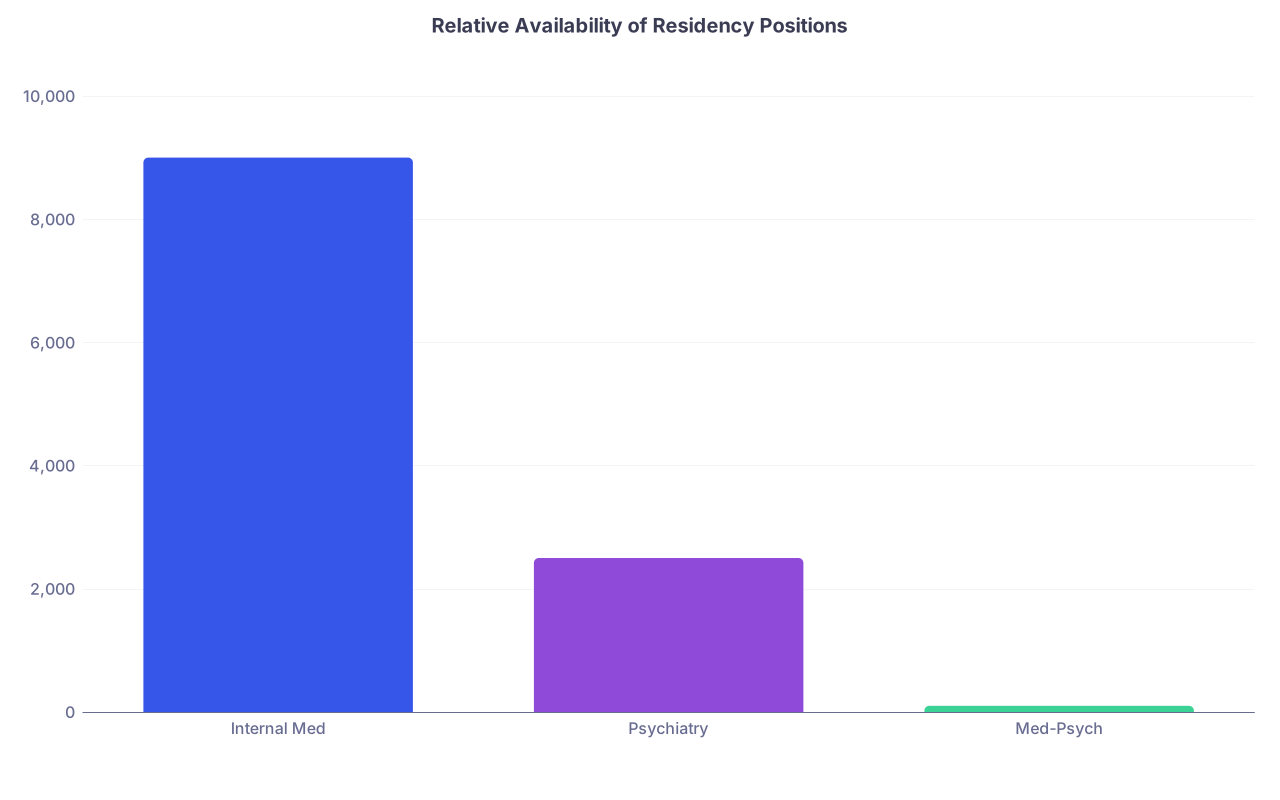
| Category | Value |
|---|---|
| Internal Med | 9000 |
| Psychiatry | 2500 |
| Med-Psych | 100 |
Should you apply Med-Psych? Ask:
- Do you actively want to keep up full internal medicine level knowledge long term?
- Do you like seriously medically complex patients with psychiatric issues (not just “some anxiety”)?
- Are you willing to do 5 years instead of 3–4 because the combination actually excites you, not just because you’re scared to choose?
If “yes, yes, and yes,” add Med-Psych to the list. It can be a way to defer the ultimatum while still committing to real training, not indecision.
The Application Fear: “What If I Apply to Both and Programs Find Out?”
You’re probably terrified of this: “If I apply to both IM and Psych, both sides will think I’m not committed and I’ll get rejected everywhere.”
I’ve seen people apply to both and match just fine. But you have to be strategic.
Here’s the rough reality:
| Strategy | Main Risk | When It Makes Sense |
|---|---|---|
| Only IM | Might regret not exploring Psych | Strong IM pull, decent stats |
| Only Psych | Might miss medicine, fewer spots | Strong Psych pull |
| IM + Psych | More work, story must be coherent | Truly torn, open geographically |
| Add Med-Psych | Very niche, limited programs | You want integrated care |
Programs know people are humans, not robots. What they hate is sloppiness and obvious “copy-paste.”
If you apply to both:
- You must write separate, specialty-specific personal statements.
- You must not send a Psych letter to IM or vice versa.
- You must have at least one strong letter in each specialty. - You must have a believable narrative for each: why IM, why Psych.
Am I saying lie? No. I’m saying emphasize different angles of the truth. Your Psych PS can talk about how you noticed mental health driving admissions in IM, and you want to focus on that dimension. Your IM PS can talk about loving complex medical problem-solving but always being attentive to patients’ psychosocial context.
Residents on selection committees can smell: “I copy-pasted a generic ‘I love patients’ paragraph into twelve specialties.” Don’t be that person.
What If You Choose “Wrong”?
This is the doomsday reel your brain is playing on loop.
Let’s walk through worst-case scenario thinking like adults:
Scenario 1: You pick IM, hate it, and want Psych
You start IM. You’re miserable for reasons beyond normal intern misery. You realize the thing that gave you life was psych consults, not the DKA admissions.
What happens?
- You can talk to your PD and explore switching into Psych (within your institution or elsewhere). This is not unheard of.
- Worst case: you finish intern year, reapply to Psych, and maybe lose a year. Annoying, yes. Career-ending, no.
- Your IM-level training will 100% make you a better psychiatrist, especially with medically complex patients.
Scenario 2: You pick Psych, hate it, and want IM
You do Psych. You miss lab values and somatic disease. You feel boxed into meds + therapy.
Options:
- Try to transfer early. Harder than within-IM transfers but still possible if you move quickly.
- Later: do an IM residency after Psych (there are people who’ve done this) or pivot into psychosomatic roles with heavy medical collaboration.
- Your psych training will make you a much better internist with tough patients, adherence issues, substance use, somatization, etc.
The point: you are not locking yourself into some trapdoor with spikes. It’s a big, annoying detour at worst. People survive worse things in medicine all the time.
Honestly, the bigger danger is staying in something that’s the wrong fit out of inertia and fear. Not the act of choosing.
What Data Do You Actually Need Before Deciding?
If you’re still in med school, here’s the stuff that’s actually useful. Not “pros and cons lists” you make at 2 a.m. and never look at again.

| Step | Description |
|---|---|
| Step 1 | Realize you are torn |
| Step 2 | Revisit rotations mentally |
| Step 3 | Shadow extra IM or Psych days |
| Step 4 | Meet with at least 1 mentor from each |
| Step 5 | Write draft personal statements for both |
| Step 6 | Decide application strategy |
Concrete moves:
Shadow or moonlight-like experience
Ask for 2–3 extra days on an IM inpatient team and 2–3 more on a Psych inpatient or CL service. But pay attention to yourself, not just the coolest attending. How do you feel at 3 p.m. each day? Drained? Stimulated? Dreading tomorrow?Talk to senior residents who are honest, not just program reps
Ask: “What sucks about your specialty that no one told you as a med student?” You’ll learn way more from the off-the-record gripes than any info session.Try to picture Post-Residency You
Not vague “future attending.” Try this: picture your average Tuesday as a 40-year-old in each field. Clinic? Hospital? What kind of problems? What type of colleagues? Which version of you feels more like someone you’d actually want to be?Draft a personal statement for each
Not to send. Just to see what comes out when you force yourself to defend each choice. Does one feel natural and specific and alive, and the other feels like you’re stretching? Pay attention to that.Look at the match stats without catastrophizing
Don’t let competitiveness alone make the decision. Yes, IM has more spots. Psych has gotten more competitive. But if you’re a reasonable applicant, you can match either with a thoughtful strategy.
The Personality Piece You’re Probably Ignoring
You don’t have to be a stereotype, but patterns exist for a reason.
People who thrive in IM often:
- Like being the “primary problem-solver” for a patient’s whole body.
- Are okay with guideline-heavy, data-heavy decision-making.
- Can tolerate high patient volume and fast task-switching.
- Get satisfaction from fixing something concrete.
People who thrive in Psych often:
- Are fascinated by people’s stories and inner worlds.
- Tolerate ambiguity and slow progress.
- Are okay with fewer “quick wins” and more chronic relationship-building.
- Get satisfaction from helping someone function better, even if you can’t cure them.
You probably see a bit of yourself in both columns. That’s fine. But ask which column feels more like “home base” and which feels like “I can pretend to be that for a while.”
Pretending is costly.
A Hard Truth: Some of This Is Just Fear of Committing to Anything
Sometimes you’re not actually torn between IM and Psych.
You’re terrified of committing, period.
You’re scared of:
- Losing all the other versions of your life you won’t live
- Being “that person” who complains 3 years in that they picked wrong
- Having to own a choice instead of hiding behind “I’m still deciding”
I’m not going to sugarcoat this: at some point you have to choose something with incomplete information. That’s adulthood in medicine. You will never have 100% certainty. You can get yourself to 70–80%, make the best call you can, and live with it.
Indecision is a decision. It’s just a terrible one.
Today: Do One Concrete Thing
You don’t need to “figure out your life” tonight. But you do need to stop passively stewing.
Do this right now:
Open a blank document and write two headings:
- “If I choose Internal Medicine, I am saying YES to…”
- “If I choose Psychiatry, I am saying YES to…”
Under each, force yourself to write at least 5 very specific, concrete things. Not vague “I like helping people.” Stuff like “managing CHF and diabetes,” “running family meetings on end-of-life,” “sitting with suicidal patients regularly,” “working mostly in clinic vs hospital,” “tolerating call frequency X,” etc.
When you’re done, step back and ask yourself:
Which list scares me in a good way, and which scares me in a bad way?
That’s your next breadcrumb. Follow it.