
The way most students pick between Family Medicine, Pediatrics, and Med‑Peds is backwards. They shadow for a week, rotate randomly, then hope their “gut feeling” is right. That is how you end up scrambling in March with a half‑baked story and an even weaker rank list.
You can do better than that. Fourth year can and should be a structured experiment to test these three options head‑to‑head.
Below is the playbook I wish more students used: a concrete, rotation‑level strategy to design MS4 so that by October you know whether FM, Peds, or Med‑Peds actually fits you.
Step 1: Get Brutally Clear on What You’re Testing
You are not just testing “Do I like kids?” vs “Do I like adults?”
You are testing:
- Day‑to‑day tasks
- Patient mix
- Clinic vs inpatient balance
- Training length and lifestyle
- How your brain likes to work (breadth vs complexity, continuity vs acuity)
Here is how the three actually differ in real life, not brochure language.
| Feature | Family Medicine | Pediatrics | Med-Peds |
|---|---|---|---|
| Training length | 3 years | 3 years | 4 years |
| Age range | All ages | Birth–21(ish) | All ages |
| Inpatient exposure | Low–Moderate | Moderate–High | High |
| Typical clinic mix | Adults + kids | Mostly kids | Often more complex pts |
| Procedural volume | Variable | Variable | Variable (site-specific) |
| Breadth vs depth | Max breadth | Peds focused | Dual internal med + peds |
Now translate that into personal hypotheses. Write these down. This is not fluff.
Examples:
- “I think I want mostly outpatient, with a mix of kids and adults, limited inpatient → leaning FM.”
- “I like sick kids, complex cases, and hospital work, and I do not care about adult medicine → leaning categorical Peds.”
- “I’m drawn to complex medicine, ICU, and chronic disease management in all ages → leaning Med‑Peds.”
These become the questions your rotations must answer:
- Do I actually enjoy adult chronic disease management (COPD, CHF, diabetes)?
- Am I energized or drained after a day of well‑child checks and reassurance?
- Do I enjoy inpatient medicine enough to justify 4 intense years?
- Does long‑term continuity clinic matter to me, or do I like hospital‑based episodic care?
Your MS4 year needs to be designed like a clinical trial on yourself. Clear hypotheses, targeted exposures, and real data.
Step 2: Build a 12‑Month Framework Before You Start Adding Rotations
Fourth year is deceptively short. You do not have infinite blocks. You cannot “just try everything.”
You need a skeleton plan that:
- Tests all three options early enough to pivot.
- Leaves space for aways (if needed).
- Protects Step 2 / CK timing.
- Avoids deadly pitfalls like doing your key decision‑making rotations in November.
Here is a simple framework that works for most schools on a 4‑week block system.
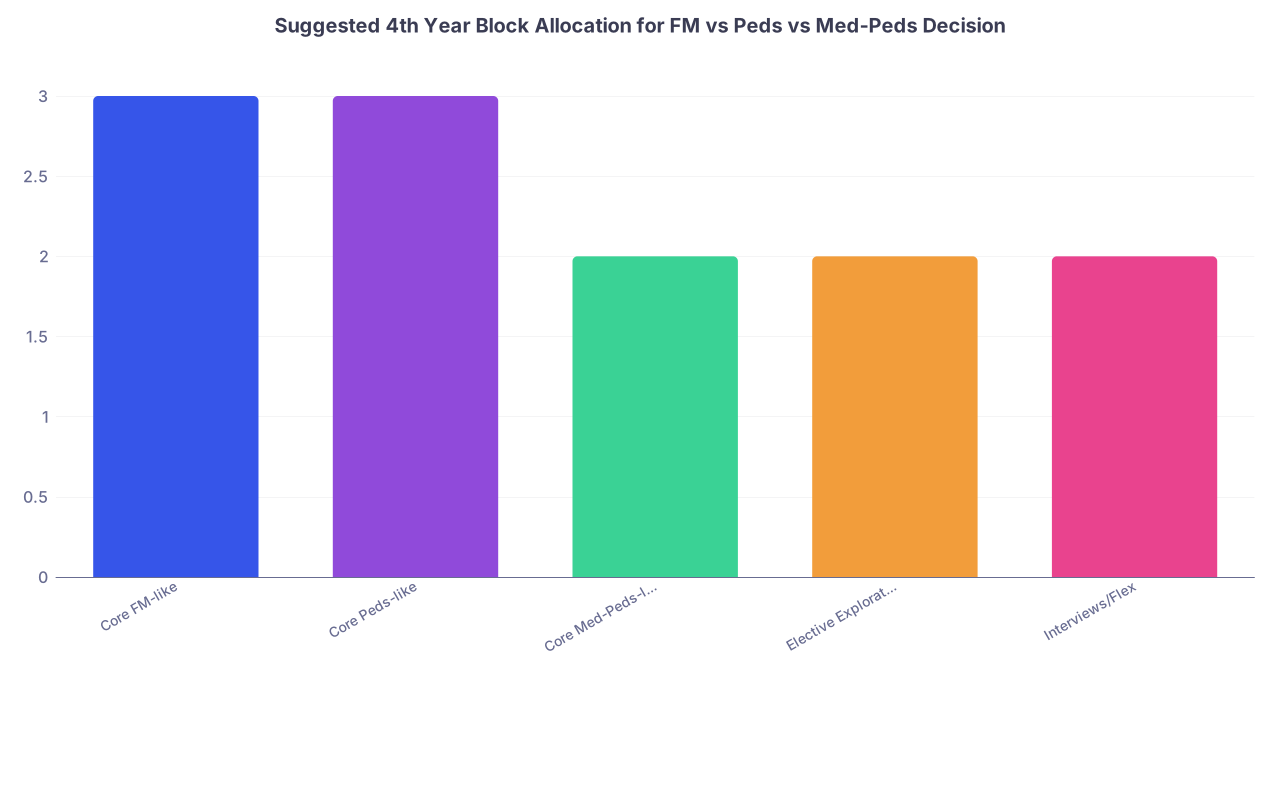
| Category | Value |
|---|---|
| Core FM-like | 3 |
| Core Peds-like | 3 |
| Core Med-Peds-like | 2 |
| Elective Exploration | 2 |
| Interviews/Flex | 2 |
Think in 3 phases:
Phase A: April–July (If your school allows early MS4 time)
- Lock in:
- At least one FM‑style ambulatory block
- At least one Peds inpatient or outpatient block
- Try to get one Med‑Peds exposure (more on how below).
- Take Step 2 / CK in this window if possible.
Phase B: August–October
- Do audition rotations in your top option(s).
- Solidify letters:
- 1–2 from your top specialty
- 1 from a closely related field (IM, Peds, FM, etc.)
- Make the actual specialty decision no later than mid‑October.
Phase C: November–March
- Interview season + backup rotations (geriatrics, NICU, PICU, urgent care, ED, etc.).
- Fill in gaps that will help you as an intern regardless of specialty.
If your school is strict about when you can schedule what, sit down with your dean or scheduler early with this kind of framework in hand. You are not asking “What should I do?” You are saying, “Here is my plan to test FM vs Peds vs Med‑Peds. Help me plug this into the calendar.”
That changes the conversation.
Step 3: Design “Stress Tests” for Each Path, Not Just Exposure
You do not need to sample each field. You need to stress test it.
That means you deliberately choose rotations that:
- Look like the real work of that specialty.
- Are intense enough to show what you love and what you hate.
- Let attendings see you in their world so they can give honest feedback.
Let’s build those stress tests.
Step 4: Build a Family Medicine Stress Test
FM is often misjudged because students see “light” versions: half‑days in student clinic, preceptorships where the attending shields them from chaos.
You want the opposite.
A. Core FM Ambulatory Rotation
Target:
- A busy continuity clinic where FM docs see:
- Adults with chronic disease
- Kids for well visits and sick visits
- Prenatal care (if possible)
- Mental health visits
Minimum: 4 weeks. 6–8 is better if you are leaning FM.
Focus on these questions daily:
- After 15–20 back‑to‑back 20‑minute visits, am I exhausted and bored, or tired but satisfied?
- Do I enjoy managing common stuff (HTN, diabetes, back pain, anxiety) over and over?
- Does the idea of caring for the same family over years feel appealing or suffocating?
B. FM Inpatient or Adult Medicine‑Heavy Block
Family Medicine residency often includes:
- Adult inpatient medicine
- Some ICU exposure
- Sometimes OB
You want at least one block that captures the internal medicine flavor of FM training:
Options:
- Adult hospitalist service
- Inpatient FM service (if your school/hospital has one)
- General internal medicine ward month
Pay attention to:
- Do I dread rounding and daily note grind, or do I find the complexity stimulating?
- How do I feel about older, medically complex patients compared to kids?
C. Optional FM “Plus” Experience
If you are FM leaning and want to see the “full power” side of FM, pick one:
- Rural full‑scope FM elective (adults, kids, OB, procedures)
- Community health center rotation serving underserved populations
- Sports medicine‑heavy FM clinic
These show you what FM can be when fully utilized, not just “urgent care with refills.”
Step 5: Build a Pediatrics Stress Test
Peds looks cute and fun on paper. In real clinics, it is reflux, viral URIs, asthma, worried parents, and a few high‑stakes calls per day. You need to see that.
A. Peds Inpatient (Core)
This is mandatory if you are seriously considering Peds or Med‑Peds.
Target: 4 weeks, preferably at an academic or busy community hospital.
You want:
- General pediatrics wards
- Exposure to:
- Bronchiolitis
- Asthma exacerbations
- Failure to thrive
- Sepsis workups
- Complex chronic kids (trachs, G‑tubes, technology‑dependent patients)
Focus on:
- Do sick kids scare you in a motivating way or just paralyze you?
- Do you enjoy families as “the unit of care,” with a parent at every bedside?
- Can you handle the emotional weight of kids with cancer, severe disabilities, or poor prognoses?
B. Peds Outpatient / Continuity‑Style Clinic
You need to experience the bread and butter outpatient side:
- Well‑child checks
- Vaccines + counseling
- Developmental surveillance
- ADHD, autism workups, behavioral issues
At least 4 weeks. The more continuity‑style, the better.
Ask yourself daily:
- Do I like the rhythm of well‑child visits, growth charts, and parental questions?
- Am I energized by advocating for kids’ health, school supports, safety?
- Does talking primarily to parents for most visits annoy me or engage me?
C. Optional Peds “Depth” Elective
Choose one to see Peds at its most intense:
- PICU or NICU
- Pediatric heme/onc
- Pediatric ED
- Pediatric subspecialty clinic (cards, GI, pulmonary)
This is often what draws people to Peds or Med‑Peds. Complex physiology, high‑stakes decisions, kids who are more medically complex than many adult ICU patients.
If you hate this level of acuity and complexity, pure Peds or Med‑Peds may not be your best long‑term home.
Step 6: Build a Med‑Peds Stress Test (Even Without a Med‑Peds Program)
Here is the issue: many schools do not have a Med‑Peds residency. Students then think they “cannot test” it. That is wrong.
Med‑Peds is essentially: full‑intensity Internal Medicine + full‑intensity Pediatrics, with residents and attendings who like:
- Complex, multi‑system disease
- All ages
- Inpatient and outpatient
- Often underserved and transitional care populations
You can simulate this even without a formal Med‑Peds rotation.
A. Pair Rotations Intentionally
Back‑to‑back or near each other:
- A strong adult inpatient medicine month
- A strong pediatric inpatient month
Or:
- Adult continuity clinic / primary care IM month
- Pediatric continuity clinic month
Then ask the Med‑Peds question:
- “Do I like both enough that I would accept fewer electives, a longer residency, and heavier call to keep them?”
If the adult month feels like a chore but peds is great → not Med‑Peds.
If peds feels tedious but adult medicine is fascinating → think categorical IM.
If you find yourself missing the other group (kids during adult month, adults during peds month) → that is a Med‑Peds signal.
B. Seek Out Actual Med‑Peds People
You need their brains, not just their rotations.
- Ask your dean or IM/Peds program directors: “Who are the Med‑Peds faculty? Residents? Alumni?”
- Set up:
- 30‑minute Zooms
- Coffee chats
- Shadow half‑days in their clinic
Ask blunt questions:
- “Which of your residents should have chosen categorical instead?”
- “What do Med‑Peds residents complain about that FM and Peds do not?”
- “What kind of student is miserable in Med‑Peds?”
Write down their answers. Patterns will emerge.
C. Away Rotations in Med‑Peds
If you are leaning Med‑Peds by early summer, do one away rotation at a Med‑Peds program that matches your personality (academic vs community, size, geographic preference).
- Ideal timing: July–September
- Types:
- Med‑Peds inpatient service
- Med‑Peds clinic block
- Split IM/Peds month with a Med‑Peds lens
This is both a stress test and an audition. So treat it like both.
Step 7: Put It All Together – A Sample Year Plan
This is what a deliberately designed MS4 year can look like for someone undecided among FM, Peds, Med‑Peds.
Assume 4‑week blocks.
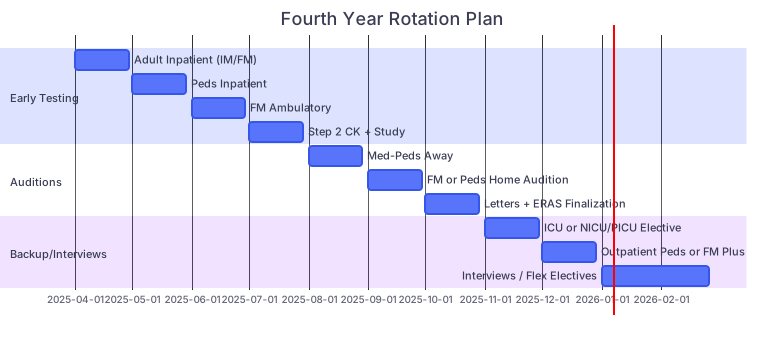
| Task | Details |
|---|---|
| Early Testing: Adult Inpatient (IM/FM) | a1, 2025-04-01, 28d |
| Early Testing: Peds Inpatient | a2, 2025-05-01, 28d |
| Early Testing: FM Ambulatory | a3, 2025-06-01, 28d |
| Early Testing: Step 2 CK + Study | a4, 2025-07-01, 28d |
| Auditions: Med-Peds Away | b1, 2025-08-01, 28d |
| Auditions: FM or Peds Home Audition | b2, 2025-09-01, 28d |
| Auditions: Letters + ERAS Finalization | b3, 2025-10-01, 28d |
| Backup/Interviews: ICU or NICU/PICU Elective | c1, 2025-11-01, 28d |
| Backup/Interviews: Outpatient Peds or FM Plus | c2, 2025-12-01, 28d |
| Backup/Interviews: Interviews / Flex Electives | c3, 2026-01-01, 56d |
Key features of this plan:
- By end of June, you have:
- Adult inpatient exposure
- Peds inpatient exposure
- FM ambulatory exposure
- Step 2 is out of the way before audition season.
- Med‑Peds away is early enough to influence your entire strategy.
- You have a home rotation in whichever specialty you are leaning by September for letters.
Tweak this for your reality, but keep the logic: early testing, then focused auditions, then padding for interviews and skill‑building.
Step 8: Collect Data Like You’re Your Own Program Director
Rotations give you raw experiences. You need to systematically capture them before memory distortion kicks in.
Use a simple 1‑page template for each block.
Rotation Reflection Template (Use Weekly, Not Just Once)
1. Rotation type and setting
- FM outpatient – FQHC clinic
- Peds inpatient – academic children’s hospital
- IM wards – community hospital, etc.
2. 1–10 Energy Score
- Rate your average day: 1 = soul‑crushing, 10 = could do this forever.
3. Best 3 moments this week
Force yourself to be specific:
- “Counseling a teen about contraception and seeing her relax.”
- “Untangling meds for a 70‑year‑old with 10 chronic conditions.”
- “Figuring out a weird rash with the attending.”
4. Worst 3 moments this week
- “Arguing with insurance about a kid’s asthma meds.”
- “Explaining poor prognosis to an adult with no family.”
- “Back‑to‑back viral URI visits where nothing changed.”
5. Tasks I would happily do for 20 years
List 3–5.
6. Tasks I never want to see again if I can help it
List 3–5.
7. Would I be okay if 60–70% of my career was this?
Answer: Yes / No / Unsure. Add one sentence why.
Do this honestly, every week. No one else needs to see it. After 3–4 rotations, patterns become very obvious.
Step 9: Pressure‑Test the Emotional and Lifestyle Realities
Students often obsess over “I like kids vs adults” and ignore the harder reality:
- Training length and intensity
- Lifestyle after residency
- Emotional load
Use what you see on rotations + conversations with residents.
A. Training Length Tradeoffs
Med‑Peds is 4 years. FM and Peds are 3.
Ask:
- Would I actually use the extra training (e.g., hospitalist work, complex disease, academic roles), or would I end up in bread‑and‑butter outpatient primary care that FM/Peds could do in 3?
- Am I okay being a year behind my FM/Peds classmates in finishing training and earning attending salary?
B. Real‑World Call and Lifestyle
Pay attention on rotations:
- Who is in the hospital at 2am? Which residents look burned out vs content?
- How do FM, Peds, and Med‑Peds attendings describe their schedule now vs during residency?
- Who can go to their kids’ soccer games reliably?
Do not just ask, “Is this lifestyle good?” Ask:
- “Could I live this lifestyle for 4 years of training and 20 years of practice?”
C. Emotional Tolerance
Peds and Med‑Peds can be emotionally brutal. So can adult medicine in a different way.
On each rotation log:
- Cases that stuck with you and why:
- A toddler with non‑accidental trauma.
- A 50‑year‑old with end‑stage COPD who keeps smoking.
- A teen with new Type 1 diabetes whose parents are overwhelmed.
Notice which kind of emotional load you naturally lean into and which you avoid.
Step 10: Decide with Your Eyes Open – And Lock Your Application Strategy
By late September or early October, you should have:
- 2–3 rotations with heavy FM flavor (clinic + adult medicine).
- 2–3 rotations with heavy Peds flavor (inpatient + outpatient).
- Intentional Med‑Peds simulation (adult + peds back to back, plus at least one Med‑Peds mentor/away if leaning that way).
- A stack of weekly reflection pages.
Now you stop sampling and pick a lane.
A. How to Make the Call Between the Three
Use this blunt checklist.
If you agree with most of these, FM is likely your best fit:
- You enjoy a mix of ages but feel most comfortable with clinic‑based primary care.
- You are more excited by breadth and continuity than by high‑acuity deep dives.
- Adult medicine does not drain you; kids are fine but not the central driver.
- The idea of 3 years of training and quickly building a practice is appealing.
If you agree with most of these, Peds is likely your best fit:
- You consistently rate peds rotations higher on your weekly energy scores.
- You like working with parents and families, not just the patient.
- You tolerate or even appreciate the emotional weight of sick kids.
- Adult chronic disease management (COPD, CAD, etc.) feels dull or less meaningful.
If you agree with most of these, Med‑Peds is likely your best fit:
- You miss the group you are not seeing (kids during adult months, adults during peds months).
- You enjoy complex, multi‑morbid cases and are okay with extra training to manage them.
- You are comfortable with a heavier inpatient workload and 4 years of residency.
- You are drawn to:
- Hospitalist work
- Transition medicine
- Complex chronic disease across the lifespan
- Academic or subspecialty pathways
B. Align Your Application Mechanics
Once you choose, do the boring but critical parts correctly:
Letters:
- FM: 2 FM letters (home and/or away) + 1 from IM or Peds is fine.
- Peds: 2 Peds letters + 1 from IM or FM.
- Med‑Peds: At least 1 IM and 1 Peds; a letter from a Med‑Peds physician is ideal.
Personal statement:
- Pull from your weekly reflections.
- Explicitly discuss why you chose this over the other two, not just why you like medicine.
-
- If truly torn FM vs Med‑Peds or Peds vs Med‑Peds, you can dual apply, but that requires early planning, extra letters, and very clear messaging.
- Do not half‑commit and then panic‑apply a second specialty in November.
Step 11: Do Not Waste the Year Even If You Are Still Unsure
Suppose you get to October and you are still not 100% certain. That happens.
Here is how you avoid a disaster:
Choose the direction with the most evidence.
If 6 reflections lean Peds and 2 lean FM, stop pretending it is 50/50.Use remaining rotations to fill universal skill gaps:
- ICU, NICU, or PICU
- ED (adult or peds)
- Geriatrics
- Palliative care
- Procedures electives (outpatient, point‑of‑care ultrasound)
Keep talking to residents and attendings.
They will often see your fit more clearly than you do. When three different Med‑Peds residents say, “You’re definitely one of us,” do not ignore that.
Your Next Concrete Step
Do not just nod and move on. You need to turn this into an actual plan.
Today, sit down and:
- List the next 6 rotation blocks on your calendar.
- Assign each block a primary testing purpose:
- “FM ambulatory stress test”
- “Peds inpatient stress test”
- “Adult inpatient Med‑Peds simulation”
- Draft a 1‑page reflection template and save it on your phone or laptop.
Then email your dean or scheduler with a subject line like:
“MS4 Plan to Compare FM vs Peds vs Med‑Peds – Need Help Slotting Rotations”
Attach your draft plan and ask for help fitting it into your school’s actual schedule.
Do that, and you will not be “hoping” your gut is right. You will be running a structured, intelligent experiment on your own future—and that is how you stop guessing and start choosing the specialty that actually fits you.

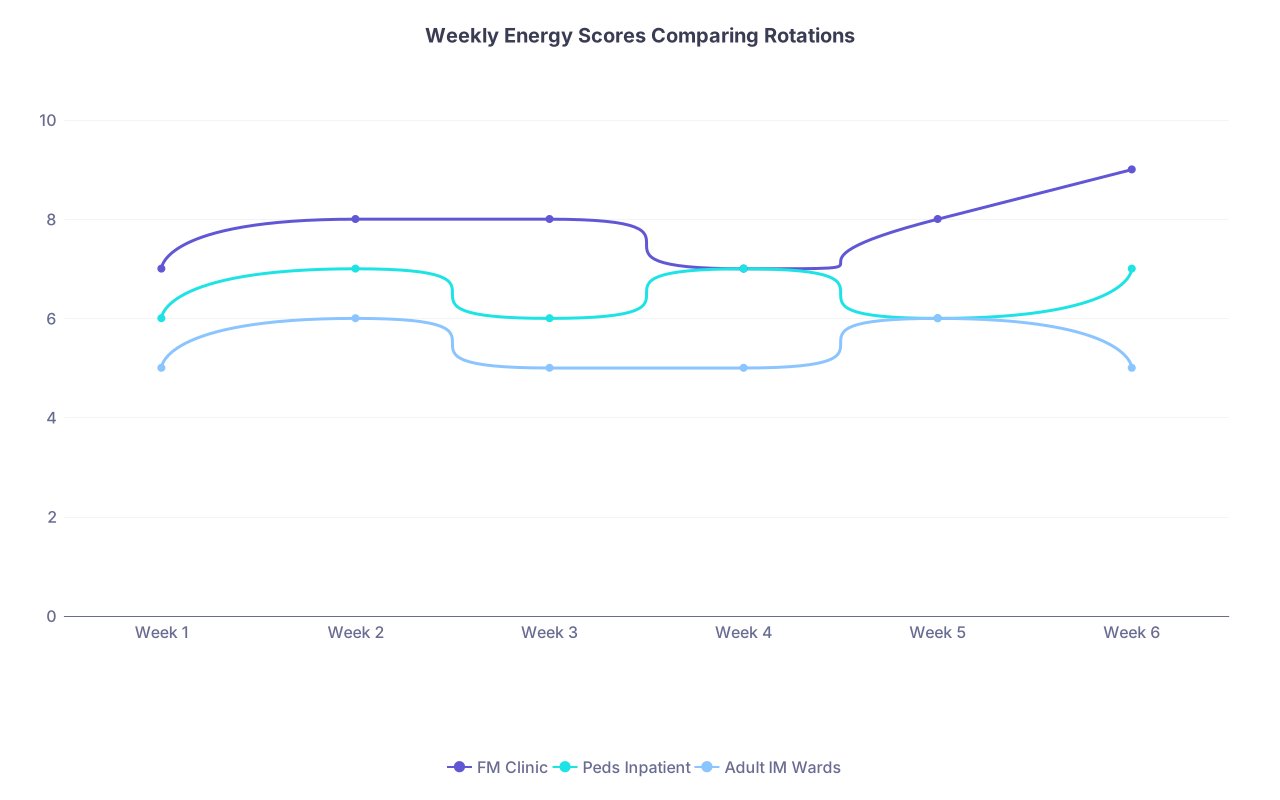
| Category | FM Clinic | Peds Inpatient | Adult IM Wards |
|---|---|---|---|
| Week 1 | 7 | 6 | 5 |
| Week 2 | 8 | 7 | 6 |
| Week 3 | 8 | 6 | 5 |
| Week 4 | 7 | 7 | 5 |
| Week 5 | 8 | 6 | 6 |
| Week 6 | 9 | 7 | 5 |


| Step | Description |
|---|---|
| Step 1 | Complete FM, Peds, IM Rotations |
| Step 2 | Pediatrics |
| Step 3 | Reassess other specialties |
| Step 4 | Med-Peds |
| Step 5 | Family Medicine or IM |
| Step 6 | Enjoy adult medicine? |
| Step 7 | Enjoy peds inpatient and outpatient? |
| Step 8 | Miss kids when on adults? |