
The way program directors actually think about 3‑year vs 4‑year internal medicine tracks is not what you’ve been told on Reddit or by your classmates. The big secret: they mostly care less about the “number of years” and more about what those years signal about you, your goals, and your realism.
Let me walk you through how this conversation really sounds in the PD meeting room, not in the glossy brochures.
The Quiet Truth: Most PDs Don’t Care About 3 vs 4… Until You Force Them To
Here’s the unvarnished reality: for the majority of internal medicine program directors, the 3‑year vs 4‑year question is a secondary filter, not a primary one.
- Are you going to be a safe intern?
- Are you going to pass boards?
- Are you going to be a problem on the floor or in the clinic?
- Are you aligned with what our program is actually built to produce?
Only after that do they start thinking: “OK, so where do they belong—3‑year academic, 3‑year community, 4‑year research-heavy, primary care–focused, etc.?”
I’ve sat in those ranking meetings at big-name university programs. The conversation is never, “This person is amazing… but they checked 3‑year, so drop them.” It’s more like:
“They’re talking about wanting a heavy research career, K‑award, big-name subspecialty, but they only applied to 3‑year community-heavy programs. Do they even understand what they’re asking for?”
That disconnect bothers PDs more than the number of years. Misalignment is the red flag.
Where 3 vs 4 does matter is in three places:
- How seriously they take your “I want to be an academic subspecialist” line.
- How they interpret your tolerance for delayed gratification and extra structure.
- How they predict your satisfaction and burnout risk.
And yes—some programs do judge. Quietly. Let’s get specific.
What 3‑Year Tracks Signal to PDs (The Good, The Bad, The Unspoken)
Most internal medicine residencies in the U.S. are 3 years. That’s still the default, the baseline. So choosing a 3‑year track doesn’t scream anything dramatic on its own.
But when PDs see you targeting only 3‑year tracks—or when you’re at an institution that has both 3‑ and 4‑year options—here’s what they’re really thinking.
The positive story they want to believe
When the narrative lines up, 3‑year tracks can signal:
- You’re efficient, driven, and want to get to fellowship or practice without padding.
- You understand that most subspecialty fellowships are 2–3 years anyway, so you’d rather get there sooner.
- You don’t need a lot of hand-holding to build a CV: you’ll find research, mentorship, and letters within a 3‑year framework.
- You value autonomy and flexibility over structured “built-in” research or primary care extras.
At strong 3‑year academic programs (think places like BIDMC, UCSF, Michigan, etc.), PDs see hundreds of residents who match into top fellowships every year. They know perfectly well that 3 years is plenty if you’re focused and self-directed.
The internal script:
“If this person shows up day one, gets into a lab by October of intern year, has two abstracts by end of PGY-2, and a strong letter from a division chief, 3 years is more than enough. We’ve watched it happen every single cycle.”
The 3‑year folks who thrive look like this: by the start of PGY‑3, they already have a fellowship plan, 1–2 posters, maybe a manuscript in progress, and letters half-drafted. PDs love those residents. They’re low-maintenance and productive.
The downside PDs won’t say in front of you
Here’s the part nobody tells you on interview day: if your application already looks “borderline academic,” then a 3‑year track can quietly reinforce their doubts.
The thought process goes something like this:
“They’re late to research, no meaningful publications, no real letters from IM faculty, vague about career goals—but they seem convinced they’re going to match GI at a top-10 program. And they want to do it in 3 years. Hmm.”
So, whether they say it or not, 3‑year track + weak academic foundation often gets mentally translated as:
- “They’re overestimating how easy it is to match competitive fellowship.”
- “They don’t really understand the academic timeline.”
- “They might be disappointed or angry when things don’t line up in time for ERAS fellowship season.”
And PDs hate surprises. They would rather not train the resident who turns bitter in PGY‑3 because they realized too late they needed more time, more research, more letters.
One academic PD I know (Northeast university program) said it bluntly to me over coffee:
“If they need four years to be competitive and they insist on three, they’re not realistic. And I’m not signing up for that conversation in PGY-3.”
They’ll still rank you. But they’ll clock the misalignment.
What 3‑year tracks absolutely are not
There’s a myth on the trail that 3‑year = “less serious,” 4‑year = “hardcore academic.” That’s lazy thinking.
PDs don’t see 3‑year residents as less ambitious. They see them as:
- Residents who need to be ready to move faster.
- People who must start building a CV basically from July of intern year if they want the competitive fellowships.
- Folks who might sacrifice some depth of research or niche expertise for speed.
If you’re planning IM → hospitalist, outpatient primary care, or a bread-and-butter non-ultra-competitive fellowship (endocrine, rheum at solid places), 3‑year is completely fine in most contexts. No one is docking you because your residency was “only three years.”
The problem isn’t 3 years. The problem is ignoring what 3 years means for your timeline.
How 4‑Year Tracks Actually Look From the PD Side
Now the part programs don’t spell out clearly to you: 4‑year IM tracks are not primarily about “you need 4 years to be a good doctor.” They’re about structure, branding, and product differentiation.
Inside the PD room, 4‑year programs often fall into one of three buckets:
- The “physician-scientist” or research-intensive 4‑year track.
- The “primary care / ambulatory leadership” 4‑year track with extra clinic, QI, systems stuff.
- The historical / hybrid model programs that simply built a 4‑year curriculum and kept it for institutional reasons.
Let’s break down how PDs view each—and what they assume about you if you choose them.
1. The research or physician-scientist 4‑year track
This is the most straightforward. Think of programs like the ABIM Research Pathway setups: extra protected time, integrated research years, structured mentorship. Some places build an unofficial “4th year” that’s essentially a built-in chief/OA/research year.
For these, PDs view applicants who choose the 4‑year option as:
- Willing to trade an extra year of resident salary for a serious academic ramp.
- More realistic about what it takes to become “fellowship competitive” at a top institution.
- Signaling real commitment to a long-term academic career (not just “I want GI because I like scopes and money”).
In internal conversations, I’ve heard PDs say things like:
“If they mark interest in our 4‑year research track, I take their ‘I want to do K‑level work in cardiology’ more seriously. At least they understand it’s not going to happen in a 2-summer project.”
Here’s the catch: once you brand yourself as a 4‑year / research-track person, PDs expect you to deliver. If you coast, do minimal research, and then try to backpedal and say “never mind, I just want hospitalist at a community site,” you will absolutely get side-eye. From both your PD and the subspecialty people who invested time in you.
4‑year research tracks are a commitment signal. Directors treat them that way.
2. The 4‑year primary care / leadership / clinician educator tracks
These are more variable. Some are phenomenal—built around strong ambulatory training, QI leadership, educational scholarship, health systems science. Others are 3‑year programs with a 4th year duct-taped on for historical or marketing reasons.
When PDs see you aim for these, they generally think:
- You actually like outpatient medicine and are willing to put in extra time to be good at it.
- You’re open to academic primary care, med ed, or administrative leadership.
- You’re less obsessed with fast-tracking to a high-paying fellowship and more interested in depth of skills.
There is a subtle status thing inside some academic departments, though they won’t say it publicly. In a few institutions, the “power and prestige” still pools around subspecialties, grant-funded researchers, and big-procedure folks. So the 4‑year primary care residents are sometimes quietly seen as “mission-aligned” but not the star researchers.
If you’re honest about wanting to be a stellar outpatient doc, PDs love you. You solve a problem they actually have: primary care pipeline. If you’re obviously using the 4‑year primary care track as a backdoor for GI or cards because you couldn’t get research elsewhere, they notice that too.
3. Legacy or hybrid 4‑year programs
These are the messy middle. Some older institutions or specific hospitals maintained a 4‑year IM curriculum because of call structures, VA requirements, or combined internal medicine–something models. Often they’ve modernized it with QI, admin, or niche rotations, but underneath, you’re basically doing 3 years of standard IM with an extra “value-add” year.
How PDs think here:
- “We know we’re asking them to sacrifice a year of attending-level salary; we better offer something real in return.”
- “If they apply here, they either want our name, our city, or our specific niche (VA exposure, global health, etc.).”
- “We should probe in the interview why they’re OK with 4 years.”
The internal mental calculus—yes, they think about it this bluntly—is often something like:
“Would I, personally, spend another year at resident salary to do this? If not, then our value proposition is unclear.”
If you come off as having no idea why you’re signing up for 4 years—aside from “this is a famous name”—that’s when they get skeptical.
What PDs Really Compare: Output, Not Duration
Here’s the part almost nobody on the trail articulates clearly. PDs don’t sit around saying, “Four-year residents are better trained.” They say:
- “Did our 4‑year track residents match more competitively?”
- “Did we get better publications, more grants, more leadership positions out of them?”
- “Were they happier or more miserable than our 3‑year cohorts?”
A few chairs track this obsessively. I’ve seen side-by-side lists of:
- Fellowship match lists by track
- Number of publications, first-author papers
- Chief resident selections
- Faculty hires from former residents
And then the quiet conversations:
“If the 4‑year folks aren’t clearly outperforming the 3‑year folks, why are we still doing this?”
So when you’re choosing between 3 vs 4, understand that PDs later judge those tracks on outcomes, not on the marketing materials. They compare what their 3‑year graduates accomplish versus what their 4‑year graduates accomplish.
If you ask the right questions on interview day, you can read exactly how confident they are in their 4‑year model.
How This Plays Out in Fellowship Applications (What Subspecialty PDs Think)
Let me shift to the fellowship side for a moment, because that’s where people really stress about 3 vs 4.
Subspecialty PDs reviewing fellowship applications care about three things related to your training length:
- Did you have enough time and structure to build a real academic or clinical profile?
- Does your timeline actually make sense for what you say you want?
- Did you use the time you had, or did you just exist in it?
Here’s the uncomfortable truth: a mediocre 4‑year resident isn’t more impressive than a strong 3‑year resident. If anything, sometimes the 4‑year resident looks worse, because the expectation is: “You had extra time. Why isn’t there more here?”
One cards PD said this almost verbatim:
“A 4‑year IM resident with a thin CV is more concerning than a 3‑year one. What did they do with that extra year?”
On the flip side, a 4‑year research track resident who shows up with:
- multiple first-author papers,
- a clear area of focus,
- strong letters from established investigators,
is taken extremely seriously. That 4th year becomes a multiplier, not a crutch.
From the fellowship PD perspective, the 3 vs 4 question looks like this:
| Resident Type | Common Reaction |
|---|---|
| Strong 3-year | “Efficient, focused, ready.” |
| Weak 3-year | “Didn’t have time or initiative.” |
| Strong 4-year | “Serious, deeply prepared.” |
| Weak 4-year | “What did they do with the extra?” |
So no, 4 years alone doesn’t rescue a weak profile. And 3 years alone doesn’t cap a strong one. Output beats duration.
How PDs Judge You Based on How You Talk About 3 vs 4
Let’s get really practical. The most revealing thing for PDs is not which box you check. It’s how you explain it when they ask, “What drew you to this track?”
Here’s what plays well behind the scenes:
For a 3‑year track:
“I’d like to pursue cardiology fellowship. I know that means starting research and mentorship early, and I’m eager to hit the ground running. I’m looking for a program where I can build that in efficiently over three years, with strong mentorship and protected elective time.”For a 4‑year research track:
“I’m aiming for an academic career in nephrology, ideally with a focus on outcomes research. I don’t just need to check a research box; I want time to learn study design, build a portfolio, and position myself for a K-type career. A structured 4‑year track fits that better than squeezing it into 3.”For a 4‑year primary care track:
“I like longitudinal outpatient care and want to be excellent at it—not just adequate. The extra ambulatory time, exposure to practice management, and QI leadership are worth an additional year to me.”
What sets off alarms is something like:
- “I heard the 4‑year track helps people get GI at better places.”
- “I picked 3 years because I don’t want to be in training forever.”
- “I figured I’d do 4 years to keep my options open.”
Those lines absolutely get dissected in the PD’s head:
“So you want the maximum benefit with minimal clarity? Hard pass on that mindset.”
The Money, Burnout, and Lifestyle Calculation PDs Know You’re Doing
Here’s the conversation PDs have with each other, not with you:
“We’re asking them to do an extra year at $65–70K instead of $250K+. We better be honest that this has to pay off.”
They know you’re calculating:
- Lost attending income for that extra year.
- More years of call, nights, weekends.
- Delayed life milestones: kids, home, loans, whatever.
Smart PDs don’t pretend this isn’t real. They also know: if they take someone into a 4‑year track who secretly resents the extra year, that resident will be miserable by PGY‑4. That misery spreads.
So when you look like you haven’t thought through the finances and fatigue, alarms go up. When you say something like:
“I’m completely fine with doing four years here because X, Y, and Z are worth that delay to me,”
they relax. You’ve already done the mental tradeoff.
What You Should Actually Do With This Information
Let me be blunt about the main mistakes I see:
- People choose 4‑year tracks when their goals absolutely do not require them.
- People choose 3‑year tracks and then act surprised that they didn’t magically become research-heavy candidates without starting work until late PGY‑2.
- People write personal statements about “serious academic goals” and then only apply to community-heavy 3‑year programs with no real research infrastructure.
Program directors watch this every year and roll their eyes.
If you’re serious about doing this intelligently, you need to be clear on three questions:
What’s my real career goal?
Not the line that sounds good. The actual endpoint: academic subspecialist, private practice subspecialist, hospitalist, outpatient primary care, med ed, admin, etc.What do I already bring to the table right now?
Research experience, publications, mentoring relationships, board-style test scores, personality fit for academics vs community settings.Do I need more time or more focus—not just more years—to get there?
Because a 4th year without intention is just an extra year of suffering.
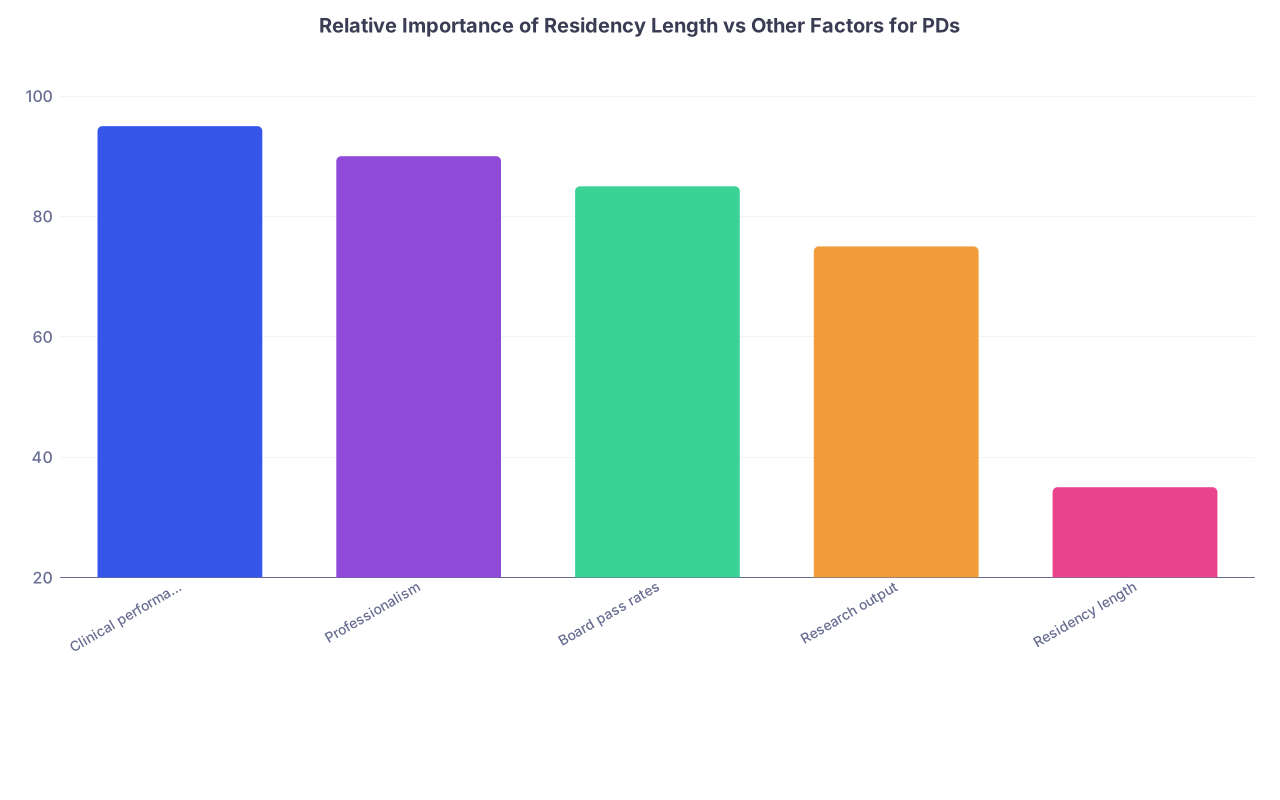
| Category | Value |
|---|---|
| Clinical performance | 95 |
| Professionalism | 90 |
| Board pass rates | 85 |
| Research output | 75 |
| Residency length | 35 |
If you align your story with your choice of 3 vs 4, PDs stop worrying. If you don’t, they assume you haven’t thought hard enough about your path—and that’s the real problem, not the number of years.
How the Decision Feels on the Inside of a Program
Let me give you a quick snapshot of how this looks from the PD chair after you’ve matched.

| Step | Description |
|---|---|
| Step 1 | Resident Starts PGY1 |
| Step 2 | Needs early mentorship |
| Step 3 | Has extra structured time |
| Step 4 | Build fellowship profile fast |
| Step 5 | Risk of weak application |
| Step 6 | Strong academic/PC output |
| Step 7 | Question value of 4th year |
| Step 8 | Track Type |
| Step 9 | Career Clarity by PGY2? |
| Step 10 | Using extra time well? |
By the middle of PGY‑2, every PD in the country knows which residents are using their structure well and which ones are just floating. That’s when the 3 vs 4 framework really bites—if you chose a model that doesn’t match your pace and ambition.
One Last Thing No One Says Directly
Between us: most PDs don’t actually care whether you do 3 or 4 years somewhere else. They care whether their structure is being chosen and used appropriately.
What they’re really thinking when they talk about 3 vs 4 is:
- “Is this applicant honest about who they are and what they want?”
- “Are they picking a track that fits that, or are they chasing prestige / fear / Reddit chatter?”
- “Will they blame us later for a choice they didn’t think through?”
You avoid that entire mess by doing the one thing most applicants skip: explicitly connecting your career goal, your current profile, and your choice of track—out loud, in your application and in your interviews.

Key Takeaways
- Program directors don’t inherently favor 3‑year or 4‑year tracks; they favor residents whose track choice matches their goals and realism.
- A strong 3‑year resident with clear focus routinely beats a weak 4‑year resident; extra years only help if you actually use them.
- When you can articulate why your chosen track (3 or 4) is the right tool for your specific career path, PDs stop worrying about the number and start seeing you as someone who actually knows where they’re going.