
The biggest mistake students make when choosing between Pediatrics and Med‑Peds is waiting until ERAS season to start thinking about it.
You cannot cram your way into clarity on this one. You have to build it, month by month, on the wards.
Below is your third‑ and fourth‑year timeline for deciding between Pediatrics and Medicine‑Pediatrics. I’ll walk you through what you should be doing, asking, and tracking at each point so that by the time you certify your rank list, you’re deciding between programs, not still confused about specialties.
Big‑Picture Snapshot: When the Peds vs Med‑Peds Decision Usually Crystallizes
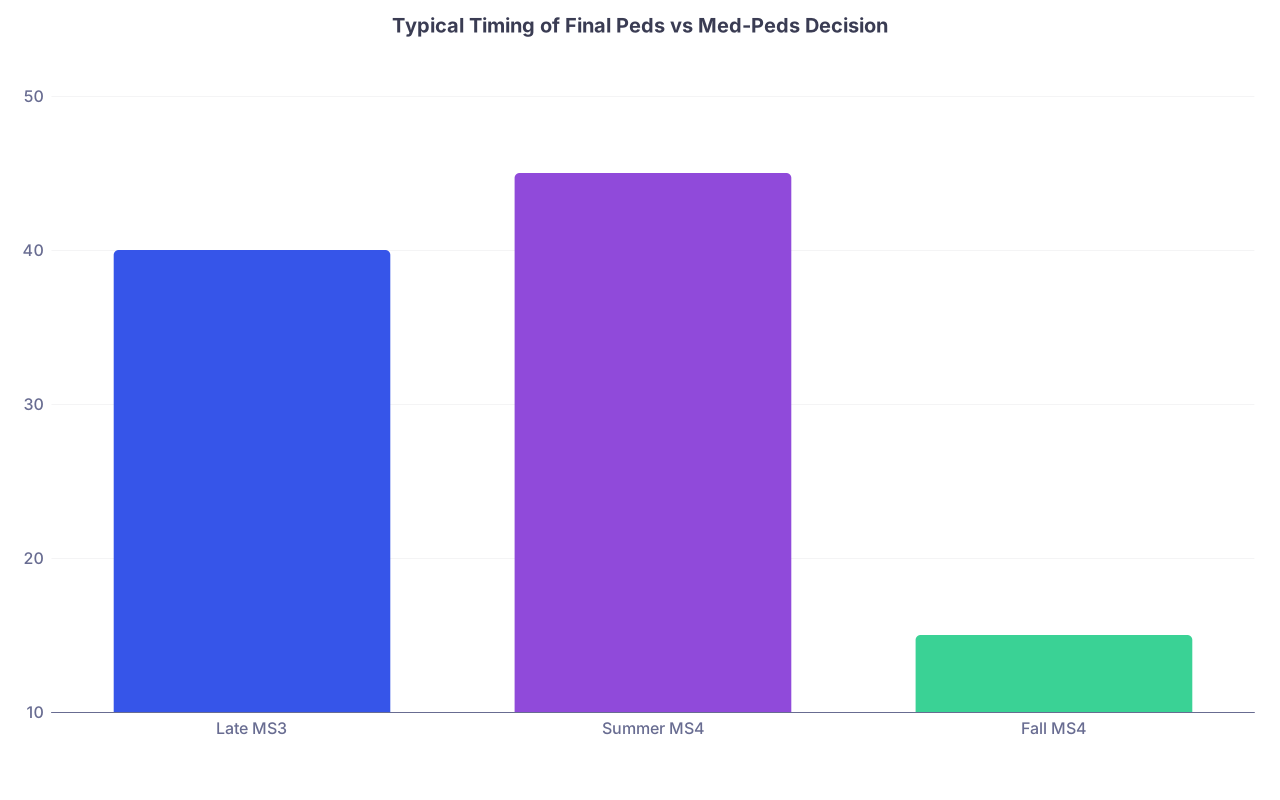
| Category | Value |
|---|---|
| Late MS3 | 40 |
| Summer MS4 | 45 |
| Fall MS4 | 15 |
Interpretation: most people who are genuinely on the fence lock in their choice between the end of third year and early fourth year. If you’re past that and still spinning, your process—not your personality—is the problem.
Third Year: The Core Year – Build Real Data, Not Vibes
Months 1–2: Before You Start Peds or IM
At this point you should:
- Write down your default bias. If I made you pick today, gut choice: Peds or Med‑Peds? Put it in your notes. You’ll come back to this.
- Clarify your non‑negotiables:
- Do you want to care for adults at all?
- Do chronic, complex patients drain you or fascinate you?
- Are you already leaning toward a subspecialty that’s heavily adult (e.g., cardiology) or heavily pediatric (e.g., neonatology)?
- Create a simple “rotation log” template on your phone or a notes app. After each shift or call:
- How was my energy at the end? (0–10)
- Moments that felt meaningful?
- Parts I dreaded?
- Interactions with patients/families that stood out?
Don’t overcomplicate it. Two minutes per day. But log something.
When You Hit Your Pediatrics Clerkship (Usually Mid‑MS3)
This rotation is your first hard data point.
At this point (week by week) you should:
Week 1
- Ignore the cuteness factor. Everyone likes smiling toddlers in dinosaur gowns. That’s not a career plan.
- Focus on:
- Can you tolerate the parents conversations? (Education, reassurance, sometimes conflict.)
- Does developmental assessment feel tedious or interesting?
- How do you feel about well‑child visits vs sick kids?
After your first call or long day, log:
- Energy at end of day.
- One thing that surprised you (good or bad).
- Whether you felt more like, “I want more of this” or “I’m glad it’s over.”
Week 2–3
Now you’re past the “everything is new” phase.
At this point you should:
- Shadow the senior resident at least half a day. Watch:
- Their role coordinating care.
- How much time they spend talking to families vs doing procedures vs notes.
- Their emotional tone by 3 p.m. Are they fried or still functional?
- Ask three specific questions to at least two different pediatric residents:
- “If you could redo it, would you still choose Peds vs Med‑Peds?”
- “On your worst week, what makes you question your choice?”
- “Which patients drain you the most?”
Write down exact quotes. They will blur later.
Week 4 (or Final Week)
By the end of the peds rotation, you should be able to answer:
- On an average day, are you more energized by:
- Normal development and reassurance?
- Acute bread‑and‑butter illness (asthma, bronchiolitis)?
- Chronic medically complex kids (CF, congenital heart disease)?
- Did you miss adult problems at all? If you never once thought, “I kind of miss adult medicine,” that’s a data point.
Mini‑checkpoint at end of Peds rotation:
Write down:
- “If I had to choose TODAY: Peds / Med‑Peds / Neither”
- Top three reasons why.
You’re not locked in. But now you’ve got an anchor.
When You Hit Your Internal Medicine Clerkship
This is where most people get clarity—or realize they’re truly split.
Week 1
At this point you should:
- Explicitly compare your first day on IM to your first day on Peds:
- Anxiety level walking into the hospital.
- How quickly the medicine “clicked.”
- Your reaction to the typical patient profile: age, comorbidities, social complexity.
- Pay attention to:
- End‑of‑life discussions: meaningful, or depressing?
- Substance use, non‑adherence, social determinants chaos. Can you handle this week after week?
Week 2–3
Now that you’re functioning, compare mechanics:
- Clinic vs wards in IM:
- Clinic: Did chronic disease management (HTN, DM, CHF) feel purposeful or repetitive?
- Wards: Did you like diagnostic puzzles and multi‑comorbidity juggling?
- Procedures and acuity:
- Central lines, paracenteses, codes. Do you want more of that in your life?
At this point you should deliberately talk to at least one Med‑Peds resident (if available):
Ask:
- “Why did you not choose categorical Peds or IM?”
- “What’s the biggest downside of being Med‑Peds?”
- “Which side (peds vs adult) do you actually enjoy more, if you’re honest?”
If you don’t have Med‑Peds at your home institution, email or message someone at a nearby program or your med school’s alumni list. Worth the effort.
Week 4 (or Final Week)
Your second mini‑checkpoint:
- “If I had to choose TODAY: Peds / Med‑Peds / Categorical IM / None of the above”
- One specific patient from this month you would gladly follow for 10 years. Kid or adult?
End of Third Year: The First Hard Fork
By the end of MS3, you’ve usually completed both Peds and IM.
At this point you should block a quiet hour and do this systematically:
Compare energy curves:
- Look back at your rotation log.
- For each week of IM and Peds, average your energy scores.
- Which rotation had more “7–10” days vs “0–3” days?
Build a simple comparison table for yourself.
| Factor | Peds (Score 1–5) | Med-Peds (Guess 1–5) |
|---|---|---|
| Enjoy parents/families | ||
| Interest in adult disease | ||
| Tolerance for chronic complexity | ||
| Desire for flexibility (adult + peds career options) | ||
| Interest in hospital vs clinic mix |
Fill this out honestly. The Med‑Peds numbers will be estimates, but that’s fine.
Ask yourself three ruthless questions:
- If Med‑Peds did not exist, would you be devastated…or mildly annoyed?
- If you were forced to see only adults or only kids for the next month, which would feel worse?
- Are you attracted to Med‑Peds because you truly want both populations long‑term…or because you’re afraid to let one go?
At the end of MS3, you do not need a final answer. But you should know if:
- You’re clearly Peds.
- You’re clearly Med‑Peds.
- Or you’re truly 50/50 and need targeted experiences early MS4.
Early Fourth Year: April–June – Design Your Schedule to Answer the Question
If you’re still deciding, your fourth‑year schedule is not just “whatever fits.” It’s your experiment.
3–4 Months Before ERAS Opens (April–June)
At this point you should:
Lock in at least one Sub‑I:
- If leaning Peds: do a Peds inpatient Sub‑I.
- If leaning Med‑Peds: strongly consider a Med‑Peds or IM Sub‑I at an institution with a Med‑Peds program.
If you can, schedule back‑to‑back:
- Example: June Peds Sub‑I, July IM or Med‑Peds Sub‑I.
- You want a side‑by‑side comparison while impressions are fresh.
Find a real mentor in each lane:
- One categorical pediatrics attending or PD‑adjacent person.
- One Med‑Peds faculty or senior resident.
- Tell them directly: “I’m deciding between Peds and Med‑Peds. I want to be very intentional about this.”
Mid‑Fourth Year: July–August – ERAS Pressure and Sub‑I Reality Check
This is where choices start to lock.
During Your Peds Sub‑I
At this point you should:
- Watch the career paths of the attendings:
- Community general peds.
- Academic hospitalist.
- Pediatric subspecialist (cards, heme‑onc, NICU).
- Ask each: “If I’m torn between Peds and Med‑Peds, what kind of student typically thrives in your world vs Med‑Peds?”
Pay attention to:
- How you feel about night float with sick kids.
- Your reaction when a critical patient wheels in: fear, excitement, dread?
- Do you still miss adult medicine—or not at all?
Capture one sentence each week:
- “This week pushed me toward: Peds / Med‑Peds, because ______.”
During Your Med‑Peds or IM Sub‑I
If you can get an actual Med‑Peds Sub‑I, perfect. If not, an IM Sub‑I with access to Med‑Peds residents works.
At this point you should:
- Ask to work with both Med‑Peds and IM residents if possible.
- On rounds, consciously compare:
- Adult multi‑system disease: does it engage you more than bronchiolitis and dehydration?
- Discharge planning + social issues: interesting puzzle or annoying obstacle?
Talk to a Med‑Peds senior about:
- How they split their future: clinic only vs hospitalist vs fellowship.
- How often they actually see both kids and adults in practice at their dream job.
Many students are shocked when they realize a lot of Med‑Peds grads end up leaning predominantly adult or predominantly peds in real life.
ERAS Season: August–September – You Cannot Apply Indefinitely Broad
At this point you should be transitioning from “figuring it out” to “committing.”
By August 15 (roughly)
You should have:
- A primary mentor in the specialty you’re more likely to choose.
- Drafted a personal statement for one side (Peds or Med‑Peds). Not both. Force yourself to see how it feels.
Test yourself:
- Try writing a paragraph that starts with:
“I am choosing Pediatrics because…”
and another:
“I am choosing Medicine‑Pediatrics because…”
One of those is going to flow more naturally. Pay attention to that.
August–Early September: Application Strategy
You have three realistic options. More than that and you’re probably diluting yourself.
| Strategy | What You Do |
|---|---|
| Peds only | Apply only categorical Pediatrics |
| Med-Peds only | Apply only Med-Peds |
| Dual: Peds + Med-Peds | Apply to both, intentionally |
At this point you should:
- Decide if you’re okay matching into either Peds or Med‑Peds. If the answer is yes, a dual application can be rational.
- If the idea of landing in categorical Peds makes you quietly angry or sad, do not do a big Peds backup application. That’s a recipe for long‑term regret.
Be clear with mentors:
- Tell your Med‑Peds mentor if you’re also applying Peds.
- Tell your Peds mentor the same.
- Vague half‑truths here burn bridges and hurt your letters.
Interview Season: October–January – Use the Visits to Pressure‑Test Your Identity
By the time invites roll in, your job isn’t just to be impressive. It’s to see where you actually fit.
On Peds Interviews
At this point you should:
- Track your gut feel at each program:
- Could I see myself as a peds‑only clinician for 30 years?
- Do I like the kind of graduates this program produces?
- Ask residents:
- “Did you ever consider Med‑Peds? Why did you not choose it?”
- “Do you work with Med‑Peds residents here? How do your roles differ?”
Pay attention to comments like:
- “I could never do adults.”
- “I thought about Med‑Peds but did not want the extra residency year.”
- “I wanted to do NICU/cardiology/etc., and Med‑Peds did not add much for that path.”
These are clues to how each pathway positions you for the life you want.
On Med‑Peds Interviews
At this point you should:
- Ask very bluntly:
- “What percentage of your graduates end up practicing mostly adult, mostly pediatric, or true mixed practice?”
- “In clinic, what is the actual age distribution of patients for most attendings?”
- Ask yourself after each Med‑Peds day:
- Did the residents feel like “my people”?
- Did the constant switching between adult and pediatric lens sound energizing or exhausting?
You should walk away from several Med‑Peds interviews thinking one of two things:
- “These are exactly my people; this is how my brain works.”
or - “I get why they love this, but I don’t see myself in their shoes.”
If it’s mostly the second reaction, that’s telling.
Rank List Season: February – The Final Reality Check
At this point you should stop collecting new data and actually decide.
Step 1: Forced Choice Exercise
Sit down and create two columns: Peds and Med‑Peds.
Fill in, very concretely:
- First job you realistically see yourself taking from each path.
- Likely patient age distribution.
- Expected clinic vs hospital mix.
- Fellowship you’d most likely pursue (if any) and whether Med‑Peds truly helps.
Then ask:
- Which column makes me feel relieved?
- Which column makes me immediately start bargaining (“Well maybe if I sub‑subspecialize…”)?
Step 2: Rank List Structure
If you applied to both:
- Option A: Intermixed list
- You rank based purely on how much you want each specific program, regardless of specialty.
- Option B: All of one specialty, then the other
- Example: all Med‑Peds first, then all Peds.
- Option C: Hard split
- Only rank one specialty at the top and a few realistic “backup” programs for the other.
Be honest: if the thought of opening your Match email and seeing “Categorical Pediatrics” feels like failure, you should not stack your list with Peds “backups” that you secretly don’t want.
Micro‑Timeline Summary
Here’s the condensed “at this point you should…” version.
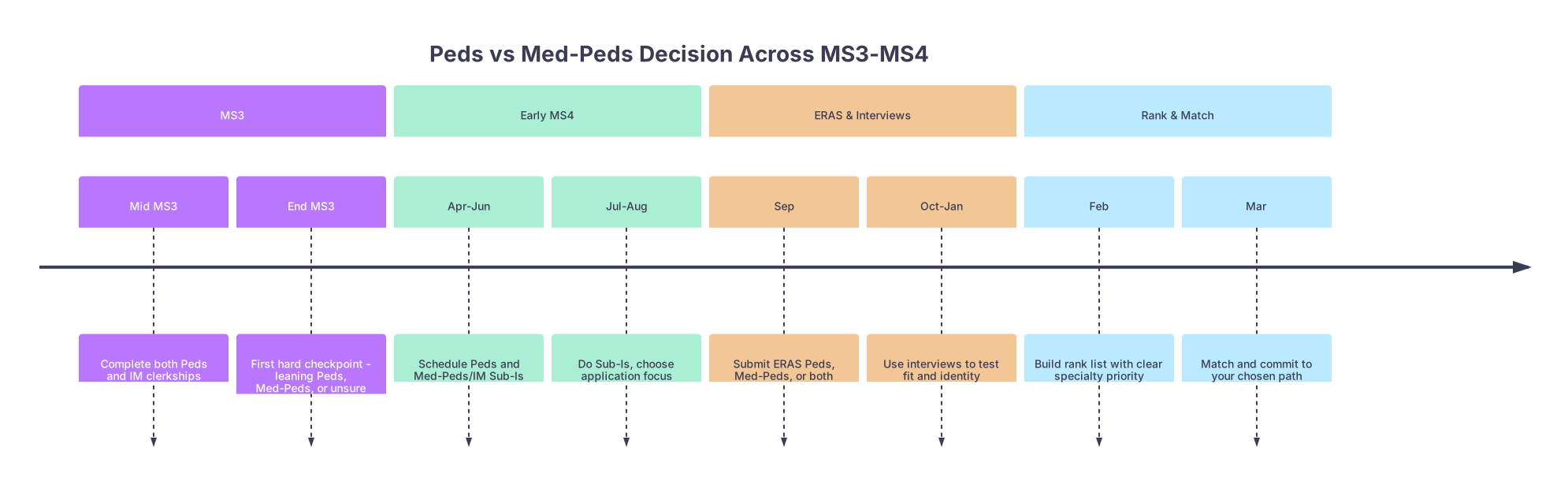
| Period | Event |
|---|---|
| MS3 - Mid MS3 | Complete both Peds and IM clerkships |
| MS3 - End MS3 | First hard checkpoint - leaning Peds, Med-Peds, or unsure |
| Early MS4 - Apr-Jun | Schedule Peds and Med-Peds/IM Sub-Is |
| Early MS4 - Jul-Aug | Do Sub-Is, choose application focus |
| ERAS & Interviews - Sep | Submit ERAS Peds, Med-Peds, or both |
| ERAS & Interviews - Oct-Jan | Use interviews to test fit and identity |
| Rank & Match - Feb | Build rank list with clear specialty priority |
| Rank & Match - Mar | Match and commit to your chosen path |
FAQ (Exactly 2 Questions)
1. Is it a bad idea to apply to both Pediatrics and Med‑Peds?
Not automatically. It’s a bad idea if you’re using Peds as a safety net you don’t actually want. If you’d genuinely be happy in either, and you can articulate real reasons for both in interviews, then dual‑applying can be reasonable—especially if your stats are borderline for the Med‑Peds programs you like. The critical part is being transparent with your mentors and being honest with yourself about how you’ll feel if you match into your “backup” specialty.
2. Does Med‑Peds really give me more options long‑term than categorical Pediatrics?
Yes and no. It absolutely opens more formal doors—adult hospitalist roles, combined clinics, transitional care, adult fellowships, etc. But in practice, many Med‑Peds grads drift toward one side over time. If your heart is 95% pediatrics, Med‑Peds is often unnecessary extra training. If you’re truly split and you can see yourself happily taking an adult‑only job or a mixed‑age role, then Med‑Peds is powerful. The degree to which it’s “more options” depends on whether you’d ever actually use the adult side of your training.