
The biggest mistake future neurologists make is drifting into the specialty instead of steering into it on a clock. Neurology rewards early, deliberate planning—and punishes last‑minute scrambling.
You want neurology. You are 18 months from submitting your rank list. Here is exactly what you should be doing, and when.
Big Picture: Your 18‑Month Neuro Timeline
You are moving through four overlapping arcs:
- Exposure and confirmation – “Do I really want neurology?”
- Competitiveness build – letters, scores, research, leadership
- Application build – ERAS, personal statement, program list
- Interview and rank strategy – signaling, visits, final decisions
Here is the high‑level view.
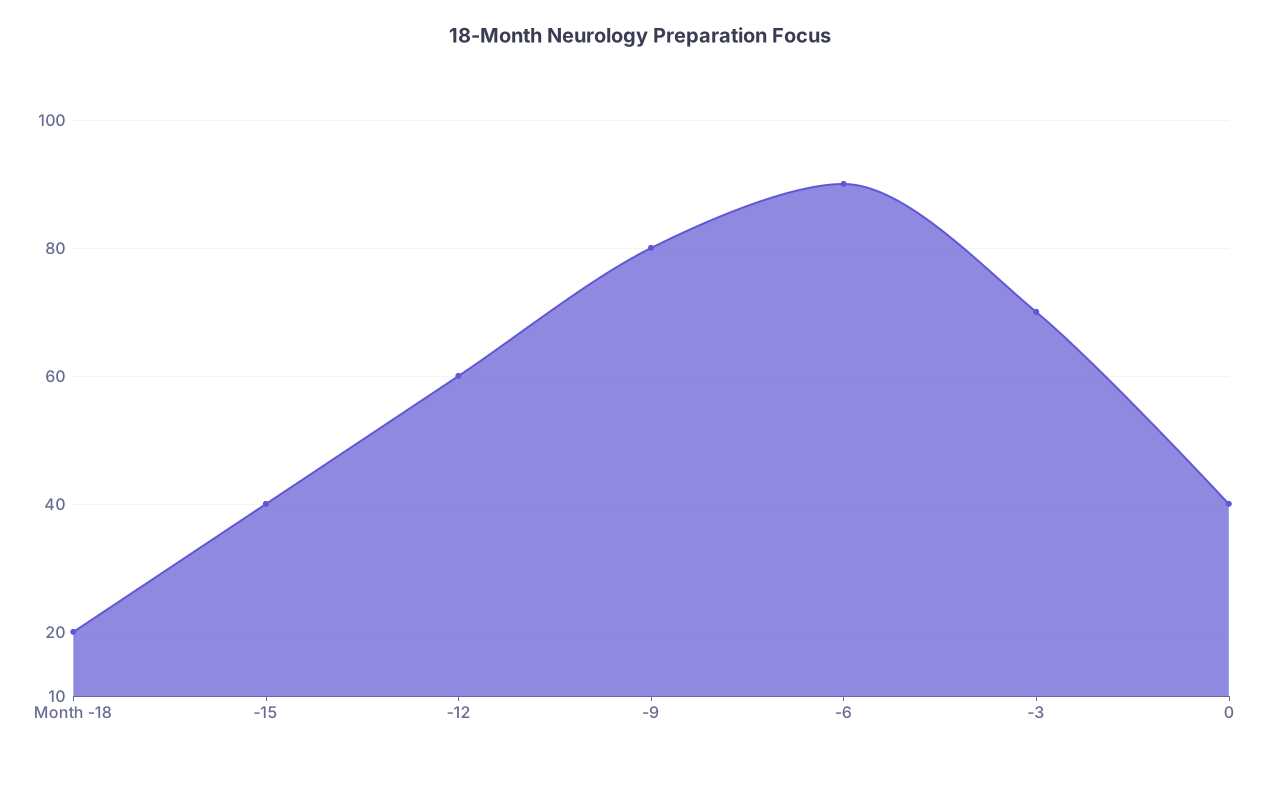
| Category | Value |
|---|---|
| Month -18 | 20 |
| -15 | 40 |
| -12 | 60 |
| -9 | 80 |
| -6 | 90 |
| -3 | 70 |
| 0 | 40 |
- Month 0 = Rank list certification deadline
- Month -18 = Roughly start of your first serious neuro exposure (clerkship / elective)
We will go month‑by‑month, then zoom into key weeks.
Months −18 to −15: First Neurology Rotation – Decide and Document
At this point you should be:
- On (or just starting) your first neurology rotation, or a related subspecialty (stroke, neuro ICU, outpatient neuro).
- Unsure but seriously considering neurology.
Objectives for this 3‑month window
- Confirm: “Yes, neurology is my field.”
- Identify at least 2 potential letter writers.
- Start a neuro‑relevant project—even a small one.
Month −18
At this point you should:
Commit to acting like a future neurologist, even if you are 70% sure.
- Show up early to preround on all your patients.
- Know every MRI / CT / EEG on your list.
- Volunteer to present at least one short teaching talk (stroke syndromes, myasthenia crisis, status epilepticus basics).
Track daily cases and impressions. Open a simple note file:
- Bullet what you saw (“MCA stroke with gaze deviation, NIHSS 14”).
- What you liked / did not like about the work.
- Phrases attendings used about residents they valued (“shows ownership,” “anticipates next steps”).
This reflection file will later power your personal statement and interview stories.
Month −17
At this point you should:
Identify your best attending and senior resident mentors.
- Which attending gives real feedback, not just “good job”?
- Which senior actually teaches on rounds?
Ask for targeted feedback mid‑rotation. Script that works:
- “I am strongly considering neurology. If I wanted to be the kind of student you would write a strong letter for, what would I need to show you over the rest of this month?”
Then you implement that feedback. Aggressively.
- Offer to help with something academic.
- Case report (unusual stroke in young patient, rare neuroimmunology case).
- Simple QI: improving tPA door‑to‑needle documentation.
- Poster for the state neurologic society meeting.
One project started now is better than five grand plans in month −3 that never happen.
Month −16 to −15
At this point you should:
Lock down at least one future LOR.
- End of rotation: “I really enjoyed working with you and I am planning to apply in neurology. Would you feel comfortable writing me a strong letter of recommendation when the time comes?”
Map your remaining clinical year.
- Ensure:
- One more senior neurology rotation or sub‑I during the upcoming “ERAS year”.
- At least one IM or ICU rotation where neurology overlaps heavily.
- Time protected for a Step 2 dedicated block before ERAS opens.
- Ensure:
Months −15 to −12: Build the Neurology Pedigree
Here is where serious applicants separate themselves.
At this point you should be:
- Past your first neuro rotation.
- Doing other clerkships but intentionally shaping your neuro profile.
Month −15
Focus on clinical strength and Step 2 planning:
Treat every IM and ICU patient with neurologic issues as “my case”.
- Seizures on the medicine floor.
- Delirium in ICU.
- Stroke rehab patient on PM&R.
Ask: “Can I follow this patient and present their neuro aspects?”
Map Step 2 CK timing:
- Neurology is competitive enough that 240+ (old scale) / ~60–70th percentile or higher is helpful, especially if Step 1 is pass only or marginal.
- Plan Step 2 so your score is back before programs review applications (roughly October).
Month −14 to −13
At this point you should:
Start or advance a neuro research / case project.
- Have a defined role: data collection, chart review, writing intro/discussion.
- Have a timeline: abstract by X date, poster/manuscript by Y.
Join neurology interest group with intent.
- Not just membership. Take a small leadership role (event coordinator, journal club organizer).
- Run one event that gets you face time with faculty (e.g., “Careers in Neurocritical Care”).
You are building a story: “Consistent interest in neurology” over more than a few months.
Months −12 to −9: Transition to Application Year
Now the clock is obvious. ERAS opens in ~6 months.
At this point you should be:
- Entering sub‑I / senior rotations.
- Strategically interacting with program directors and future letter writers.
Month −12
At this point you should:
Schedule your neurology sub‑I or advanced rotation for:
- Ideally between Month −10 and −8.
- At your home institution if strong; if not, plan an away later.
Clarify your competitiveness honestly. Use a quick self‑audit:
| Metric | Strong for Neuro | Needs Work |
|---|---|---|
| Step 1 (if scored) | ≥ 230 | Below 220 / pass only |
| Step 2 CK | ≥ 240 | Below 230 or unknown |
| Neuro Letters | 2–3 strong faculty | 0–1 generic letters |
| Research | Neuro-related poster/pub | No scholarly activity |
| Clerkship Grades | Mostly High Pass/Honors | Several Low Pass/Pass |
Where you fall now dictates how aggressive your next months need to be.
Month −11
At this point you should:
Clarify who your 3–4 letter writers will be.
- 2 neurologists (one ideally department leadership or PD / APD).
- 1 IM or ICU attending who can say you are solid medically and work hard.
- Optional: research mentor if they know you well.
Start a master CV and “ERAS content” doc.
- Every activity with:
- Dates
- Hours per week
- Leadership roles
- 1–2 bullet impact statements
- Every activity with:
This document saves you many hours later.
Month −10 to −9
At this point you should:
Crush your neurology sub‑I.
- Take ownership: you know every lab and imaging result before rounds.
- Volunteer for overnight calls; show you can handle acute neuro issues.
- Ask for more responsibility explicitly: “I would like to function as close to an intern as possible this month.”
Signal your interest to the department.
- Meet with the PD or clerkship director:
- “I am committed to neurology. I would appreciate your advice on how to be a strong applicant from our school.”
- Meet with the PD or clerkship director:
Names get remembered in meetings later when they rank students for letters and home program spots.
Months −9 to −6: Step 2, Away Rotations, and Application Skeleton
This is peak workload. You cannot wander through these months.
At this point you should be:
- Scheduling / taking Step 2.
- Doing a home sub‑I or starting an away.
- Building the scaffolding of your ERAS.
Month −9
At this point you should:
Finalize Step 2 test date.
- Aim for score release by early October at the latest.
- If you are weak on standardized tests, earlier is better so you can adjust your application strategy.
Plan any away rotations strategically.
- Neurology is not as away‑heavy as ortho or derm, but a well‑chosen away can help if:
- Your home program is weak or absent.
- You are targeting a specific region.
- You are from a lower‑tier school aiming for a more academic program.
- Neurology is not as away‑heavy as ortho or derm, but a well‑chosen away can help if:
Month −8
At this point you should:
- Begin drafting your personal statement skeleton.
- Pull 3–4 moments from your neuro reflection file:
- First stroke code.
- Patient you followed from ICU to rehab.
- Ethical dilemma around prognosis in severe brain injury.
- Choose one to open with, one to close with.
- Pull 3–4 moments from your neuro reflection file:
Do not polish yet. You just need structure.
- Update your mentors.
- Short email: your current rotations, research progress, and plan for applications.
- Keeps you in their mental foreground as “the neurology student”.
Month −7 to −6
At this point you should:
Take Step 2 and then move on.
- Two weeks before: practice NBMEs, tighten weak systems (neuro, cards, ID).
- Day of: execute, then do not obsess. Score is coming whether you worry or not.
Request letters formally.
- For attendings who already agreed:
- Send CV + short bullet list of cases / projects you did with them.
- Remind them, “I will be applying in neurology; letters are due around [ERAS date]. I would be very grateful for a strong letter.”
- For attendings who already agreed:
Refine your program target list.
- Make three tiers:
- Reach (top academic: MGH, UCSF, Penn, Columbia).
- Solid academic / strong community.
- Safety (often community / smaller university programs).
- Make three tiers:
Months −6 to −3: ERAS Build and Application Launch
Now everything must shift from “getting ready” to concrete deliverables.
ERAS typically opens around June; submission is encouraged very early in the cycle.
Month −6 (ERAS Opens)
At this point you should:
Create / log into ERAS immediately.
- Begin entering:
- Demographics and education.
- Experiences (from your master doc).
- Publications and presentations.
- Begin entering:
Get a near‑final personal statement draft.
- One clear narrative: why neurology, why you, why now.
- Cut fluff about “ever since I was a child fascinated by the brain.”
- Replace with: “At 3 am, standing outside a CT scanner waiting to see if the basilar was open, I realized…”
Confirm letters in ERAS.
- Assign letter writers, send them the ERAS letter request forms.
- Politely remind anyone who has not started.
Month −5
At this point you should:
Finalize your program list draft.
- 35–60 programs for most US MDs; more if red flags exist (low scores, no home program).
- Ensure mix of geography and tier.
Polish application language.
- Every experience entry should:
- Show concrete impact (“Coordinated monthly epilepsy support group; average attendance 15 patients”).
- Avoid empty verbs (“exposed to,” “helped with”).
- Every experience entry should:
Check in with your department.
- Some neurology departments “advise” how many programs to apply to based on historical match data for students like you.
- Ask if they plan to send a departmental letter or advocate calls.
Month −4 (Submission Month)
At this point you should:
Submit your ERAS application as close to the opening of submissions as possible.
- Do not wait weeks. Neurology programs review early applicants first.
Confirm all letters have been uploaded.
- If one is missing, gently follow up with the writer or have a backup ready.
Prepare a basic interview packet.
- Updated CV.
- One‑page summary of your projects and interests.
- Short list of faculty at each program whose work interests you.
Months −3 to −1: Interview Invitations and Execution
Now your focus shifts from building to performing.
At this point you should be:
- Monitoring email like it is your job.
- Controlling your schedule strategically.
- Practicing how you present yourself as a future neurology resident.
Month −3 (Early Interview Season)
At this point you should:
Respond to invites quickly.
- Same day if possible.
- Use a calendar system that:
- Avoids double‑bookings.
- Minimizes back‑to‑back days in the same week to prevent burnout.
Tighten your interview story.
- Practice:
- “Tell me about yourself” – 60–90 seconds.
- “Why neurology?”
- “Why academic vs community?” (or vice versa)
- A difficult patient or ethical challenge.
- Practice:
Research each program lightly but specifically.
- You do not need to memorize their whole website.
- You do need:
- Main strengths (stroke center, epilepsy, movement).
- Any notable research areas you can reference.
Month −2
At this point you should:
- Be in the thick of interviews.
- After each:
- Write down 3 things you liked.
- 1–2 concerns.
- Names of interviewers and any residents you clicked with.
- After each:
These notes will rescue you when you build your rank list and everything blends together.
- Send targeted thank‑you notes.
- Not novels. 3–5 lines referencing a specific conversation.
- Skip generic, obviously copy‑pasted messages.
Month −1 (Late Interview Season)
At this point you should:
Recognize interview fatigue and compensate.
- Do not accept every last‑minute invitation if it adds nothing to your portfolio.
- Protect mental bandwidth for programs you truly care about.
Start a draft rank order list.
- Group programs into:
- “I would be excited to match here.”
- “I would be okay matching here.”
- “I am applying here only as backup; I would still rather match here than not at all.”
- Group programs into:
If a program falls below that last threshold, it should not be on your list.
Month 0: Final Rank List and Last‑Minute Signals
This is where good applicants make bad decisions out of fear. Do not.
At this point you should:
- Have completed all interviews.
- Have enough data to decide where you will thrive.
Building Your Final Rank List
Use a structured approach, not vibes alone.
| Factor | Program A | Program B | Program C |
|---|---|---|---|
| Call schedule | Q4 | Q3 | Night float |
| Stroke exposure | High | Moderate | High |
| Research support | Strong | Limited | Moderate |
| Location fit | Good | Excellent | Poor |
| Resident culture | Collegial | Mixed | Strong |
At this point you should:
Rank by preference, not odds.
- The match algorithm favors the applicant. If you love a place, rank it higher even if you think it is a reach.
Weigh training quality over superficial perks.
- Call is temporary; weak clinical training is permanent.
- Look hard at:
- Variety and complexity of cases.
- Autonomy vs supervision.
- Fellowship placement track record.
Use your notes, not your memory.
- Re‑read your post‑interview notes.
- Talk with 1–2 trusted mentors, not a committee of ten.
Communication in the Final Weeks
At this point you should:
Send a single, clear “top choice” message if appropriate.
- Only if you mean it.
- Only to one program.
- “You are my top choice and, if fortunate to match, I would be thrilled to train at your program.”
Avoid over‑communicating.
- Programs are drowning in emails.
- Noise does not help you.
After Submission: Holding Pattern With Purpose
Once your rank list is certified, the application year is no longer under your control. That does not mean the months are wasted.
At this point you should:
Finish any ongoing research to the nearest logical endpoint.
- Abstract submission.
- Poster presentation.
- Draft manuscript.
Polish clinical skills that will matter as an intern.
- Basic neuro exam, efficiently performed.
- Management of common issues: status epilepticus algorithm, acute stroke orders, meningitis workup.
You are no longer performing for programs, you are preparing for your future patients.
Micro‑Timeline: A Sample Week in Peak Season
To make this concrete, here is a snapshot.
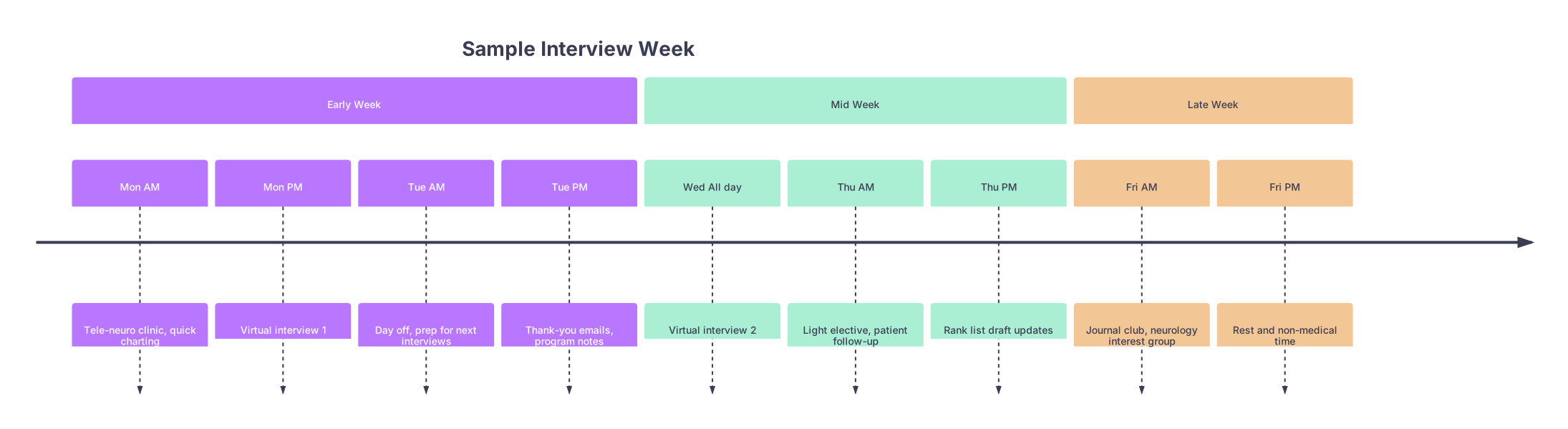
| Period | Event |
|---|---|
| Early Week - Mon AM | Tele-neuro clinic, quick charting |
| Early Week - Mon PM | Virtual interview 1 |
| Early Week - Tue AM | Day off, prep for next interviews |
| Early Week - Tue PM | Thank-you emails, program notes |
| Mid Week - Wed All day | Virtual interview 2 |
| Mid Week - Thu AM | Light elective, patient follow-up |
| Mid Week - Thu PM | Rank list draft updates |
| Late Week - Fri AM | Journal club, neurology interest group |
| Late Week - Fri PM | Rest and non-medical time |
You will not follow this exactly. But if your week is pure chaos with no time set aside for reflection, you are doing it wrong.
Today’s Action Step
You are somewhere on this 18‑month arc. Pick your spot honestly.
Now do one concrete thing that the timeline says you should already have done:
- If you are just finishing your first neurology rotation: email one attending and ask for mid‑ or end‑rotation feedback with the exact script above.
- If you are 6–9 months from ERAS: open a blank document and list every neuro‑relevant case or moment that stuck with you; that is your personal statement seed.
- If you are close to interviews: create a simple spreadsheet with each program and three columns—strengths, concerns, gut feeling.
Open your calendar right now and block a 30‑minute window this week labeled “Neurology game plan.” Then match your current position to this timeline and adjust your next month on purpose, not by inertia.