
You are here
It’s February of M2. Systems block is frying your brain, you’ve got Step 1 (or your school’s equivalent) looming, and your class group chat just blew up with one question:
“Has anyone figured out their third‑year rotation order yet?”
You’re not just any student though. You’re staring down two big unknowns: psychiatry and neurology. You like the brain. You like thinking. You’re not sure if you like 2 a.m. pages or holding retractors for six hours. You want to test fit psych vs neuro before you commit to a residency path.
The problem: your school gives you a rotation lottery or limited ability to rearrange blocks. Your dean says, “Just do what works with your schedule.” Completely unhelpful.
So here’s the real question: When, exactly, should you schedule psychiatry and neurology in third year if you want to figure out which specialty fits you?
Let’s walk it chronologically.
Big‑picture: How psych and neuro should fit into your year
Before we go month‑by‑month, you need the skeleton of third year.
Typical core rotation breakdown:
| Rotation | Length |
|---|---|
| Internal Medicine | 8 weeks |
| Surgery | 8 weeks |
| Pediatrics | 6 weeks |
| OB/GYN | 6 weeks |
| Psychiatry | 4–6 weeks |
| Neurology | 4–6 weeks |
Most schools spread this across July–June. ERAS for residency opens early June of M4, and you should have a strong sense of specialty by end of M3, latest.
You’re trying to answer two questions by then:
- Am I a psych person?
- Am I a neuro person?
- Or neither, and I just like brain‑adjacent thinking?
To do that, you want:
- Enough exposure to both psych and neuro before you lock in a specialty.
- Enough time after deciding to:
- Do at least one away/sub‑I.
- Get strong letters from that field.
- Shape your M4 schedule to support that choice.
That means:
- You need both psych and neuro done by March of M3 at the absolute latest.
- Ideally, you’ve done at least one of them by November–January.
So the strategy: think in three windows.
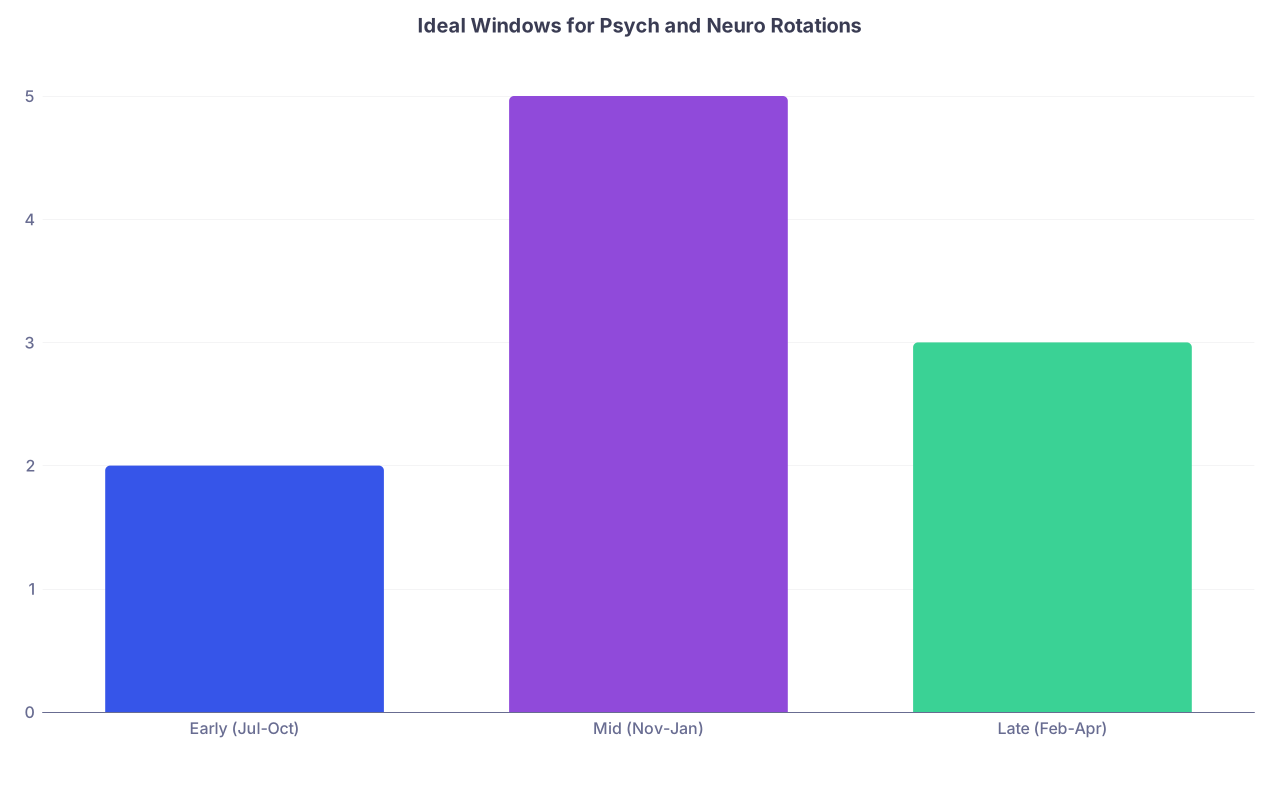
| Category | Value |
|---|---|
| Early (Jul-Oct) | 2 |
| Mid (Nov-Jan) | 5 |
| Late (Feb-Apr) | 3 |
- Early window: July–October
- Mid window: November–January
- Late window: February–April
You want psych and neuro distributed across these so you can compare them in context.
Step 1: Before schedules lock (6–9 months before M3)
Let’s say it’s November–January of M2. At this point you should:
Check your school’s rules
- Which rotations are locked in sequence? (e.g., “Neuro must follow medicine.” Very common.)
- Which blocks are fixed groupings? (Some schools pair psych + neuro in one 8–10 week block.)
- Are there site‑specific differences? (Academic center vs VA vs community psych, stroke‑heavy vs epilepsy‑heavy neuro.)
Clarify your status with psych and neuro Ask yourself:
- “Am I legitimately split between these two as career options?”
- “Is one clearly more likely but I still want to confirm?”
- “Do I just need to know whether I like brain fields at all?”
That affects how early you need them.
Decide your priority window If:
- You’re very torn between psych and neuro →
At this point you should aim to have one by October, the other by January. - You’re leaning heavily toward one (e.g., 70% psych, 30% neuro) →
At this point you should schedule that favorite one in the mid window (Nov–Jan) where you’ll be competent enough to shine but still early enough to pivot.
- You’re very torn between psych and neuro →
Rank “anchor” rotations first Reality check: your psych and neuro placement will get squeezed around surgery, medicine, and OB.
Strong anchors:
- Internal Medicine early‑mid year (first or second) gives you:
- Systems thinking skills that help in both psych and neuro.
- Surgery not first if you’re unsure you want a procedural field. You will just get steamrolled and not learn much.
At this point you should push for:
- Medicine in the first half of the year.
- At least one “lighter” rotation (psych or peds at many places) not as your very first block if you want a fair view of that field. You’ll be too incompetent to judge.
- Internal Medicine early‑mid year (first or second) gives you:
Month‑by‑Month: Ideal patterns for psych & neuro
Assume your M3 runs July–June. I’ll give you a few realistic templates.
Pattern A: “I’m truly torn between psych and neuro”
Goal: See both fields early enough to compare, but not so early that you’re a useless third wheel.
Ideal structure:
July–August – Internal Medicine
At this point you should:- Learn how to write notes, present, carry 3–5 patients.
- Build a foundation in neuro exam, mental status, delirium vs dementia vs psychosis.
- See consult psych and neuro on the wards in passing.
September–October – Neurology
Your skills from medicine carry over. You can:- Do focused neuro exams without being paralyzed by step‑by‑step checklists.
- Present stroke, seizure, headache reasonably cleanly.
- Start thinking: “Do I enjoy this style of rounding and thinking?”
November–December – Surgery or OB/GYN
Gives contrast. You see:- Fast‑paced, procedural medicine.
- What you miss about neuro (or don’t miss) when you leave it.
January–February – Psychiatry
Now you’re no longer totally green. On psych you can:- Run full interviews on your own.
- Handle collateral, documentation, maybe a small caseload.
- Really feel the day‑to‑day: pace, emotional load, patient population.
March–April – Pediatrics / OB / whatever is left
At this point you should:- Compare your gut reactions:
- Did you dread or look forward to psych days?
- Neuro notes feel satisfying or exhausting?
- Start quietly committing: “If I had to apply in 3 months, which one?”
- Compare your gut reactions:
May–June – Elective or repeat exposure (if allowed)
If you’re still stuck:- Do a psych‑heavy consult service or CL (consult‑liaison) psych elective.
- Or an epilepsy/EMG clinic/neuromuscular elective for more neuro nuance.
Key with this pattern: you’ve finished both psych and neuro by February. That’s early enough to:
- Plan an M4 sub‑I in your chosen field for July/August.
- Contact letter writers before they forget you.
Pattern B: “I’m leaning psych but want to rule out neuro”
In this case, I’d protect psych from being too early. You need to be good enough at basic clinical work to actually test fit.
Ideal layout:
July–August – Surgery or OB/GYN
You get:- Baptism by fire.
- A sense of what high‑acuity procedural medicine feels like.
September–October – Internal Medicine
Build:- Reasoning, rounding skills, real notes.
November–December – Psychiatry
At this point you should:- Decide: “If the year ended today, would I be ok choosing psych?”
- Pay attention to:
- How drained or energized you feel at the end of the day.
- How much you care about the long‑term therapeutic arc vs acute crises.
January–February – Neurology
You’re now a functional student. On neuro you can:- Compare directly to psych: same brain emphasis, different day structure.
- Notice: Are you drawn more to imaging, localization, and exam, or to narrative, trauma, and behavior?
March–April – Peds / remaining core.
May–June – Early elective in the winner (psych vs neuro).
If by end of February you still cannot choose, you’re not behind. But at this point you should:
- Book a July/August M4 sub‑I in the current frontrunner.
- Plan a September elective in the runner‑up as backup.
Pattern C: “Scheduling is rigid and you have limited control”
Sometimes the registrar smiles and says, “We can’t move psych or neuro. They’re in Block 3 and Block 7.” Great.
When that happens, your job shifts from choosing the month to choosing how you use the time before and after.
Example fixed order:
- July–August – Surgery
- September–October – Psychiatry
- November–December – Pediatrics
- January–February – Internal Medicine
- March–April – Neurology
- May–June – OB/GYN
Here’s how to salvage this:
At this point you should:
Before psych (July–August)
- Accept that psych is coming a bit early.
- Use the end of M2 and start of M3 to:
- Review basic interview structure and MSE (mental status exam) scripts.
- Shadow one half‑day in outpatient or inpatient psych if you can. Lower the learning curve.
During psych (Sept–Oct)
- Treat it as a first pass at the field, not the final decision.
- Keep notes for yourself:
- What parts of the day you enjoy.
- Which patient populations you do not want for the rest of your life (e.g., child vs geriatric vs inpatient vs outpatient).
Before neuro (Jan–Feb medicine → Mar–Apr neuro)
- Medicine will set you up nicely:
- Get good at neuro exam on medicine patients with “confusion,” “weakness,” “dizziness.”
- On neuro (Mar–Apr), you can:
- More fairly compare it to psych now that you’ve grown clinically.
After both (May–June)
- If still unsure, this is where you:
- Ask for a short targeted elective in one of them early M4.
- Start talking to mentors in both departments about realistic lifestyle, fellowship options, and where your personality fits.
Micro‑timeline: what to do during each rotation to test fit
Timing is only half the game. You can put psych in the perfect month and still waste the chance if you just passively follow residents around.
During Psychiatry (whenever it lands)
First week:
- At this point you should:
- Learn core workflows: how new intakes are done, how rounds are structured, how notes are written.
- Ask to follow 2–3 patients closely from admission to discharge.
Weeks 2–3:
- Act as if you’re the intern:
- You propose full treatment plans on rounds.
- You handle collateral calls (with supervision).
- You write notes that could be signed with minimal edits.
- Ask yourself daily:
- “Can I handle this level of emotional load long‑term?”
- “Do I like interviewing this much?”
Week 4+ (if longer block):
- Seek variety:
Ask to see:- At least one psych emergency setting day (ED or CPEP equivalent).
- At least one outpatient or consult‑liaison session if possible.
During the block you should also:
- Jot down specific moments that made you think “I love this” or “Absolutely not.”
You’ll forget later.
During Neurology
First week:
- Lock down the neuro exam. Yes, the whole thing. But focus on:
- Cranial nerves.
- Motor, reflexes, coordination.
- Sensation in a structured, not chaotic way.
Weeks 2–3:
- Focus on common bread‑and‑butter:
- Stroke.
- Seizure.
- Headache.
- Neuropathy and back pain.
- Ask yourself:
- “Do I like thinking in lesion‑localization terms all day?”
- “How do I feel about chronic, often non‑reversible disease?”
Week 4+:
- Try to experience at least:
- One day each of: clinic, inpatient consults, maybe EMU (epilepsy monitoring unit) if they’ll let you.
- Notice:
- Do the attendings seem burned out or energized?
- Are the patient interactions meaningful to you, or does it feel like detective work with humans as the side effect?
Key checkpoints during the year
Let’s slice the year into decision checkpoints.
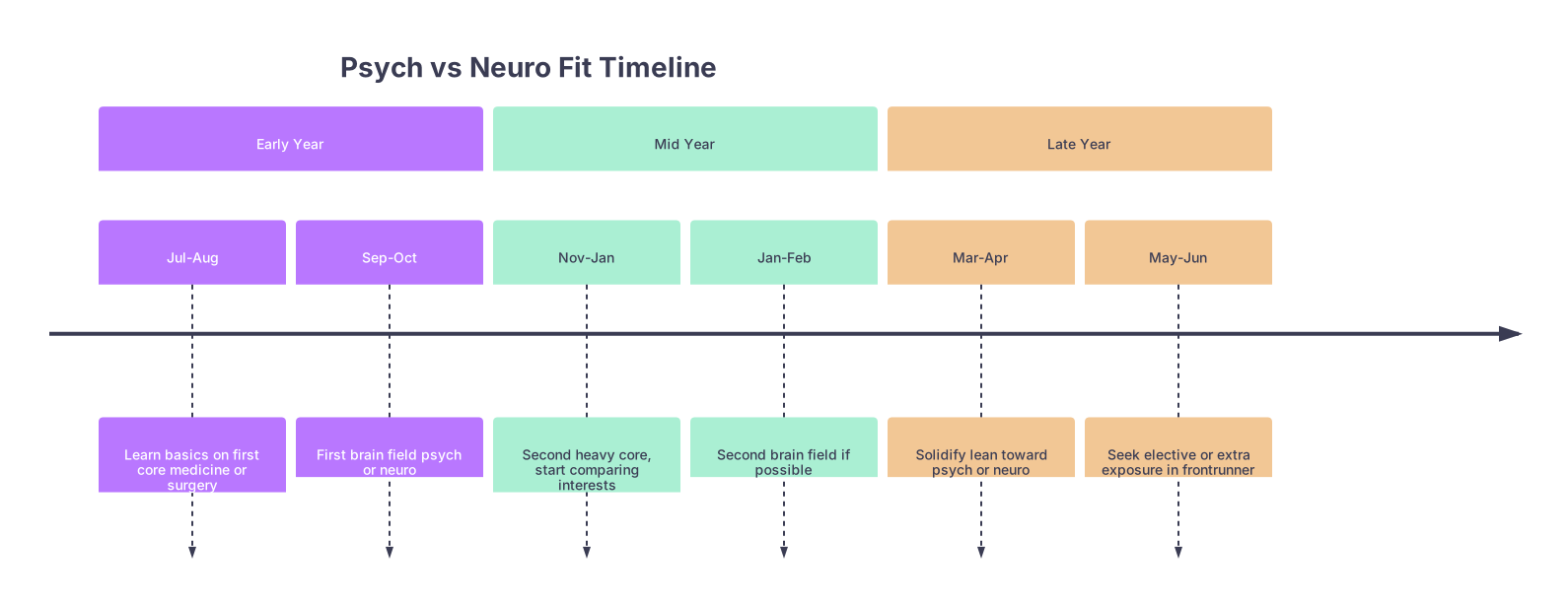
| Period | Event |
|---|---|
| Early Year - Jul-Aug | Learn basics on first core medicine or surgery |
| Early Year - Sep-Oct | First brain field psych or neuro |
| Mid Year - Nov-Jan | Second heavy core, start comparing interests |
| Mid Year - Jan-Feb | Second brain field if possible |
| Late Year - Mar-Apr | Solidify lean toward psych or neuro |
| Late Year - May-Jun | Seek elective or extra exposure in frontrunner |
Checkpoint 1: After your first brain rotation (psych or neuro)
At this point (usually Sep–Dec) you should be able to answer:
- “If this were my only option, could I live with it?”
- “What specifically made days good vs bad?”
- Example: “I loved 1:1 conversations but hated the lack of objective tests” → might pull you toward neuro.
- Or, “I loved the narratives and hated chasing reflexes for 30 minutes” → that’s a psych clue.
Important: you do not need to decide here. Just document your reactions.
Checkpoint 2: After both psych and neuro are completed
This is the big one. Usually by Jan–March of M3.
At this point you should:
- Force a written comparison. Not vibes. A simple table in your notes:
| Factor | Psychiatry | Neurology |
|---|---|---|
| Enjoyment (1–10) | ||
| Emotional load | ||
| Intellectual satisfaction | ||
| Tolerance for uncertainty | ||
| Lifestyle fit (call, clinic pace) |
Be brutally honest. You’re not submitting this to anyone.
If one is clearly ahead, act like that’s your choice and start behaving accordingly (seeking mentors, asking about letters, planning electives). If it flips later, fine, but you’ll be at least partially prepared.
Checkpoint 3: Before building your M4 schedule (around March–April)
By the time your school asks for M4 preferences:
At this point you should:
- Have a working decision: psych vs neuro vs neither.
- Plan:
- July/August: sub‑I or audition elective in your primary choice.
- Another 4‑week elective in that field in the fall (if applying to more competitive neuro programs especially).
- Optional short elective in the alternate field only if you’re genuinely still 50/50.
Do not wait until June to start this. By then schedule options are usually garbage.
Common mistakes with psych/neuro timing
I’ve watched people do this badly. Repeatedly. Avoid these:
Doing psych as your very first rotation when you’re truly considering it as a career
You’re too incompetent to know if the field fits you. You’re just drowning in how to write notes and find the bathroom.Leaving both psych and neuro until late March–June
That gives you:- No time for sub‑Is.
- Weak letters rushed right before ERAS.
- A panicked specialty decision.
Over‑weighting one environment E.g., hating psych because your site was:
- An under‑resourced state hospital with constant codes and restraints.
Or loving neuro because you only saw the academic epilepsy clinic with motivated, insured patients.
Ask to see at least one different setting within the same rotation.
- An under‑resourced state hospital with constant codes and restraints.
Ignoring how your body feels It’s not all “intellectual interest.” Pay attention to:
- Sleep schedule tolerance.
- How drained you are after different kinds of patient encounters.
- Your reaction to chronic suicidal ideation vs chronic progressive neurological decline.
Example: Tight decision, nearly too late
Quick real sequence I’ve seen:
- July–Aug: Surgery
- Sept–Oct: Peds
- Nov–Dec: OB/GYN
- Jan–Feb: Medicine
- Mar: Neurology (4 weeks)
- Apr: Psychiatry (4 weeks)
- May–Jun: Electives
This student thought they were “open to everything,” then realized mid‑March they loved both psych and neuro and had four weeks each to decide before building an M4 year.
How they salvaged it:
- During neuro (Mar) they:
- Asked to attend extra outpatient clinics.
- Looked specifically at which days they went home talking about cases.
- During psych (Apr) they:
- Took ownership of a small caseload.
- Asked to sit in on therapy and CL consults.
- In May:
- Scheduled a 2‑week elective on CL psych.
- Talked to mentors in both departments about career paths and fellowship options.
- By June:
- Chose psych, booked a July inpatient psych sub‑I, and lined up a letter from CL and inpatient.
Not optimal timing. But focused, intentional use of those months pulled it back from the edge.
Final takeaways
Do not let both psych and neuro drift to the end of third year. Aim to have both completed by February–March so you can actually act on your decision.
Avoid putting your probable future specialty as your very first rotation. You want some baseline competence before you judge fit.
During the psych and neuro blocks themselves, treat them like field tests, not just requirements: push for responsibility, sample different settings, and write down your reactions so you’re deciding from data, not vague memory.