
Most students pick IM, FM, or Peds for the wrong reasons—and far too late.
They “liked their third‑year attending,” or they “didn’t hate” a rotation, and suddenly a 30‑year career is riding on a few random weeks. That’s lazy career planning. You can do better.
Here’s a year‑by‑year, month‑by‑month roadmap from early MS2 through MS4 that forces you to test drive Internal Medicine (IM), Family Medicine (FM), and Pediatrics (Peds) in a deliberate way—so by ERAS season you are not guessing. You’re executing.
MS2: Lay the Foundation (You’re Choosing Data, Not Just Vibes)
At this point you should set up the decision framework that will guide the next 24 months. You are not “choosing a specialty” yet. You’re deciding how you’re going to decide.
MS2, Fall (Aug–Dec): Define What Actually Matters
During organ systems and Step/Level studying, you should:
Build your comparison grid.
Create a simple document with three columns: IM, FM, Peds. Rows:- Typical patient population
- Inpatient vs outpatient mix
- Procedures vs cognitive work
- Continuity vs episodic care
- Lifestyle (call, nights, weekends)
- Fellowship options / scope
- Practice settings (academic, community, rural, FQHC)
- Breadth vs depth of knowledge
You will fill this in over 2 years, not today.
Start low‑stakes shadowing.
Two half‑days each—nothing intense, just enough to watch the workflow.- IM: Hospitalist service or general IM clinic
- FM: Community clinic or residency clinic
- Peds: General peds clinic or inpatient peds
Watch for:
- How often they say “I don’t know, let’s look it up” vs “I’ve seen this 100 times”
- How much time is spent on documentation vs doctor‑ing
- Whether you like talking to adults, kids, or entire families
Start your “specialty journal.”
After each shadowing session, write 5 bullets:- 2 things you liked
- 2 things you disliked
- 1 thing that surprised you
This will be gold when you’re writing personal statements and when your memory magically rewrites history later.
MS2, Spring (Jan–Apr): Use Step Prep to Test Your Brain Style
At this point you should use exam prep as a personality test.
Notice what content feels natural.
- Do you enjoy multi‑system adult medicine vignettes with tons of comorbidities? That’s IM.
- Do you like “well person + screening + preventive care” questions? Very FM.
- Do you find peds growth charts, vaccine schedules, and congenital stuff oddly satisfying? That’s your Peds brain waking up.
Align early reading with interests.
When you hit practice questions:- Tag “internal medicine‑type” cases that were fun, not just solvable
- Same with FM (preventive care, chronic disease in clinic context)
- Same with Peds (development, newborn issues, school‑age problems)
Schedule a reality‑check meeting.
Before dedicated:- Meet with an IM generalist, an FM doc, and a general pediatrician
- Ask each:
- “What do you like least about your specialty?”
- “What kind of student should absolutely not go into this?”
- “If you were choosing again right now, would you pick it again?”
Take notes. If someone hesitates on that last question, highlight it.
MS2, Dedicated (Apr–Jun): Protect Options, Don’t Over‑Commit
Your job here is simple: scores keep all three doors open.
- IM: competitive for the more academic programs, especially if you want cards/crit care later
- FM: more forgiving on scores, but don’t coast just because you “might do FM”
- Peds: some programs are chill, others (children’s hospitals) absolutely care
You do not need a decision. You need a score that doesn’t close any of the three.
MS3: The Crucial Test‑Drive Year
Now you actually see the jobs. This is where people screw up and just “go with what’s next on the schedule.” Don’t do that.
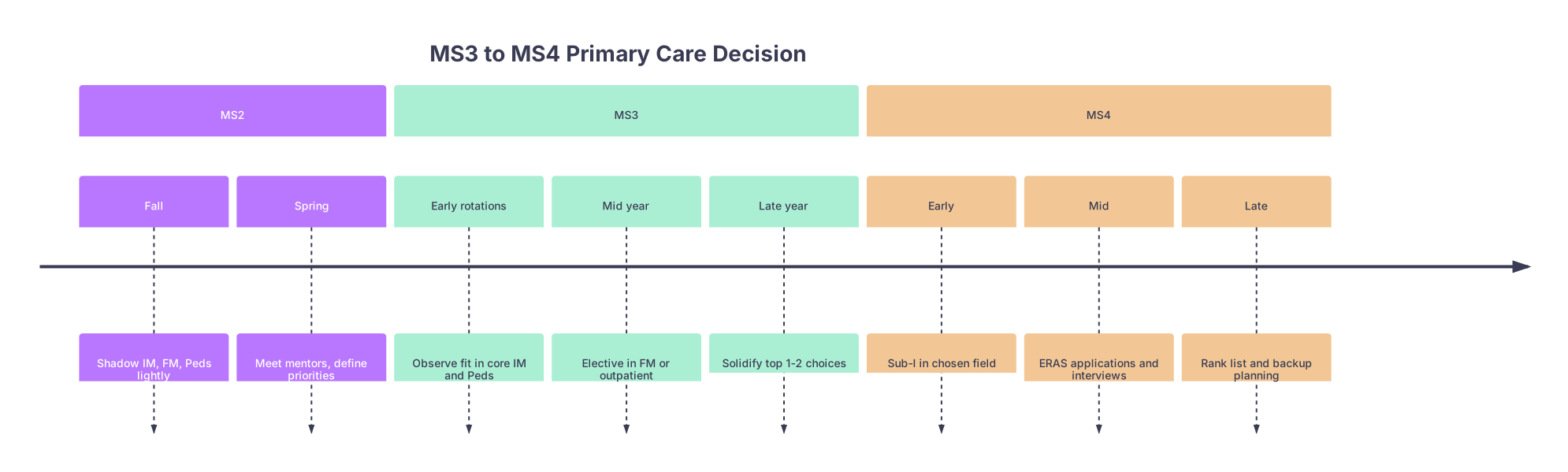
| Period | Event |
|---|---|
| MS2 - Fall | Shadow IM, FM, Peds lightly |
| MS2 - Spring | Meet mentors, define priorities |
| MS3 - Early rotations | Observe fit in core IM and Peds |
| MS3 - Mid year | Elective in FM or outpatient |
| MS3 - Late year | Solidify top 1-2 choices |
| MS4 - Early | Sub-I in chosen field |
| MS4 - Mid | ERAS applications and interviews |
| MS4 - Late | Rank list and backup planning |
Before MS3 Starts (Scheduling & Strategy)
At this point you should plan your rotation order strategically:
- Aim to have IM and Peds in the first 2/3 of MS3, not both stuck at the very end.
- Try to add at least one FM or outpatient primary care elective late MS3 or early MS4.
- If your school allows:
- Frontload IM
- Put Peds soon after
- Slot FM or a primary care elective once you’ve seen both
This gives you real comparisons, not vague impressions.
IM Rotation (Usually 8–12 Weeks): What You Must Track
During IM you should watch for three things:
Cognitive style:
- Do you like complex, multi‑organ disease in older adults?
- Do you enjoy long differential lists and guideline games (e.g., heart failure meds, anticoagulation)?
- Do family meetings and disposition planning feel meaningful or just exhausting?
Inpatient vs outpatient preference:
- Most IM rotations skew inpatient. Ask to spend time in clinic.
- See if day after day of wards feels:
- Energizing
- Neutral
- Soul‑sucking
Your reaction to future path options:
- Attendings will talk about cards, GI, heme/onc, pulm/crit, etc.
- Ask yourself: “Do I like the idea of specializing later?”
- If the answer is yes, IM is your only pipeline of these three.
- Can you picture doing 80–90% adult medicine forever?
- Did you like logic‑heavy, data‑dense rounds?
- Did you mind that continuity is limited during residency?
If you’re “meh” on all three, IM might still be a backup, but probably not your main.
Peds Rotation (Usually 4–8 Weeks): Filter Out Fantasy
Peds looks cute from the outside. The reality is different.
During Peds you should:
Separate “liking kids” from “liking pediatric medicine.”
- Liking kids = enjoying high‑fives and stickers
- Peds medicine = parents, chronic conditions, growth charts, vaccines, lots of social work
Watch your patience level.
- Can you explain the same thing three times—to the child, the parents, and maybe grandparents?
- Does the emotional weight of sick kids crush you or motivate you?
Notice clinic vs hospital preference.
- Outpatient well‑child checks + sick visits
- Inpatient (if you see NICU/PICU, pay attention to how that feels)
End of Peds rotation checklist:
- Did sick kids leave you drained for days or were you okay after debriefing?
- Did you like growth & development as a core theme?
- Could you imagine dealing with parents’ anxiety all day, every day?
If you loved the medicine but hated the emotional load—or vice versa—write that down clearly.
FM Exposure (Varies by School): Don’t Rely on Stereotypes
Some schools have a dedicated FM clerkship. Others bury FM inside “primary care” or electives. At this point you should seek explicit FM exposure if it’s not built in.
When you’re in an FM setting:
Track the breadth.
- Adults, kids, OB (in some practices), procedures (skin, joint injections), chronic disease, urgent care.
- Ask: “Do I like doing a bit of everything, or does that feel scattered?”
Notice continuity and community vibe.
- FM is usually where you see 5‑10 year relationships.
- Look at the waiting room: this is your future panel.
Pay attention to scope limitations.
- FM can do a lot, but often hands off complex stuff. Are you okay with being the coordinator, not the do‑everything expert?
- Did you enjoy “all ages, all problems” or did it feel chaotic?
- Did the idea of rural or underserved practice appeal to you?
- How did you feel about being the first stop for everything?
Late MS3: Narrow to Top Two and Stress‑Test
By the time you finish core rotations (or near the end), you should narrow to 2 of the 3: IM, FM, Peds.
If you “like all three,” that’s not a compliment; it means you haven’t asked hard enough questions yet.
Month‑by‑Month: End of MS3
Mar–Apr (or equivalent late‑year block): Sorting & Conversations
At this point you should:
Rank your rotations emotionally.
Forget prestige. Which days:- Went by fastest
- Left you tired but satisfied
- Made you talk about interesting cases after you got home
Meet three kinds of mentors:
- One categorical IM resident or attending
- One FM resident or attending (ideally community based)
- One general pediatrician (hospital or clinic)
Ask each:
- “What would push a student away from this specialty?”
- “What do your unhappy colleagues usually complain about?”
- “If I’m debating between IM vs FM vs Peds, what’s the deciding factor you usually see?”
Get honest feedback on your fit.
- Share your self‑assessment: “Here’s what I liked on IM vs FM vs Peds.”
- Ask: “Based on that, what would you suspect I’ll like five years from now?”
You are not asking them to choose for you. You’re asking for pattern recognition from someone 5–20 years ahead.
May–Jun: Plan MS4 to Answer Remaining Questions
Once you’ve got a tentative top two (say, IM vs Peds, or FM vs IM):
- Schedule:
- One Sub‑I/Audition in the front‑runner (IM or Peds or FM) early MS4
- One additional elective in the runner‑up field, if you’re genuinely torn
- If you’re leaning FM but your school has weak FM exposure:
- Arrange an away or local community FM elective early MS4
- If you’re IM‑leaning and thinking fellowship:
- Try to spend time on that subspecialty service (cards, pulm, etc.) during late MS3 or early MS4
MS4: Lock It In and Optimize Your Application
By MS4 start, you should have a primary specialty picked or be down to a very tight IM vs FM or IM vs Peds decision. Dragging a three‑way tie into July is asking for stress.
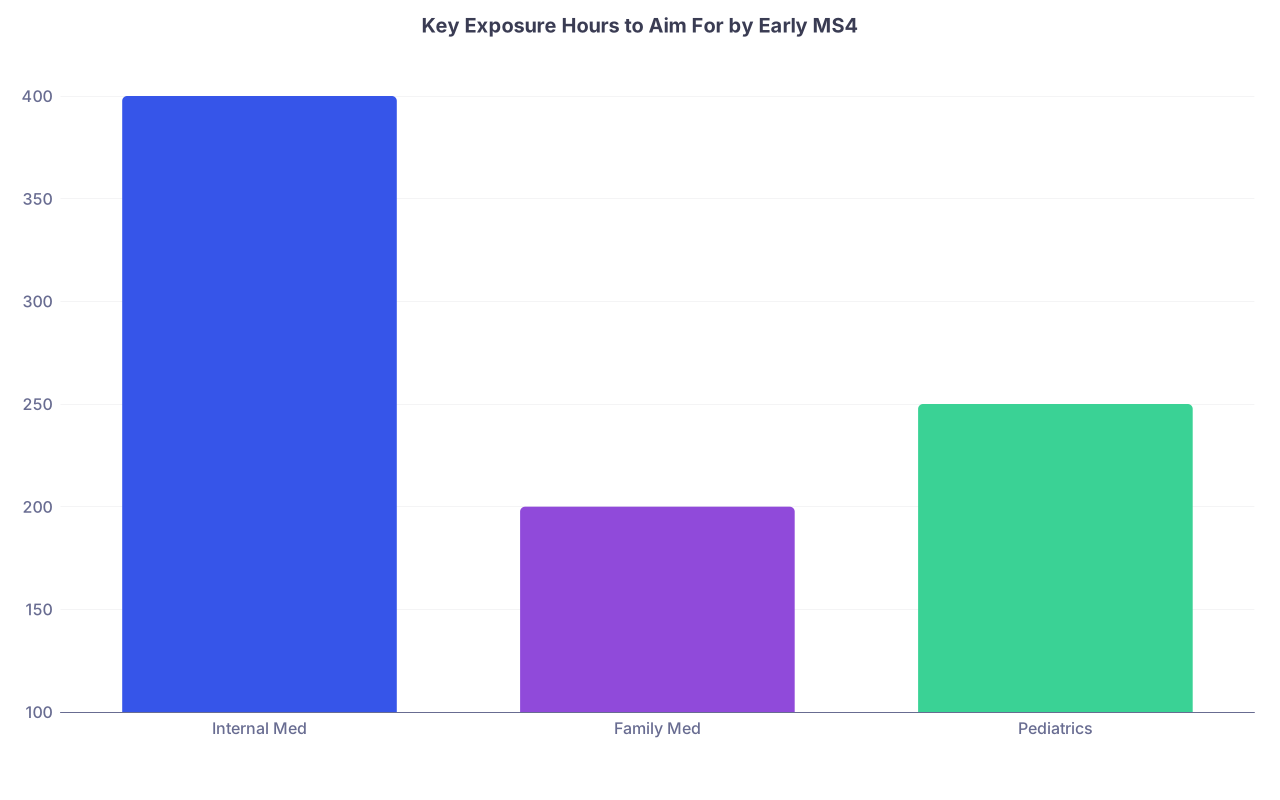
| Category | Value |
|---|---|
| Internal Med | 400 |
| Family Med | 200 |
| Pediatrics | 250 |
Early MS4 (Jul–Sep): Sub‑Is and Final Decision
At this point you should:
Do a Sub‑I in your likely choice.
- IM: inpatient ward Sub‑I
- FM: inpatient FM service or heavy‑responsibility FM elective
- Peds: inpatient peds or NICU/PICU‑adjacent Sub‑I
During this month, track:
- How you feel at 5 pm post‑call
- How you interact with the intern/residents (these are your future peers)
- Whether the cases feel “right” to you—challenging but satisfying, not soul‑draining
Use week 2 of your Sub‑I to make the call.
Do not wait until ERAS opens to decide:- If you’re still torn IM vs FM:
- Ask: “Do I want mostly adult internal medicine with later subspecialty options (IM), or do I want all‑ages continuity with more outpatient and community focus (FM)?”
- If you’re torn IM vs Peds:
- Ask: “Do I want adult chronic disease complexity, or do I want my cognitive energy going to growth/development and parents?”
- If you’re torn FM vs Peds:
- Ask: “Am I willing to give up caring for adults if I choose Peds? Or do I actually love adult chronic disease and just like kids on the side?”
- If you’re still torn IM vs FM:
Decide by the time ERAS opens. Could you dual apply (e.g., IM + FM, or Peds + FM)? Yes. Many do. Sometimes it’s smart. But your primary identity should be clear in your own head, even if you’re hedging.
Mid MS4 (Sep–Dec): Applications & Interviews
By now your job is execution, but you should still be checking for alignment.
Application Framing (How You Sell the Choice)
When you write your personal statement and talk in interviews:
- IM: Emphasize enjoyment of complexity, multi‑morbid patients, and interest in potential fellowship or becoming a “medical home” for complex adults.
- FM: Emphasize continuity, whole‑person/family care, community focus, and comfort with broad, cradle‑to‑grave medicine.
- Peds: Emphasize advocacy for children, development, working with families, and comfort with emotionally loaded situations.
If you’re dual‑applying:
- Make separate narratives. Programs can smell copy‑paste a mile away.
On Interview Days
During interviews you should silently track:
- Which residents look burned out vs content
- What percentage of graduates go to fellowship (IM, Peds) vs full‑scope practice (FM)
- How they talk about clinic volume and documentation burden
You’re not just ranking prestige. You’re ranking where you’ll learn the version of IM, FM, or Peds you actually want to practice.
Quick Comparison Snapshot: IM vs FM vs Peds
| Factor | Internal Medicine (IM) | Family Medicine (FM) | Pediatrics (Peds) |
|---|---|---|---|
| Main Patient Group | Adults only | All ages | Children only |
| Typical Setting | More inpatient | More outpatient | Mixed, child‑focused |
| Fellowship Options | Many subspecialties | Limited, niche | Several subspecialties |
| Continuity Emphasis | Moderate | High | High (kids, families) |
| Breadth vs Depth | Deep adult medicine | Very broad | Deep child‑focused |
Red Flags & Reality Checks by Stage
During MS2
- You’re “set” on Peds but have never spent a full day in a pediatric clinic.
- You dismiss FM because “it’s just simple clinic stuff.” (That’s wrong; FM can be extremely complex, just in a different way.)
- You ignore IM because “hospital medicine seems depressing,” without seeing a modern hospitalist team.
During MS3
- You love your IM team and decide “IM forever” even though what you actually liked was your resident’s personality.
- You choose Peds because you felt emotionally obligated after seeing sick kids, not because you liked the medicine.
- You rule out FM without a full‑scope exposure (including procedures, OB where applicable, and community work).
During Early MS4
- You still “haven’t decided” and are hoping some magical sign appears during your Sub‑I.
- You’re dual‑applying but giving exactly the same story to IM and FM programs.
- You’re picking purely based on perceived lifestyle without understanding that clinic‑heavy FM and Peds can be just as intense as IM, in different ways.
FAQs
1. Is it smart or dumb to dual‑apply (e.g., IM + FM or FM + Peds)?
It depends why you’re doing it. Dual‑applying because of geography or competitiveness can be very rational. Dual‑applying because you refuse to make a decision is less defensible. If you dual‑apply:
- Have a clear internal preference (even if you never say it out loud).
- Tailor your personal statements, letters, and talking points separately for each specialty.
- Be honest with yourself about which match result would actually make you happy.
2. What if my school barely offers any Family Medicine exposure?
Then you have homework. In late MS3 or early MS4:
- Arrange an FM elective at a community site or FM residency clinic.
- Spend at least 2–4 weeks seeing full‑spectrum FM, not just a half‑day shadow.
- Talk to FM residents specifically about scope, lifestyle, and how much inpatient/OB they actually do post‑residency.
Without that, you are essentially guessing about FM. That’s not acceptable if you’re seriously considering it.
3. I liked both IM and Peds. How do Med‑Peds and combined paths fit into this timeline?
Med‑Peds is not a loophole for indecision. It’s for people who genuinely want both adult and pediatric complex medicine and are okay with a more intense training path. Use the same timeline:
- By late MS3, if you still strongly like both IM and Peds and can clearly articulate why, start meeting Med‑Peds faculty.
- Do at least one IM Sub‑I and one Peds‑heavy elective or acting‑internship.
- Apply to Med‑Peds only if you can explain to yourself—and programs—why you want dual training instead of picking one.
Open your rotation schedule and your calendar right now. Block one hour this week to:
- List IM, FM, and Peds across the top of a page,
- Plug in your completed experiences under each, and
- Decide which one you need to see next to move from “I’m not sure” to “I’m testing a real hypothesis.”