
The biggest mistake pediatrics residents make about global health is thinking it “starts later.” It doesn’t. If you treat global health as an elective hobby you’ll bolt on in PGY-3, you’ll end residency with a few stamps in your passport and nothing resembling a real portfolio.
Here’s the actual play: you build a coherent, credible global health portfolio stepwise across all three years of pediatrics residency. Month by month. Rotation by rotation. Not random trips. A trajectory.
Below is a concrete, time-anchored plan: what you should be doing in each phase of residency to walk out with a real track record—projects, mentorship, skills, and letters that global health fellowships and NGOs actually care about.
Big Picture: What Your Portfolio Should Look Like by End of Residency
By the end of PGY-3, you want at least:
- 1–2 strong global health mentors who know your work well
- 1 sustained project (QI, research, education, or implementation) with measurable outcomes
- 1–2 substantive experiences with underserved or global-like settings (abroad or domestic)
- Documented skills: language, teaching, data, or program design
- At least one tangible “product”:
- Poster/paper/abstract, OR
- Curriculum developed, OR
- Protocol/guidelines you helped build and implement
If you’re not aiming for that level of substance, you’re not building a portfolio; you’re collecting memories.
Intern Year (PGY-1): Foundation and Positioning
Your primary job PGY-1 is to become a safe, competent pediatrician. Global health sits on top of that, not instead of it. But you can still lay serious groundwork.
Months 1–3: Just Survive, But Pay Attention
At this point you should:
- Focus 90% on:
- Not missing sick kids
- Not getting fired
- Figuring out your hospital systems
- Quietly observe:
- Who in your department is actually doing global health?
- Which attendings disappear to Malawi, Haiti, or the Indian Health Service?
- Which clinics serve refugees, migrants, or complex social-need populations?
Your actions in this window:
- Keep a simple “interest log” in your notes app:
- Names of attendings doing global work
- Topics that keep grabbing your attention (nutrition, vaccines, NBS, NICU outcomes, refugee health, etc.)
- Say one sentence early:
- “I’m really interested in global child health; if you know anyone I should talk to, I’d love recommendations.”
That’s it. Do not sign up for a big project yet. You don’t know your bandwidth.
Months 4–6: Find Mentors and “Global Adjacent” Work
Now your footing is better. Time to intentionally position yourself.
At this point you should:
Identify 2–3 potential mentors
- Ask co-residents: “Who’s actually doing global work here?” (They know.)
- Look at your department’s website for:
- “Global Health Track,” “Center for Global Health,” “International Child Health,” “Immigrant/Refugee Health Clinic.”
- During or after rounds, ask:
- “I’ve been interested in global pediatrics long term. Is there someone here who works in that space that you’d recommend I talk to?”
Schedule 2–3 low-stakes meetings
- 20–30 minutes, Zoom or office.
- Your script:
- Brief background (1–2 minutes)
- What you think you’re interested in (vague is OK)
- Ask how they built their path and what they wish they’d done earlier.
Your goal: ONE primary mentor or “anchor person” by the end of PGY-1.
- Start “global-like” clinical exposure
- Ask chief residents if you can:
- Join a refugee clinic session
- Sit in a complex care or foster care clinic
- Shadow anyone doing telehealth for low-resource settings
- Ask chief residents if you can:
Months 7–9: Pick a Focus Area and Small Project
You still can’t take on a giant trial. But you can start something small and aligned.
At this point you should:
Choose a focus lane (not forever, just for now):
- Example lanes:
- Neonatal outcomes in low-resource settings
- Vaccine delivery and uptake
- Pediatric emergency triage and stabilization
- Chronic disease in underserved settings (sickle cell, HIV, asthma)
- Refugee/immigrant child health
- Example lanes:
With your mentor, define a tiny, realistic PGY-1 project:
- Chart review starter: “Characteristics of refugee children presenting to our ED with fever”
- QI-lite: “Improving completion of TB screening for new immigrant patients”
- Education: “Develop 1–2 case-based teaching sessions on global respiratory infections”
Keep it small enough that if it dies, you don’t collapse.
You should be meeting your mentor every 6–8 weeks now, even if brief.
Months 10–12: Lock in PGY-2 Opportunities
This is where most residents blow it. They wait until PGY-2 to ask about electives and hear: “Those rotations were full six months ago.”
At this point you should:
Talk to your Program Director and chief residents about:
- Global health elective policies
- Away elective approvals
- Funding sources for travel (department funds, institutional global health office, outside grants)
Request or reserve for early PGY-2:
- 1 global or “global-like” elective block:
- Examples:
- Indian Health Service pediatrics
- Refugee clinic elective
- Hospital’s international partner site
- Domestic “global equivalent” (rural, border health, tribal nations)
- Examples:
- 1 global or “global-like” elective block:
Clarify all the boring-but-deadly details:
- Credentialing timelines for external sites
- Malpractice coverage
- Language requirements
- Housing and visa issues if international
If you have a global health track at your institution, this is also when you apply or formally opt in.
PGY-2: Build Depth and Visible Output
PGY-2 is the make-or-break year. Too busy to think but just senior enough to actually drive a project.
PGY-2, Quarter 1 (Months 13–15): Start a Real Project
At this point you should:
- Review your PGY-1 mini-project:
- Is it worth expanding?
- Did anyone care about the findings?
- Is there a natural next step?
If yes, scale up. If no, cut it and start fresh with something more strategic.
You want a project where, by the end of PGY-2, you can realistically have:
- Abstract submitted
- Local presentation delivered
- Draft manuscript started, or at least a clear “results” section
Common viable PGY-2 project types:
- QI/implementation at home that parallels global practice
- Improving ORT use for dehydration
- Reducing unnecessary imaging for bronchiolitis
- Standardizing sepsis bundles in the ED
- Education projects
- Simulation curriculum for low-tech resuscitation
- Case series teaching on malnutrition, TB, or rheumatic heart disease
- Partnership-based projects with a global site
- Tele-education series
- Screening tool pilot
- Chart review of a specific condition at the partner hospital
You should now be blocking 2–4 hours per week for global work. Protect it like it’s a clinic.
PGY-2, Quarter 2 (Months 16–18): Do Your First Major Field or “Global-Equivalent” Elective
This is when your earlier planning pays off.
At this point you should:
- Go on your first major global elective (if allowed in PGY-2), or:
- Work at an Indian Health Service site
- Spend time in a border health clinic
- Do a rural underserved pediatrics block
During that elective, you’re not a tourist. You’re collecting raw material for your portfolio:
- Field notes on:
- System gaps
- Workflow differences
- Resource constraints and clever local solutions
- Concrete metrics:
- Number of patients seen
- Diagnoses you commonly treated
- Process changes you suggested or helped pilot (if appropriate)
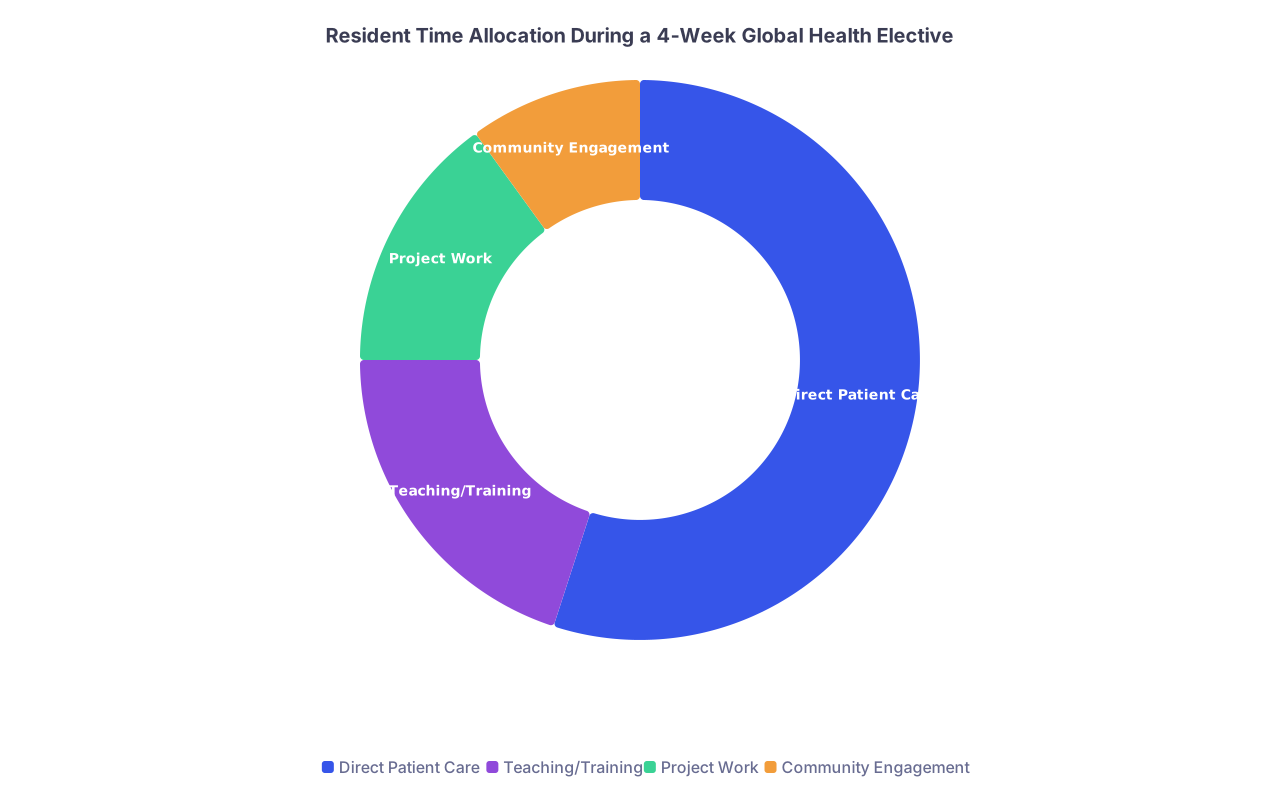
| Category | Value |
|---|---|
| Direct Patient Care | 55 |
| Teaching/Training | 20 |
| Project Work | 15 |
| Community Engagement | 10 |
You also:
- Have frank conversations about needs:
- “What projects do you actually want help with?”
- “What past residents did that was useful vs. annoying?”
The point is continuity. You want a reason to stay engaged with this site between visits, not just a few weeks of intense clinic work.
PGY-2, Quarter 3 (Months 19–21): Turn Experience into Products
You’re back from the field. This is where most people just… move on. You won’t.
At this point you should:
Convert that elective into tangible outputs:
- Case reports (interesting TB, rheumatic disease, severe malnutrition case with teaching value)
- Local noon conference: “What I learned from X setting and why it matters here”
- Abstract for:
- PAS, AAP, global health conferences, or your institution’s research day
Tighten your project work:
- Clean your dataset
- Finalize pre/post measures for your QI work
- Draft introduction and methods for anything you’ll try to publish
You should also schedule a mid-PGY-2 career check-in with your primary mentor:
- Clarify:
- Do you actually want a global health fellowship?
- Or a job with 10–20% protected global time?
- Or just be “strongly global-informed” in a domestic underserved setting?
Your answer shapes how hard you push in PGY-3.
PGY-2, Quarter 4 (Months 22–24): Line Up PGY-3 Leverage
At this point you should be thinking strategically:
For those aiming at global health fellowships:
- Identify 5–8 fellowship programs you’re realistically competitive for
- Check what they like to see:
- 1st author anything?
- Formal MPH?
- Specific partner regions or languages?
For those aiming at global-focused jobs directly after residency:
- Start a list of:
- NGOs, academic centers, and hospital systems with global arms
- Domestic underserved settings that value global skills (tribal health, FQHCs with large migrant populations)
- Start a list of:
| Program | Region Focus | Degree Option | Typical Start Requirement |
|---|---|---|---|
| Baylor Int. Pediatrics | Africa/Latin | MPH available | 1–2 pubs or major project |
| CHOP Global Health | Various | None required | Strong field experience |
| Boston Children’s GH | Global mixed | MPH/MPH-lite | Proven longitudinal work |
| UCSF HEAL Fellowship | Domestic/global | None req. | 2-year commitment, underserved focus |
| Cincinnati Int. Child Health | Varied | Optional cert | Strong mentorship letters |
You should be:
- Asking mentors where your current CV is thin
- Planning 1–2 more high-yield outputs before December of PGY-3
PGY-3: Consolidation, Leadership, and Applications
This year is about proof. You prove that your interest survived the grind and turned into consistent contribution.
PGY-3, Quarter 1 (Months 25–27): Lead Something
At this point you should:
- Step into a leadership role in at least one area:
- Co-lead the residency global health interest group
- Coordinate monthly global case conferences
- Be the point person for your ongoing QI or education project
You’re transitioning from “interested resident” to “emerging colleague.”
Also, this is your last realistic window to:
- Submit abstracts
- Finish data collection
- Lock in letters of recommendation
If you’re going for fellowships, you want:
- One letter from your global mentor
- One from a clinical leader who can vouch you’re not just good “over there” but an excellent pediatrician here
PGY-3, Quarter 2 (Months 28–30): Application Season and Second Elective
This is where timing gets tight.
At this point you should:
If applying to global health fellowship:
- Have your personal statement emphasize:
- One coherent narrative (not six random trips)
- Evidence of sustained engagement (2–3 years with similar theme/site)
- Concrete skills you bring (language, data, curriculum design, etc.)
- Have your personal statement emphasize:
Schedule a final global or underserved elective:
- Either returning to the same site (ideal)
- Or a complementary setting (e.g., if your first was NICU abroad, try outpatient refugee health at home)
That second elective should:
- Deepen relationships ("I’ll be in touch after fellowship applications")
- Generate one more set of cases or ideas you can talk about in interviews
PGY-3, Quarter 3 (Months 31–33): Interviews and Show Your Work
At this point you should:
Be prepared with:
- A 1–2 slide mini-portfolio you can adapt:
- One slide: your global path (sites, topics, mentors)
- One slide: your key project (what you did, what changed, what you learned)
- A 1–2 slide mini-portfolio you can adapt:
For interviews (jobs or fellowships), you should be ready to answer:
- “What did you actually do on the ground?”
- “How did you avoid being a burden to the host site?”
- “Where did you fail, and what did you change because of that?”
Also, start planning:
- How you’ll sustain involvement during the transition from residency to next step
- Concrete email check-ins with mentors and site partners
PGY-3, Quarter 4 (Months 34–36): Hand-Off and Future-Proofing
This is the part nobody plans for: leaving well.
At this point you should:
Document and hand off your projects:
- Clean protocols
- Teaching files
- Data dictionaries
- Step-by-step “how to run this” notes for the next resident
Solidify relationships:
- Final meeting with your mentor:
- “Here’s where I’m headed next”
- “How can we stay connected?”
- Email your global site partners:
- Share how the work you did will be carried forward
- Offer to stay involved remotely if realistic
- Final meeting with your mentor:
You walk out of residency with:
- A coherent story
- Actual contributions
- People who will pick up the phone for you
That’s a global health portfolio. Not just travel.
Visual Timeline: 3-Year Global Health Portfolio Plan
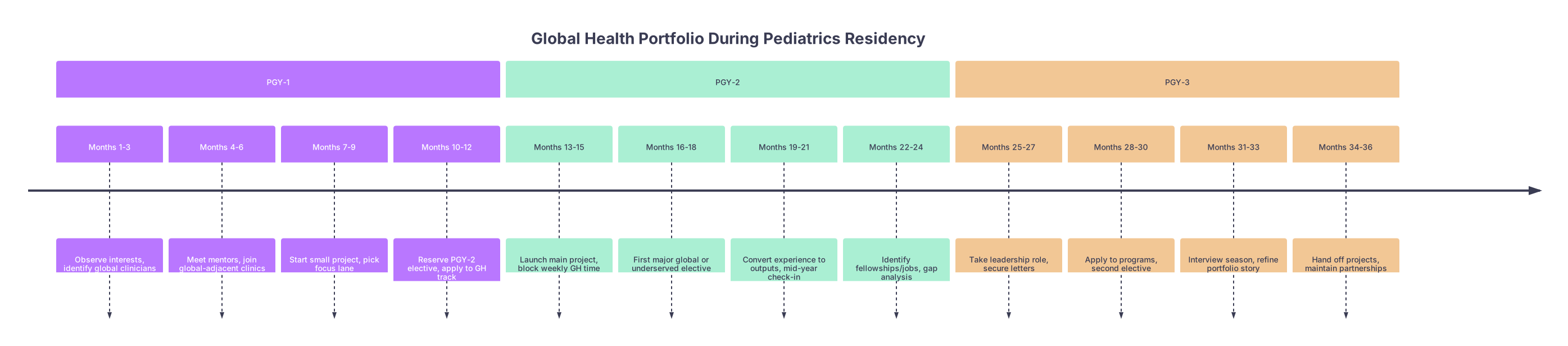
| Period | Event |
|---|---|
| PGY-1 - Months 1-3 | Observe interests, identify global clinicians |
| PGY-1 - Months 4-6 | Meet mentors, join global-adjacent clinics |
| PGY-1 - Months 7-9 | Start small project, pick focus lane |
| PGY-1 - Months 10-12 | Reserve PGY-2 elective, apply to GH track |
| PGY-2 - Months 13-15 | Launch main project, block weekly GH time |
| PGY-2 - Months 16-18 | First major global or underserved elective |
| PGY-2 - Months 19-21 | Convert experience to outputs, mid-year check-in |
| PGY-2 - Months 22-24 | Identify fellowships/jobs, gap analysis |
| PGY-3 - Months 25-27 | Take leadership role, secure letters |
| PGY-3 - Months 28-30 | Apply to programs, second elective |
| PGY-3 - Months 31-33 | Interview season, refine portfolio story |
| PGY-3 - Months 34-36 | Hand off projects, maintain partnerships |
Example Weekly Rhythm Once You’re Established (PGY-2/3)
To make this real, here’s how your average non-ICU week might look when you’re in the “portfolio-building” phase:
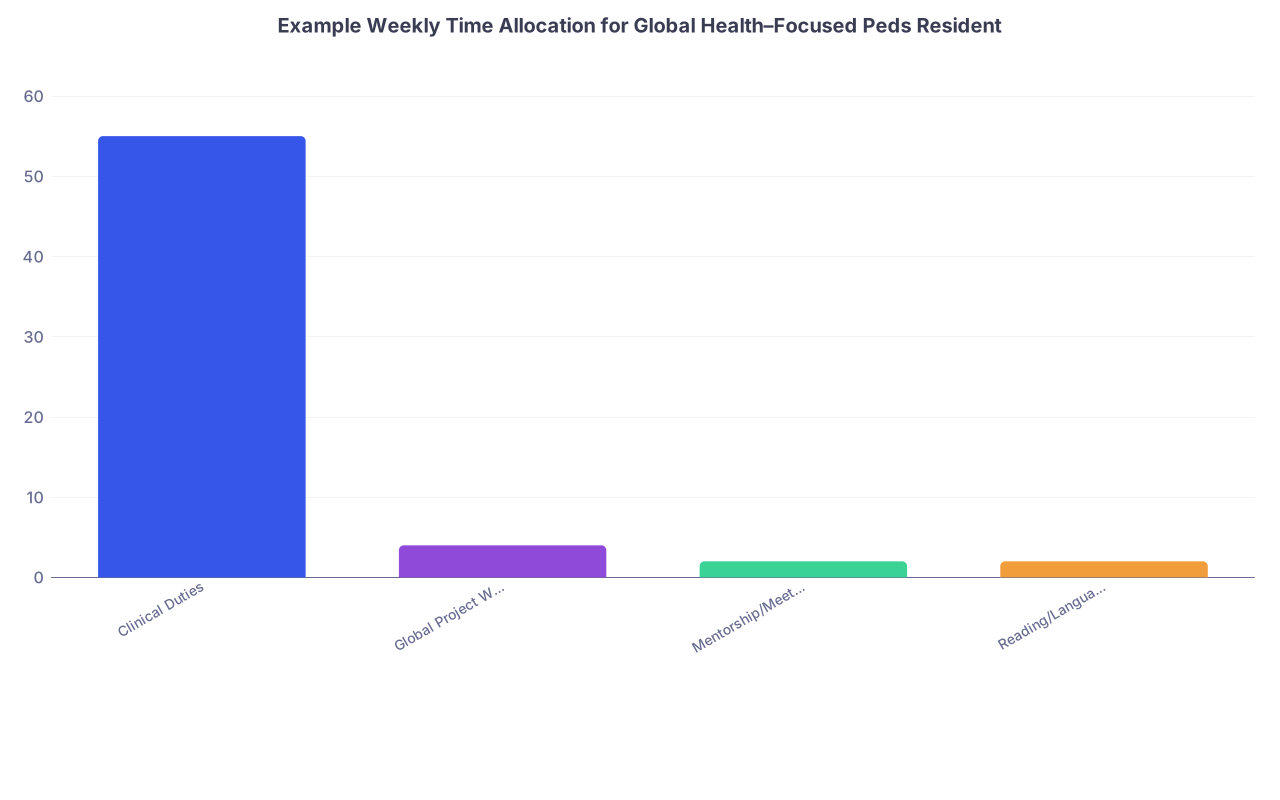
| Category | Value |
|---|---|
| Clinical Duties | 55 |
| Global Project Work | 4 |
| Mentorship/Meetings | 2 |
| Reading/Language Practice | 2 |
Translation:
- Clinical: 50–60 hours (you’re still a resident)
- Global project: 3–5 protected hours
- Mentor meetings / networking: ~2 hours
- Self-study (articles, language building): ~2 hours
The residents who actually build something meaningful usually maintain this rhythm for 18–24 months.
Quick Checklist by Phase
End of PGY-1 – You Should Have:
- At least one primary global health mentor
- One small project started or completed
- A PGY-2 global or underserved elective scheduled
- Clear sense of your tentative “lane” (topic or region or population)
End of PGY-2 – You Should Have:
- One major project with data mostly collected
- At least one presentation (local, regional, or national) submitted or planned
- One substantive field or “global-equivalent” experience completed
- A draft plan for fellowship or job targeting
End of PGY-3 – You Should Have:
- Project outputs (abstract, poster, manuscript in progress, or curriculum)
- Strong letters specifically referencing your global work
- 2–3 mentors who commit to ongoing support
- A clear, cohesive narrative of your global health journey
FAQ (Exactly 3 Questions)
1. Do I need an international rotation to have a credible global health portfolio?
No. An international rotation helps, but it’s not mandatory. Domestic underserved settings (tribal health, rural clinics, migrant health centers, refugee programs) can be just as valuable if you approach them with the same humility and longitudinal engagement. What matters more: continuity, contribution, and reflection—not geography.
2. Is it a mistake to start an MPH during pediatrics residency for global health?
Doing a full MPH during residency is usually a bad idea unless your program is explicitly structured for it (e.g., 4-year combined tracks). Residents underestimate the bandwidth cost and end up doing both poorly. If you want more training during residency, think smaller: a certificate program, online courses in implementation science, or focused biostat/epidemiology modules. Save the full MPH for fellowship or early career if you still need it.
3. How many publications do I need for a global health fellowship in pediatrics?
There’s no magic number, but 1–2 meaningful first- or co-first-author outputs tied to a coherent project is usually enough. Programs are more impressed by one sustained, thoughtful effort than by five disconnected minor posters. If by the end of PGY-3 you’ve got: one main global-related project + at least one abstract/poster (with a manuscript in progress), you’re in the competitive range for most pediatric global health fellowships—assuming your clinical performance and letters are strong.
Key points: Start early, choose continuity over “mission trips,” and protect a few hours every week for real work. If you do that across three years, your “interest in global health” stops being a line in your personal statement and becomes something people can actually see.