The biggest mistake IM residents make about fellowship is deciding “academic vs community” the week they submit ERAS. That is at least 12 months too late.
You do not “drift” into an academic or community career. You build one, step by step, starting as early as intern year. Here is exactly when and how that decision should start to crystallize.
Big Picture: The Real Decision Points
Before we go month‑by‑month, you need the map.
| Factor | Academic Track | Community Track |
|---|---|---|
| Research output by fellowship apps | 2+ abstracts, 1+ manuscript preferred | 0–1 projects, not critical |
| Letters of recommendation | At least 1–2 from research/academic mentors | Mostly clinical supervisors |
| Career goal clarity by end of PGY-2 | High (subspecialty + research/teaching interest) | Moderate (subspecialty + practice style) |
| Interview pitch | Research potential and teaching | Clinical productivity and patient care |
| Geographic flexibility | Often limited to academic centers | Wider (large and small cities) |
You are deciding three overlapping things:
- Fellowship type (cards, GI, heme/onc, pulm/crit, etc.).
- Training environment (academic medical center vs community‑based program).
- Long‑term career (physician‑scientist/educator vs high‑volume clinician).
Those are not identical. You can:
- Train academically and later work in community.
- Train community and later join an academic-affiliated practice (harder, but happens).
- Start “community‑minded” then get pulled into academics after a strong research mentor.
So the goal is not to lock yourself into one box on day one. The goal is to keep both doors open early, then narrow intentionally on a timeline.
Medical School and Application Year (M4 → PGY‑1 Match): Laying Groundwork
At this point you should not be obsessing over “academic vs community fellowship.” But you should be quietly building optionality.
M4 Fall–Winter: Choosing IM Programs
At this point you should:
- Decide if you care about maximally competitive fellowships (cards, GI, heme/onc at big-name places).
- Sort your residency list accordingly.
If you are even 30% tempted by a future academic career, your rank list should:
- Prioritize programs with:
- Strong fellowship placement.
- Multiple NIH‑funded attendings.
- In‑house fellowships in your likely field.
- Treat pure community IM programs without academic ties as high risk for that path.
You do not need to commit to “academic” yet. But you do need to avoid shutting that door before residency begins.
M4 Spring: After Matching
At this point you should:
- Email the program coordinator or APD once and say:
- You are excited to start.
- You are interested in exploring subspecialty X and possibly academics.
- Ask one concrete question:
- “Which attendings should I talk to early if I want to keep research/academics on the table?”
That one email tells your future program leadership: this resident is thinking ahead. They file your name mentally under “potential fellowship applicant,” which changes what opportunities reach you.
PGY‑1 (Intern Year): Keep Both Doors Open
The mistake I see: interns declaring “I am definitely community” in September, then flipping 18 months later when they discover they love heme/onc, and now they have zero research and no academic mentors. Fixable, but uphill.
PGY‑1, July–September: Survival and Reconnaissance
At this point you should:
- Focus on becoming a competent intern. No one cares about your “academic future” if your notes are late and you miss pages.
- Quietly observe:
- Which attendings publish.
- Which ones talk about “my grant,” “my lab,” “our trial.”
- Which ones are pure workhorses seeing 20 patients a day with no research.
Make a simple list:
- Column A: research‑heavy academic mentors.
- Column B: outstanding clinicians you would trust with your family.
You want real relationships in both columns. Academic vs community is not “smart vs not smart.” It is lifestyle, priorities, and how you get rewarded.
PGY‑1, October–December: First Micro‑Decisions
At this point you should:
- Ask yourself bluntly after each subspecialty rotation:
- “Could I see myself doing this for 30 years?”
- “Do I like the thinking, or just the procedures, or neither?”
- Raise your hand when small opportunities appear:
- Quality improvement projects.
- Case reports (those weird zebra admissions).
- “Help with data collection” for a faculty project.
If you feel even mild curiosity about academics, you need at least one small scholarly project started by December. Not finished. Started.
Because academic fellowships will eventually ask: “What did you do as an intern?”
PGY‑1, January–March: First Fork in the Road (Quiet, Reversible)
At this point you should:
Have a working hypothesis:
- Path A: “Probably academic‑leaning / subspecialty competitive.”
- Path B: “Probably community‑leaning / broader general IM or less research‑heavy fellowship.”
You are not cementing anything. You are deciding where to invest your limited bandwidth.
If leaning Academic:
- Identify 1–2 potential mentors in your tentative field.
- Send a short, clear email:
- You are a PGY‑1 interested in [field].
- You want to get involved in a small, realistic project.
- You can dedicate X hours per week.
- Ask your chief residents which residents “matched big” in your desired field. Study what they did.
If leaning Community:
- Focus on:
- Being clinically excellent.
- Getting strong clinical evaluations.
- Becoming that intern attendings actually request again.
- You can still do minimal research, but your priority becomes:
- Bread‑and‑butter medicine.
- Efficient workflow.
- Patient communication skills.
PGY‑1, April–June: Locking in Optionality
At this point you should:
- Have at least one of the following in motion:
- Case report or small series.
- QI project with a real timeline.
- Data collection on someone else’s study.
- Know which three subspecialties interest you most.
If you have zero academic activity by June and suddenly want a top‑tier academic cards fellowship later, you are already behind. Not dead. Behind.
PGY‑2: The Decision Year
This is when “academic vs community track” stops being theoretical. By the end of PGY‑2, your application narrative is mostly set.
Here is the year as it really plays out.
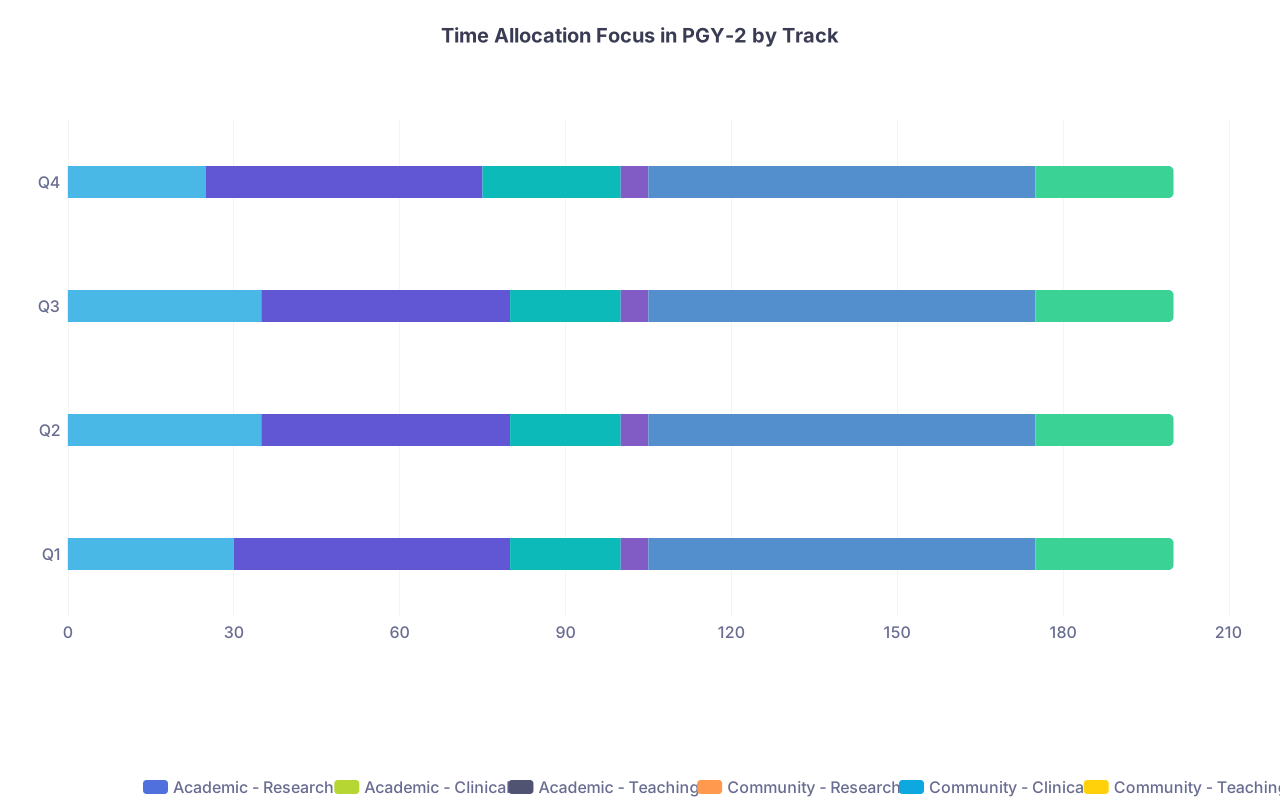
| Category | Academic - Research | Academic - Clinical | Academic - Teaching | Community - Research | Community - Clinical | Community - Teaching |
|---|---|---|---|---|---|---|
| Q1 | 30 | 50 | 20 | 5 | 70 | 25 |
| Q2 | 35 | 45 | 20 | 5 | 70 | 25 |
| Q3 | 35 | 45 | 20 | 5 | 70 | 25 |
| Q4 | 25 | 50 | 25 | 5 | 70 | 25 |
PGY‑2, July–September: Formalizing Your Direction
At this point you should:
- Sit down (actually sit down) with your program director or APD.
- State clearly:
- The fellowship(s) you are considering.
- Whether you are leaning academic or community‑oriented training and career.
- Ask:
- “What have successful applicants from this program done in that lane?”
- “Where have our last 5 fellows in that subspecialty matched?”
If leaning Academic:
- Your mentor list should be real, not vague.
- Aim to:
- Convert ongoing projects into abstracts by winter.
- Get on at least one manuscript, even as middle author.
- Start teaching:
- Medical students.
- New interns.
- Morning reports or small chalk talks.
If leaning Community:
- You still need a coherent story:
- “I want to train in a high‑volume, clinically focused program with strong hands‑on experience.”
- Work on:
- Efficiency.
- Autonomy.
- Bread‑and‑butter skills that community programs value.
You can still change tracks later, but the further in PGY‑2 you go, the more expensive the switch.
PGY‑2, October–December: Hard Choice Deadline for Competitive Academics
This is the true inflection point. For competitive academic fellowships, you need to decide “academic vs largely community” by the end of this window.
At this point you should:
- Look at your CV honestly and pick a lane:
Academic-leaning reality check:
- Do you have:
- At least 1–2 abstracts/posters submitted or planned by spring conferences?
- A project that could plausibly become a paper?
- At least one mentor who would go to bat for you at a national program?
If “no” across the board, you have three options:
- Sprint now – aggressively push 1–2 projects across the finish line this year.
- Plan for a research year or chief year – common in competitive fields.
- Pivot to excellent community‑oriented fellowship programs where research is a bonus, not a prerequisite.
Community-leaning reality check:
- Do you:
- Consistently get strong clinical evaluations?
- Handle admissions and cross‑cover without drama?
- Have attendings who say “I would hire you”?
If “no,” you do not magically become a strong community fellowship applicant just by “not doing research.” You still need excellence. Just a different kind.
PGY‑2, January–March: Application Season Prep
At this point you should:
- Start tightening your ERAS story.
If Academic track:
- Draft a personal statement that clearly frames:
- Your subspecialty interest.
- Your research focus or at least academic questions you care about.
- Your long‑term role: clinician‑educator vs physician‑scientist.
- Target upcoming abstract deadlines aggressively (ACC, ASH, ATS, DDW, etc.).
- Decide which academic programs match your trajectory:
- Not just the “top 10” list someone posted online.
- Places where your mentors have connections.
If Community track:
- Your personal statement should:
- Emphasize clinical volume, autonomy, procedural interest (if relevant).
- Highlight QI/leadership roles (chief of a service, scheduling, committees).
- Research can appear, but as seasoning, not the main dish.
- Start mapping:
- High‑volume community programs.
- Academic‑affiliated community fellowships (good compromise tier).
PGY‑2, April–June: Finalizing Your List and Letters
At this point you should:
- Lock down your letter writers:
Academic:
- At least:
- 1–2 letters from academic mentors (research or major projects).
- 1 from a strong clinical attending in your subspecialty.
- These letters must say:
- That you think like an academic.
- That you follow through on projects.
- That you teach well.
Community:
- Primarily:
- Clinical letters from attendings who saw you handle real work.
- Maybe 1 letter that includes a small QI or leadership piece.
- These letters must say:
- You are safe, efficient, and pleasant to work with.
- You function like a junior attending.
PGY‑3: Applications, Interviews, and Accepting Tradeoffs
By now, the “academic vs community” choice is not in your head. It is in your ERAS list.
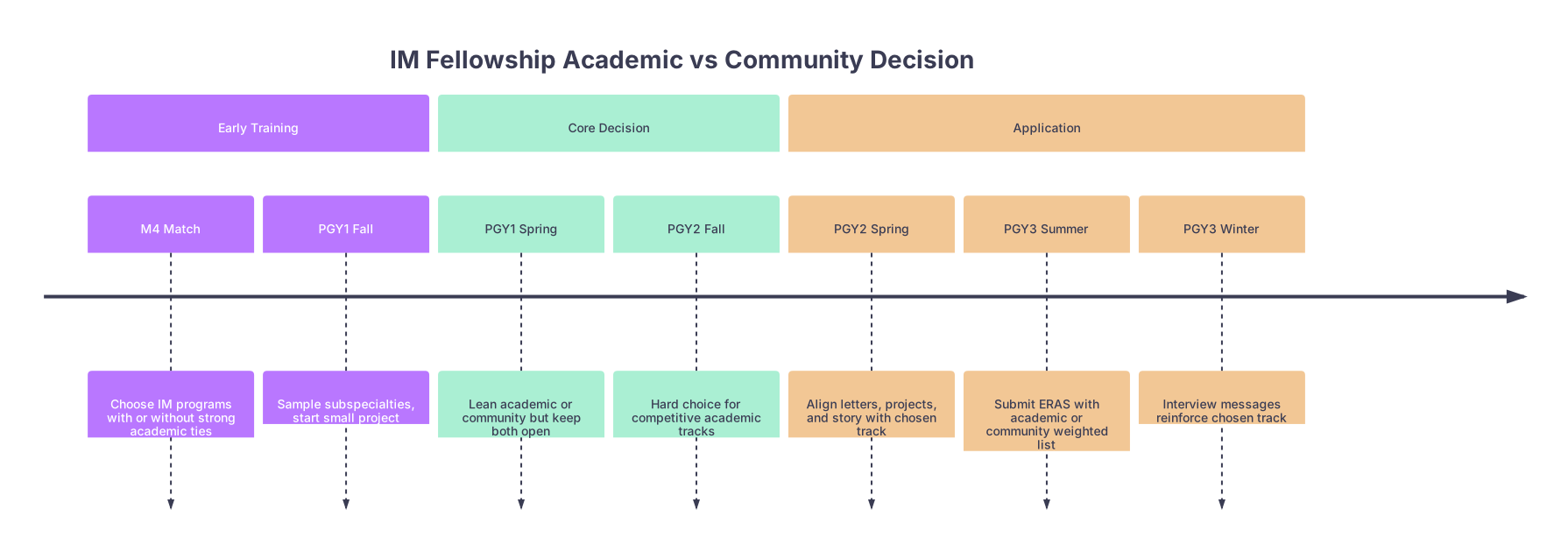
| Period | Event |
|---|---|
| Early Training - M4 Match | Choose IM programs with or without strong academic ties |
| Early Training - PGY1 Fall | Sample subspecialties, start small project |
| Core Decision - PGY1 Spring | Lean academic or community but keep both open |
| Core Decision - PGY2 Fall | Hard choice for competitive academic tracks |
| Application - PGY2 Spring | Align letters, projects, and story with chosen track |
| Application - PGY3 Summer | Submit ERAS with academic or community weighted list |
| Application - PGY3 Winter | Interview messages reinforce chosen track |
PGY‑3, July–September: ERAS Submission
At this point you should:
- Submit an application that clearly reads academic or community‑focused. Mixed signals hurt you.
Academic application signals:
- Multiple scholarly activities in the experiences section.
- Abstracts and manuscripts in the pubs section.
- Strong programs on your list where your mentors can send emails.
Community application signals:
- Heavy emphasis on:
- Inpatient volume.
- Nights, cross‑cover, float experiences.
- Leadership roles (chief resident, committee work).
- Many community-based fellowships on your list.
- Geographic preferences consistent with real life (not “only NYC and LA” when you have zero research).
You can mix a few of each type, but the majority should match your chosen track.
PGY‑3, October–January: Interview Season – What You Say Differently
At this point you should:
- Tailor your message by program type.
Academic interview:
- Talk about:
- Specific research questions or themes.
- How you want to integrate teaching, research, and clinical work.
- Where you see yourself on the spectrum: 80/20 clinical/research vs 50/50 etc.
- Show that you understand:
- Grants, protected time, promotion tracks. You do not need to be an expert, but you should not be clueless.
Community interview:
- Talk about:
- How much you enjoy taking ownership of busy services.
- Your desire for hands‑on procedures (for some specialties).
- Plans for community practice, maybe with teaching of residents or students.
- Show that you understand:
- The realities of productivity, call, and real‑world patient care outside ivory towers.
PGY‑3, February–March: Rank List Reality Check
At this point you should:
- Be honest about which future you actually want Monday morning at 7 a.m., not in fantasy.
If you rank an academic‑heavy list:
- You are choosing:
- More pressure for output and CV building.
- Less control over geography sometimes.
- More meetings, committees, and academic politics later.
If you rank a community‑heavy list:
- You are choosing:
- More clinical time, more patients, more real‑world responsibility.
- Less built‑in research infrastructure.
- Often better compensation and flexibility.
Do not rank an academic program first if you secretly want a 4‑day‑a‑week mostly outpatient life with minimal committees. And do not rank a tiny community program first if you will resent the lack of research support for the next decade.
After Fellowship Match: Course Corrections and Late Pivots
Here is the part most people do not tell you: you can still cross from one world to the other later. It is just harder and slower.

Academic to community:
- Very common.
- You finish an academic fellowship, decide you hate grants, and take a community job.
- Your academic background becomes a selling point: “We have a fellowship‑trained subspecialist from [Big Name] on staff.”
Community to academic:
- Harder, but not impossible.
- Usually looks like:
- Community fellowship → strong clinical reputation → join academic‑affiliated group → gradually add teaching and some research.
- Or: extra training / research year after fellowship with an academic mentor.
- You must:
- Produce something academic (QI, education research, clinical series).
- Show you can contribute beyond pure RVU generation.
The earlier you know you might want academics later, the more you should quietly preserve that option during residency and fellowship: one project here, one mentor there.
Quick Timeline Snapshot: When You Actually Decide
| Timepoint | What You Should Decide | Impact |
|---|---|---|
| M4 Rank List | Choose residency with/without strong academic infrastructure | Sets ceiling for later options |
| PGY-1 Spring | Lean academic vs community, start matching mentors | Guides early projects |
| PGY-2 Fall | Firm choice for competitive academic fellowships | Determines project intensity and ERAS story |
| PGY-3 Summer | Application list composition (academic vs community-heavy) | Locks in training environment |
| Post-fellowship | Job type (academic center vs community practice) | Final career lane, but still modifiable |


| Step | Description |
|---|---|
| Step 1 | IM Residency Start |
| Step 2 | PGY1 Spring Lean |
| Step 3 | PGY2 Research Focus |
| Step 4 | PGY2 Clinical Focus |
| Step 5 | Academic-heavy Fellowship List |
| Step 6 | Community-heavy Fellowship List |
| Step 7 | Academic Job or Community Later |
| Step 8 | Community Job or Academic Later |

The Three Things To Remember
- You start deciding “academic vs community” no later than PGY‑1 spring, and you cement it for fellowship purposes by PGY‑2 fall. Later than that and you are swimming upstream.
- Academic tracks require visible scholarly work and mentors; community tracks require visible clinical excellence and reliability. Neither path rewards being mediocre at everything.
- You are not marrying the track forever. You are choosing your next 5–10 years. Keep one eye on optionality, pick a lane on time, and then run hard in that direction.