It’s 6:45 a.m. on a Tuesday in late October. The neurology program director has exactly 40 minutes before morning report. ERAS is open on one screen, email on the other. There are 680 applications in the queue for 8 categorical spots. She is not “holistically reviewing” 680 files. She is triaging.
Here’s the part no one tells you: by the time she truly “reads” an application, it has already survived three or four brutal, fast filters. And those filters aren’t the ones med school advisors usually talk about.
You’re told to write a heartfelt personal statement, get “good letters,” and show “commitment to neurology.” Fine. Necessary, but secondary. In neurology, most PDs are looking for a very specific set of hidden signals first. If those aren’t there, you never reach the warm-and-fuzzy parts of your file.
Let me walk you through what actually happens on the other side of the screen.
How Neuro PDs Actually Scan Your File
Here’s the real order of operations in many neurology programs when they first open an application. Not what they say at panels. What they do.

| Step | Description |
|---|---|
| Step 1 | Open ERAS List |
| Step 2 | Quick Click In |
| Step 3 | Check Filters |
| Step 4 | Neurology Signals Check |
| Step 5 | Bin - Unlikely |
| Step 6 | Priority Review |
| Step 7 | Secondary Pile |
| Step 8 | Home vs Away School? |
| Step 9 | US vs IMG? |
| Step 10 | USMLE/COMLEX Scores |
| Step 11 | Home Rotation or Strong Neuro LOR? |
No one’s doing this exact flowchart consciously, but this is the pattern. They’re scanning for fast “yes” and “no” signals.
The key for you: what counts as a strong neurology “signal” on that first pass?
Signal #1: Your School + Neurology Context
Program directors will never admit how much your school label changes their starting assumptions. But it does.
They’re not just asking, “Where did this person go to med school?” They’re asking three much more specific questions:
- Is this a school we know produces decent neurology residents?
- Does this school even care about neurology?
- Do we have any pipeline or history with them?
| Category | What PDs Think Quickly |
|---|---|
| Own medical school | Known quantity, easier to assess, priority for interview |
| Known neurology “feeder” schools | Expect solid neurology exposure and letters |
| Generic US MD | Neutral, rely heavily on the rest of file |
| US DO | Variable, look for strong neurology rotation and Step 2 / COMLEX |
| IMG | Need extra evidence: scores, US rotations, neuro LORs |
At an academic neurology program, I’ve watched PDs do this live: the ERAS list is sorted by school, and they literally say things like, “Oh, we like XXX Med, their students always function well as interns” or “Y School’s neuro letters are all fluff, skip to their Step 2.”
If you’re not from a “known” school or neurology-heavy place, you’re not dead. But your application has to scream, “I found neurology anyway and took it seriously.”
That means: clearly labeled neurology sub-I, neurology electives, and at least one letter from someone who actually practices neurology in the U.S.
Signal #2: The Real Score Thresholds (And How Neuro PDs Think)
Neurology likes to pretend it’s “less score-obsessed.” Reality: they’re slightly less neurotic than ortho or derm, but there are still unspoken thresholds.
Here’s the inside view: PDs often use raw scores to thin the pile long before they start reading narratives. The exact numbers vary by program type.
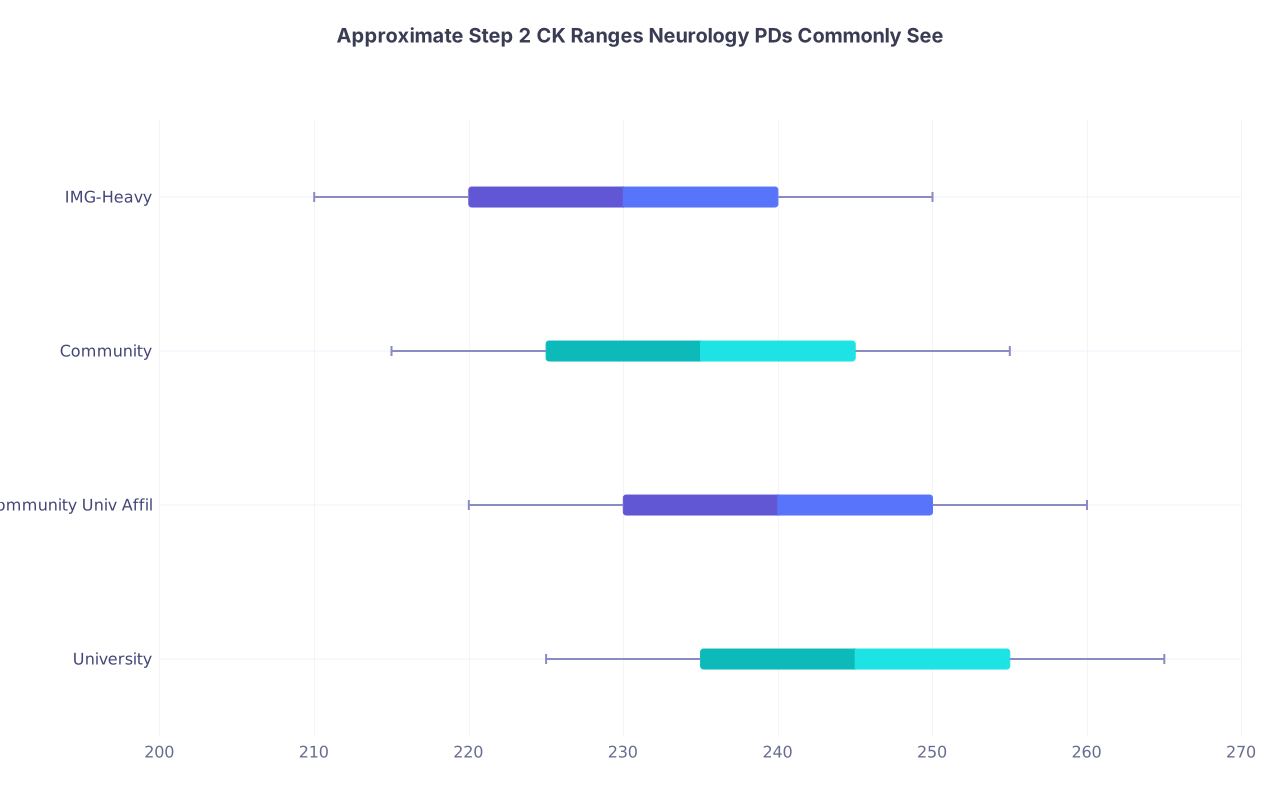
| Category | Min | Q1 | Median | Q3 | Max |
|---|---|---|---|---|---|
| University | 225 | 235 | 245 | 255 | 265 |
| Community Univ Affil | 220 | 230 | 240 | 250 | 260 |
| Community | 215 | 225 | 235 | 245 | 255 |
| IMG-Heavy | 210 | 220 | 230 | 240 | 250 |
You won’t see those numbers printed on a website, but this is the ballpark PDs are working with.
What they actually do:
- University neurology with fellowships and lots of research: quietly uses something like 235–240+ Step 2 as a soft screen for U.S. grads. Some leeway if everything else is perfect or if you’re from their home school.
- Solid mid-tier university-affiliated programs: often comfortable 225–240. Under 220 they start looking for a compelling reason to keep you in the pile.
- Community-heavy or IMG-heavy programs: more flexible, but they still worry about who’s going to pass the boards on the first try.
The hidden neuro-specific piece: PDs care more about pattern than a single number.
They’re looking at:
- Step 1 (even pass/fail) plus clerkship comments to see if you struggled with complex reasoning.
- Step 2 CK: especially your neuro, psych, and medicine–relevant performance. If they see “Below expectations” on neurology or internal medicine shelf, that’s a mental note.
I’ve watched PDs say things like: “230 but honors in medicine and neurology, strong letters—fine” vs “242 but marginal in clinical evals and weak narrative comments—risky.”
Scores get you into the room. The pattern keeps you there.
If your numbers are average or slightly below for your target tier, your application has to overcompensate in two places: neurology commitment and clinical performance.
Signal #3: Neurology Exposure That Actually Counts
Every MS4 applying neurology writes, “I developed a strong interest in neurology during my third year.” PDs barely read that line anymore.
What they’re scanning for instead:
- Is there a clearly labeled neurology sub-internship?
- Did you do it at your home program, a strong away, or some random private practice rotation?
- Do your evals from that rotation read like someone we’d trust at 2 a.m.?
Here’s the blunt truth: a medicine sub-I is important, but for neurology PDs, your neurology sub-I (if you have one) is often the single most heavily weighted line in your clinical history.
They look for phrases like:
- “Functions at intern level”
- “Takes ownership of patients”
- “Strong clinical reasoning in complex neuro cases”
- “Recognizes sick vs not sick and escalates appropriately”
And they’ll notice the negative signals:
- “Pleasant to work with” with nothing else substantive
- “Will make a good resident in the right program” (translation: not here)
- “Needed significant guidance for basic tasks”
If your school does not offer a formal neurology sub-I, you need something that looks and smells like one: inpatient adult neuro at a U.S. academic center, with real responsibility and a formal evaluation that you can reference in your application.
Signal #4: The Hidden Hierarchy of Neurology Letters
Everyone tells you, “Get strong letters.” Neurology PDs are way more specific than that.
Here’s the actual internal ranking I’ve seen PDs use when they sort letters:
| Letter Type | How PDs Privately Rate It |
|---|---|
| Chair or PD of Neurology who knows you well | Gold tier, heavily weighted |
| Inpatient neurology attending from sub-I | Very strong, huge signal for readiness |
| Well-known academic neurologist at strong away | Strong, especially for top programs |
| General IM attending, very detailed | Helpful but secondary |
| Research PI in neurology who barely saw you clinically | Mixed; good for research programs only |
What they actually do when they open letters:
First, they check who wrote it. If it’s someone they know or have seen on committees or publications, they immediately assume the letter is interpretable.
Then they hunt for two or three key sentences:
- Anything that compares you to peers: “Top 5% of students I’ve worked with in 10 years”
- Anything about autonomy and reliability: “I would trust them with my own family member”
- Anything about communication and team function, especially in difficult situations: “Defused tension with a challenging family, showed maturity beyond level”
And yes, they can smell a lukewarm letter in five seconds. Neurology has a lot of “nice” people, but the experienced attendings still telegraph concern with polite language. Phrases like:
- “With further development, has potential…”
- “When given clear structure, performs adequately…”
- “Quiet but pleasant student…”
Those are red flags in a neuro PD’s head. It says you might freeze when the stroke pager goes off.
If you’re at a school where the neurology faculty barely know you, you have to fix that before application season. That might mean deliberately doing your sub-I early, asking for feedback mid-rotation, and explicitly telling the attending, “I’m planning to apply neurology and would really value a detailed letter if you feel you can support me strongly.”
Push for specificity. Neuro PDs care far more about concrete descriptions of your behavior than your supposed “passion for the brain.”
Signal #5: Your Storyline and Internal Consistency
Here’s one of the secrets applicants never realize: PDs are not looking for perfection. They’re looking for coherence.
Neurology has a high burnout and dropout rate at some places. PDs are burned by applicants who “fell into neuro” or panicked into it when more competitive specialties didn’t work out. They’re trying to answer one quiet question on the first scan:
“Does this person actually belong in neurology, or are they just fleeing something else?”
They look for story patterns like:
- Third-year neuro rotation → sub-I in neurology → neuro research or QI → maybe neuro interest group leadership → letter from neuro → personal statement that reflects real patient stories from neuro.
- Consistent signals over time, not a sudden “I love neuro” discovered last month.
They also catch the opposite pattern:
- Two years of heavy ortho/derm/anesthesia activities, Step 1 gunning, no neuro mentioned until MS4, vague personal statement about “longitudinal patient care” that could apply to anything.
- Or: US MD with average scores, zero neuro exposure until very late, generic IM letter, neuro personal statement that feels templated.
Those applications get an eyebrow raise. They’re not always tossed, but they move to a lower-priority bin.
This is where IM residents and neurology fellows at your home institution can be worth their weight in gold. They know exactly what looked “real” versus last-minute when they applied. Ask them to read your experiences and personal statement and tell you whether your neurology story sounds authentic and continuous or patched together.
Signal #6: Subtle Red Flags PDs Catch Fast
There are a few things neurology PDs notice in seconds that you might think you’ve buried.
Patterns of “disorganized,” “late,” “needed reminders” in clerkship comments
In neurology, detail and follow-through are non-negotiable. If they see you missed notes, lost track of tasks, or consistently turned in things late, that’s a big concern. They imagine you forgetting to check a repeat CT on an acute stroke.Unexplained leaves or big gaps in training
Leaves happen. Mental health, family, personal crises. None of that automatically hurts you. What bothers PDs is when the gap is there, the MSPE hints at “concerns,” but your application never acknowledges or explains anything. That reads as avoidance, not resilience.Remediation with no clear resolution
If you failed a clerkship or needed remediation, PDs look for evidence that you improved afterward. A failed neurology shelf followed by honors in neurology sub-I and great comments? Fine. A failure in medicine with more “borderline” comments later? That’s a risk.Unrealistic program list pattern
Neuro PDs talk. If your application clearly screams “top-10-or-bust,” and you only applied to big-name places with zero geographic or realistic spread, some PDs assume you’re not grounded. Not fatal, but it influences how they interpret the rest.
Signal #7: Research – When It Matters And When It Doesn’t
Neurology is bifurcated here. At heavy academic shops (think big university neuro departments with multiple fellowships and NIH grants), research is not just decoration. It’s a screening tool for future faculty.
What those PDs look for:
- At least one neurology- or neuroscience-related project, ideally with your name somewhere near the front on a poster or abstract.
- A clear narrative that you know what you did: in your ERAS description and in your personal statement or experiences.
- Bonus: a letter from your research PI saying you saw projects through and weren’t just a warm body entering data.
But here’s the quiet truth many advisors don’t say out loud: at a ton of mid-tier or community-affiliated neurology programs, research is nice but functionally irrelevant. They’ll pick the reliable, clinically strong student with no research over the scattered “neuro research superstar” every time.
The subtle thing they all look for though is commitment and follow-through. Did you stay on a project for a year and actually get something to a meeting? Or did you join three labs for three months each and never finish anything?
That pattern tells them more about your future as a resident than the actual topic of the research.
Signal #8: Geography, Fit, and the “Would You Actually Come Here?” Question
Here’s a quiet PD obsession: yield. They’re judged (formally or informally) by how many of their ranked applicants actually come. They hate wasting interview slots on people who clearly won’t rank them.
So when they scan your file, they’re asking themselves, “Is there any reason to think this person might realistically want to be here?”
They look for:
- Ties to the region (undergrad, family, partner, grew up there).
- Repeated theme in your experiences about urban vs rural, certain patient populations, certain practice settings that match their program.
- Signals in your geographic spread of applications. If you’re from the East Coast, applied to 50 programs, and they’re the only Midwest or Deep South program on your list, they wonder why.
If you have a non-obvious reason to want a certain geographic area or program type, you cannot assume they’ll guess it. You need to say it. Somewhere. Briefly in your personal statement or in your experiences. Otherwise they assume you’re using them as a backup.
How To Stack These Signals In Your Favor
Let me be direct about what actually moves the needle the most on that first pass, especially if you’re not coming in as a perfect applicant:
- One strong neurology sub-I at a reputable site, with outstanding evals.
- At least one heavy-hitting neurology letter that says more than “hard-working and pleasant.”
- A Step 2 score that’s at least in the realistic range for your target tier, with no catastrophic clerkship narrative.
- A coherent neurology story: early interest or at least a believable pivot, plus tangible follow-through.
- Clear geographic or program-specific reasons that make you look like a serious candidate, not a tourist.
Everything else—personal statement eloquence, research glitter, perfect formatting—that’s secondary.
FAQs
1. If my Step 2 score is below the “typical” range for academic neurology, am I automatically out?
No, you’re not automatically out, but you’ve lost your easiest screening advantage. At that point PDs will only keep you in the pile if the neurology signals are very strong: excellent neuro sub-I evals, powerful LORs, and clear evidence that you’re reliable and coachable. You’ll probably need to target a broader range of programs, emphasize your clinical performance, and be realistic about top-tier academic places.
2. How many neurology letters do I actually need for a strong neuro application?
For most neurology programs, two neurology letters plus one strong medicine (or other core clerkship) letter is plenty. One of those neuro letters should be from your sub-I or main inpatient attending, and if possible one from a PD/chair or recognizable academic neurologist. More than three letters doesn’t usually help; it just dilutes the impact unless they’re all exceptionally strong.
3. Is it a mistake to apply neurology if most of my early activities were in another specialty?
Not necessarily, but you have to own the pivot and show you didn’t just panic after getting a disappointing score. You need a clear, honest story about how you shifted, plus high-quality neurology experiences and letters that establish this isn’t a rebound specialty. If your recent year looks authentically neuro-focused and your evals back that up, most PDs will accept that students grow and change—as long as your story is consistent and believable.
Key points to leave with: neurology PDs make very fast decisions based on a handful of hidden signals—school context, score pattern, neurology sub-I performance, LOR strength, and coherence of your neurology story. If you want to survive that first pass, build your application so those signals are obvious at a glance. And do not rely on the personal statement to rescue a file that doesn’t already look like it belongs in neurology.