
It’s late August. You’re three days into your pediatrics sub‑I at a big children’s hospital. You’re exhausted, half the meds are still foreign names, and the intern you’re following seems to chart faster than you can think. But in the back of your mind there’s a louder worry:
“This is my audition for residency. Do they actually care what I do here… or is it all going to come down to my interview in December?”
Let me be blunt.
In pediatrics, your sub‑internship at a program (or its affiliated hospital) can outweigh your interview performance by a mile. At a lot of places, the interview is there to confirm what they already decided about you based on how you worked on the wards.
You’re not told that explicitly, of course. But the faculty talk. The chiefs talk. The residents definitely talk. I’ve sat in on those meetings. I’ve watched applicants with “OK” interviews sail to the top of the rank list because the residents said four magic words: “Crushed it on sub‑I.”
Let me show you how this really works.
How Programs Actually Rank You in Pediatrics
Forget the official line about “holistic review” for a second. Here’s what drives a lot of pediatric rank decisions behind closed doors: known quantities.
Program directors hate risk. They’ll use test scores to screen, personal statements for vibe, and letters for broad strokes. But what they really want is proof of how you function on a real pediatric team. Not in a 20‑minute scripted conversation. Across 4 weeks at 5:15 a.m. when everyone is tired and the list exploded overnight.
A sub‑I does three things an interview never will:
- Shows your work ethic day after day, not just on your best day.
- Exposes how you treat nurses, RTs, parents, and other students when you’re not performing.
- Lets residents test the most important question: “Would I want to sign out to this person at 7 p.m. in January?”
You know how many times I’ve heard in rank meetings:
“Her interview was fine. But she killed it on the wards. She’s top tier.”
Versus:
“He interviewed great. But on his sub‑I, he disappeared after rounds and did the bare minimum. Hard no.”
The interview is a 20–30 minute curated snapshot. The sub‑I is a 160‑hour reality show with no editing.
Why Pediatrics Cares So Much About Your Sub‑I
Pediatrics is different from some surgical fields where the question is, “Can this person operate?” In peds, the question is simpler and more brutal:
“Would I trust this person with my sick 3‑month‑old at 3 a.m.?”
The people who can answer that honestly are not the people in your interview room. It’s the senior resident you prerounded with. The intern you helped cross‑cover for. The night float who watched you stay late to call a worried parent back.
That’s why your sub‑I carries so much weight.
Here’s how the hierarchy of information actually works at many children’s hospitals:
| Factor | Influence Level (Real World) |
|---|---|
| Performance on home/away sub‑I | Very High |
| Resident informal feedback | Very High |
| SLOEs / strong narrative letters | High |
| Dean's letter / MSPE | Moderate |
| Interview performance | Moderate |
| Step 2 score (post-screening) | Low–Moderate |
Program directors will never say “interview is low priority.” But once you clear the basic threshold of “not a social disaster,” your day‑to‑day sub‑I behavior usually matters more.
What Residents and Attendings Really Say After You Leave
Let me give you the unvarnished version.
After interview day, the feedback usually sounds like:
“Nice enough.”
“Seemed enthusiastic.”
“Quiet but fine.”
“Good fit.”
Nothing very specific, unless you were extremely charismatic or extremely awkward.
After a sub‑I, the feedback sounds more like this:
- “She was basically an intern already. Stayed late, knew her patients cold, helped her co‑students.”
- “He was on his phone constantly. Never offered to help. The nurses did not like him.”
- “Really kind with families, but got flustered when things got busy. I’d still rank her; she improved by the end.”
- “Resident‑repellent energy. Everyone was relieved when the rotation ended.”
Program directors remember those phrases. They put a lot more stock in “basically an intern already” than “good interview.” They should. One predicts actual performance. The other predicts… how you act sitting in a conference room with coffee and pastries.
And by the way, the nurses’ informal read of you can move the needle. Not officially. But when residents say, “The nurses really loved working with her,” that usually aligns with: kind, responsive, not dismissive, doesn’t disappear.
The Silent Scoring System of a Sub‑I
No one hands you a rubric, but it exists. Different programs emphasize different things, but pediatrics tends to quietly score you on the same core questions:
- Are you reliable?
- Are you coachable?
- Do you give a damn about kids and families?
- Are you safe?
Notice what is not on that list: “Are you charming for 20 minutes?”
During a sub‑I, this is how those questions actually get answered.
1. Reliability
Do you show up on time, pre‑round on your own patients without being chased, follow through on tasks without excuses, and respond to pages?
I’ve watched residents tank applicants with one sentence:
“Honestly, I just could not trust them to do what they said they’d do.”
You do not recover from that in pediatrics. Reliability beats intelligence every time.
2. Coachability
Are you teachable? Do you take feedback once and implement it, or do you argue and rationalize?
I’ve seen students with mediocre knowledge but excellent coachability rank higher than “brilliant but defensive” students. Example I still remember:
- Student A: Knew guidelines, quoted UpToDate endlessly, argued about fluid bolus volumes with the fellow.
- Student B: Missed a few details early, took feedback, showed clear upward trajectory over 4 weeks.
Who got the stronger “would absolutely rank” feedback? Student B. Every time.
3. Caring About Kids and Families
You can’t fake this for four weeks. You either sit on the edge of the bed and talk to the 9‑year‑old about Minecraft, or you do not. You either circle back to answer a parent’s question without being reminded, or you do not.
In pediatrics, the resident grapevine will crucify students who clearly do not like kids. I have literally heard: “I don’t think they like children that much. Hard pass.”
4. Safety
Attitudes that get you quietly black‑listed:
- Casual about med doses (“It’s just Tylenol”)
- Blowing off vitals (“They always tachy”)
- Not calling for help when a kid looks worse because “I didn’t want to bother anyone”
Once a resident says “I’m worried about their safety judgment,” your great interview does not matter.
Why the Interview Is Almost Never the Decider
I’ve watched full‑day interview debriefs at pediatric programs. Here’s the pattern.
By the time interviews happen:
- They already know your Step scores.
- They already read your letters.
- If you rotated there, they already know your reputation.
The interview is mainly checking:
- Are you weird, arrogant, or clearly not into peds?
- Do you communicate well enough with parents?
- Do your stated values match what they think their program is about?
- Are there any red flags that didn’t show up in writing?
What the interview almost never does is elevate someone far above what their sub‑I performance predicted. It can confirm “we like them,” or occasionally rescue someone whose application looked flat but whose personality is exceptional. But that’s the exception, not the rule.
The ranking logic often looks like this behind the scenes:
- “Rotated here and was excellent” + “interview fine or better” = rank highly.
- “Rotated here and was mediocre” + “interview good” = maybe mid‑list or drop.
- “Rotated here and residents did not like them” = gone, no matter how smooth the interview.
- “Did not rotate here, very strong application, excellent interview” = solid rank, but still behind the known quantities the team loved.
If you want to weaponize your time, focus on where the leverage is. In pediatrics, that’s the sub‑I.
What a High‑Impact Peds Sub‑I Actually Looks Like
You don’t need to be a genius or have done NICU research since undergrad. Programs are looking for signals you can function at the intern level with supervision.
On a strong sub‑I, you look like this from the team’s perspective:
- You gradually take ownership of a real intern‑sized census. Not day 1, but by week 3–4.
- Your notes are usable. Not perfect, but not something the intern has to completely rewrite.
- You know your patients cold. The resident asks, “What did the 2 a.m. BMP show?” and you know or you checked.
- You anticipate next steps: “I already put in the discharge prescriptions draft,” or “I checked if they can get this med covered.”
- You help even when it’s not “your” patient: “Do you want me to call that lab?” “Want me to help with discharges?”
On paper, this looks like generic “be helpful.” But the devil’s in the details. Let me give you a concrete before/after.
Weak sub‑I behavior:
- Shows up on time, pre‑rounds on two patients.
- Writes notes that are long and fluffy, misses key overnight issues.
- Waits to be told what to do. Frequently says, “Anything else I can do?” but doesn’t see the obvious tasks sitting in front of them.
- Disappears to “read” without checking in with the intern.
- Good with kids when in the room, but rarely spends extra time with them.
Strong sub‑I behavior:
- By week two, pre‑rounds on all assigned patients plus one more if the intern is drowning.
- Notes are short, structured, with clear plans tied to active problems.
- Before asking, “Anything else?” they say, “I already called PCPs on our likely discharges and confirmed follow‑up; I can start on discharge instructions for bed 12 if you like.”
- Sticks around for admissions, even if it means staying a bit late.
- Takes extra 10 minutes to explain things to anxious parents so the intern does not have to do it from scratch.
Guess who the team remembers during rank meeting six months later.
Data Reality: Why Programs Lean So Hard on Rotations Now
One more piece of context. With Step 1 now pass/fail, and a thousand applicants all claiming “passion for pediatrics,” programs are leaning harder on:
- Step 2 for screen.
- Sub‑I / away rotation performance for rank.
Some chairs and PDs will explicitly say in private meetings: “Our most predictive factor for resident success is how they performed as a sub‑I with us or at a similar hospital.”
So yes, the stakes of your peds sub‑I are higher than they were a decade ago. That’s just the ecosystem you’re in.
Here’s the shift in emphasis I’ve watched:
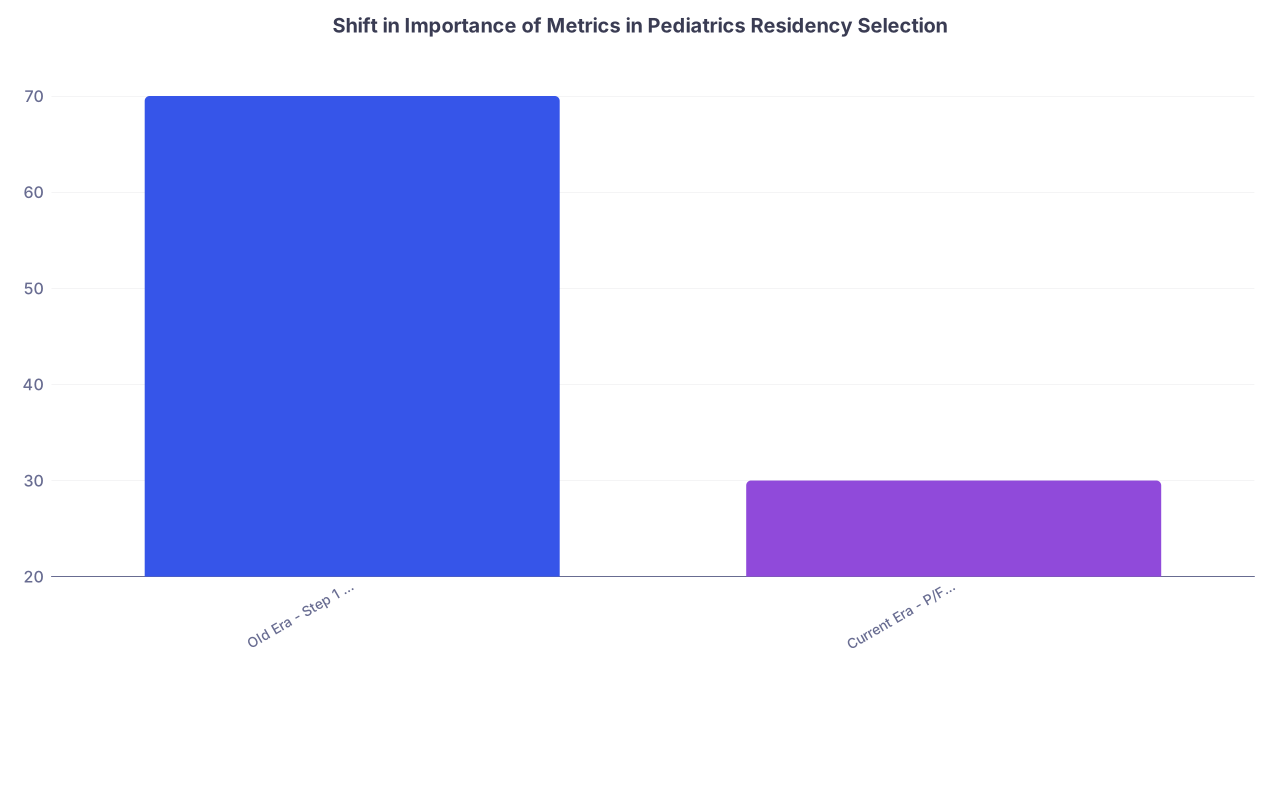
| Category | Value |
|---|---|
| Old Era - Step 1 heavy | 70 |
| Current Era - P/F Step 1 | 30 |
Obviously that’s illustrative, not a literal percentage. But the trend is real: subjective, longitudinal observations on the wards are now king.
Choosing and Timing Peds Sub‑Is Strategically
If you’re serious about pediatrics, you get exactly two or three high‑impact moves:
- A home peds sub‑I where you want a strong letter and to impress your own department.
- One, maybe two away rotations at target programs or similar‑tier children’s hospitals.
Where people screw this up:
- Doing an away at a top‑10 program “just to see if I can hang,” when they’re not ready, and then underperforming. That poor sub‑I can haunt your letters and reputation.
- Doing a peds sub‑I too early, before they’ve built basic inpatient skills. Then they look clueless on simple tasks like updating med lists or writing sign‑out.
- Doing four different pediatrics things and never doing one place deeply enough to be truly known.
Your best‑case scenario is this:
- Strong home peds sub‑I → glowing letter.
- One targeted away at a realistic reach or match‑level program where you intend to seriously apply.
- Possibly a NICU or PICU sub‑I at your home institution if peds is clearly your future, to show you can handle acuity.
And you treat each of those 4‑week blocks like they matter more than your interview. Because they do.
How to Behave on a Sub‑I So the Interview Becomes a Formality
Let me be very specific about the behaviors that make your interview almost irrelevant—because everyone already wants you.
Act like a junior intern by week two.
Don’t ask, “Can I do X?” every five minutes. Instead, say, “I started X, is that OK?” while still respecting scope and safety.Own your mistakes without drama.
“I missed that low glucose result; I should have checked the labs again before sign‑out. I’ve set a reminder for future patients.” Residents love that. Defensive students get buried.Know your patients better than anyone.
You might not know every PICU management guideline. Fine. But you must know exactly what changed in your kid’s ROS, meds, and vitals in the last 24 hours.Scale up your contribution over the month.
The worst look is being the same level of timid and dependent on day 18 as day 3. PDs love to hear: “They grew a ton during the month.”Be good to nurses and staff.
Not performatively. Just… like a decent human. Say thank you. Ask what you can do to make their jobs easier. The residents notice who “gets it” and who doesn’t.
If you do those things, your interview day usually sounds like this behind the scenes:
“She rotated with us. Everyone loved her. Interview was totally fine. Rank her high.”
No one is micro‑analyzing your answer about “biggest weakness” at that point.
When a Great Interview Does Matter
There are two specific scenarios where your peds interview can significantly move your rank:
You did not rotate there, and you’re applying from a lesser‑known med school.
If you blow them away as someone mature, grounded, and clearly kid‑centered, you can rise above applicants who are more generic on paper.You had an average home peds sub‑I but have clearly improved by the time of interviews.
Some PDs will reconsider if your faculty say, “They’ve grown a lot this year,” and your interview reflects that.
Even here, though, it’s usually the summary from people who’ve worked with you that seals the deal, not your single conversation on interview day.
The Part No One Tells You: Residents Remember Who Showed Up for Them
Here’s something you will never see written in official program materials.
Residents remember who helped them get through brutal call nights.
That time you volunteered to stay and help finish notes so the intern could shovel food into their mouth? That matters. That time you insisted on seeing the 10 p.m. admit with the senior so you could learn—residents remember that. And when it’s time for sub‑I feedback, that memory becomes:
“Honestly, I’d be thrilled to have them as a co‑intern.”
That sentence carries more weight in the rank meeting than anything you say in a suit on Zoom.
A Simple Mental Reframe
If you remember nothing else, remember this:
Your pediatric sub‑I is your real interview.
Your interview day is mostly just your closing statement.
Act accordingly.
If you treat the sub‑I like a month‑long audition where every nurse, resident, and attending is silently answering, “Would I trust this person with my patients?”, you’ll do the things that actually matter.
Years from now, you will not be thinking about whether you stumbled on that one interview question about “five‑year goals.” You’ll remember the month you turned into almost‑an‑intern, the kid whose asthma you finally got under control, and the resident who later told you, “We fought to rank you high.”
That’s the stuff that actually moves your career.
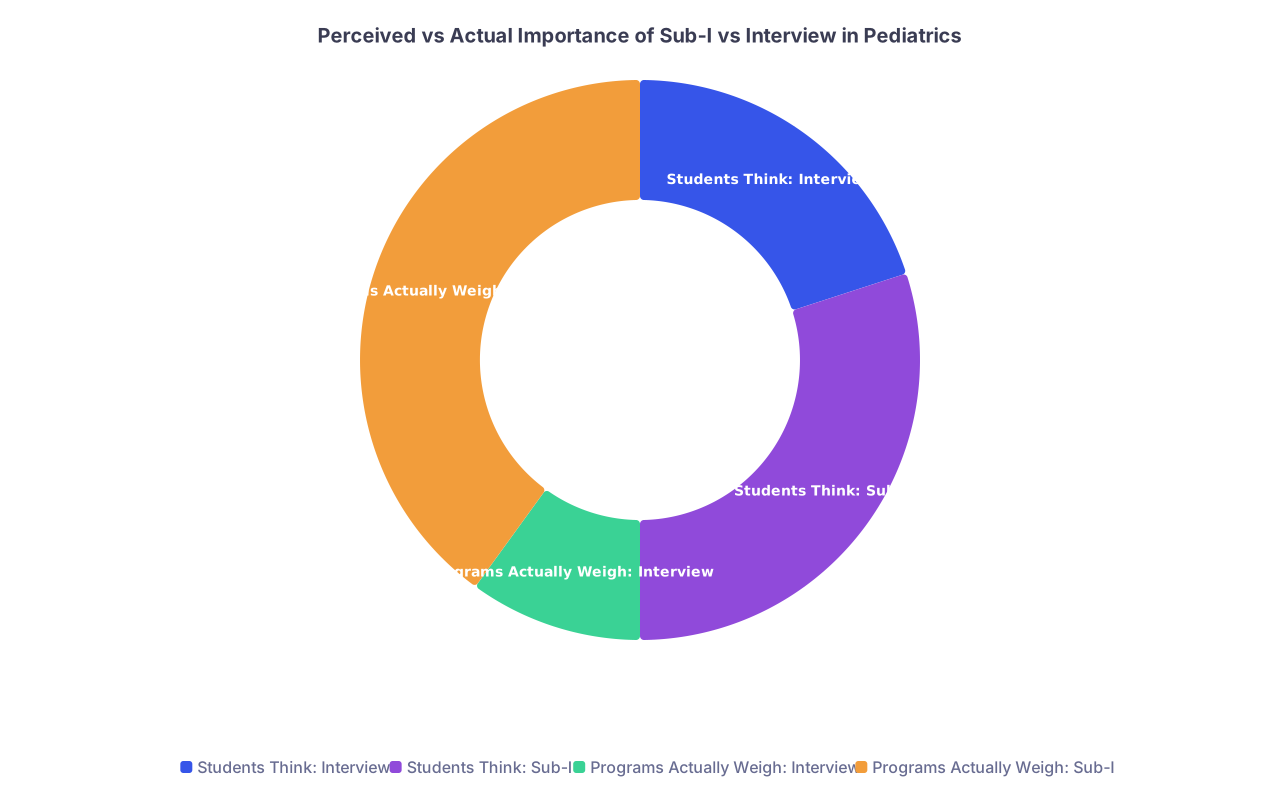
| Category | Value |
|---|---|
| Students Think: Interview | 40 |
| Students Think: Sub-I | 60 |
| Programs Actually Weigh: Interview | 20 |
| Programs Actually Weigh: Sub-I | 80 |