
Last winter, a PGY-2 walked into my office shaking, clutching a drip coffee like a life raft. On paper he was “fine”—no formal complaints, pass-level evaluations, steps all done. But two attendings had already warned me: “Keep an eye on him. Something’s off.”
Same month, another resident was quietly becoming every attending’s favorite person to work with. No awards, nothing flashy, but suddenly everyone was saying the same thing in faculty meeting: “We should keep her here as faculty if she wants.” She had no idea we were talking about her like that. But we were. A lot.
Let me tell you what actually happens behind those closed doors: program directors track residents constantly. Not in some official spreadsheet labeled “burnout risk” and “future star” (though some come uncomfortably close), but through a thousand small signals, patterns, and whispered comments that never make it into MedHub.
This is the part no one really explains to you. So I will.
The Hidden Radar: What PDs Are Really Watching
Most residents think their program director only sees the obvious: eval scores, exam results, serious professionalism issues. That’s the surface data. Necessary, but shallow.
Here’s the truth: long before a resident “crashes” or, conversely, gets fast-tracked into chief or junior faculty, there’s already a pattern we’ve been tracking. Informally. Quietly.
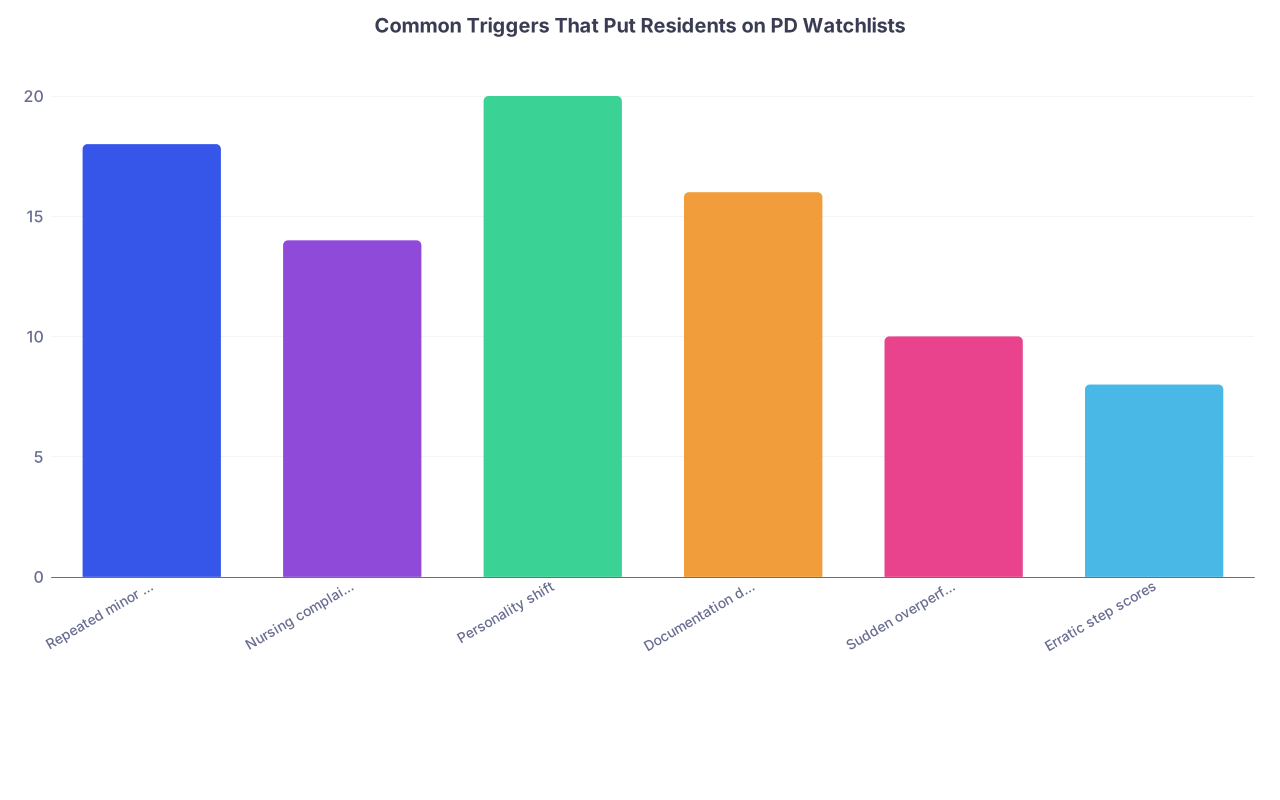
| Category | Value |
|---|---|
| Repeated minor lateness | 18 |
| Nursing complaints | 14 |
| Personality shift | 20 |
| Documentation delays | 16 |
| Sudden overperformance | 10 |
| Erratic step scores | 8 |
We watch five buckets of behavior obsessively:
- How you show up
- How the team talks about you
- How you react under pressure
- How your performance trend moves over time
- What your “off-stage” signals look like
Residents burning out and residents quietly excelling both light up this radar. Just in different patterns.
Let’s get specific.
The Burnout Signature: How PDs Know Long Before You Do
Nobody wakes up on Tuesday suddenly “burned out.” It’s a slow leak. We see the leak weeks to months before things explode.
1. The Subtle Deterioration Pattern
What you feel as “I’m just tired” often looks like this from our side:
- Evaluations that used to say “enthusiastic, engaged, pleasant” shift to “seems tired, quieter than usual, somewhat disengaged.”
- Your narrative comments lose adjectives. That’s not accidental. Faculty stop reaching for positive descriptors when they’re worried.
I sat in one CCC (Clinical Competency Committee) meeting where a colleague said, “Six months ago every eval on him used the word ‘curious.’ Now I see ‘efficient’ and ‘gets the job done.’ That’s code. Something’s wrong.” She was right. He later admitted he’d been waking up with chest pain before every call.
You’ll see it in your evals if you know how to read them. Most residents never look for the trend.
2. The Nursing Barometer
The first non-trainee group to notice burnout is almost always nursing. They have an animal-level sense for resident distress.
Here’s the kind of thing that quietly comes to me in the hallway:
“Hey, Dr. S, your PGY-1 on medicine nights… he seems really shut down lately. He used to explain his thought process; now he just says ‘fine, order it’ and walks off.”
That comment goes straight into my mental file. I may not put it in writing. But I start watching.
Burned out residents often show one of two nursing patterns:
- Increasing irritability, curt communication, zero bandwidth for small questions
- Increasing passivity, avoiding eye contact, vague orders, “whatever you think is fine”
Both are red flags. One looks aggressive. The other looks empty. Either way: now you’re on radar.
3. Micro-Absenteeism and “Harmless” Lateness
No-shows and big professionalism disasters are late-stage problems. The early stage is deceptively mild:
- “A few minutes late, but always has a reason”
- “Texts co-resident to cover pre-rounding because tired/sick/stuck” a bit more often
- Uses every last possible minute of conference or sign-out as buffer, slowly erasing all slack from the day
On the books, it’s nothing. In our heads, we track pattern. When a resident who was always five minutes early becomes always five minutes late, I notice. That shift matters more than you think.
4. Documentation Drift
One of the most reliable burnout markers no one talks about: documentation style.
Burning-out resident charts change in predictable ways:
- Notes get shorter and flatter. Same phrases. Less nuance.
- Or the opposite: rambling notes, disorganized, clearly written at 2 AM when you had no business still being awake.
When I see a previously crisp, structured note writer start dumping huge, scattered narratives into the chart, I don’t think “suddenly bad writer.” I think “mental bandwidth is gone; they’re drowning.”
Some PDs actually pull random charts before CCC meetings and read through notes looking for exactly this.
The Quiet Excellence Signature: Why Some Residents Seem “Lucky”
Here’s the flip side. The residents who “quietly excel” are not always the ones with the highest test scores or the most publications. Often they’re the ones who slowly build an undeniable pattern of being the person everyone wants around.
We talk about them long before they realize it.
1. Shift in How Attendings Phrase Things
There’s a distinct turning point in written and spoken feedback when a resident moves into “quiet star” territory.
Early comments: “Strong performer, pleasant to work with, reads a lot.” Good. Standard.
Later comments:
- “I would trust her with my sickest patient.”
- “Functions above level; could handle solo admit shifts now.”
- “If she wants a fellowship, I’d call anyone for her.”
Those phrases are currency. They signal to the PD: this person isn’t just good; they’re the kind you build a program around.
2. The “I Want Them on My Service” Effect
There’s a very simple behind-the-scenes metric:
Which names get requested.
I’ve heard variants of:
- “Can we get Ahmed on our ICU month again next year?”
- “If possible, put Liz on my elective; she gets stuff done and teaches the students.”
We never tell you that people are asking for you by name. We probably should. But honestly, half the time we’re afraid it will go to your head.
When multiple attendings and senior residents start requesting you, that’s when PDs start thinking chief resident, faculty track, or strongly supporting top-tier fellowship letters.
3. Stable Under Pressure, Not Superhuman
The myth is that “star” residents are unbreakable machines. The truth: the ones we rate highest are often the ones who have boundaries but stay steady in the storm.
On a brutal call night:
- Burnout-track resident either explodes or completely disappears emotionally.
- Quiet-excellence resident still looks human—tired, maybe frustrated—but keeps their tone level, makes safe decisions, triages tasks intelligently, and asks for help before things fall apart.
I remember one night attending telling me: “She paged me early, before it all went to hell. That alone makes me trust her more, not less.” Residents never believe that, but it’s true. Seeking help at the right time is a positive data point, not a weakness.
The Informal Watchlists: Yes, They Exist
Nobody calls them “burnout lists” or “future star lists.” But they exist all the same.
| Category | What PDs Actually Say |
|---|---|
| Clear concern | "We need to keep an eye on him." |
| Quietly struggling | "Something is off, not sure what." |
| Reliable solid | "Always steady, no drama." |
| Quiet excellence | "We should keep her here if we can." |
| Future chief/faculty | "She is a program builder." |
We usually do this sorting in CCC meetings, leadership huddles, or random hallway debriefs. The labels are unspoken but very real.
1. The “We Need to Keep an Eye on Them” Group
This is not the group you want to be in, but it is not a death sentence.
Signals that land you here:
- Repeated “seems tired” comments
- One or two professionalism near-misses (snapped at nurse, disappeared for 45 minutes, weirdly incomplete sign-outs)
- Step score or in-training exam drops sharply compared to your baseline
Response from PDs: increased scrutiny, more informal check-ins, strategic pairing with strong seniors, and sometimes quiet conversations with chief residents: “Stick closer to him this month. Let me know if you see anything.”
Most residents have no idea this conversation happened.
2. The “Quiet Excellence” Group
This group doesn’t always get awards. Sometimes they’re introverts. But everyone knows exactly who they are.
Common triggers for this mental category:
- Nurses keep saying, “If my family is here, I want her as their doctor.”
- Students say, “He’s the only resident who consistently teaches me and checks in.”
- Faculty consistently mention you in positive ways without being prompted.
These are the ones I think about when someone retires and I wonder, “Who could grow into that role in five years?”
What PDs Do When They Think You’re Burning Out
This part depends heavily on personality and culture of the program. Some PDs are direct. Some are conflict-avoidant. Some are excellent at early intervention. Some are terrible and only show up when something explodes.
But broadly, the internal playbook looks like this:
Step 1: Pattern Confirmation
Before confronting you, we try to make sure it’s not just one hypersensitive attending.
We:
- Review a run of evaluations from multiple rotations
- Ask chiefs quietly, “What’s your sense of how they’re doing?”
- Sometimes pull a couple of notes to see if documentation matches the concern
If two or three vectors line up—evals, nursing comments, exam performance—then we move.
Step 2: The “How Are You Really Doing?” Meeting
You know the one. “Can you stop by my office for a few minutes?” No specific agenda in the email.
Here’s the cynical truth: by the time you get that invite, we’re already worried. The purpose is rarely casual.
In that meeting, a few things are being evaluated in real time:
- Do you have insight into how you’re presenting?
- Can you talk about stress and limits without falling apart or getting hostile?
- Are there obvious fixable drivers (family crisis, financial disaster, new baby, toxic rotation)?
If you say you’re “fine” while every data point says you’re not, our concern intensifies. Lack of insight is scarier than exhaustion.
Step 3: Quiet Protections or Quiet Escalations
If we believe you’re at true burnout risk, we might:
- Adjust your upcoming schedule slightly: fewer brutal stretches back-to-back, strategic electives placed earlier
- Pair you with attendings known to be good teachers and not screamers
- Encourage mental health visits and, in good programs, help streamline that process so you’re not punished for going
In worse programs, the opposite happens:
- You get labeled “fragile,” and people start withholding opportunities
- Your name comes up in rank meetings with language like “not sure about her resilience,” which is poison for certain fellowships
That’s the dark side. It happens. I’ve seen it.
What PDs Do With Residents Who Quietly Excel
On the other end of the spectrum, PDs make bets. Human bets. Who is worth extra investment?
We will not tell you this directly, but it shows up in opportunities:
- You’re asked to sit on a curriculum committee “to get the resident viewpoint” (translation: we’re testing you as a future leader).
- You’re invited to help interview applicants. We want them to see you and we want to see how you represent the program.
- A PD says, “If you’re thinking about fellowship, let’s start planning early. We can get you in front of X, Y, Z people.”
| Period | Event |
|---|---|
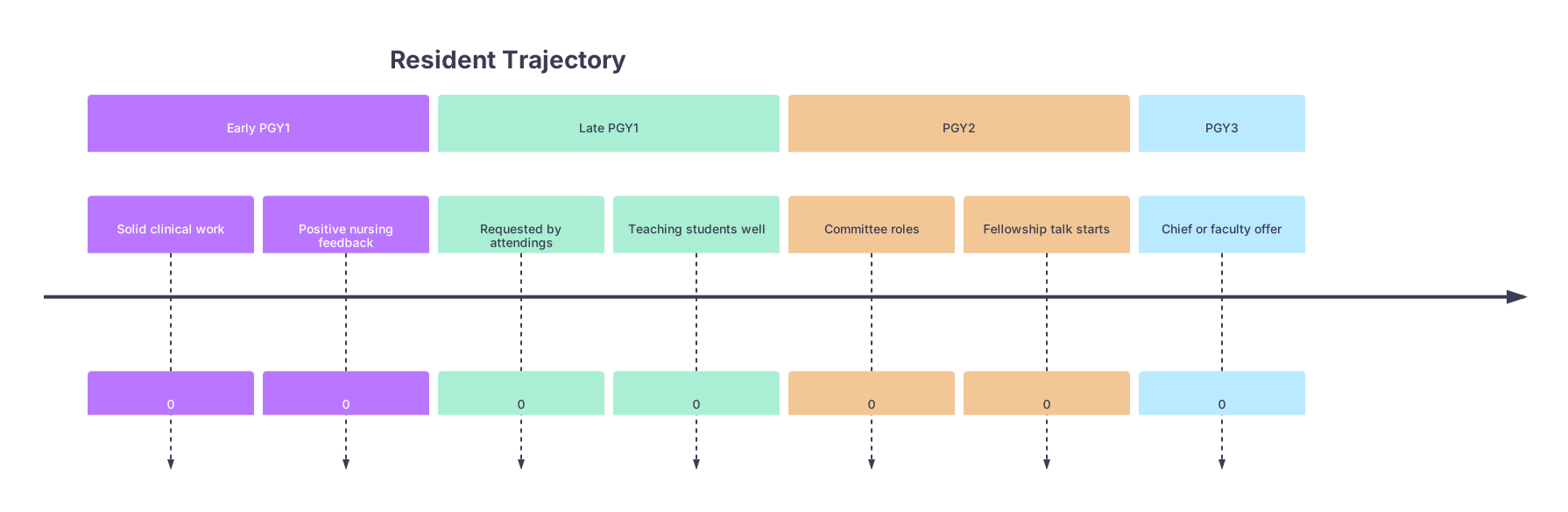
| Early PGY1 - Solid clinical work | 0 |
| Early PGY1 - Positive nursing feedback | 0 |
| Late PGY1 - Requested by attendings | 0 |
| Late PGY1 - Teaching students well | 0 |
| PGY2 - Committee roles | 0 |
| PGY2 - Fellowship talk starts | 0 |
| PGY3 - Chief or faculty offer | 0 |
You think it’s random. It’s not. It’s the culmination of a year or two of quiet conversations about you when you weren’t in the room.
How To Tilt Toward “Quiet Excellence” Instead of “Burnout Watch”
You cannot control everything. Some programs are malignant. Some PDs are checked out. Some life situations will steamroll even the most resilient resident.
But there are things you can control that radically change how you show up on the PD radar.
1. Control the Variability, Not the Peak
We care far more about your floor than your ceiling.
The resident who is brilliant on a good day and terrifying on a bad day is much riskier than the resident who is always “solid-plus” with the occasional great day.
Quiet excellence = high, stable floor. Not occasional fireworks.
That means:
- Keep your basic communication polite, even when tired.
- Double-check orders for safety even if your note will be late. Safety beats speed.
- When you’re having a truly awful day, tell your senior: “I’m at 60% today, I need help prioritizing.”
That last one alone can pull you off the burnout watchlist, because it shows insight and protects patient care.
2. Build a Consistent Nursing Reputation
Nurses talk. Constantly. And PDs listen.
You want phrases like:
- “He always calls back fast.”
- “She explains her plans and listens when we’re worried.”
You do not need to be everyone’s best friend. But if three different charge nurses tell me some version of “He’s safe, he listens,” your stock rises fast.

3. Show Controlled Vulnerability Up the Chain
Here’s the paradox: hiding everything is not how you avoid the burnout list. It’s how you end up there with no safety net.
The residents I worry about least are the ones who, once or twice a year, knock on my door and say something like:
“I’m handling things overall, but this run of nights has been brutal and I’m noticing I’m getting more irritable. I don’t want to head down a bad road. Can we look at my upcoming schedule?”
That is gold. It shows:
- Insight
- Proactive problem-solving
- Concern for safety
I file that as “strong professional judgment,” not “weakness.”
The Dark Truth: Some PDs Abuse This Information
I’m not going to sugarcoat it. Some leaders weaponize these informal impressions.
They:
- Overload the “quiet stars” until they, too, burn out
- Decide a resident is “fragile” and then interpret every normal human moment through that lens
- Use burnout concerns as cover for not supporting residents facing bias, bullying, or toxic attendings
If you feel you’re being treated as “the problem” when the environment is what’s broken, you’re not crazy. That happens. More than it should.
In those settings, outside mentors—fellowship directors at other institutions, faculty you met on away rotations, advisors from med school—become crucial. They can help you decide when to push, when to document, and when to just survive and get out.
How This Should Affect How You Choose a Residency
This isn’t just academic psychology. It should change how you evaluate programs before you commit three to seven years of your life.
On the interview trail, you’re not just asking, “Are they strong in cardiology?” You’re asking, “How do they treat the burned out and the excellent?”
Signs of a healthier program:
- Residents can describe a time someone struggled and got real help, not punishment.
- Chief residents speak respectfully about struggling co-residents, not with contempt.
- Faculty talk about residents as future colleagues, not disposable labor.
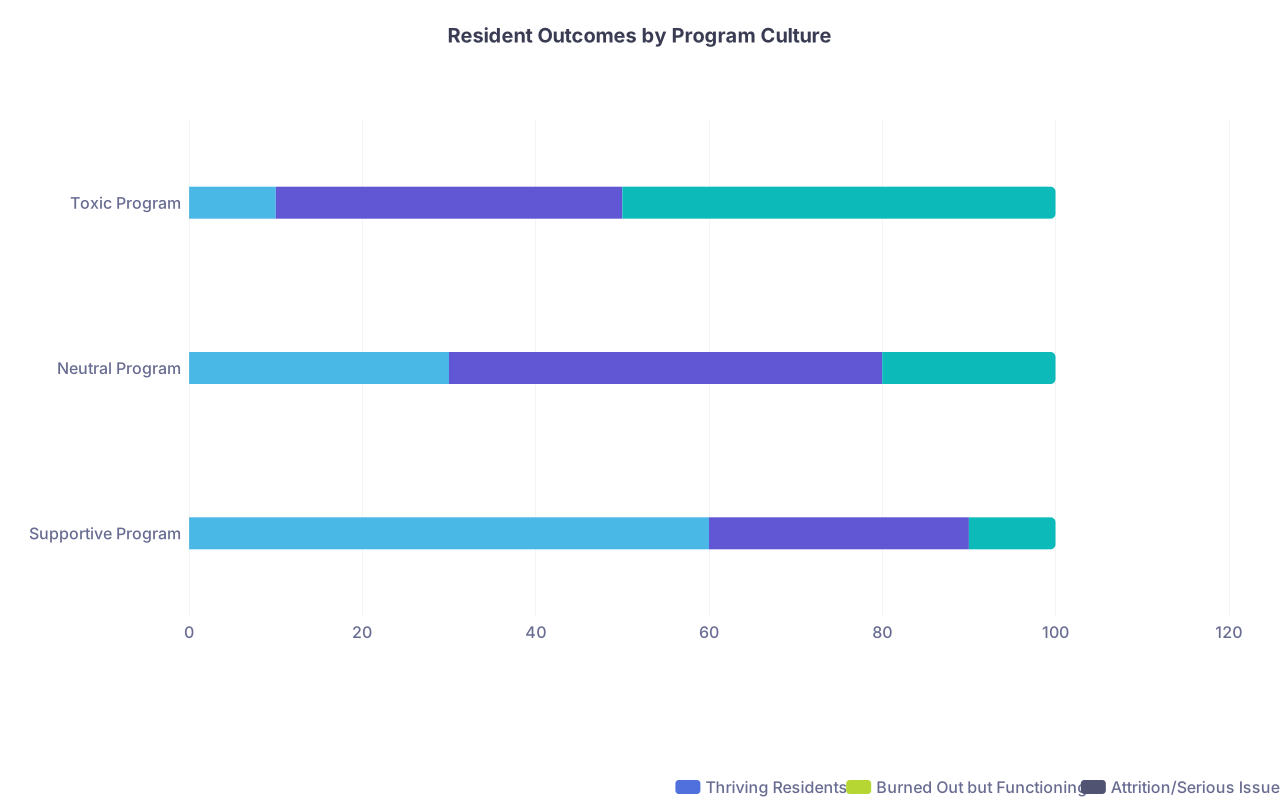
| Category | Thriving Residents | Burned Out but Functioning | Attrition/Serious Issues |
|---|---|---|---|
| Supportive Program | 60 | 30 | 10 |
| Neutral Program | 30 | 50 | 20 |
| Toxic Program | 10 | 40 | 50 |
Ask pointed questions on interview day:
- “Can you tell me about how the program supports residents going through personal crises?”
- “When residents really excel here, what tends to happen for them in terms of opportunities?”
Watch how specific the answers are. Vague talk = vague support.

Final Thought
Years from now, you will barely remember your exact in-training exam percentile or how many patients you saw on that insane post-call morning. But you will remember which leaders saw you clearly—both when you were drowning and when you were quietly doing the best work of your life.
Program directors are watching. Constantly. Not just to judge, but to sort, to protect, to invest, and sometimes, yes, to control.
Your job is not to perform for that hidden radar. Your job is to build a version of yourself that is stable, honest, and teachable enough that when you inevitably hit the wall—or quietly start to soar—the story that gets told behind closed doors is one you can live with.