It's September of your MS2 year. You just got out of neuroanatomy small group, your psych pre-clinical course is finally getting interesting, and you keep catching yourself thinking, “I like both. I do not want to give one up.” Someone offhandedly mentioned “combined neuro-psych programs” and now you’re 12 tabs deep into Google, slightly overwhelmed, slightly excited, and wondering when you’re supposed to start planning for this niche path.
You’re early. Which is good. Because for something this small and quirky, early and deliberate beats late and panicked every time.
Here’s the timeline from now (early MS2) through Match for applying to combined Neurology–Psychiatry (and related neuro-psych hybrids), broken down into:
- MS2: Exploration + foundation
- MS3: Clinical proof + targeted positioning
- Early MS4: Application execution
- Interview season + ranking
I’ll walk you month-by-month where it matters, and “by season” when that’s all you need.
Big Picture: What Combined Neuro‑Psych Actually Is (and Why Timeline Matters)
Before we go month-by-month, you need a mental model.
Combined neuro-psych means:
- A small number of integrated, usually 5-year programs
- You leave residency board-eligible in both Neurology and Psychiatry (or at least with that intent—check each program)
- These are not the same as doing a neuro residency and then a psych fellowship, or vice versa
Programs are few. Think:
- Brown Neuropsychiatry
- Cincinnati combined Neuro-Psych
- Some programs do Neuro + Psych + sometimes Family or Peds variations
The bottlenecks you’re up against:
- Limited spots (often 1–3 per program, sometimes fewer)
- Program directors who want to see that your interest in the interface is real, not a last-minute “couldn’t decide” move
- You need to look good enough for stand‑alone Neurology and stand‑alone Psychiatry, because you should absolutely apply to both in parallel as a safety net
That’s why starting in MS2 matters. You’re building:
- Clinical credibility in both domains
- A coherent story about why the overlap
- Enough applications to not box yourself into a single tiny applicant pool
At each phase, your question is:
“How do I show I can handle both, and that I actually want both?”
MS2: Exploration, Signals, and Early Positioning
Fall MS2 (September–December): Quiet Setup Phase
At this point you should:
Clarify your baseline interest.
- Start a simple running document titled “Why neuro + psych?”
- Any case, lecture, or patient that triggers that “this is both neuro and psych” reaction—write it down.
- You’ll use this for your personal statement and interviews later, but now it just keeps your thinking sharp.
Talk to real humans.
Within the next 4–6 weeks:- Email or meet:
- A neurologist (ideally one doing behavioral neurology, epilepsy with psych comorbidity, or movement disorders with psych overlap)
- A psychiatrist with an interest in neuropsychiatry, psychosis, TBI, or CL psych with neuro focus
- Say bluntly: “I’m an MS2 considering combined neuro-psych. Do you know anyone who has done this or a program I can talk to?”
- Your goal is not a CV line. Your goal is clarity and names.
- Email or meet:
Research reality check.
If you’re not doing any research yet:- Pick one of:
- A neurology project with clear psych overlap (e.g., depression post-stroke, cognitive impairment in epilepsy)
- A psychiatry project with neurologic overlap (e.g., psychosis in epilepsy, neurocognitive outcomes in SUD)
- The content matters more than which department owns it. You want to be able to say: “My work sits at the interface.”
- Pick one of:
Start thinking about Step/Level exams strategically.
- Combined programs aren’t looking for 280 monsters, but they do want “safe” scores.
- You should aim for solid, no‑drama performance to be credible for both neuro and psych.
- That means: during MS2, don’t treat neuro and psych systems as “lightweight”—these will define your brand.
Spring MS2 (January–May): Locking Direction + Step Prep
At this point you should:
Confirm this is a serious path, not a passing crush.
- By March, you should have had at least:
- One substantial conversation with someone who knows combined programs
- Reviewed current lists of combined programs (they change; always cross‑check on each program’s site)
- If by now you’re thinking “I only really care about psych but like neuro content,” then apply psych only and stop forcing it. Combined is overkill if one side is just ‘mildly interesting’.
- By March, you should have had at least:
Align your research and extracurriculars.
Between January and April:- Try to structure a small, doable project with:
- Clear patient population or topic at the neuro-psych interface
- A timeline that lets you have at least a poster or abstract by early MS4
- Examples:
- Retrospective chart review on functional neurologic disorder outcomes
- Data on cognitive impairment among depression patients in a neurology clinic
- Try to structure a small, doable project with:
Plan your exam timing.
- Make sure your Step/Level 1 timing doesn’t crush your ability to do:
- Early MS3 neuro and psych rotations well
- Extra reading and reflection during those rotations
- Translation: do not bury yourself in a late exam date that bleeds into MS3 and leaves you depleted when you actually need to shine clinically.
- Make sure your Step/Level 1 timing doesn’t crush your ability to do:
MS3: Clinical Proof You’re a Real Neuro‑Psych Person
MS3 is where you build your actual case. This year matters more than your pre-clinical posturing.
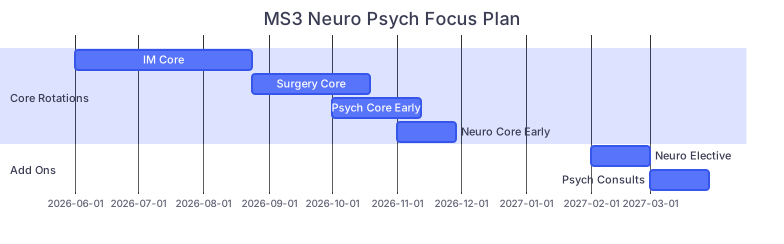
| Task | Details |
|---|---|
| Core Rotations: IM Core | a1, 2026-06, 12w |
| Core Rotations: Surgery Core | a2, after a1, 8w |
| Core Rotations: Psych Core Early | a3, 2026-10, 6w |
| Core Rotations: Neuro Core Early | a4, 2026-11, 4w |
| Add Ons: Neuro Elective | b1, 2027-02, 4w |
| Add Ons: Psych Consults | b2, 2027-03, 4w |
Step Zero: Rotation Scheduling (Late MS2 / Early MS3)
At this point you should arrange:
- Psych and Neurology as early as possible in MS3.
- Ideal: both completed by end of winter MS3.
- Reason: you’ll need:
- Strong letters from both sides
- Enough time to do at least one focused elective/sub‑I before ERAS
Fight for early slots. Swap if you have to. Yes, people will be annoyed. Do it anyway.
Early MS3 (First Half of the Year): Get Data on Yourself
During your first major rotations (IM, Surgery, etc.):
- Show you’re clinically reliable.
Combined programs aren’t just looking for dreamy thinkers. They want functional residents who can function on a stroke team or on a high‑acuity psych service.
When you hit:
Psychiatry Core (ideally by fall MS3)
At this point you should:
Work like this rotation is your audition.
- Be the student who:
- Knows neuro on psych patients (e.g., can discuss workup for new cognitive changes)
- Reads about catatonia, delirium vs psychosis, FND vs factitious, etc.
- Be the student who:
Identify a letter writer.
By week 3–4:- Pick one attending who:
- Actually saw you daily
- Understands you’re considering combined neuro-psych
- Say: “I’m planning to apply to combined neurology-psychiatry and to both neurology and psychiatry programs. I’d love to work toward a strong letter from you if you feel you can write one.”
- You are not asking for the letter yet. You’re asking to be evaluated with that in mind.
- Pick one attending who:
Collect neuro-psych cases.
- Keep note of:
- Delirium vs psychosis cases
- New onset psychosis with neurologic flags
- Substance‑related neurocognitive disorders
- These will become stories for your personal statement and interviews.
- Keep note of:
Neurology Core (ideally same fall–winter window)
At this point you should:
Again, treat this as an audition.
- On stroke or general neuro, be the student who:
- Brings up mood, anxiety, cognition, and functional status
- Asks about neuropsychiatric manifestations of disease (MS, epilepsy, Parkinson’s, etc.)
- On stroke or general neuro, be the student who:
Secure a neuro letter writer.
- Same playbook as psych:
- Explain the combined path
- Ask explicitly if they’re comfortable commenting on your strength as someone who could pursue neurology or neuro-psych.
- Same playbook as psych:
Find the interface.
- Proactively ask: “Are there patients on our service who might also be complex psychiatrically?”
- Volunteering to see those patients makes you memorable and gives you authentic stories.
Late MS3: Converting Interest Into a Competitive Application
Spring MS3 (February–May): Refining Your Angle
At this point you should:
Do at least one targeted elective.
- Options:
- Neuropsychiatry clinic (if your school has one)
- Behavioral neurology
- Epilepsy clinic with psych comorbidity
- CL psychiatry with strong neuro component
- If your school doesn’t have these, you’ll plan away rotations for MS4. For now, identify what’s missing.
- Options:
Double-check your program list and understand the ecosystem.
| Pathway Type | Length | Board Eligibility | Number of Programs | Risk Level |
|---|---|---|---|---|
| Combined Neuro-Psych | 5 yrs | Neuro + Psych | Very few | High |
| Neurology only | 4 yrs | Neurology | Many | Lower |
| Psychiatry only | 4 yrs | Psychiatry | Many | Lower |
| Neuro then Psych | 4 + 3 | Sequential, long training | Not formal track | Highest |
You should be leaning toward:
- Apply combined + neuro stand‑alone + psych stand‑alone
- Not “combined or bust” unless you’re absurdly risk‑tolerant
Line up letters plan.
Target by May MS3:- 1 strong psych letter
- 1 strong neuro letter
- 1 IM or surgery (for general medicine credibility)
- Optional: research or niche neuro-psych letter
You’ll mix and match these for different programs in MS4.
Early MS4: Away Rotations, Sub‑Is, and Application Build
Now the clock is loud. ERAS is real. Timelines matter.
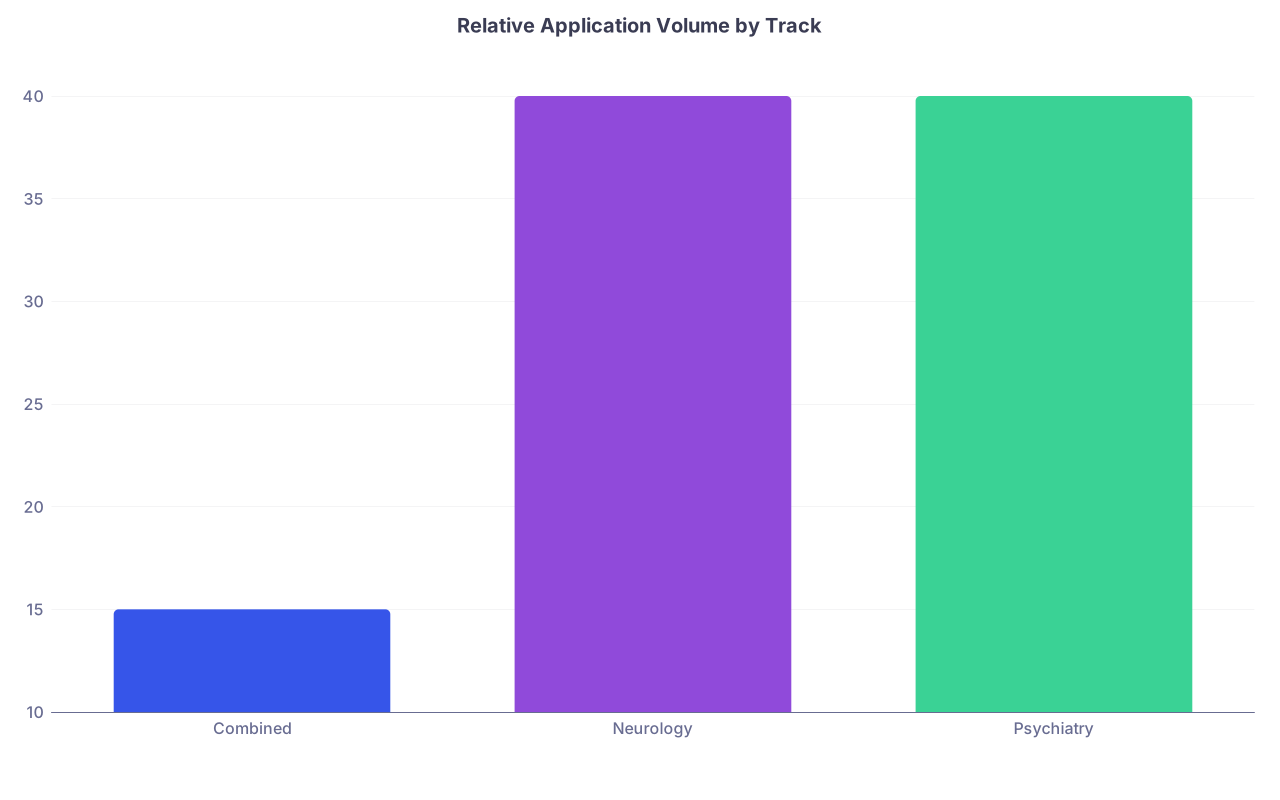
| Category | Value |
|---|---|
| Combined | 15 |
| Neurology | 40 |
| Psychiatry | 40 |
(Those values are a reasonable target: a small number of combined programs plus a healthy number of neurology and psychiatry applications.)
Late Spring / Early Summer Before MS4 (April–June)
At this point you should:
Lock in away rotations (if doing them).
- If your school lacks strong neuro-psych stuff, aim for:
- 1 away in neuropsychiatry/behavioral neuro/CL psych at a place with a combined program you like
- Email program coordinators early.
- In your request, actually say: “I’m planning to apply to your combined neurology-psychiatry program and would like to complete an elective to better understand the training and patient population.”
- If your school lacks strong neuro-psych stuff, aim for:
Draft your personal statement structure.
You probably need 2–3 versions:- Combined neuro-psych statement
- Neurology‑only statement
- Psychiatry‑only statement
They should be obviously related but not copy‑paste clones. Combined statement has to answer:
- Why you need both, not just “I can’t decide”
- How your experiences specifically live at the interface
Summer MS4 (June–August): Sub‑Is + Final Application Build
At this point you should:
- Do sub‑I(s) in one or both fields.
Ideal combo:
- 1 sub‑I in Neurology (inpatient service, stroke, or general)
- 1 advanced Psych rotation or sub‑I (inpatient psych, CL psych)
During each:
- Re‑introduce your goal: “I’m applying to combined neuro-psych and to both fields individually.”
- Ask for letter updates from prior attendings early in the block.
Finalize program list.
By early August:- Make a 3-column spreadsheet:
- Combined programs (with details: length, structure, board eligibility)
- Neurology programs (with reach/target/safety)
- Psychiatry programs (same)
- Check for:
- Application tracks—some combined programs are separate ERAS tracks under psych or neuro
- Any weird supplemental materials or essays
- Make a 3-column spreadsheet:
Polish your personal statements.
Combined statement should:- Start with a concrete neuro-psych case you saw (not a vague “ever since I was a child…”)
- Move quickly to:
- How your psych rotation shaped your understanding of neuro disease
- How your neuro experiences exposed psych complexity
- Why a dual‑board path, not just being “psych-minded neurologist” or “neuro-savvy psychiatrist”
Application Submission: ERAS and Parallel Strategies
September MS4: Submitting ERAS
At this point you should:
Submit early in the opening window.
- There is zero strategic value in waiting if your pieces are ready.
Customize experiences section.
- For combined and neuro programs:
- Emphasize neuro-heavy work, neuro-psych projects, and your ability to manage neurologic illness
- For psych programs:
- Highlight psych longitudinal work, CL experience, and interface themes
- Don’t lie. Just order and frame appropriately.
- For combined and neuro programs:
Assign letters strategically.
Typical setup:
- Combined programs:
- 1 neuro letter
- 1 psych letter
- 1 general medicine or research letter with interface relevance
- Neurology programs:
- 2 neuro‑leaning letters (one pure neuro, one interface or IM)
- Optional psych letter if it strengthens your narrative of interest in neurocognitive/behavioral issues
- Psychiatry programs:
- 2 psych‑leaning letters
- Optional neuro letter if it clearly adds value, especially if you’re drawn to psychosis, TBI, FND, etc.
- Do not hide your combined interest.
- Programs don’t love surprises.
- It’s fine to say in psych or neuro apps:
- “I’m also applying to combined neuro-psych because many of my interests are at the interface. I’d be thrilled to train in either pure psych/neuro or in a combined track.”
Interview Season: Managing Three Parallel Tracks
October–January: Interviews
At this point you should:
- Know how to explain your path in 3 versions.
You need tight, honest answers to:
For combined programs:
- “Why do you need both fields?”
- “How do you see your career being different from a neurologist working closely with psychiatry or a psychiatrist with strong neuro knowledge?”
For neurology programs:
- “You’re also applying to psych and combined. Why are you still a good fit for a pure neurology track?”
- Emphasize:
- You love the diagnostics, neuro exam, acute management, etc.
- The psych interest will make you better with complex neuro patients.
For psychiatry programs:
- “Are you going to leave us for neurology?”
- Emphasize:
- Your dedication to severe mental illness, the psychotherapeutic alliance, CL, or neurocognitive psych
- How your neuro knowledge will serve that work, not replace it.
Don’t oversell indecision.
- “I couldn’t decide” is a weak answer.
- “I noticed all my favorite patients live at this interface” is a strong one.
Track impressions separately.
- After each interview, jot:
- Patient mix
- Faculty/appetite for neuro-psych thinking
- Resident attitudes (“We love the combined folks” vs “No idea what they do”)
- After each interview, jot:
Rank List: Strategy When Programs Are Scarce
February–March MS4: Ranking
At this point you should:
- Decide if combined is your true #1 or just a nice‑to‑have.
Ask yourself bluntly:
- “If I got into a top‑tier psych or neuro program vs a mid‑level combined, what would I pick?”
Your rank list must reflect that honestly.
- Rank within each category.
General approach:
- If combined is your top priority:
- Rank all combined programs you’d realistically attend at the very top
- Then rank neurology and psychiatry programs interleaved according to your true preference
- If combined is “nice but not essential”:
- Place them high but not above significantly better-fit standalone programs you’d rather attend.
- Double-check viability.
- Don’t put a program on your rank list if:
- The vibe was hostile to neuro-psych
- You’d be miserable if it was your only outcome
- Don’t put a program on your rank list if:
Yes, even if they have a combined spot.
FAQ (Exactly 4 Questions)
1. Do I have to do a ton of research to match into a combined neuro‑psych program?
No. I’ve seen people match with modest research as long as it’s coherent. A couple of posters or an abstract that clearly sits at the neuro-psych interface is usually enough. What hurts more is totally unrelated research (like ortho outcomes) plus a sudden “I love neuro-psych” statement with no experiential backbone. Depth beats quantity. A small, well-thought-out neuro-psych project plus strong clinical letters is better than five random papers.
2. Is it risky to apply combined neuro‑psych, neurology, and psychiatry all at once? Do programs hate that?
Not if you’re transparent and your story is consistent. Programs only get annoyed when they feel like your interest is performative. If you can clearly explain the thread connecting all three—“I love the brain and behavior interface; here’s how I’d be happy in each path”—most PDs respect that. The real risk is applying only to combined when there are so few spots. Parallel applications are just risk management.
3. What if my school doesn’t have any neuropsychiatry or behavioral neurology electives?
Then you build the best proxy you can. Use: CL psychiatry, epilepsy clinics, movement disorders, memory clinics, or TBI rehab. If none of those exist locally, look outward: away rotations at institutions with stronger neuro-psych presence, or remote research with a faculty mentor elsewhere. Programs do not expect your school to be perfect. They expect you to show effort in seeking out neuro-psych exposure within what’s available.
4. When is it “too late” in med school to decide on combined neuro‑psych?
If you wake up in January of MS4 and decide you want combined with zero prior neuro or psych commitment, you’re late. Concretely: by the end of MS3 you should have both core rotations done, at least one letter in each field, and some story that shows sustained interface interest. Deciding in late MS2 or early MS3, like you are now, is ideal. You still have time to stack rotations, letters, and a small project that all point in the same direction.
Key points:
- Use MS2 and early MS3 to quietly build a real neuro‑psych identity: rotations, mentors, and at least one interface‑focused project.
- Apply broadly and in parallel: combined + neurology + psychiatry, with tailored statements and letter mixes, not a one‑size‑fits‑all application.
- When ranking, be brutally honest with yourself about whether combined is truly your top priority or just one of several good paths to the kind of patients you want to care for.