
The biggest lie you have heard about choosing psychiatry is that if you “figure it out late,” you are already behind. You are not. You are just on a compressed timeline—and that means you need a ruthless, month‑by‑month plan.
This guide assumes you are in the second half of MS3 when the psych lightbulb finally goes on. You like the interviews more than the imaging. You care more about stories than staging. And now you are staring at the calendar wondering whether you can still make a serious run at psychiatry.
You can. But you do not have time to wander.
First: Know Where You Are on the Calendar
Everything in this plan hinges on when in MS3 you realize you might want psych.
To keep this concrete, I will assume a typical U.S. calendar:
- MS3 runs July–June
- ERAS opens mid‑June after MS3
- Applications submit September
- Interviews October–January
Adjust the month names if your school is off‑cycle, but the relative order stays the same.
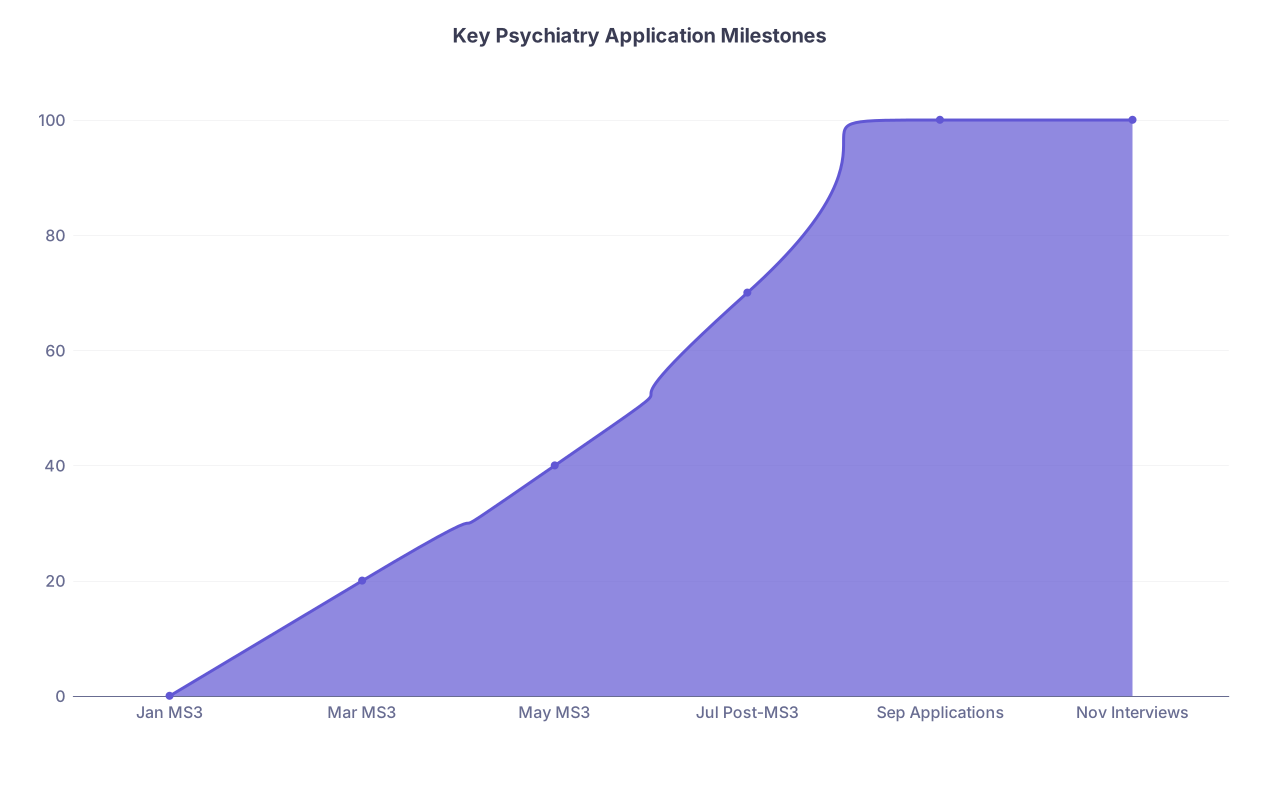
| Category | Value |
|---|---|
| Jan MS3 | 0 |
| Mar MS3 | 20 |
| May MS3 | 40 |
| Jul Post-MS3 | 70 |
| Sep Applications | 100 |
| Nov Interviews | 100 |
Think in phases:
- Discovery phase – “I think I like psych.”
- Commitment phase – “I am going for it; I need evidence on paper.”
- Application build phase – “I am polishing, not reinventing.”
I will walk you month‑by‑month from the moment you realize “Psych might be it” through submitting ERAS.
Month 0: The Moment You Realize “I Might Be Psych”
This is not a calendar month. This is the week you first suspect psych is your thing.
At this point you should:
Lock down your current situation
- What rotation are you on right now?
- Where is psych in your schedule (done, upcoming, missing)?
- What does your Step 1 / Step 2 timeline look like?
Do a 30‑minute reality check on psych as a field
- Read one concise overview (e.g., AAMC Careers in Medicine psychiatry page).
- Look at:
- Lifestyle (call, nights, outpatient focus)
- Competitiveness (US MD vs DO vs IMG)
- Fellowship options (child, addiction, consult, forensics, etc.)
- You are not choosing yet. You are checking whether this is plausible.
Talk to one human in psychiatry within 7 days
- Options:
- Your school’s psych clerkship director
- A psych attending you just worked with
- A senior resident who was friendly on the unit
- Script it bluntly:
- “I realized I might be interested in psychiatry, but I am late MS3. Can I get 15 minutes to ask how to explore it quickly and still be competitive?”
- Options:
Your first goal is not to decide. Your first goal is to stop losing time by drifting.
Month 1: Lock in Exposure and a Realistic Path
Assume Month 1 is roughly January–March of MS3 for someone who discovered psych in the back half of the year. If your timing is different, this is just “the first full month after you realize psych might fit.”
At this point you should:
1. Map Your Remaining Third‑Year Schedule
You need to know where the chess pieces are.
- List each remaining MS3 block through June:
- Core rotations left (IM, surgery, peds, ob‑gyn, etc.)
- Any open “elective” or “selective” spots
- Any required psych block (if not done)
Then meet with:
- Your academic advisor or dean’s office
- Psych clerkship director (if accessible)
Ask two specific questions:
- “What is the earliest I can get onto an inpatient psych or consult psych elective?”
- “Is there a way to rearrange remaining rotations to get more psych before ERAS?”
Sometimes the answer is no. You still ask. I have seen schedules moved around for students who were clear and proactive.
2. Decide Your “Testing Period” – 4–8 Weeks
You do not need to commit to psych for life this month. You need a serious trial period where you act “as if” you are going for psych and see how it feels.
That means:
On your current rotation, you:
- Volunteer for patients with heavy psychiatric overlay (delirium, substance use, mood disorders).
- Present with a psych lens: “I am wondering about PTSD here…” instead of ignoring it.
- Ask attendings how they work with psychiatry on complex cases.
Aim for 1–2 half‑days of shadowing psych:
- Outpatient mood/anxiety clinic
- Adult inpatient unit
- C/L psych if available
You are not padding your CV yet. You are calibrating your interest.
3. Start a Psychiatry Interest Log
You need receipts. Not just vibes.
Create a simple document and for each psych‑relevant encounter note:
- Date, setting
- Brief situation
- What you liked / disliked
- Skills you used (motivational interviewing, de‑escalation, family meetings)
This log becomes:
- Content for your personal statement
- Fuel for conversations with mentors
- Evidence that you are not a last‑second tourist
Month 2: Commit or Cut
By Month 2, you have had several weeks of deliberate exploration. This is when you stop “considering” and decide whether to commit to psychiatry as your primary plan.
At this point you should:
1. Make a Clear Choice
Use three questions:
- Do I consistently enjoy psych‑heavy days more than non‑psych days?
- Can I picture myself still interested in psych after 20 years?
- Are there any other specialties that seriously compete right now?
If psych wins, you:
- Call it: “I am applying psychiatry.”
- Stop hedging with five other fields in your head.
- Start building a competitive psych application.
If you are still torn between, say, psych and neurology:
- You are not ready to commit.
Then you schedule one more month of side‑by‑side comparison:- Ask for a neuro elective and a psych elective in adjacent blocks.
- Set a hard deadline: decision by the end of that second elective.
2. Secure a Psych Elective Before ERAS
You need at least one strong psych rotation completed before applications. Two is better.
Work with scheduling to:
- Turn any “open” elective or sub‑I block into:
- Inpatient psych
- C/L psych
- Outpatient psych with good teaching
- Place it no later than July–August (ideally in late MS3 / very early MS4).
You are looking for:
- Strong attendings known to write meaningful letters
- Settings that give you daily, real responsibility:
- New patient interviews
- Presenting to the team
- Writing notes and plans

3. Identify Letter‑Worthy Psych Faculty
Letters matter more than you think in psychiatry. Programs are small. People read them.
By the end of Month 2, have names of 2–3 psychiatrists who:
- Know you or will know you on upcoming rotations
- Actually teach
- Are respected by residents
Email something like:
“I am leaning strongly toward applying to psychiatry and will be on your service in May. I hope to work closely with you and get feedback on whether I would be a strong candidate for the field.”
You are signaling. Early.
Month 3: Build Evidence and Start Positioning
Month 3 is where you stop just “exploring” and start stacking your file so that by the time ERAS opens, it does not look like a last‑minute pivot.
At this point you should:
1. Optimize Your Current Rotation for Psych Skills
Whatever rotation you are on, you can tilt it toward psych.
- On Internal Medicine:
- Volunteer to see patients with delirium, substance use, anxiety about illness.
- Practice clear, empathic explanations: capacity, risk, goals of care.
- On Surgery or OB/Gyn:
- Pay attention to perioperative anxiety, postpartum mood disorders, opioid use.
- On Pediatrics:
- Ask about school performance, family dynamics, sleep, mood.
Then document:
- Times you de‑escalated an angry family
- Times you clarified a complex consent conversation
- Times you recognized depression, anxiety, psychosis before others did
These become concrete bullets in your MSPE comments and letters.
2. Have a Formal Mentorship Meeting
You need one psych attending who acts as your application quarterback.
Arrange a 30‑minute meeting and bring:
- Your unofficial transcript
- Step scores (or when you expect to take Step 2)
- A rough CV
- Your interest log
Ask directly:
- “Given my record, what tier of psychiatry programs makes sense?”
- “What do I need to accomplish in the next 3–4 months to be a solid applicant?”
- “Can you help me identify 1–2 rotations that will showcase my strengths?”
You want:
- Realistic feedback
- Strategy on program selection later
- Agreement to write a letter if you perform well clinically
Month 4: Psych Rotation + Letter Hunting
By Month 4 you should be on, or about to start, a substantial psych experience (core clerkship or elective). This is the pivot point where many “late discoverers” either solidify their trajectory or wash out silently.
At this point you should:
1. Treat Your Psych Rotation Like an Audition
You are not there to “see if you like it” anymore. You are there to:
- Confirm your choice
- Generate at least one, preferably two, strong letters
Concrete behaviors for this month:
- Arrive early, leave a bit late. Reliability matters more here than raw brilliance.
- Volunteer for:
- New admissions
- Challenging family meetings
- Leading a brief psychoeducation group (if allowed)
- Ask for feedback weekly:
- “What can I improve in my interviews and case presentations?”
Tell your attending(s) by week 2:
- “I plan to apply to psychiatry and this is my primary psych rotation. If I continue to perform well, would you be willing to consider writing a strong letter for my application?”
If they hesitate, that is your answer. You still perform well, but you identify another attending or site for a second chance.
2. Start Tracking Program Types You Like
During this rotation, pay attention to:
- What kind of hospital you enjoy:
- County vs academic vs VA vs private
- What culture fits you:
- Psychoanalytic leaning vs biologic vs community‑oriented
- How much you care about:
- Research
- Psychotherapy training
- Forensic exposure
- Child/adolescent cases
Create a simple table.
| Feature | You Prefer | You Avoid |
|---|---|---|
| Hospital type | VA/County | Pure private |
| Training focus | Strong therapy | Minimal therapy |
| Research intensity | Moderate | Heavy bench |
| Patient population | SMI, underserved | Mostly worried well |
| Call schedule | Manageable | Heavy q4 overnight |
This seems early, but it pays off when you later filter 80+ programs.
Month 5: Step 2, CV Tightening, and Early Program Recon
By Month 5 (usually late spring of MS3), your psych rotation is either in progress or just ended. This is where you balance exam timing and application prep.
At this point you should:
1. Plan (or Execute) Step 2 CK with Psych in Mind
Psychiatry is not as score‑obsessed as derm or ortho. Still, a weak Step 2 can hurt you, especially if Step 1 is pass/fail.
Your goal:
- Take Step 2 by late June–July so programs see your score early.
- Aim to outperform your practice average by scheduling realistically, not heroically.
Study with a psych lens:
- Do not blow off the psychiatry questions.
- Pay attention to:
- Substance use treatment algorithms
- Mood/anxiety/psychosis diagnostics
- Neurocognitive disorders
- Side effects and interactions of psych meds
2. Clean Up Your CV for Psych
You cannot magically generate a decade of psych research. You can, however, frame your existing experiences in a way that fits.
For each activity, ask:
- “Does this show communication, longitudinal care, interest in vulnerable populations, or mental health?”
Examples:
- Hospice volunteering → empathy, complex conversations, grief.
- Homeless shelter work → social determinants, serious mental illness overlap.
- Peer counseling, tutoring, RA → listening, crisis triage, mediation.
If you genuinely have nothing mental‑health adjacent:
- Add one small but real psych‑related activity now:
- Join the psych interest group and help with 1 event.
- Volunteer one afternoon at a crisis line (with training).
- Assist a psych faculty member with a simple chart review or QI project.
Do not make it fake. But even limited, late activity beats zero.
3. Begin Rough Program List Building
You do not need a final list yet. You do need a sense of range.
Filter by:
- Geography you will actually tolerate
- Program type (academic vs community)
- Competitiveness level vs your metrics
Ask your mentor:
- “Given my scores and evaluations, how many programs should I target?”
- US MD with solid transcript: 25–40 programs is common.
- DO / IMG or weaker metrics: often 40–60+.
Month 6: Early MS4 Blocks, Final Psych Exposure, and Letters Locked
This is often June–July, straddling the end of MS3 and start of MS4. ERAS is about to open. This is where late psych deciders either look “late” or look like they were deliberate all along.
At this point you should:
1. Do One “Showcase” Psych Elective or Sub‑I
If your school allows a sub‑I or advanced psych elective before ERAS:
- Choose the site that:
- Has a strong reputation
- Either could become a home letter or an away‑like experience
Treat it like a mini audition rotation:
- Ask to follow your own small panel of patients
- Take ownership: calls to families, collateral, follow‑up planning
- Present concise formulations with biopsychosocial structure
By the end of this block you should:
- Have two psych letters promised (one from core, one from advanced/away)
- Possibly a third from non‑psych (IM, FM, or surgery) showing work ethic
2. Officially Request Letters with Specifics
Give each letter writer:
- Your CV
- Step scores
- Draft personal statement (even rough)
- A 1‑page “brag sheet”:
- Specific cases where you performed well
- Attributes you hope they might mention (clinical reasoning, empathy, initiative)
Be explicit:
“I am applying to psychiatry this cycle and would appreciate a strong, detailed letter if you feel you can write one. If not, I completely understand and would be grateful if you could let me know.”
You want enthusiasm, not faint praise.
Month 7: ERAS Opens – Turn Exploration into a Coherent Story
ERAS typically opens mid‑June with submission in September. By now you are committed to psych, have at least one solid psych clinical experience, and letters in progress.
At this point you should:
1. Draft Your Personal Statement with a Clear Timeline
Your late discovery is not a liability if you frame it correctly.
Key structure:
- Hook – a specific psych patient encounter that reflects how you think now.
- Timeline – briefly show:
- Initial plans (e.g., IM, neuro)
- Turning point experiences
- Why psych fit better than alternatives
- Evidence – reference:
- Your psych rotations
- Longitudinal activities, even if not “labeled” psych
- Forward look – what you want in training:
- e.g., strong psychotherapy training + SMI exposure + teaching role
Avoid:
- “I have always been fascinated by the human mind” clichés.
- Over‑explaining why you decided late. Just show that once you did, you moved decisively.
2. Finalize Program List with Mentor Input
With your mentor:
- Sort programs into:
- Reach
- Target
- Safer
- Make sure:
- You are not chasing only big‑name places.
- You include solid mid‑tier programs and a few safety nets appropriate to your profile.
Use your earlier preference table to cut places that do not fit:
- If you hate heavy call and county chaos, do not apply to 10 county warzones.
- If you want strong therapy training, avoid programs that barely mention it on their websites.
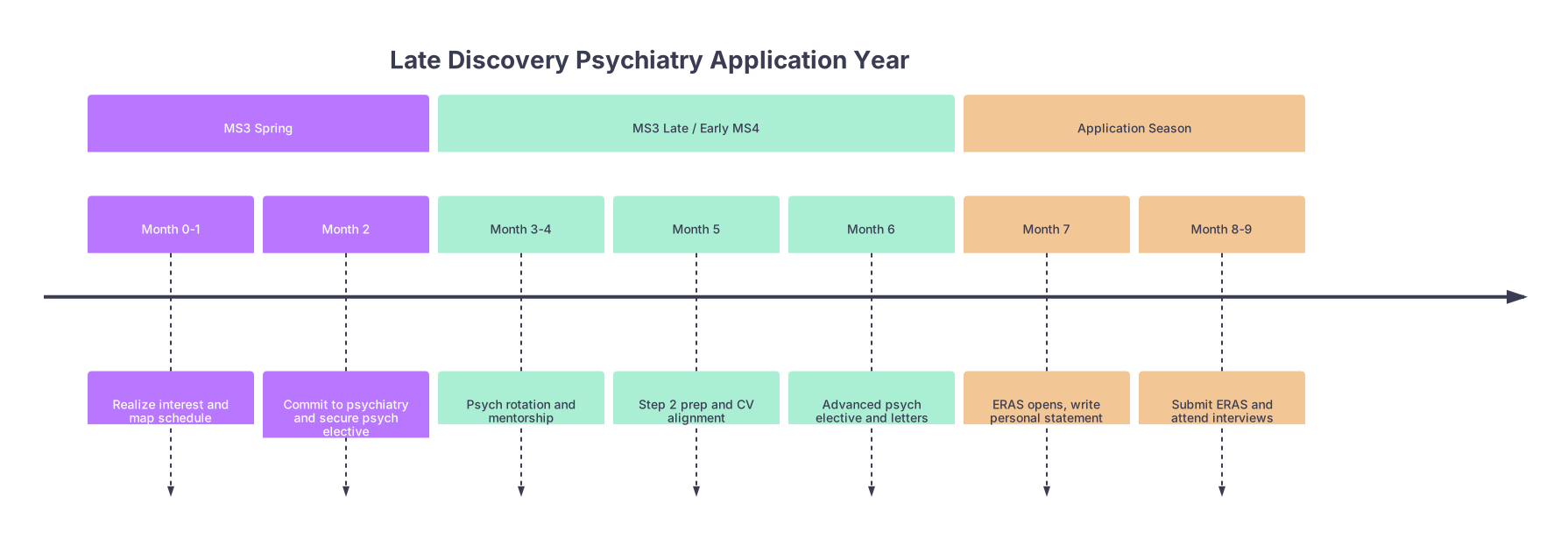
| Period | Event |
|---|---|
| MS3 Spring - Month 0-1 | Realize interest and map schedule |
| MS3 Spring - Month 2 | Commit to psychiatry and secure psych elective |
| MS3 Late / Early MS4 - Month 3-4 | Psych rotation and mentorship |
| MS3 Late / Early MS4 - Month 5 | Step 2 prep and CV alignment |
| MS3 Late / Early MS4 - Month 6 | Advanced psych elective and letters |
| Application Season - Month 7 | ERAS opens, write personal statement |
| Application Season - Month 8-9 | Submit ERAS and attend interviews |
Month 8 and Beyond: From Applicant to Future Psychiatrist
Once ERAS is submitted, the “exploration” period is over. You are now doing the predictable application dance: emails, interviews, awkward Zoom socials.
Two final points for this phase:
- During interviews, own your timeline:
- “I discovered psychiatry later in third year, once I had enough exposure to compare it against other fields. Once I realized it was the best fit, I deliberately structured my remaining time to deepen my experience and confirm that decision.”
- Keep your psych engagement alive:
- Keep attending case conferences, journal clubs, interest group events.
- Do not vanish from the department just because your application is in.
Programs notice who sticks around.
Three Things to Remember
- Discovering psychiatry late in MS3 is not disqualifying. It is only a problem if you pretend you decided earlier or fail to act decisively once you know.
- Your month‑by‑month goal is simple: move from vague interest → concrete exposure → believable commitment, backed by at least two strong psych letters and coherent experiences.
- Psychiatry cares deeply about how you think and relate, not just when you picked the field. Show that your late decision was thoughtful, tested, and followed by disciplined action, and you will not look late—you will look deliberate.