
If you hate the ICU but love medicine, your problem is not that you chose the wrong field. Your problem is that you are treating “ICU misery” like a personality flaw instead of a data point.
You can build a very good internal medicine career and almost never step into an ICU again. But you need to be deliberate. Otherwise residency will drag you through critical care-heavy paths that burn you out, sour you on IM, and make you think you picked the wrong specialty.
Let me walk you through how to fix this, step by step.
Step 1: Separate “ICU Hate” Into Its Component Parts
“ICU is terrible” usually means five or six different things mashed together. You need to unpack them.
Make a quick list. What exactly do you hate?
Common culprits I see:
- The emotional weight: constant death, goals-of-care, family meetings
- The sensory overload: alarms, noise, lights, nonstop pages
- The workflow: endless pre-round data mining, micromanaged rounds
- The tasks: vents, pressors, ABGs, lines, codes
- The culture: aggressive “cowboy” mentality, hierarchy, turf wars
- The schedule: nights, 28-hour calls, 12–14 hour days back-to-back
Now flip it: what do you like about medicine?
- Longitudinal care?
- Ambulatory clinic?
- Teaching?
- Diagnostic puzzles on the floor?
- Neat physiology but not the crashing patient?
- Procedures but not codes?
Write both lists down. Literally. Not in your head. You are designing your future job description; treat this like it matters.
Here is why this distinction is critical:
- If you hate all acutely unstable patients, you probably want a career that is ward/clinic heavy and ICU-light.
- If you mainly hate the ICU culture/rounds but actually like managing sick patients, you might still love cards, pulm, or hospitalist medicine in the right setting.
- If you hate end-of-life chaos but enjoy problem solving, geriatrics, palliative care, and outpatient IM can fit you very well.
You are not deciding “ICU or no ICU.” You are deciding how much acute-care exposure you can tolerate before your quality of life collapses.
Step 2: Understand How ICU-Dependent Each IM Path Actually Is
Internal medicine is not one job. It is a network of jobs with very different relationships to the ICU.
Here is the reality snapshot:
| Career Path | Typical ICU % of Work | ICU Requirement Long-Term? |
|---|---|---|
| Outpatient IM (PCP) | 0–5% | No |
| Academic Hospitalist | 0–20% | Sometimes (varies by site) |
| Community Hospitalist | 0–50% | Often (co-manage ICU) |
| Cardiology | 10–40% | Yes (CCU/ICU exposure) |
| Pulm/Critical Care | 40–80% | Absolutely |
| GI/Heme-Onc/Rheum/Endo | 0–10% | No (mostly consult/clinic) |
If reading “Pulm/Critical Care 40–80% ICU” makes your stomach drop, good. You just ruled out a fellowship. Progress.
To drive this home, here is a very simple way to visualize careers by ICU intensity:
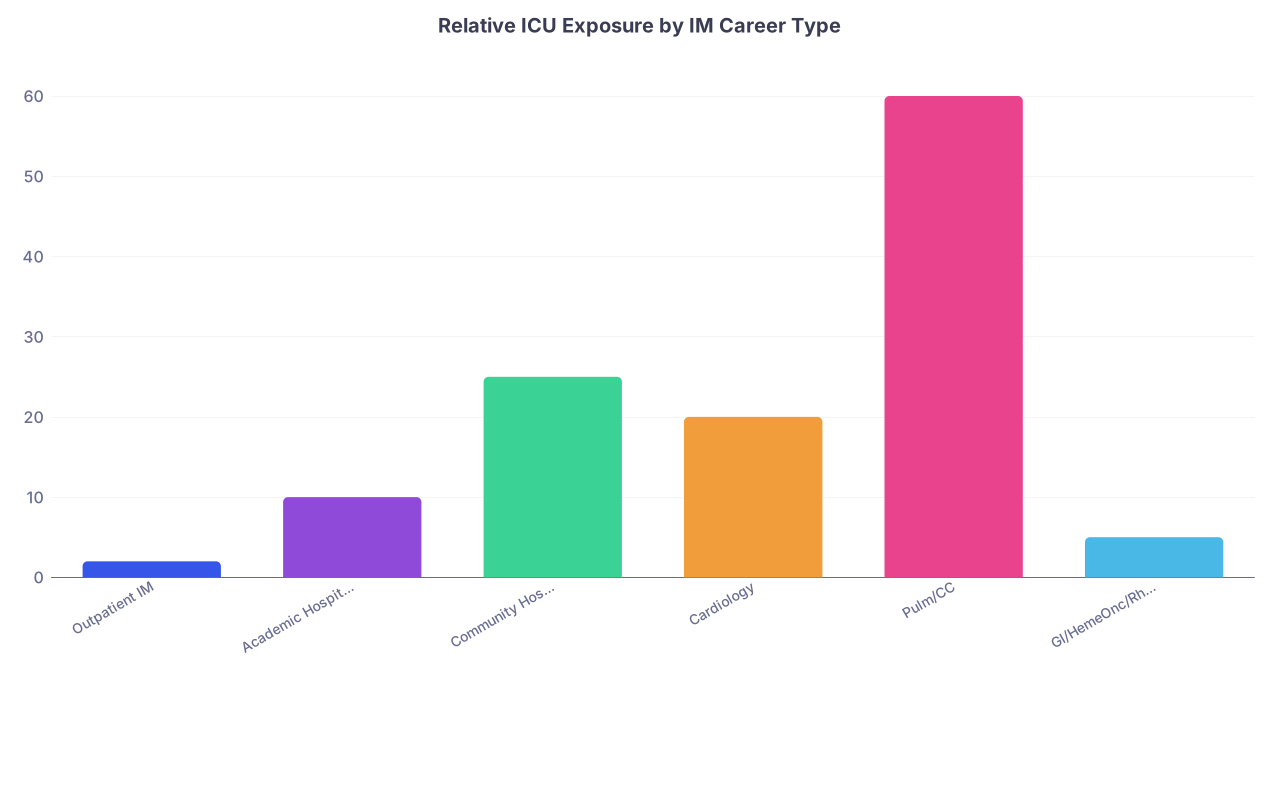
| Category | Value |
|---|---|
| Outpatient IM | 2 |
| Academic Hospitalist | 10 |
| Community Hospitalist | 25 |
| Cardiology | 20 |
| Pulm/CC | 60 |
| GI/HemeOnc/Rheum/Endo | 5 |
Key takeaway: you can absolutely live in internal medicine and engineer a career with minimal ICU. You just cannot walk blindly into “hospitalist anywhere” or “cards/pulm because I liked the physiology” without thinking through the ICU piece.
Step 3: Fact-Check Your ICU Experience – Was It Actually ICU, or That Rotation?
Some ICU rotations are miserable for structural reasons:
- A malignant attending who “pimps until you cry”
- Poor staffing: 1 resident + 1 intern for a full unit
- Consulting services dumping work on the primary ICU team
- No closed-door workroom, nonstop interruptions
- Endless family meetings crammed into 5 minutes at the end of rounds
Before you swear off all critical care, ask:
- Was this a teaching ICU or a service ICU?
- Was this a quaternary center (ECMO, transplants) or a community unit?
- Was there any day that felt “good hard” instead of “pure misery”?
I have seen residents go from hating their surgical ICU month at a trauma-heavy center to actually tolerating (not loving, but tolerating) a medical ICU month at a smaller hospital where:
- The census was 10 instead of 20
- Rounds took 2 hours, not 5
- Nurses and residents functioned as a real team
You are allowed to hate the ICU. But make sure you hate the concept (unstable patients, vents, codes) and not just a specific dysfunctional unit.
If you are not sure, ask upper-levels and recent grads:
- “Which of our ICU rotations is closest to what community ICUs are actually like?”
- “Do our hospitalists here ever go into the ICU?”
- “How much ICU time do your outpatient attendings do? Any?”
Their answers will tell you how much of your pain is structural vs intrinsic.
Step 4: Map Out IM Career Options For People Who Dislike the ICU
Let us build you an actual menu. You probably fall into one of these buckets:
A. “I Love Longitudinal Care and Hate Crashing Patients”
You likely want:
- Outpatient IM (general medicine, possibly with some niche like obesity, HIV, women’s health)
- Geriatrics
- Endocrinology
- Rheumatology
- Allergy/Immunology
These are low-ICU specialties where:
- Your contact with vents, vasopressors, and codes is negligible
- Most of your day is clinic + messages + occasional inpatient consults
- Emotional burden is more about chronic disease and function, not acute deaths
B. “I Like Inpatient Puzzles but Not the ICU Chaos”
You likely want:
- Academic hospitalist in a system with closed ICUs and strong intensivist teams
- GI, heme-onc, or ID where you can consult on sick inpatients but rarely run the ICU yourself
- A hybrid job with ward attending + resident clinic + some teaching
Key filters you should use:
- “Do your hospitalists run the ICU or just co-manage?”
- “Who is team leader during codes?”
- “Is your ICU closed, open, or hybrid?”
Ask these on interviews. Programs that pretend the answers do not matter are waving a red flag.
C. “I Actually Like Sicker Patients but Hate the Way Our ICU Runs”
Here you might still fit:
- Cardiology (but pick a group where critical care is shared or where there is a dedicated CCU team)
- Hospitalist in a large academic center with 24/7 intensivist coverage
- Pulmonary without critical care in rare settings (harder but possible in some groups)
You probably need less structural chaos and more support, not less acuity.
Step 5: Use Residency Itself Strategically (Not Passively)
You cannot avoid ICU in an IM residency. ACGME will not let you. But you can control:
- How much it dominates your identity
- Who you learn from
- How you protect your mental bandwidth
Here is a stepwise residency strategy if you hate the ICU but love medicine.
1. Survive, Do Not Specialize, During ICU Blocks
Priority list for your ICU months:
- Learn the basics well: vents, pressors, sepsis, DKA, GI bleed, stroke management.
- Protect yourself from learned helplessness. Ask: “What is the minimum skill set I want to walk away with so I never feel useless on the floor?”
- Set emotional boundaries. You are not required to emotionally absorb every bad outcome.
You are not becoming an intensivist. You are getting fluent enough to manage the first 30–60 minutes of a crash before help arrives.
2. Build a Resume That Points Away From Critical Care
When you have a choice of electives and projects:
- Pick clinic-heavy electives: primary care, endocrine, rheum, geriatrics, palliative, allergy
- Choose inpatient consults that are ICU-light: rheum, endocrine, geriatrics, sometimes heme-onc
- Avoid padding your CV with critical care research if you already know you hate it
If you want fellowship:
- Geriatrics: target continuity clinics, nursing home experience, QoL/functional status projects
- Endocrine: diabetes clinics, thyroid nodule clinic, inpatient hyperglycemia consults
- Rheum: autoimmune clinics, MSK ultrasound exposure, lupus/vasculitis cases
- Heme-Onc: malignant heme wards, infusion center time
The theme: direct your reputation away from “this person is great in the ICU” and toward “this person is thoughtful with complex chronic disease”.
3. Signal Early to Program Leadership What You Want
Many residents keep their preferences secret and then wonder why they are steered into ICU-heavy roles.
Be explicit with your PD / APD:
- “Long-term I see myself in outpatient-focused IM or a low-ICU fellowship like endocrine or rheum.”
- “I want to be competent in critical care but do not plan a career in it. Can I prioritize more clinic electives once I hit the ICU requirements?”
Reasonable programs will work with you. Some will not. That tells you something too.
Step 6: Choose Your First Job With ICU Exposure in Mind
The biggest trap for people who hate the ICU: taking a “generic hospitalist” job where they quietly expect you to cover the unit half the time.
You must interrogate job offers. Aggressively. Things to ask before you sign anything:
ICU Structure
- “Is the ICU open, closed, or hybrid?”
- “Do hospitalists write ICU orders or only consult?”
- “Who is attending of record in the ICU?”
Call and Nights
- “Does night coverage include ICU admissions and cross-cover?”
- “Is there in-house intensivist at night?”
- “How many codes per night on average?”
Scope of Practice
- “Are hospitalists expected to manage vents and pressors?”
- “Are procedures (central lines, intubations) mandatory, optional, or intensivist-only?”
Here is a quick comparison:
| Job Type | ICU Model | Hospitalist Role in ICU | Good for ICU-Averse? |
|---|---|---|---|
| Large Academic Center | Closed | Consult only | Yes |
| Mid-size Community Hospital | Open | Primary ICU management | No |
| Hybrid Academic-Community Site | Hybrid | Admit, intensivist co-manage | Maybe |
| VA Hospital (many, not all) | Closed | Rare ICU involvement | Often |
If the recruiter cannot answer these questions clearly, assume worst case.
Step 7: If You Are Early (MS3/MS4): Deciding Whether IM Is Still Right
Maybe you are still a student thinking: “I loved cards, I loved clinic, but I hated that ICU month. Should I abandon medicine entirely?”
Not yet.
Here is the decision tree I use with students:

| Step | Description |
|---|---|
| Step 1 | Enjoys medicine overall |
| Step 2 | Consider outpatient heavy fields like FM, psych, path |
| Step 3 | Still OK for IM, target outpatient or consult subspecialties |
| Step 4 | IM still possible, but avoid ICU linked fellowships |
| Step 5 | Hates all acutely sick care? |
| Step 6 | ICU hate from culture or from acuity itself? |
Key reality checks for students:
- Every core field has its version of “ICU pain”
- Surgery: trauma, SICU, middle-of-the-night consults
- OB/GYN: labor floor chaos, hemorrhages
- EM: constant resuscitations, no continuity
- Internal medicine still offers the widest range of low-ICU, intellectually satisfying jobs.
If what you actually love is:
- Talking to patients
- Long-term relationships
- Managing multiple chronic conditions and medications
- Interpreting nuanced labs, imaging, and guidelines
Then IM remains the most flexible platform for you, especially if you engineer it toward outpatient or consult-based subspecialties.
Step 8: Build a Personal “ICU Minimal” Career Blueprint
You need a concrete plan, not just vibes. Sketch this out:
1. Your Non-Negotiables
Examples:
- “No mandatory ICU time after residency.”
- “No requirement to run codes alone.”
- “No more than 1–2 ICU shifts per month, if any.”
2. Your Preferred Daily Work
- 60–90 minute new patient visits in clinic?
- Inpatient rounding with resident teams but no ICU responsibilities?
- Subspecialty consults that are mainly diagnostic reasoning + management plans?
3. Target Paths That Match
Match your list to feasible jobs:
- Outpatient only IM
- Subspecialty clinic (endo, rheum, allergy, geri, some heme-onc practices)
- Academic non-ICU hospitalist (closed ICU)
- VA clinic or CBOC (community-based outpatient clinic)
Then list the training steps that get you there:
- “IM residency → strong continuity clinic → endocrine fellowship → academic endocrine clinic job”
- “IM residency → focus on geri/palliative → geriatrics fellowship → SNF + outpatient geri practice”
- “IM residency → teaching focus → academic hospitalist in closed-ICU system”
Step 9: Use Data, Not Fear, To Choose a Fellowship (Or None)
If you are mid-residency and debating fellowship, do not guess.
Make a brutally honest grid. For each option, rate 1–10 (10 = high) for:
- ICU exposure
- Clinic time
- Inpatient consults
- Procedures
- Emotional load (death/bad outcomes)
- Lifestyle control
Then actually put numbers down. For example:
| Specialty | ICU Exposure (1–10) | Clinic Time (1–10) | Emotional Load (1–10) |
|---|---|---|---|
| Endocrine | 2 | 9 | 4 |
| Rheum | 2 | 8 | 5 |
| GI | 4 | 7 | 6 |
| Heme-Onc | 5 | 6 | 8 |
| Cards | 7 | 5 | 7 |
Now overlay your tolerance. If your ICU exposure ceiling is “3,” then cardiology is out, no matter how much you liked that one cath we did on rounds.
Step 10: Manage the Mental Game – Not Just the Logistics
Hating the ICU can make you feel weak or “less of a doctor.” That is nonsense.
Here is what is actually true:
- Medicine needs people who can sit with chronic illness and uncertainty, not just people who can intubate in 30 seconds.
- The skill to guide a complex diabetic patient for 20 years arguably prevents more morbidity than managing one septic shock admission.
- You are allowed to structure your career to preserve your sanity.
However, you must:
- Be honest about your limits. Do not pretend you are “fine” in the ICU and then quietly melt down every rotation.
- Learn enough acute care to be safe. Even as an outpatient doc, you will occasionally have a crashing patient in clinic.
- Stop apologizing for wanting a sustainable job. “I do not want to run codes at 2 a.m. at age 60” is not weakness. It is planning.
If you want a quick mental framework:
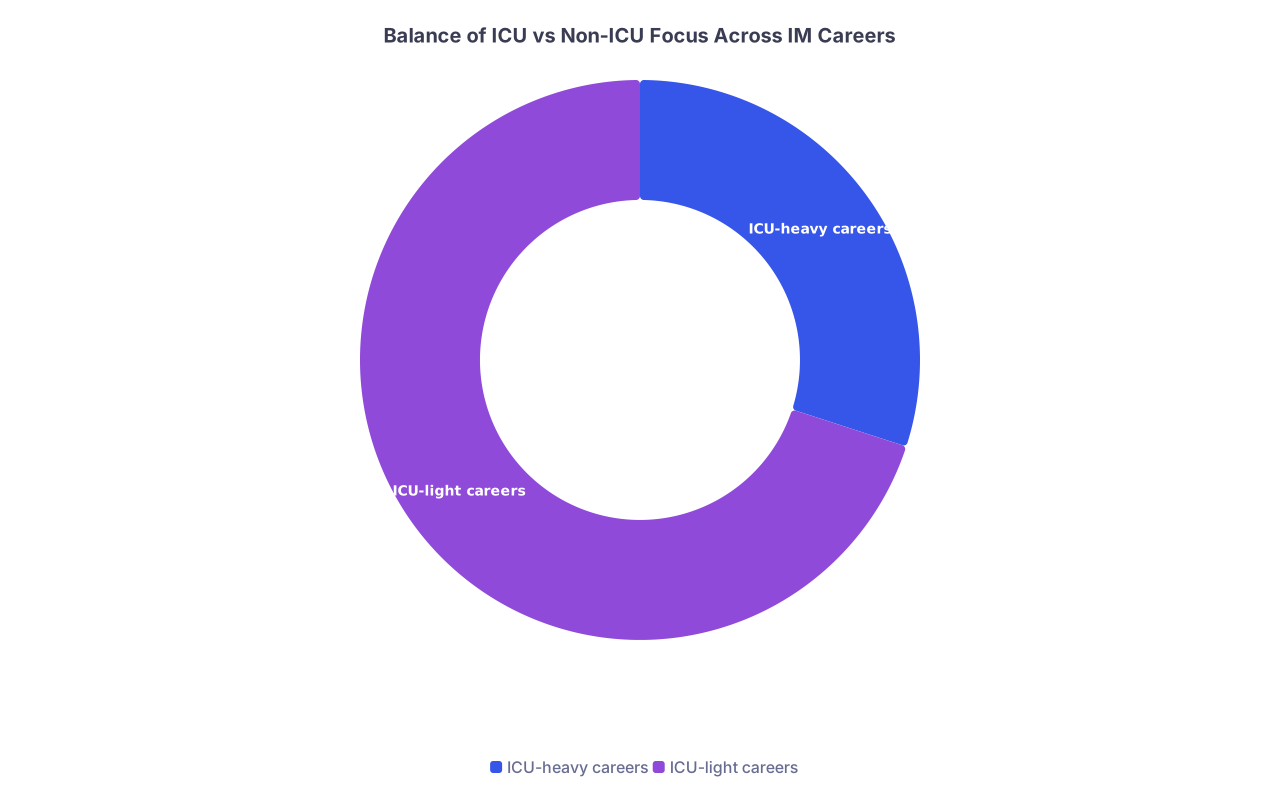
| Category | Value |
|---|---|
| ICU-heavy careers | 30 |
| ICU-light careers | 70 |
Most internal medicine roles are not ICU-heavy. The field is not defined by the worst month of your residency.
Step 11: Tactical Scripts – What to Actually Say
Let me make this concrete. Here are phrases you can use with:
Program Director (Residency)
“I want to be upfront about my long-term goals. I am likely heading toward an outpatient-focused or low-ICU subspecialty like endocrine or rheum. I want solid critical care skills for safety, but I do not expect to pursue an ICU-heavy career. Can we plan my electives and continuity experiences accordingly?”
Fellowship Director (Interviews)
“I enjoy complex chronic disease management and longitudinal relationships, which is why I am drawn to [subspecialty]. During residency I learned I can function in the ICU, but my strengths and interests are in clinic-based, diagnostic, and long-term care rather than in ongoing ventilator and vasopressor management.”
Job Recruiter
“I am looking for a role without routine ICU coverage. Specifically, I am not interested in being the primary attending of record in the ICU or managing vents and pressors independently. Closed ICUs or consult-only models are a good fit for me. How does your hospital structure that?”
This is how you stop “hoping” things will work out and start specifying what you will and will not do.
Step 12: Recognize When You Actually Might Need a Different Field
I am biased toward salvaging IM for you, because it is flexible and powerful. But there are red flags that suggest you may be fighting the wrong war:
- You dread any inpatient medicine, not just the ICU.
- You find acute calls (pages, cross-cover) intolerably stressful, even when patients are stable.
- You dislike both the ICU and ward, and your only joy is clinic with stable patients.
Then you should at least consider:
- Family medicine (more clinic, less inpatient in many jobs)
- Psychiatry
- Pathology
- Radiology
- A non-clinical or primarily administrative career later on
If every flavor of inpatient IM feels like a mistake, do not chain yourself to it just because you started down the path.
Visual: Training Path Timeline For an ICU-Averse IM Resident
To tie it together, here is a basic training path layout you might follow:
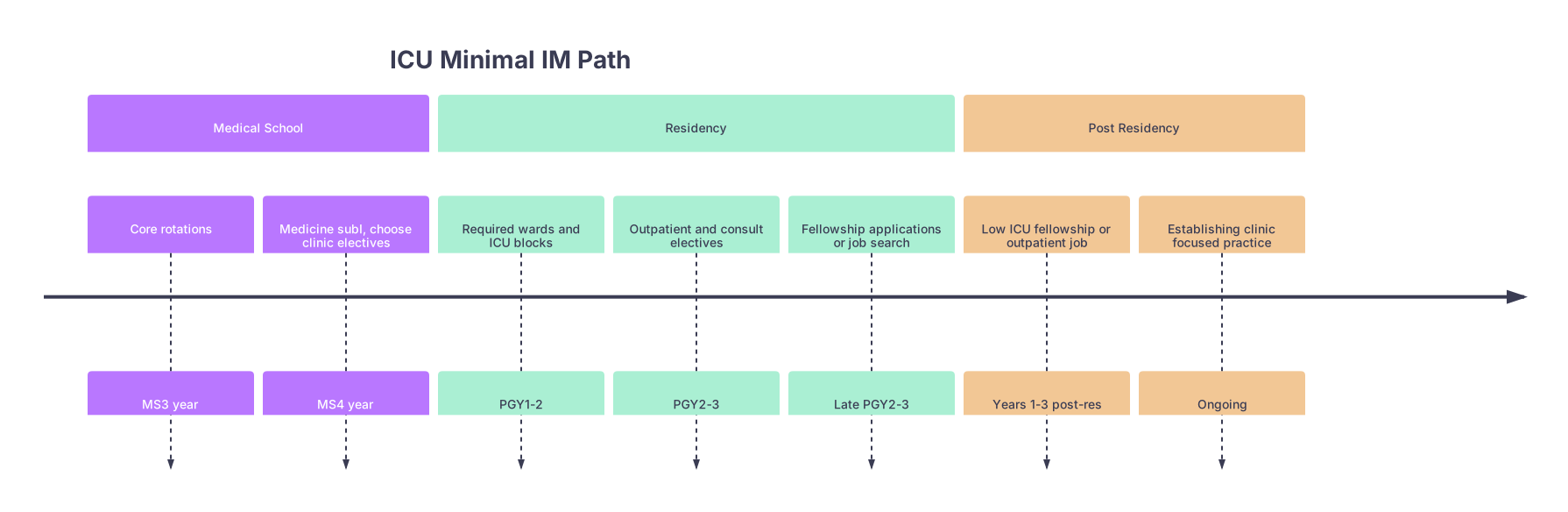
| Period | Event |
|---|---|
| Medical School - Core rotations | MS3 year |
| Medical School - Medicine subI, choose clinic electives | MS4 year |
| Residency - Required wards and ICU blocks | PGY1-2 |
| Residency - Outpatient and consult electives | PGY2-3 |
| Residency - Fellowship applications or job search | Late PGY2-3 |
| Post Residency - Low ICU fellowship or outpatient job | Years 1-3 post-res |
| Post Residency - Establishing clinic focused practice | Ongoing |
This is not fantasy. Hundreds of residents do exactly this every year and barely see an ICU once they are out.
Bottom Line
If you hate the ICU but love medicine:
- Treat your ICU dislike as a data point, not a defect. Use it to actively shape your residency choices, fellowship decisions, and first job.
- Internal medicine still gives you many ICU-light paths: outpatient IM, geriatrics, endocrine, rheum, allergy, consult-heavy subspecialties, and closed-ICU hospitalist jobs.
- Be explicit and tactical. Ask the hard questions about ICU expectations, structure your electives accordingly, and stop being vague about your boundaries. Your future sanity depends on it.