
The way most students compare Family Medicine and Internal Medicine is lazy and wrong. “FM sees kids, IM does not” is not a career decision framework. It is a bumper sticker. You need a structured, step‑by‑step plan that connects who you are, how you want to practice, and how the real job market works.
This is that plan.
You are not choosing between FM and IM. You are choosing between FM outpatient jobs and IM outpatient jobs in a very specific future reality: your life 5–10 years from now. So we are going to reverse‑engineer the decision from there and walk through it systematically.
Step 1 – Define Your Actual Future Outpatient Life (Not the Brochure Version)
Forget the specialty labels for a moment. Start with the end state.
Sit down and write answers to these. No hand‑waving. Numbers and specifics.
Clinical scope
- Do you want to see:
- Adults only?
- Adults + kids?
- Prenatal care? Simple OB? None?
- Procedures in clinic (joint injections, skin, women’s health, etc.) or mostly cognitive visits?
- Complexity tolerance:
- Do you like multi‑morbid 75‑year‑olds with 15 meds and five subspecialists?
- Or do you prefer bread‑and‑butter + some complexity?
- Do you want to see:
Work structure
- Ideal weekly template:
- Number of clinic days?
- Half‑days vs full days?
- Any inpatient at all? (Yes/no, and how much.)
- Call:
- Phone only? Nights? Weekends?
- How many nights/weekends per month are tolerable?
- Ideal weekly template:
Demographics and setting
- Age mix: lots of geriatrics vs young families vs broad mix.
- Urban, suburban, rural?
- Academic vs community vs FQHC vs private practice vs big corporate system?
Career levers
- How important are these to you, on a 1–5 scale:
- Academic teaching
- Research/QI
- Leadership/admin roles
- Lifestyle flexibility (part‑time, telehealth)
- Geographic freedom
- How important are these to you, on a 1–5 scale:
Write this out. Then condense into a 4–5 line “future job description,” something like:
“Full‑time outpatient, adults only, minimal call, large health system clinic, moderate complexity, optional teaching, urban/suburban in the Midwest.”
You will use this as a measuring stick for FM vs IM.
Step 2 – Understand the Real Training and Job Differences That Matter for Outpatient Work
Now that you have a rough picture of future you, let’s compare FM vs IM only on factors that actually hit your outpatient life.
| Dimension | Family Medicine (FM) | Internal Medicine (IM) |
|---|---|---|
| Typical patient age | All ages (peds + adults + geri) | Adults only (18+ or 16+ depending site) |
| Training length | 3 years | 3 years |
| Inpatient exposure | Required, but less heavy | Heavier inpatient focus in many programs |
| Fellowship pathways | Limited but growing | Broad, especially subspecialties |
| Outpatient job market | Very strong | Very strong |
What actually matters for future outpatient practice
Scope of practice
- FM: broadest scope. You are trained in:
- Pediatrics
- Adult medicine
- Prenatal care, sometimes OB
- Basic women’s health (Pap, contraception, IUD, etc.)
- Behavioral health basics
- IM: deep dive into adults:
- Complex chronic disease management
- Inpatient and ICU exposure
- Less (or no) pediatrics, OB, or procedures unless you seek them out
- FM: broadest scope. You are trained in:
Brand perception and referral role
- In many systems:
- FM = “PCP for everyone”
- IM = “PCP for medically complex adults”
- Reality: both can be primary care for adults. HR and marketing will often nudge:
- Young families → FM
- Older/complex adults → IM
- In many systems:
Path dependence
- FM → most paths stay generalist. Fellowships exist (sports, geriatrics, palliative, addiction, OB, hospitalist) but most FM end up in broad outpatient primary care.
- IM → massive fellowship infrastructure (cards, GI, pulm/crit, ID, etc.). Even if you think you want outpatient primary care now, you will be surrounded by subspecialty pull.
Procedural experience
- FM clinics often emphasize:
- Skin procedures
- Joint injections
- Women’s health
- Some MSK, sports, etc.
- IM clinics tend to be more visit‑based, less procedure heavy (exceptions exist, but that is the pattern I have seen repeatedly in community systems).
- FM clinics often emphasize:
None of this says “better” or “worse.” It says “different trajectory.”
Step 3 – Map Training to Your Future Job Description
Now we connect Step 1 and Step 2. This is where people usually skip ahead and regret it later.
Take your “future job description” and ask, line by line: Does FM or IM train me better for this exact thing?
Let’s walk through some common scenarios.
Scenario A – You want broad outpatient practice with kids and adults
- “I like clinic, variety, continuity. I genuinely enjoy well‑child checks, vaccines, teenagers, and adults. Zero interest in inpatient or subspecialty fellowship.”
FM is the default correct answer.
Why:
- Pediatrics exposure is built in and robust.
- Comfort with simple acute care in kids (otitis, asthma, ADHD, etc.).
- FM job market aggressively wants exactly this profile, especially outside major academic cities.
Could you force this with IM? Sort of, but:
- You will not have formal peds training.
- Many systems will prefer FM for “family clinic” style positions.
- You might still get hired to see kids in some rural areas, but you will be less comfortable and potentially less insurable.
Scenario B – You want adult‑only outpatient primary care with high medical complexity
- “I like puzzling through complicated adult multi‑morbid cases. I want outpatient only, but I want the sickest adult patients, lots of meds, close work with subspecialists.”
IM leans stronger here.
Why:
- IM residency builds a deep comfort with complex adult medical care and inpatient‑outpatient continuity.
- Subspecialists often trust and collaborate more easily (fair or not) with IM colleagues on advanced adult issues.
- If you pivot later to a fellowship (cards, GI, heme/onc), IM is your runway.
Could FM do this? Yes, especially academically oriented FM physicians with strong medicine rotations. But if you already know you only want adults and like that high‑complexity internal‑medicine feel, IM is more aligned.
Scenario C – You want outpatient, but you are seriously considering a future fellowship
You need to be brutally honest with yourself.
If any of this sounds like you:
- “I might want heme/onc. Or maybe pulm. Or maybe cards. I am not sure yet.”
- “I like clinic but also like the idea of procedures and subspecialty consults.”
- “I care a lot about academic prestige and subspecialty options.”
Then IM is the rational choice.
FM can get you into some fellowships (sports, geriatrics, palliative, addiction, OB, sometimes hospitalist tracks). But the subspecialty universe of IM is simply on another scale.
Scenario D – You want leadership, QI, system‑level outpatient impact
Here, both are fine technically; the question is what setting you picture.
- Big academic health system CMO or ambulatory director → IM slightly more common historically, but FM is growing here, especially in population health and primary care innovation.
- Community system outpatient medical director → I have seen FM and IM equally in these roles.
Your training program choice matters more than FM vs IM for this scenario. You want:
- Strong QI curriculum
- Leadership mentoring
- Exposure to system projects
- Possibly an MPH or similar
Step 4 – Compare Training Environments Side by Side for Outpatient Skills
Now we zoom into residency itself, because your day‑to‑day training shapes how comfortable you will be in the clinic.
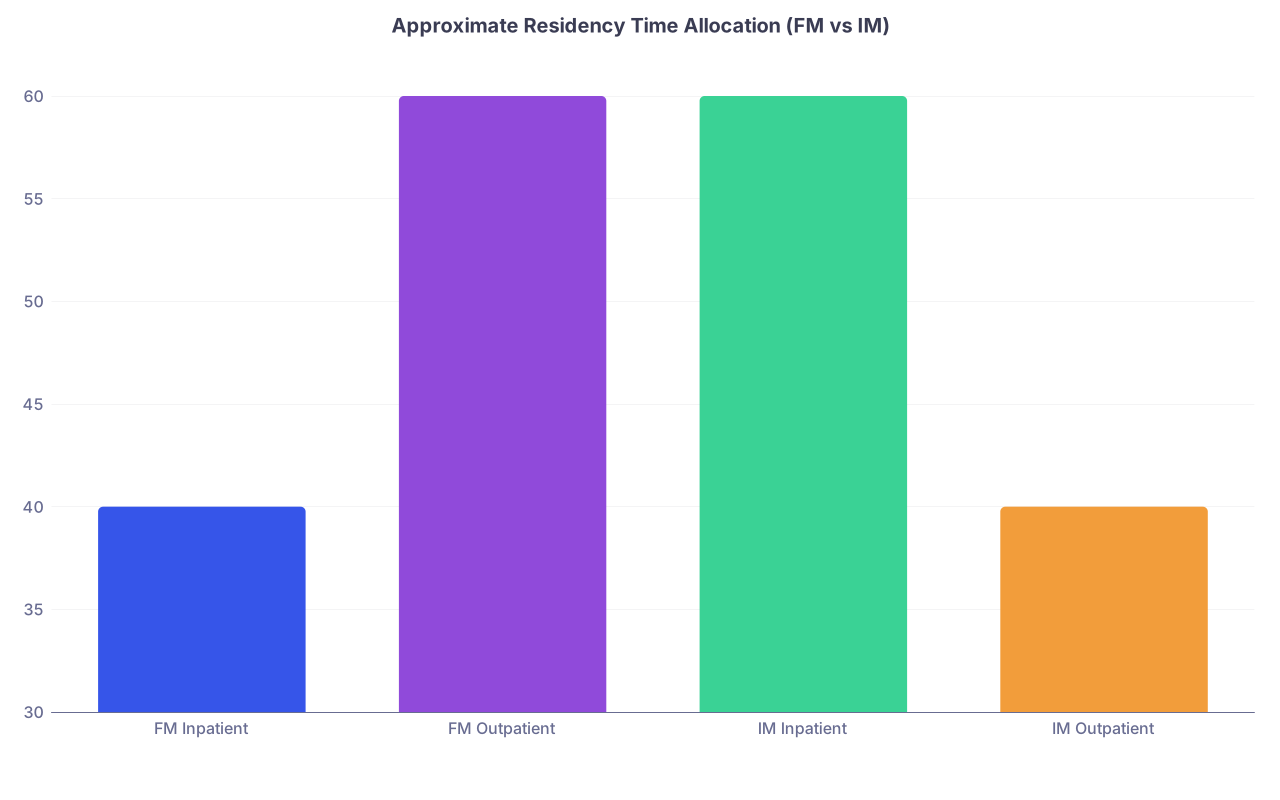
| Category | Value |
|---|---|
| FM Inpatient | 40 |
| FM Outpatient | 60 |
| IM Inpatient | 60 |
| IM Outpatient | 40 |
Numbers vary wildly by program, but the pattern is real: FM tends to be more outpatient‑weighted, IM more inpatient‑weighted.
Here’s how to interrogate programs during interviews and second looks.
For FM programs – questions to ask
- “How many half‑days of continuity clinic per week each year?”
- “How much dedicated peds clinic vs inpatient peds?”
- “What outpatient electives are available? Can I build a heavy‑clinic, low‑inpatient schedule by PGY‑3?”
- “What procedures do residents regularly do in clinic?”
- “Where do your grads go? How many end up in outpatient‑only jobs, and what types of clinics?”
Red flag responses:
- Heavy inpatient service with residents complaining about low clinic time.
- Little structured peds clinic experience.
- Graduates mostly doing inpatient/hospitalist or non‑traditional jobs (unless that is what you want).
For IM programs – questions to ask
- “How is ambulatory continuity clinic structured?”
- Half‑day per week? Block model? Hybrid?
- “What percentage of residency time is in clinic vs inpatient?”
- “Are there ambulatory tracks or primary care tracks?”
- “What outpatient electives exist (e.g., rheum clinic, endocrine clinic, HIV clinic, geriatrics clinic)?”
- “What percentage of graduates go into outpatient primary care vs fellowship vs hospitalist?”
Good signs if you want outpatient IM:
A dedicated primary care track with:
- Extra ambulatory training
- Panel management experience
- Exposure to chronic disease management programs
Significant clinic time in PGY‑2 and PGY‑3.
Leadership that openly values primary care, not just matching into cards and GI.
Step 5 – Do a Local Job Market Reality Check
People make a huge mistake here: they choose a specialty based on a vague national narrative instead of where they actually want to live.
You need to look at job postings like a PGY‑3 would.
Concrete protocol: 90‑minute job market scan
Set a timer. Do not overthink this.
- Pick 2–3 likely cities/regions you might want to practice in.
- Go to:
- PracticeLink
- NEJM CareerCenter
- Indeed
- Major health system career pages in those regions
- Search:
- “Family medicine physician outpatient”
- “Internal medicine physician outpatient”
- For each posting that looks vaguely like your future job description, capture:
- Required specialty (FM vs IM vs “FM/IM”)
- Patient mix (adults only vs all ages)
- Setting (FQHC, private, academic, corporate)
- Call schedule
- Any explicit preference (e.g., “IM preferred for complex adult panel”)
You will start to see patterns fast.
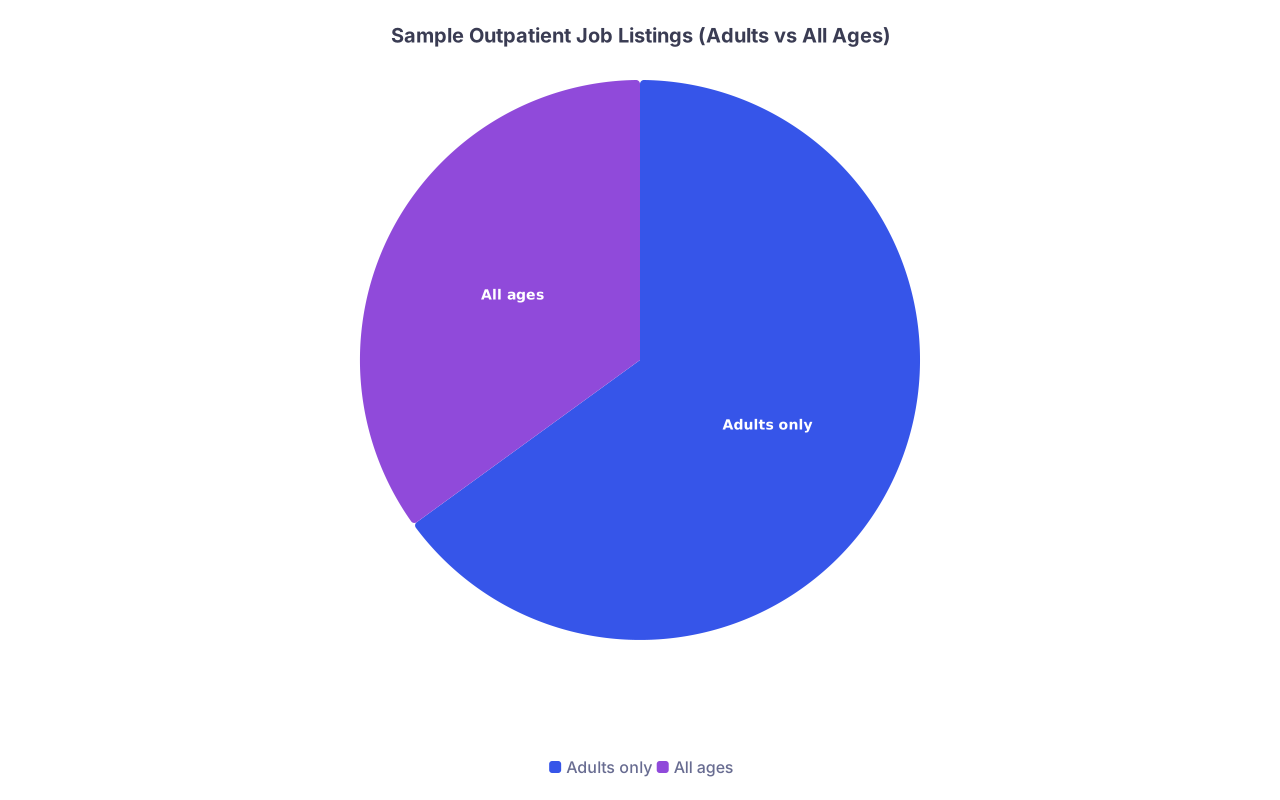
| Category | Value |
|---|---|
| Adults only | 65 |
| All ages | 35 |
This hypothetical split is typical in urban/suburban markets: more adult‑only jobs, but most of them accept either FM or IM. Rural markets will often show even more “FM or IM” flexibility.
Collect your data in a simple table or spreadsheet. Ask:
- Are most positions “FM or IM”?
- Are pediatric‑inclusive jobs mostly labeled “FM only”?
- Are complex adult primary care roles trending to “IM preferred”?
This is reality. Let it inform you.
Step 6 – Shadow and Simulate: Test‑Drive Both Lifestyles
Do not make this decision off lecture slides and Reddit threads. You need live exposure.
What to do in medical school (or early residency if you are still rotating)
- Arrange at least:
- For each, specifically observe:
- Patient age mix across the half‑day
- Complexity of cases
- Number of procedures
- Visit lengths
- Use of team members (nurse, MA, social work, pharmacists)
- Ask the same three questions every time:
- “Why did you choose FM/IM instead of the other?”
- “What parts of your training were most useful for your current outpatient job?”
- “If you had to train again purely for this current job, would you pick the same specialty?”
You will hear patterns. IM docs in outpatient often say:
- “I liked inpatient as a resident but wanted lifestyle later.”
- “I enjoy working with complex adults and coordinating with subspecialists.”
FM docs in outpatient often say:
- “I like continuity, variety, the family context.”
- “I like seeing kids grow up and managing across the lifespan.”
Then, do a simple mental exercise.
Simulation: How do you feel after a mock clinic grid?
Write a sample schedule for each specialty based on what you saw.
FM clinic half‑day sample:
- 2‑month‑old well visit
- Diabetes follow‑up
- Prenatal visit
- 8‑year‑old asthma check
- Pap smear
- Medicare annual wellness
IM clinic half‑day sample:
- New CHF consult post‑discharge
- Uncontrolled diabetes, CKD3
- Multi‑morbid 78‑year‑old on 18 meds
- Atrial fibrillation management
- COPD and OSA follow‑up
- Hypertension and lipids
Ask yourself, very bluntly: Which half‑day feels more like “my people, my problems, my rhythm”?
Your gut here is more reliable than any online comparison chart.
Step 7 – Map Risk, Flexibility, and “Escape Hatches”
You are not just choosing what you like now. You are choosing how trapped or flexible you will be later.
FM – flexibility profile
- Easy to:
- Do full‑scope primary care any location.
- Include kids, OB (if trained), and broad breadth.
- Pivot between:
- FQHC
- Community clinic
- Concierge / DPC
- Rural broad practice
- Harder to:
- Enter traditional IM subspecialties (cards, GI, pulm, renal).
- Market yourself purely as a “complex adult specialist” in some tertiary centers.
IM – flexibility profile
- Easy to:
- Go into almost any adult subspecialty with fellowship.
- Do hospitalist work, even if you start outpatient.
- Become an “adult‑only” outpatient expert, especially for complex patients.
- Harder to:
- Do pediatrics.
- Do broad cradle‑to‑grave family care.
- Get OB exposure at all.
So, quick diagnostic questions:
- If you wake up 10 years from now and discover that:
- You actually hate clinic and love ICU – IM gives you a cleaner pivot.
- You love small‑town broad outpatient with kids, a bit of OB, and lots of continuity – FM gives you a cleaner pivot.
You are choosing your future escape route today.
Step 8 – Build a Comparison Table for You, Not in General
Generic “pros/cons” lists are useless. You need a weighted comparison based on your own priorities.
Do this on paper or a simple doc. Example:
List your top 7–10 priorities (from Step 1).
Example:- See kids
- Adult complexity
- Lifestyle (no inpatient)
- Academic options
- Fellowship possibilities
- Clinic procedures
- Geographic flexibility
Assign weights (1–5) based on how much you care about each.
Score FM and IM (1–5) on each priority for you, based on everything you have learned (not what a blog says).
Quick illustration:
| Priority | Weight | FM Score | IM Score |
|---|---|---|---|
| See kids | 5 | 5 | 1 |
| Adult complexity | 4 | 3 | 5 |
| No inpatient future | 4 | 4 | 4 |
| Academic options | 3 | 3 | 4 |
| Fellowship paths | 5 | 2 | 5 |
| Clinic procedures | 3 | 4 | 2 |
| Geographic flex | 4 | 5 | 5 |
Then multiply and sum (Weight × Score) for each specialty. You will get a rough “fit score.” It is not math magic. It is a forcing function to be honest about your values.
Step 9 – Align Your Residency Application Strategy (FM, IM, or Both)
Once you have a lean toward one specialty, you still have to manage risk and the match process.
Option 1 – Commit fully (FM only or IM only)
Best when:
- Your weighted comparison is decisively tilted.
- Your application is strong enough for your target specialty at the programs you like.
Then your plan is simple:
- Tailor your personal statement strongly toward that specialty.
- Arrange letters from that department.
- Target programs with strong outpatient training, as described above.
Option 2 – Dual apply (FM + IM) with future outpatient focus
This is controversial, but I have seen it used intelligently when:
- The student is truly torn but knows they want primary care/outpatient.
- They are realistic about:
- Writing two versions of their personal statement.
- Getting specialty‑appropriate letters for both.
- Answering “Why this specialty?” convincingly in each interview.
Key rule: Do not send the same generic primary care statement to both. Programs see right through it.
You can honestly say:
- To FM: “I am drawn to broad, full‑spectrum care including children and potentially OB in X setting.”
- To IM: “I am drawn to complex adult chronic disease, potential subspecialty options, and adult‑focused ambulatory care in X setting.”
Then, ranking season:
- Put programs in the exact order that matches your career clarity, not some weird “IM is more prestigious” hierarchy. Prestige does not help at 4:30 pm on a Friday with 18 patients and a broken printer.
Step 10 – Use a Short, Hard Checklist Before You Lock In
Before you click “submit” on ERAS choices or commit mentally to FM vs IM, run yourself through this checklist. No excuses.

| Step | Description |
|---|---|
| Step 1 | Define future outpatient job |
| Step 2 | Shadow FM and IM |
| Step 3 | Research local job market |
| Step 4 | Compare residency training |
| Step 5 | FM favored |
| Step 6 | IM favored |
| Step 7 | Weighted personal scoring |
| Step 8 | Choose FM or dual apply |
| Step 9 | Need kids in my panel? |
| Step 10 | Want subspecialty option? |
If you cannot confidently check these boxes, you are guessing:
- I can describe my ideal future outpatient job in 3–4 sentences.
- I have shadowed at least one FM and one IM outpatient physician and asked them the same set of questions.
- I have looked at real job postings in at least 2 regions for FM and IM outpatient roles.
- I understand the inpatient vs outpatient balance of the FM and IM programs I am likely to match at.
- I have done a personal weighted comparison of FM vs IM based on my own priorities, not generic lists.
- I can give a crisp, honest 1‑minute answer to “Why FM?” and to “Why IM?” even if I end up choosing only one.
If you cannot check them, your next step is not more Reddit threads. It is to complete the missing steps above.
One More Hard Truth: Personality Fit Matters More Than You Think
One pattern I have seen repeatedly:
- People who naturally think like generalists and enjoy variety + continuity across life stages are usually happier in FM long‑term.
- People who naturally think like internists and enjoy digging deep into adult pathophysiology and complex chronic disease are usually happier in IM, even if they stay outpatient.
Neither group is smarter. They are just wired for different misery and different joy.
Ask your attendings who know you:
- “When you see me on the wards and in clinic, do I seem more like an FM person or an IM person? And why?” Push them for specifics:
- Do you light up in complexity discussions on the inpatient service?
- Or in well‑child visits and longitudinal family moments?
Their off‑the‑cuff answer is often uncomfortably accurate.
What You Should Do Today
Do not “think about” FM vs IM for another six months. Act.
Concrete task for the next 24–48 hours:
- Open a blank document.
- At the top, write: “My ideal outpatient job in 10 years:” and force yourself to write 4–5 specific sentences.
- Then, on the same page, create two headings: “FM for that job” and “IM for that job.” Under each, list:
- 3 ways that specialty fits that future.
- 3 ways it does not fit as well.
- When you are done, email a copy to one FM attending and one IM attending and ask them:
“Does this reasoning track with what you see in real practice? What am I missing?”
That one exercise will move you further than 10 more hours of passive reading.