
It is December. You are PGY-2 in a big-name university internal medicine program that quietly prides itself on its cards, GI, and heme/onc match list.
Morning report ends, people linger to talk about a recent NEJM article on SGLT2s in HFpEF. Someone jokes, “If you are not at least considering cards, are you even in this program?”
You are not considering cards. You are thinking: “I want to do outpatient primary care. Maybe community-based. Maybe FQHC. Maybe a teaching clinic. But… not this fellowship arms race.”
And the fear kicks in:
- Will my PD think I underachieved?
- Will letters dry up because I am “wasting” their fellowship pipeline?
- Am I going to tank my reputation with attendings who expected me to do something “big”?
Here is the reality: pivoting from a competitive internal medicine trajectory (cards, GI, heme/onc, academic hospitalist with heavy research) to primary care is not a failure. It is a change in mission.
You can do this without burning bridges. You just have to be deliberate.
Step 1: Get Clear on What You Actually Want, Not Just What You Are Rejecting
You cannot sell a pivot based only on what you are running away from.
“Fellowship feels too competitive and toxic.”
“Research is miserable.”
“I am exhausted.”
All valid. None of those frames help when you are talking to program leadership.
You need a positive, specific “toward” story.
Start with three concrete questions:
Clinical reality:
- Do you see yourself 70–90% outpatient?
- Do you like continuity clinic more than wards?
- Do you feel more energized by complex chronic disease management than by ICU-level shock or emergent cath lab cases?
Setting and structure:
- Academic primary care vs community vs FQHC vs VA?
- Full-time clinic vs mixed inpatient-outpatient?
- Interest in teaching, QI, leadership roles?
Lifestyle and values:
- Are predictable hours a priority?
- Do you want deep long-term relationships with patients?
- How much do you care about salary vs flexibility vs location?
Write this out. Literally on paper or a document.
Create a short “career direction statement” in 2–3 sentences. This will be the backbone of every conversation:
“I have realized I am most engaged by continuity care and managing complex chronic disease over years rather than focusing on acute subspecialty care. I want to build a career in outpatient internal medicine, ideally in an academic or teaching-oriented primary care setting where I can combine clinic with resident education and quality improvement work.”
Or:
“My long-term goal is to work in community-focused primary care, likely in an FQHC or similar setting, with an emphasis on underserved populations and team-based care. I want to develop expertise in chronic disease management, behavioral health integration, and population health.”
That kind of clarity is what turns “backing out of competitiveness” into “strategic alignment.”
Step 2: Understand the Politics of Your Program Before You Talk
Every IM program has a culture. Some worship fellowship. Some genuinely value primary care. Many pretend to value both, but their actions scream “fellowship or bust.”
You are not changing that culture. You are navigating it.
Pay attention to:
Who are the “primary care champions” in your program?
- Primary care track director
- Clinic director
- PD or APD with outpatient focus
- Hospitalist who is respected but obviously pro-PC
What actually gets celebrated?
- Only cards and GI matches at graduation slides?
- Or do they also highlight graduates going into primary care, chief roles, and academic hospitalist positions?
History:
- Have recent residents gone into primary care and been supported?
- Or did they quietly disappear onto a final slide with no comment?
You want to know this before you schedule your first “career pivot” meeting.

Step 3: Choose the Right First Person to Tell (Hint: Not Always the PD)
Do not open with: “Hey Dr. Smith, I am dropping cards and doing primary care,” in a random corridor conversation.
You need a controlled first conversation.
Best first options:
A mentor who:
- Knows you clinically.
- Has some institutional power.
- Is not 100% defined by their subspecialty ego.
Primary care track director / clinic director:
- These people want primary care wins. They are your natural allies.
An APD with a reputation for being resident-focused, not CV-focused.
Bad first options:
- Highly competitive subspecialty PD whose entire identity is their match list.
- Peers who love gossip.
- Random fellowship attendings you barely know.
How to frame the first outreach
Email example:
Subject: Career direction conversation
Dear Dr. ___,
I have been thinking carefully about my long-term career goals and would very much value your perspective. I am considering a path focused on outpatient internal medicine/primary care and want to make sure I approach this thoughtfully and professionally.
Would you have 20–30 minutes in the next couple of weeks to discuss how to best align my remaining residency time and how to communicate this within the program?
Best,
[Name], PGY-2 IM
You are signaling three things that people respect:
- You have a direction.
- You are serious about doing it right.
- You care about relationships and program expectations.
Step 4: Script the Conversation So It Sounds Deliberate, Not Like Giving Up
The conversation itself is where bridges are either reinforced… or burned.
Here is the structure I have seen work repeatedly.
1. Start with affirmation, not rejection
You are not saying: “This program is too fellowship-heavy and toxic for me.”
Better:
“I am very grateful for the training I am getting here, and I have learned a lot from the subspecialty exposure. Over the past year, though, it has become clear to me that my long-term fit is in outpatient-focused internal medicine.”
You respect the program. You are not attacking the values of those who chose a different path.
2. Explain the positive pull, not the negative push
Bad:
- “The culture around fellowship is too intense.”
- “I hate research.”
Good:
“I find that the most meaningful part of my week is continuity clinic—seeing patients over time and managing complex chronic conditions.”
“I like subspecialty medicine, but the parts that really energize me are when I can integrate everything for the patient rather than focusing on one organ system.”
“I have realized I am more drawn to systems-of-care problems and team-based chronic disease management than to subspecialty procedural work.”
You are moving toward something.
3. Show that the decision is thoughtful, not impulsive
Mention:
Specific experiences:
- “My FQHC elective.”
- “The IM-PC track clinic.”
- “My work with the hypertension QI project.”
Time frame:
- “I have been thinking about this over the last 6–9 months as I have rotated through both ICU and subspecialty services.”
This counters the “oh they just could not cut it” narrative.
4. Ask for guidance explicitly
You want them on your team.
“I want to make sure I approach this in a way that reflects well on the program and preserves relationships. How would you suggest I structure the next year to support this career path, and who else should I talk to?”
Now you have turned a possible disappointment into a chance for them to mentor.
Step 5: Talk to Your PD the Right Way (Timing, Content, Tone)
Eventually, your PD needs to know. Do not delay so long that it looks like you hid your plans.
Timing
- PGY-2: Ideal. Plenty of time to adjust electives and projects.
- Late PGY-3: Fine, but you will mostly be in job-hunt mode rather than structural changes.
Do not wait until:
- Fellowship ERAS opens and you “suddenly” are not applying.
- Annual evaluations when they ask, “So, which fellowships?”
What to say to the PD
Structure it:
- Appreciation
- Clear direction
- Evidence of thoughtfulness
- Ask for support
Example:
“Dr. ___, I wanted to update you on my career plans. I am very grateful for the strong subspecialty exposure here, and I came in assuming I would probably pursue something like cardiology or heme/onc. Over the last year, though, I have realized my best fit is in outpatient internal medicine / primary care, especially in a setting where I can do both clinical work and teaching.”
“I have thought carefully about this after my FQHC elective, my continuity clinic experience, and talking with Dr. X and Dr. Y. I am not backing away from challenge; this is about aligning my work with what I enjoy most and where I think I will be most effective long-term.”
“I would really appreciate your advice about how I can shape my remaining time here to strengthen that trajectory, and how I should approach job applications so that I represent the program well.”
You are doing three very PD-friendly things:
- You show gratitude.
- You are not indecisive.
- You explicitly care about program reputation.
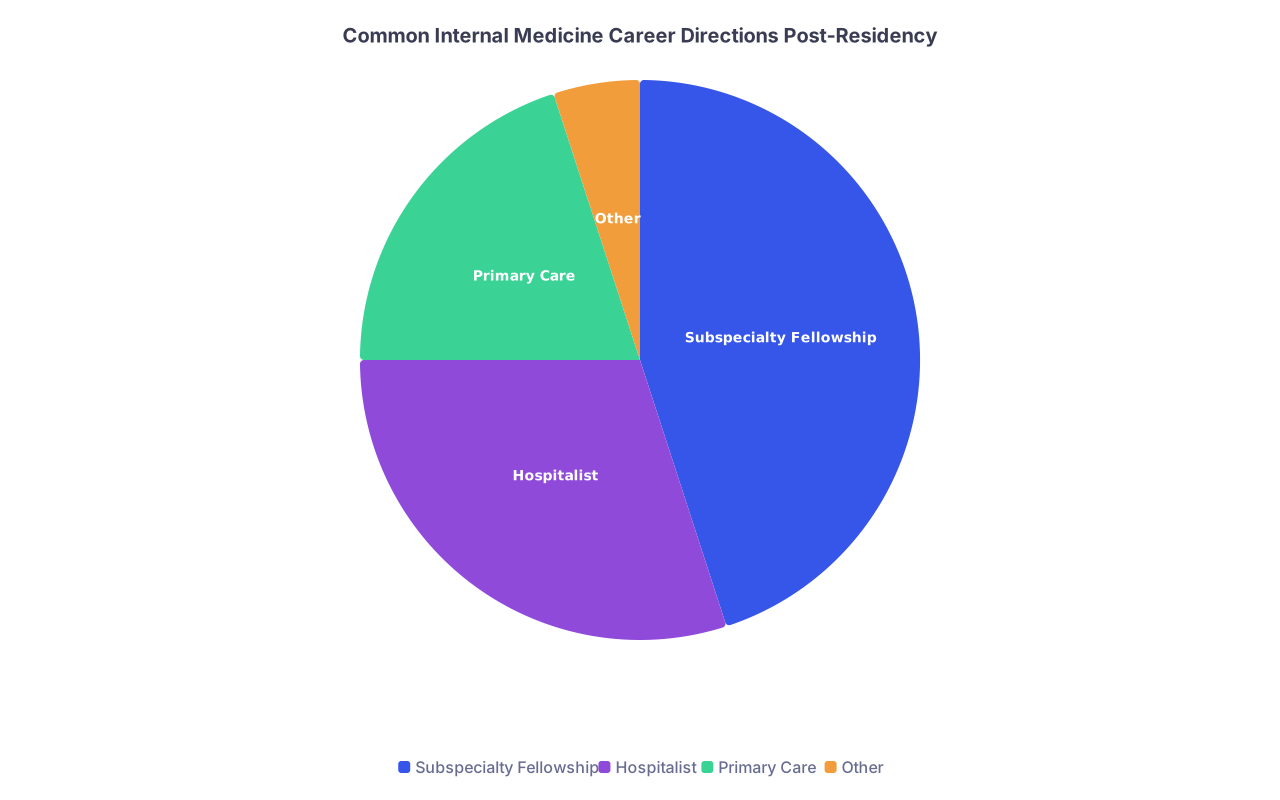
| Category | Value |
|---|---|
| Subspecialty Fellowship | 45 |
| Hospitalist | 30 |
| Primary Care | 20 |
| Other | 5 |
Step 6: Protect and Reframe Relationships with Subspecialty Faculty
You might already be known as “the cards person” or “the onc person.” You did an elective, maybe a research project, they talked about letters.
Here is how to pivot without leaving scorched earth.
1. Tell them directly, not through the grapevine
If someone invested real time in you, they deserve to hear it from you.
Example:
“Dr. ___, I wanted to share an update. When we started working together, I was seriously considering [subspecialty]. Over this past year I have realized that my strongest fit is actually in outpatient internal medicine and primary care.”
“I have really valued learning from you and working on [project]. The exposure helped me clarify that what I enjoy most is integrating this subspecialty knowledge into longitudinal care rather than focusing on one organ system exclusively.”
You are saying: “Your field mattered. It helped me decide.”
2. Invite their support in a new way
“If you are comfortable, I would still value your perspective on how to be a strong internist for patients who will be seeing your field frequently, and how I can best prepare for that.”
Smart move. You treat them as a content expert, not just a fellowship gatekeeper.
3. Do not trash the subspecialty culture
Even if the cards lab is brutal or the GI rotation was misery. Complaining about the field as you exit is the easiest way to get labeled unprofessional.
Keep that venting for trusted peers, not attendings.
Step 7: Rebuild Your CV for Primary Care (Without Wasting Prior Work)
You do not need to erase your subspecialty or research history. You need to reframe it.
Clinical structure
If possible, adjust electives:
- More ambulatory blocks.
- FQHC, VA, community clinics.
- Geriatrics, palliative, addiction, behavioral health integration.
Keep some subspecialty work, but with a primary-care slant:
- Diabetes clinic instead of purely endocrine consults.
- HF clinic instead of exclusively CCU.
- HIV clinic instead of only ID inpatient.
Scholarly work
Take whatever you did and ask: “How does this matter to an outpatient internist?”
Examples:
Cardiology research → emphasize:
- Impact on HF management in the outpatient setting.
- Risk stratification tools PCPs actually use.
Oncology research → emphasize:
- Survivorship issues.
- Long-term toxicity monitoring.
- Coordination of care with PCP.
QI projects → gold mine:
- Hypertension control.
- Diabetes metrics.
- Vaccination rates.
- Transitions of care (readmissions).
On your CV, group things under headings that scream primary care, like:
- “Chronic Disease Management and Population Health Projects”
- “Quality Improvement in Outpatient Care”
| Original Focus | Primary Care Reframe |
|---|---|
| Cardiology HF rotation | Long-term management of HF in clinic |
| Oncology inpatient elective | Survivorship care and late effect monitoring |
| ICU QI on sepsis bundles | Early detection / outpatient follow-up process |
| Lipid genetics project | Familial hyperlipidemia screening in primary care |
Step 8: Manage Your Reputation Day-to-Day (This Is Where Bridges Are Actually Built)
People remember three things:
- Whether you worked hard.
- Whether you were decent to nurses and staff.
- Whether you seemed to care about patients.
If you keep performing clinically, most reasonable faculty will respect your pivot, even if it does not feed their subspecialty.
Concrete actions:
- Finish strong on all rotations, including subspecialty.
- Show up prepared for clinic, on time, notes done, follow-up tight.
- Do not mentally check out of residency because you “only” want primary care now.
You want the PD to be able to say in any direction:
“They are going into primary care, but they could have matched competitive fellowship if they wanted. Great resident.”
That line is pure professional capital.
Step 9: Use Letters of Recommendation Strategically
You are not applying to fellowship. But you will be applying for:
- Academic primary care positions
- Community outpatient IM roles
- FQHC / VA / integrated health system jobs
- Possibly primary care chief or junior faculty roles
You want letters that speak to:
- Breadth of clinical ability
- Ownership and reliability
- Longitudinal patient care skills
- Teamwork and professionalism
Ideal mix:
- PD letter (mandatory; programs and employers expect it)
- Primary care / clinic attending who has watched you over time
- One subspecialty or inpatient attending who can say “This person is simply an excellent internist”
When you ask for letters, guide them clearly:
“I am applying for primary care–focused internal medicine positions, ideally with continuity clinic and teaching. If you are able, it would help if you could comment on my outpatient / continuity care, reliability with follow-up, and ability to manage complex chronic disease over time.”
Do not be vague. Busy faculty appreciate direction.
Step 10: Plan the Actual Job Search Intelligently
You have two big tasks now:
- Find a job that truly matches your new direction.
- Make sure that job reflects well on you and your program.
Use your network before you spray Indeed or PracticeLink.
Sources:
- PD and APDs: “Where have recent grads gone for primary care that you feel good about?”
- Clinic director: “Which systems or practices treat primary care as a core service, not a billing machine?”
- Senior residents who went PC last year.
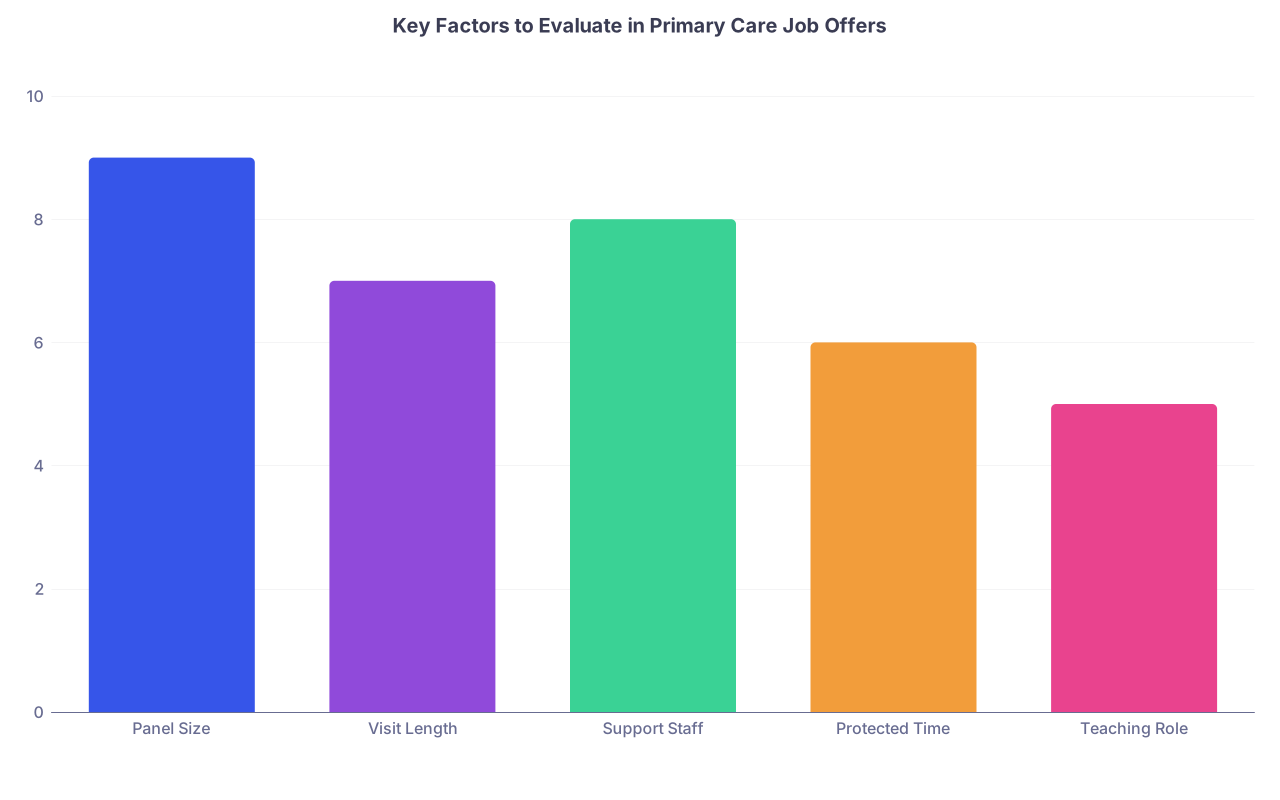
| Category | Value |
|---|---|
| Panel Size | 9 |
| Visit Length | 7 |
| Support Staff | 8 |
| Protected Time | 6 |
| Teaching Role | 5 |
Concrete things to look at:
- Panel size expectations (and how fast they expect you to grow it)
- Average visit length:
- 15 minutes for everything? Red flag for burnout.
- Team structure:
- RN care management?
- PharmD support?
- Behavioral health integrated or not?
- Call structure and weekend coverage.
- Protected time for:
- Teaching
- QI
- Admin (if relevant)
Then shape your application materials (CV + cover letter) with a consistent message:
“I trained in a competitive academic internal medicine program with strong subspecialty exposure. Over time I chose to focus on primary care because I am most engaged by continuity care, chronic disease management, and team-based outpatient medicine. I am looking for a role where I can combine high-quality clinic care with teaching and quality improvement.”
Programs and employers like clarity. They dislike hedging.
Step 11: Do Not Apologize for Choosing Primary Care
You will encounter subtle (or not subtle) condescension:
- “You could have easily done cards.”
- “Primary care is a waste of our research infrastructure.”
- “You are too smart for clinic all day.”
Translate all of that mentally to:
“I project my own values onto everybody, and I cannot imagine a different definition of success.”
Your job is not to argue. Your job is to calmly own your path.
Sentence you should get used to:
“I thought seriously about fellowship, but after real experience in both subspecialties and ambulatory care, primary care is where I feel I will be most effective and most satisfied long term.”
That is it. No long defense. No apology.
And on the flip side, do not swing to the other extreme and denigrate fellowship paths. That just makes you look reactive and immature.
Step 12: Keep One Eye on Future Flexibility
Here is a quiet truth: a strong primary care internist with solid letters from a good IM program still has options later.
Two examples I have seen:
- Resident goes into primary care at a VA, gets deep into clinical work + QI, then 4–5 years later applies to a part-time geriatrics or palliative fellowship. Matched. No drama.
- Resident takes academic primary care position, builds a teaching and QI portfolio, becomes PC track APD. Zero regret.
So while you should commit to the primary care pivot, you should also:
- Maintain your board exam performance.
- Keep at least one or two scholarly/QI efforts alive.
- Stay in touch with mentors, both PC and subspecialty.
You are not locking yourself in a tiny box. You are choosing a starting point.

| Step | Description |
|---|---|
| Step 1 | Competitive IM trainee |
| Step 2 | Subspecialty application |
| Step 3 | PC mentors and PD discussion |
| Step 4 | Reframe CV and experiences |
| Step 5 | Primary care job search |
| Step 6 | Supported primary care career |
| Step 7 | Clarify goals |
FAQ (Exactly 3 Questions)
1. Will pivoting to primary care hurt my relationship with my PD or program?
If you handle it casually and late, it might. If you handle it early and professionally, it usually does not. Meet with a mentor first, then your PD, and frame it as a thoughtful decision based on real experiences, not burnout or fear. Explicitly say you care about representing the program well and ask how to structure your remaining time to be a “win” for both you and them. Most PDs respect clarity and maturity more than they care about which box you land in.
2. Should I still do subspecialty electives or switch everything to outpatient blocks?
You should not make your schedule one-dimensional. Keep enough subspecialty and inpatient exposure to be a competent internist and to maintain credibility. But bias your electives toward ambulatory experiences that fit primary care: FQHCs, VA clinics, geriatrics, addiction, palliative, complex chronic disease clinics. When you do subspecialty blocks, focus on how the knowledge will translate to your future clinic patients and mention that explicitly when talking to attendings and in letters.
3. Does choosing primary care close the door to doing a fellowship later?
Not automatically. If you keep your clinical performance strong, maintain relationships with faculty, and stay engaged in at least some scholarly or QI work, you keep a pathway open. I have seen primary care internists later match into geriatrics, palliative, rheumatology, even cardiology, particularly when they can explain a coherent story (“I built a foundation in primary care, then decided I wanted to subspecialize in X for these reasons”). Do not choose primary care as a “placeholder,” but know that a well-executed primary care career start does not permanently lock every other door.
Open your email right now and draft a 4–5 sentence message to one mentor you trust, asking for a 20–30 minute meeting about aligning your career toward primary care. Do not overthink it. Send it. That is the first real step in pivoting with your bridges intact.