
The way most students judge pediatrics after one rotation is flawed. You are probably measuring the wrong things.
You just finished your peds rotation and your gut reaction is: “I did not love that.” Now you are wondering if that means pediatrics is off the table. Maybe you feel guilty because you “like kids” and thought you would adore it. Or you are relieved because you felt miserable and want permission to walk away.
Slow down. One clerkship block is a terrible sample size for a 30-year career decision.
This is the checklist I wish more students used: stepwise, concrete, and brutally honest. By the end, you will not have a guaranteed answer. But you will have an organized, objective assessment instead of a vague bad taste in your mouth.
1. Separate “I disliked pediatrics” from “I disliked this specific rotation”
First fix: stop treating your single rotation as a referendum on the whole specialty.
Ask yourself, bluntly:
- Did I hate pediatrics?
- Or did I hate:
- Waking up at 4:30 am
- This hospital
- This team’s culture
- This call schedule
- Feeling useless and confused every day
Those are not the same.
Quick environment debrief (10–15 minutes)
Grab a piece of paper. Draw three columns:
- Column A: Things that clearly belong to “pediatrics as a specialty”
- Column B: Things that clearly belong to “this particular rotation/site/team”
- Column C: Not sure / mixed
Now go through these prompts and sort them:
- Team culture
- Did attendings like to teach or were they burned out and impatient?
- Were residents supportive or did they treat students as scut machines?
- Did you feel psychologically safe asking questions?
- Workload and schedule
- What time did your day realistically start and end?
- How many truly miserable days per week did you have?
- Were you actually on peds or was it 50% waiting for labs + 50% discharge paperwork?
- Patient population
- Age ranges you saw most (NICU infants vs. toddlers vs. teenagers)
- Level of acuity (PICU vs. bread-and-butter bronchiolitis)
- Socioeconomic mix (tertiary referral center vs. community hospital)
- Institutional factors
- EMR nightmares
- Chronic understaffing
- Terrible physical layout (always walking between towers)
- Rotating at 3 different sites in 4 weeks
Anything that clearly falls into “this hospital / this team” does not automatically apply to pediatrics across the board.
Reality check: pediatrics is broad
You might have done “pediatrics” but really experienced a very narrow slice: inpatient general peds at an academic safety-net hospital. That is not outpatient developmental clinic. That is not pediatric emergency medicine. That is not PICU or subspecialty clinic.
Use this table to gut-check how narrow your sample was:
| Career Setting | Typical Student Exposure on Core Peds Rotation |
|---|---|
| Outpatient general peds | 0–30% |
| Inpatient ward | 50–90% |
| PICU/NICU | 0–20% |
| Peds emergency medicine | 0–30% |
| Subspecialty clinics | 0–25% |
If your rotation was 90% inpatient gen peds and you are judging all of pediatrics off that, your sample is weak. Treat it as such.
2. Use an objective “fit” checklist instead of vibes
You need structure. “I just didn’t click” is not a usable data point.
Score pediatrics against 10 core fit dimensions. Use a 1–5 scale:
- 1 = Strong mismatch
- 3 = Neutral / mixed
- 5 = Strong match
Be ruthless but specific.
| Dimension | Your Score (1–5) |
|---|---|
| 1. Tolerance for family dynamics | |
| 2. Comfort with nonverbal patients | |
| 3. Interest in growth/development | |
| 4. Patience with repetition | |
| 5. Emotional resilience with sick kids | |
| 6. Appeal of preventative care | |
| 7. Enjoyment of teaching/education | |
| 8. Comfort with lower pay vs other specialties | |
| 9. Preference for team-based work | |
| 10. Tolerance for system issues (social determinants, CPS, access) |
Now let’s define these concretely.
1. Tolerance for family dynamics
- You will negotiate with parents constantly.
- You will repeat explanations to multiple caregivers.
- You will manage anxiety, denial, and sometimes anger directed at you.
Ask yourself:
- Did talking to parents drain me or feel satisfying?
- Did I like the challenge of getting buy-in from skeptical caregivers?
- When a helicopter parent pushed back, did I feel energized or furious?
If this is a 1–2 for you, the core of pediatrics will frustrate you daily.
2. Comfort with nonverbal patients
A lot of pediatrics is inference: vital signs, exam cues, caregiver reports.
- If you need a robust history from your patient to feel safe, that is a flag.
- If you liked relying on observation, pattern recognition, and caregiver input, that is a plus.
Ask: Were you anxious all the time because you “could not get a good history,” or did you enjoy the puzzle?
3. Interest in growth and development
Peds is obsessed with milestones, vaccination schedules, and longitudinal progress.
- Did you find developmental checklists tedious or fascinating?
- Were you interested in growth curves or did you fake it?
If none of that sparks any curiosity, outpatient peds will bore you.
4. Patience with repetition
Peds has a lot of the same stuff:
- Viral URIs
- Otitis media
- Asthma exacerbations
- Well-child checks
If your brain needs rare zebras to stay engaged, you might suffer in general peds but still love a pediatric subspecialty (heme-onc, cardiology, etc.).
5. Emotional resilience with sick children
Key point: react honestly here. You are not a better person because you want to be sad all day.
- Did you feel wrecked for hours after seeing a very sick child?
- Did the emotional weight linger and impair your function?
- Or did you feel sad but still functional, with a sense of purpose?
One red flag: if you found yourself emotionally checking out or dissociating just to get through the day. That may mean this is not sustainable for you.
6. Appeal of preventative care
Peds is heavy on prevention:
- Vaccines
- Nutrition counseling
- Developmental surveillance
- Anticipatory guidance
Some people love maximizing lifetime health trajectories. Others want complex diagnostics and procedures.
Which reaction do you remember more: boredom during well-child visits, or genuine interest in preventing problems early?
7. Enjoyment of teaching and education
You teach constantly:
- Parents
- Kids (teenagers especially)
- Teachers, school nurses, coaches
If you enjoyed explaining asthma to a teenager in a way that actually landed, that is a good sign.
If you gritted your teeth every time you had to repeat “no antibiotics for viral infections,” that is a sign too.
8. Comfort with lower salary ceiling
You have seen the charts. Peds is near the bottom of the income list. That will not change during your career.
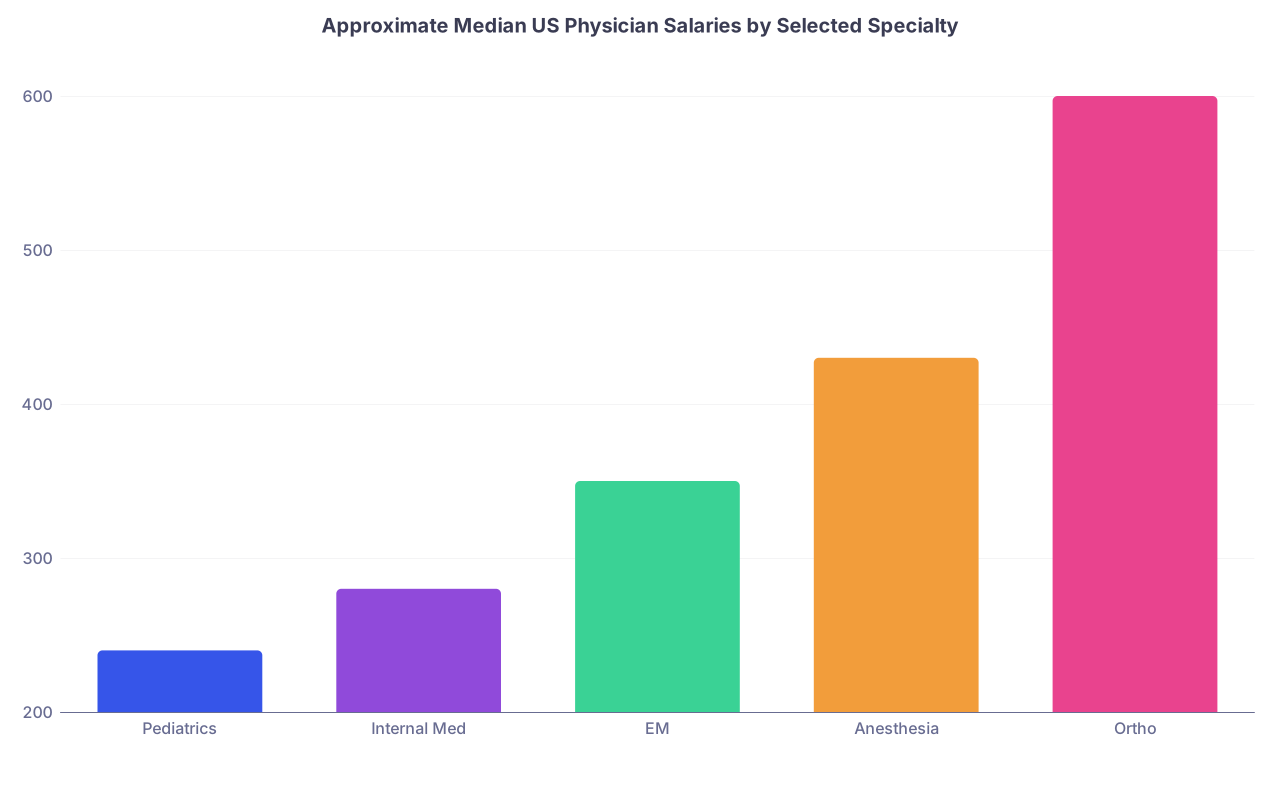
| Category | Value |
|---|---|
| Pediatrics | 240 |
| Internal Med | 280 |
| EM | 350 |
| Anesthesia | 430 |
| Ortho | 600 |
Ask yourself:
- Does the income disparity bother me deeply?
- Could I accept lower pay if the day-to-day work fit me well?
If money is a major driver for you, do not lie to yourself. You will resent pediatrics later.
9. Preference for team-based work
Peds is intensely collaborative:
- Social work
- Child life
- Nursing
- PT/OT/speech
- Schools and community orgs
If you prefer more autonomy and less coordination, large pediatric systems can feel suffocating. Smaller community practices are different.
10. Tolerance for system issues
You will see:
- CPS cases
- Housing insecurity
- Parents with low health literacy
- Missed follow-ups due to transport, work, or cost
If these social determinants always felt like “someone else’s problem,” pediatrics will be exhausting. If you felt pulled to solve them, even in small ways, that matters.
When you finish scoring, look for patterns. If you are 1–2 on most core elements (family interaction, nonverbal patients, development, prevention), that is meaningful.
3. Dissect your negative experience step-by-step
Now zoom in on what exactly felt bad about your rotation.
Do a “bad moments” autopsy
Write down 5–10 specific moments where you thought:
- “I hate this.”
- “I cannot do this for 30 years.”
- “Get me out of here.”
For each, answer:
- What actually happened? (Concrete facts, not feelings.)
- Who was involved? (Resident, attending, nurse, patient, parent.)
- What part was inherent to pediatrics and what part was situational?
- Could that scenario realistically be different in another setting?
Example:
- Moment: Resident snapped at you during pre-rounds after you missed a lab result.
- Inherent to pediatrics? No. That is residency culture + personality.
- Situational factors: overworked, post-call, toxic team.
- Conclusion: Not a peds-specific issue.
Another example:
- Moment: You almost cried seeing a previously healthy 5-year-old intubated in the PICU, parents sobbing at bedside.
- Inherent to pediatrics? Yes. Sick kids are part of the job.
- Can setting change it? Somewhat, but serious illness will always exist in peds.
- Conclusion: This emotional reaction matters.
You are trying to strip away the noise and isolate the signal of whether the core of the field fits you.
4. Get more data: controlled “mini-experiments”
If you are still uncertain after the checklist and autopsy, your job is to collect targeted data, not to ruminate for six months.
Set up 2–4 small experiments:
A. Shadow a different flavor of peds
Ask your clerkship director or advisor to help you arrange:
- Half-day in a community outpatient clinic
- One shift in pediatric ED
- A day in a subspecialty clinic (allergy, GI, endocrine, etc.)
Before each:
- Write a 2–3 sentence hypothesis. Example: “I think I will like outpatient peds more because the pace is calmer and the relationships are longer-term.”
After each:
- Quick score (1–5) on: “Could I imagine doing this most days for 10+ years?”
Do not overcomplicate this. You are running small, targeted tests.
B. Talk to 3 different pediatricians
Not “random chat.” Structured info gathering.
Find:
- A general pediatrician (outpatient)
- A hospitalist or subspecialist
- A relatively new grad (0–5 years out of training)
Ask each:
- What parts of your day give you energy?
- What parts drain you the most?
- What surprised you most about pediatrics after residency?
- If you had to pick a different specialty now, what would you pick and why?
You are looking for patterns in what they describe as “the core of the job,” not just their hospital’s quirks.
5. Compare pediatrics directly to your other top option
Do not assess pediatrics in a vacuum. You are not choosing between pediatrics and nothing. You are choosing between pediatrics and…something else.
Use a direct comparison grid.
Pick your realistic alternate specialty (or top two). Maybe:
- Internal medicine
- Family medicine
- EM
- Anesthesiology
- Psychiatry
- Something else
Now build a side-by-side comparison:
| Factor | Pediatrics (Score 1–5) | Alternate Specialty (Score 1–5) |
|---|---|---|
| Day-to-day enjoyment | ||
| Fit with personality | ||
| Tolerance of patient pop | ||
| Emotional sustainability | ||
| Lifestyle (hours/schedule) | ||
| Income expectations | ||
| Training length/intensity | ||
| Long-term career options |
Then ask:
- If pediatrics is a 3 and internal medicine is a 4 on most things, are you rejecting pediatrics because it is bad or because something else is better?
- Would you feel regret if pediatrics disappeared from your options entirely?
That “if it vanished” question is powerful. If your main feeling is relief, that tells you something.
6. Watch out for biased thinking that ruins decisions
There are common traps I see over and over.
Trap 1: “If I were a good person, I would pick pediatrics”
No. You are not a better human because you choose a lower-paid field with cute patients. You are also not a villain for wanting a life and an income that match your priorities.
Judge specialty fit on alignment, not on moral points.
Trap 2: “My classmates loved peds, so something is wrong with me”
You saw students post cute baby pictures on Instagram and say, “Best rotation ever!!!” You did not feel that.
Sometimes that is just personality difference:
- More introverted, drained by constant family interaction
- Less comfortable when patients cannot describe their symptoms
- More drawn to physiology puzzles than developmental issues
That is not pathology. That is information.
Trap 3: “I was bad at the rotation, so I must not fit the field”
Students confuse early incompetence with misfit all the time.
Ask:
- Was I bad because I did not try, or because I was overwhelmed by a new environment?
- Did I improve by the end?
- Did anyone actually say I was unsafe or unteachable, or is this just my perfectionism screaming?
Being clumsy on your first clerkship block does not predict your entire career trajectory.
7. Turn your reflections into a concrete decision plan
You need an action plan, not infinite reflection.
Use this decision protocol:
Step 1: Lock in your scores and notes
- Finish the 10-dimension fit checklist.
- Complete your “bad moments” autopsy.
- Keep everything in one document.
Step 2: Decide if pediatrics is:
- Clearly out (core misfit on multiple dimensions)
- Clearly in the running (mixed but not strongly negative)
- Top choice (despite a rough rotation)
If it is clearly out:
- Write a brief statement for yourself: “I am not pursuing pediatrics because X, Y, Z are core parts of the field that do not fit my strengths or tolerances.”
- Share this with an advisor and gut-check it, but do not obsess. Move on.
If it is still in the running:
- Plan 2–3 mini-experiments (shadowing, extra exposure) over the next 2–3 months.
- Set a deadline: “By [date], I will decide whether pediatrics stays on my rank list of specialties.”
If it is top choice but you had a bad rotation:
- Focus on finding programs that avoid what you hated (toxic culture, specific settings).
- Use your reflection to explain in a personal statement or interviews how you processed the experience and still chose pediatrics.
8. How to talk about “not loving peds” with advisors and in applications
You do not need to hide that you struggled on peds, but you do need to frame it intelligently.
With advisors
Say:
- “I expected to love pediatrics but did not enjoy my core rotation. I am trying to distinguish between a bad fit with that environment and a bad fit with the specialty. Here is the checklist I used and what I found…”
This signals maturity, not indecision.
On applications (if you do not choose peds)
You do not need to explain why you avoided pediatrics in an IM or FM personal statement. Nobody cares. Focus on why you chose your field, not why you rejected others.
On applications (if you do choose peds despite a rough rotation)
If an evaluator or letter hints at struggle, be ready:
- “My core peds rotation was challenging. The service was high volume and I initially struggled with the emotional weight of sick children. That experience forced me to examine my fit carefully. I sought additional exposure in [clinic / ED / subspecialty], and those experiences confirmed that, despite the difficulty, working with children and families is what I find most meaningful.”
You are not pretending it was perfect. You are showing you processed it like an adult.
9. Quick reality check: what usually predicts peds satisfaction?
From watching multiple classes move through this, I see a pattern.
Students who end up happy in pediatrics usually:
- Do not mind (or actively enjoy) talking to parents at length.
- Are okay with the emotional reality of occasionally tragic cases.
- Get bored by adult chronic disease management but not by child development.
- Accept the lower salary as a trade-off for the patient population and daily work.
- Do not need procedures or ICU-level acuity to feel valuable.
Students who bail on pediatrics usually:
- Dread family meetings.
- Feel constantly on edge with nonverbal patients.
- Are more compelled by adult pathology, procedures, or critical care.
- Are quietly very bothered by the income gap.
- Feel emotionally flooded or detached around sick children.
You probably see yourself in one of those clusters.
FAQ (exactly 4 questions)
1. What if I hated inpatient pediatrics but liked the few outpatient days I had?
Then your next step is obvious: get targeted outpatient exposure. Request a half-day or a week in a community clinic or continuity clinic if your school allows it. Many students are turned off by the pace and chaos of inpatient wards but thrive in primary care settings where the focus is prevention and long-term relationships. If you consistently enjoy outpatient kids’ visits but not inpatient, general outpatient pediatrics or a pediatrics-adjacent field (like med-peds, family medicine with strong pediatrics) may still be on the table.
2. I felt emotionally destroyed by a single very sick child. Does that mean I cannot do pediatrics?
Not automatically. A strong emotional reaction means you are human, not that you are unfit. The key is what happens over time: do you adapt, find coping strategies, and still feel the work is worth it? Or do you shut down and dread going back? Use your reaction as a data point: talk to pediatricians about how they cope, maybe shadow in a less acute setting, and see if your distress decreases with exposure. If, even after that, the emotional load feels unbearable, that is a valid sign that full-time pediatrics may not be sustainable for you.
3. My pediatric attendings gave me average or lukewarm evaluations. Is that a sign this field is not right?
Not necessarily. Lukewarm evals can reflect late rotation timing, busy teams, or you being early in your clinical growth. Read the narrative comments carefully: are they saying you lacked interest in children and families, or just that you were quiet, unsure, or needed more medical knowledge? The former might point to misfit; the latter is just being a learner. Use your own internal reactions and the structured checklist more heavily than one or two generic evaluation forms.
4. How long should I keep pediatrics “in play” before ruling it out definitively?
Give yourself a clear timeline. Usually 2–3 months after your core rotation is enough if you use that time well. In that period, complete the objective checklist, run 2–4 mini-experiments (shadowing different settings), and talk to at least three pediatricians. Then set a decision date and commit. Dragging this out for a year does not produce better insight; it just adds anxiety. Your goal is not to find a perfect calling. It is to choose a specialty where the core daily work fits your strengths, tolerances, and long-term life goals better than the alternatives.
Open your peds evaluation and your rotation calendar right now. Write down three specific moments you hated and three you did not mind—or even liked. Start sorting them into “pediatrics as a field” vs “this specific rotation.” That is your first real step from vague dislike to an informed decision.