
The myth that internal medicine will crush your soul is exaggerated—and also, annoyingly, not 100% wrong.
You’re not crazy for being scared of IM. You’re actually paying attention. You’ve probably heard some version of: “IM is constant codes,” “You’ll drown in notes,” or my favorite, “If you like sleep, don’t do medicine.” And now you’re sitting here thinking: am I about to sign up for three years of misery just because I sort of like physiology and clinic?
Let’s slow this down. Not sugarcoat it. But also not catastrophize it to the point you can’t think straight.
What you’re really afraid of (and whether it’s legit)
Most people don’t fear “internal medicine” as a concept. They fear specific, vivid things:
- Never sleeping
- Constant pages and codes
- Being emotionally wrecked by sick patients
- Drowning in documentation and micromanagement
- Losing your personality and hobbies for 3 years
- Being “too soft” or “too slow” for a high-acuity field
You’re probably thinking some version of: “Everyone else seems tougher. What if IM breaks me and they all handle it fine?”
Let me be blunt: IM can be intense. On bad rotations, the work feels endless and pointless. On good rotations, you’re exhausted but sort of proud. The real question isn’t “Is IM intense?”—it’s “Is IM too intense for how I’m wired, and are there ways to make it more livable if I choose it?”
That’s a different question. And much more solvable.
Reality‑check: How intense is IM actually compared to other fields?
You’re probably hearing noise from everywhere—surgery people saying “You guys have it easy,” derm people talking about 4pm finishes, psych people hinting medicine is for masochists.
Here’s some grounding.
| Specialty | Hours/week (residency) | Overnight call frequency | Typical patient acuity |
|---|---|---|---|
| Internal Med | 60–80 | q4–7 nights or night float | High on wards/ICU |
| General Surgery | 70–90 | q3–5 nights or night float | High, more emergent |
| Pediatrics | 55–75 | q4–7 nights or night float | Moderate–high in PICU |
| Psychiatry | 50–65 | Less overnight; more home call | Low–moderate |
| Radiology | 50–60 | Limited nights; some night float | Diagnostic, indirect |
Is IM “the worst”? No.
Is it chill? Also no.
The intensity of internal medicine swings wildly depending on:
- Service (ICU vs clinic vs wards vs electives)
- Type of hospital (county vs community vs big academic)
- Program culture (malignant vs functional vs actually supportive)
A county hospital MICU month can absolutely feel like getting hit by a truck. A rheumatology clinic elective can feel like a long but very normal job.
The painful part: in residency, you don’t get a choice most of the time. You rotate through the heavy stuff whether you like it or not.
The four big fears about IM intensity—broken down honestly
Let’s name them and dissect them. Because vague fear is paralyzing; specific fear is at least negotiable.
1. “I won’t be able to handle the workload and hours”
This is probably the loudest one in your head.
You’re picturing:
Post‑call, 10 notes left, pager going off, attending asking about every single sodium level from the last year, and you’re running on 3 hours of broken sleep and cold pizza.
Parts of that are real.
- Wards + ICU months are heavy.
- Long call or night float means circadian chaos.
- You’ll have days where you’re behind from 7am and never catch up.
But here’s the pattern I’ve seen over and over: the people who think they’ll completely fall apart… usually don’t. They’re stressed, anxious, frustrated—but functioning. The “I’m sure I’ll fail” crowd is almost always more conscientious and on top of things than the “I’ll just wing it” crowd.
You adapt to:
- Writing notes faster
- Presenting more succinctly
- Anticipating what attendings will ask
- Prioritizing: this task now, that can safely wait
You’re not suddenly “okay” with 28‑hour calls. You just become… capable. And that’s enough.
What does break people isn’t usually the raw volume. It’s:
- Toxic culture (shaming, yelling, passive‑aggressive stuff)
- Zero support when you’re floundering
- Feeling like no matter how hard you work, you’re always “behind”
Those things are about program choice, not about IM as a specialty.
2. “Sick, complex patients will emotionally wreck me”
Internal medicine isn’t outpatient sports physicals and refilling birth control (like some of FM can be). You’ll see:
- End‑stage liver disease from alcohol at 32
- Repeat COPD admissions who keep coming back
- ICU patients who never meaningfully wake up
- Families begging you for miracles that don’t exist
If you’re already someone who carries everything home with you, this feels terrifying.
Reality check: yes, some days you’ll go home heavy. You’ll think about the patient on pressors whose family finally agreed to comfort measures. You’ll have cases that sit with you for years.
But intensity here is different from what you think. The emotional load often becomes most intense when:
- You’ve had no debrief, no processing time
- The team treats tragedy like a checklist item
- You feel helpless and useless
And again, that’s about humans and systems.
In IM, you do get:
- Longitudinal care (clinic continuity, following your patients when they’re admitted)
- Families who are deeply grateful
- Concrete wins: DKA reversed, sepsis treated, heart failure stabilized
If you’re worried you “feel too much”: that’s usually not a disqualifier. It just means you’ll need some intentional boundaries and maybe a good therapist. The people I worry about are the ones who brag about being “numb to it all.”
3. “I’m going to drown in notes, orders, and mindless tasks”
Honestly? Documentation in IM is not a myth. It’s… a lot.
You’ll be charting:
- H&Ps
- Daily progress notes
- Discharge summaries that read like novels
- Med recs, order sets, prior auth nonsense
If you hate writing, organizing thoughts, or reading other people’s notes, IM will feel heavier. Because cognitive work is the job.
But there are ways the “intensity” of paperwork changes:
- Attendings who help you focus on what matters vs nitpick formatting
- Programs that build semi‑reasonable templates
- Teams where interns share the load instead of shifting it to the Most Anxious Person
You will get faster.
You will not magically enjoy charting.
Ask yourself this: does written communication about patients feel meaningful or just maddening? If part of you likes synthesizing stories and plans—IM’s documentation demands are intense but not soul‑destroying. They’re just… part of the package.
4. “I’ll lose myself for three years and never get my life back”
You’ve probably heard someone say: “Residency is just survival. You can have a life when you’re attending.” And that line is poison if you already have anxiety about losing control of your time and identity.
Here’s the complicated truth:
- On some rotations, your life will 90% disappear.
- On others, you’ll have evenings and actual weekends off.
- How much of “you” stays intact depends on boundaries and program culture.
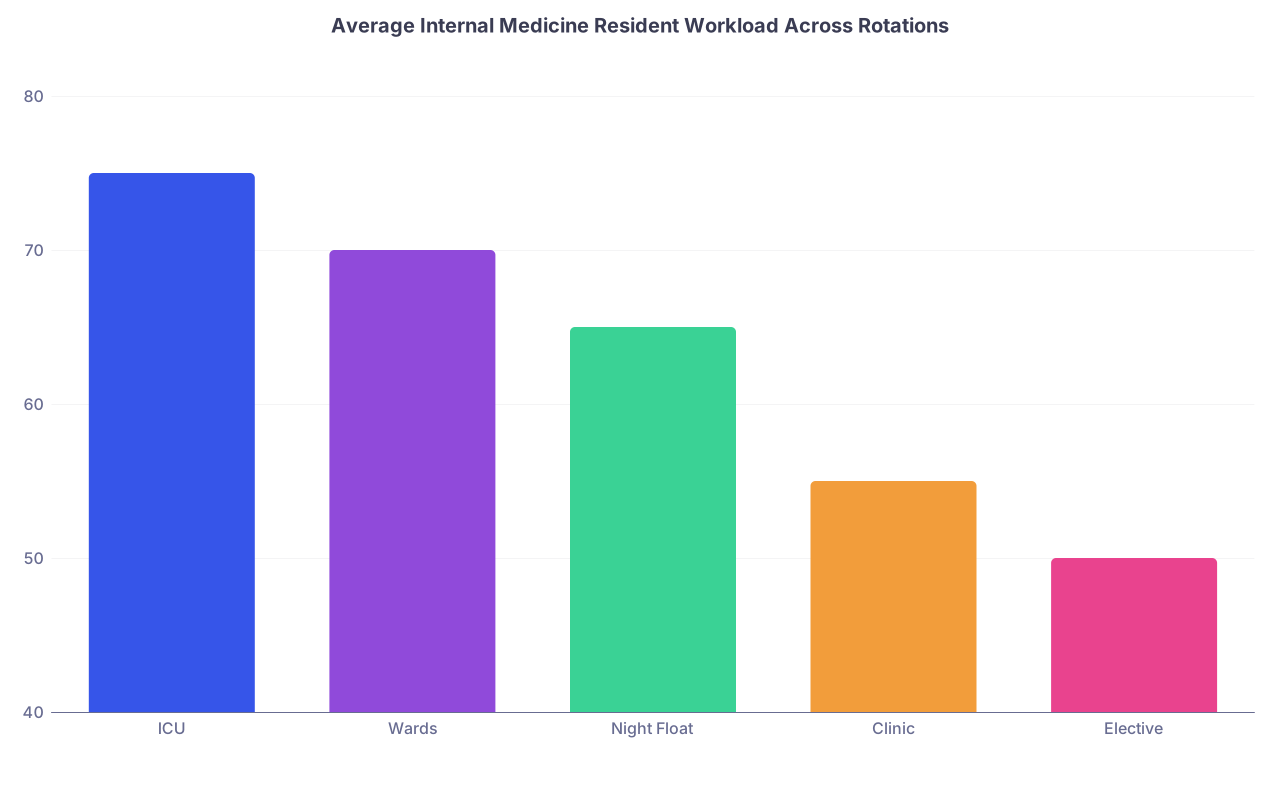
Look at this pattern across an average IM year:
| Category | Value |
|---|---|
| ICU | 75 |
| Wards | 70 |
| Night Float | 65 |
| Clinic | 55 |
| Elective | 50 |
Yes, those are big numbers. But notice: it’s not 75 every single week of the year. The intensity comes in waves. You will have lighter blocks where you can:
- See friends
- Work out more than once every three weeks
- Remember what daylight looks like
The real danger is not the schedule alone. It’s when you:
- Say yes to every committee, teaching gig, and research thing out of fear
- Refuse to ask co‑residents for help because you don’t want to seem weak
- Decide your only value is productivity
Those behaviors turn an already intense field into something unbearable.
How to tell if IM’s intensity might actually fit you
Let’s assume you’re not trying to be a martyr. You just genuinely like medicine but fear burning out. What should you look for in yourself?
Pay attention to these:
Do you like thinking through messy, multi‑problem patients, even if it takes longer?
If you secretly enjoy untangling a chart disaster or a complicated management decision, that’s IM‑brain. The intensity will feel more like overuse than like incompatibility.How do you respond now to high‑stress situations in rotations?
Not “do you feel calm,” but: do you still function? Even when you’re sweating and your heart is pounding, are you able to think “next step is this”?Can you tolerate being wrong in public and still show up again the next day?
IM culture can be very “pimp heavy” and detail‑oriented. If shame freezes you completely, you’ll suffer more. If you feel shame but still learn and come back—there’s hope.Do you prefer breadth and continuity over quick in‑and‑out procedures?
If you get bored when a case is “done” after one fix, you may actually thrive in IM’s long‑term, big‑picture intensity. If you hate circling back over and over, maybe less so.
The hidden truth: intensity is less about specialty, more about program
You’re probably trying to pick a specialty like it’s a personality quiz: “Anxious but caring, likes thinking but hates chaos → probably psych?” That’s not how this works.
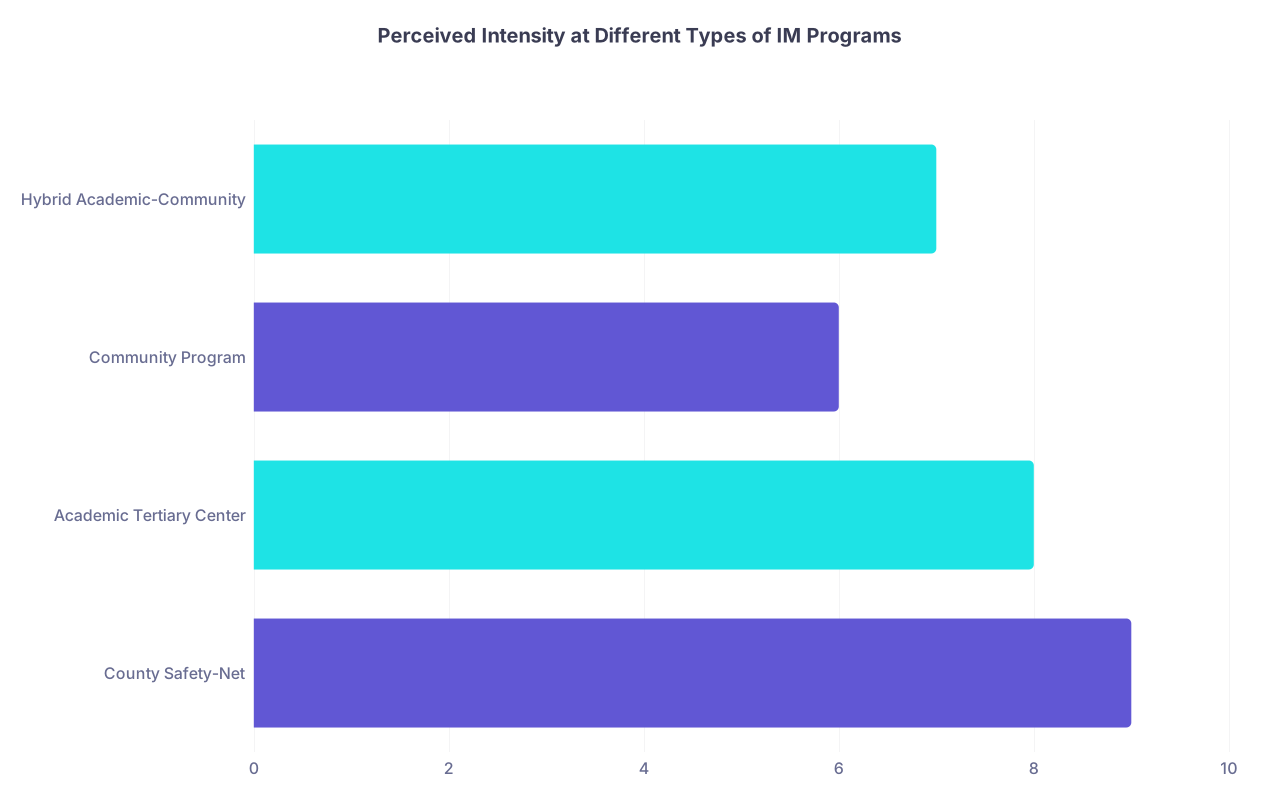
Two internal medicine programs can feel like completely different careers.
| Category | Value |
|---|---|
| County Safety-Net | 9 |
| Academic Tertiary Center | 8 |
| Community Program | 6 |
| Hybrid Academic-Community | 7 |
(Scale here is resident‑reported “how intense does this feel” from 1–10. Very scientific. Definitely not just what residents complain about at 1am.)
County + big academic IM:
- More sick patients
- More social complexity
- More expectations for research/teaching
- Often more formal hierarchy
Community IM:
- Often more manageable volume
- Less constant high‑acuity (but still plenty of sick patients)
- Often fewer fellows, so more autonomy earlier
You can modulate intensity by:
- Choosing programs with strong outpatient focus
- Looking for places known as “supportive” rather than “prestigious but brutal”
- Asking residents blunt questions about how often they feel unsafe, overwhelmed, or ignored
What you should actually be asking current IM residents
Don’t ask, “Is your program intense?” Everyone will say yes and shrug.
You need sharper questions. Things that get at whether you, specifically, would survive or completely unravel.
Try things like:
- “How often do you leave work after 7pm on ward months?”
- “On your worst day in the last 6 months, what happened and how did your program respond?”
- “When you’re behind, what do your co‑residents and attendings actually do?”
- “Do you ever feel unsafe caring for the number of patients you’re assigned?”
- “How many months per year feel truly brutal vs ‘normal hard’?”
You’re not interviewing for a badge of honor. You’re trying to predict whether your nervous system can survive this.
If you’re already burned out… should you still choose IM?
This is the question almost no one says out loud, but I’ve heard versions of it whispered in hallways:
“I’m already exhausted from med school. If I’m this tired now, won’t IM kill me?”
Or worse: “I like medicine, but I’m so fried that the idea of ICU terrifies me. Does that mean I’m weak? Or in the wrong field?”
Here’s my honest take:
- If your burnout is from toxic environments and not from medicine itself, IM might still fit—if you choose your program very carefully.
- If you feel no curiosity about patient care anymore, that’s more worrying. IM leans hard on wanting to understand and fix things.
- If you’re already numb, hopeless, and disengaged, you don’t need a “less intense specialty”; you need real support (therapy, time off, maybe a LOA) before you commit to any residency.
Internal medicine won’t magically heal burnout. But it’s also not guaranteed to make it worse. The wrong match between you + program culture, though? That absolutely will.
Thoughtful next steps if you’re still scared
You don’t have to decide today. But don’t keep letting this swirl as one big, nameless fear. Break it down and test it.
Some concrete moves:
- On your next IM rotation, keep a simple log for 1–2 weeks: hours worked, how drained you feel (1–10), what parts gave you energy vs stole it. Patterns matter.
- Do at least one honest ICU or ward month where you’re really paying attention to how you feel day to day—not how you “should” feel.
- Talk to one senior IM resident who is openly anxious or sensitive (not the “I love 100‑hour weeks” person). Ask what made it survivable or not.
- Write down your top 3 non‑negotiables for your life during residency (e.g., see my partner weekly, run twice a week, sleep at least 6 hours most nights) and ask, “Is there any IM program on earth where these could realistically exist?” The answer is almost always yes—but not at every place.
And if after all that, IM still feels like too much? That’s not failure. That’s self‑knowledge.
I’ve seen people switch from IM to psych, FM, radiology, even non‑clinical paths and finally sleep again—literally and metaphorically. I’ve also seen people who were sure they were “too soft” for IM end up thriving because they found the right program and the right people.

| Step | Description |
|---|---|
| Step 1 | Interested in IM |
| Step 2 | Evaluate program culture |
| Step 3 | Consider less acute fields |
| Step 4 | Apply IM selectively |
| Step 5 | Reassess specialty choice |
| Step 6 | Tolerate high acuity at least some of time |
| Step 7 | Find supportive programs |
| Category | Value |
|---|---|
| Bad Fit | 30 |
| Neutral Fit | 60 |
| Good Fit | 85 |


FAQ (exactly 5 questions)
1. What if I like the content of internal medicine but hate the idea of residency?
Totally normal. Liking the intellectual side and dreading the training structure are two separate things. If the thought of three hard years feels awful but being an internist appeals to you long‑term, that’s still a valid path. In that case, your job is to be extremely picky about program culture and support, not to abandon IM entirely on fear alone.
2. Does being anxious automatically mean IM is a bad choice for me?
No. Anxious people often do well in IM because they double‑check orders, follow up on labs, and care a lot. The issue isn’t “do you have anxiety,” it’s “does your anxiety paralyze you or push you to act?” If you freeze completely under pressure, you may struggle more—but that’s true in any acute care setting, not just IM.
3. Is internal medicine really worse than surgery in terms of intensity?
Different flavor of intense. Surgery is more physically grueling, more OR‑centered, more brutally early mornings. IM is more cognitively dense, emotionally layered, and paperwork heavy. Some people would rather stand all day and operate than manage 18 complex medicine patients. Others feel the opposite. Neither is “worse,” but IM is not the “easy” option some people pretend it is.
4. Can I choose IM but plan to go into a less intense subspecialty later?
Yes, and a lot of people do. Cards and ICU are one end of the intensity spectrum; allergy, rheum, endo, outpatient heme/onc or general IM clinic are much more lifestyle‑friendly. Just remember: you still have to get through those three core IM years first. Fellowship doesn’t erase residency.
5. What’s one red flag that an IM program’s intensity will be unhealthy for me?
If current residents laugh nervously when you ask about support, or say things like “You just kind of survive” or “They only care about numbers,” that’s a massive red flag. Another: if nobody can remember the last time leadership changed something because residents said it was unsafe or unsustainable. If your gut is already clenching just talking to them, believe it.
Key takeaways so you’re not spiraling:
- Internal medicine is intense, but not uniformly and not uniquely—program culture matters more than the word “IM” itself.
- Being scared doesn’t mean you’re unfit; it means you’re thoughtful. Pay attention to how you function under stress now, not some imaginary “residency version” of you.
- You’re allowed to choose a path that doesn’t destroy you. That can be IM—with the right fit—or something else entirely.