You’re in your third-year clerkships, or maybe it’s the middle of intern year in a TY/prelim spot. You just finished a pediatric month that surprised you by how much you liked it… then you did Family Medicine and kind of liked that too. Now every attending you meet asks, “So what specialty are you thinking?” and your brain replies, “Peds… or FM… or… I don’t know.”
You Google “Peds vs FM lifestyle,” stare at Reddit threads at 1 a.m., and tell yourself you’ll figure it out “after this next rotation.” You are dangerously close to punting this decision until ERAS forces your hand.
That’s how people end up in the wrong specialty. Not because Peds or FM is “bad.” But because they picked for the wrong reasons, lied to themselves about what they actually enjoy, or misunderstood what these jobs look like in real life.
I’ve watched people do this. Loved kids, hated parents → chose Peds anyway → miserable. Loved procedures, picked an outpatient-heavy FM job → felt bored and stuck. Loved cradle‑to‑grave continuity → chose subspecialty Peds fellowship and realized they missed adults.
You’re here so you (hopefully) do not repeat that.
Let’s walk through the classic misalignment mistakes between Pediatrics and Family Medicine that come back to bite people. Then we’ll talk about what to actually test, ask, and notice before you lock in a path.
Mistake #1: Confusing “I like kids” with “I want a career in pediatrics”
Liking kids is not a decision tool. It’s a baseline human trait.
The trap looks like this:
You have a fun peds month. Stickers. Tiny blood pressures. Baby smiles. You think, “Adults are annoying, kids are cute, I’ll do Peds.”
Then you hit PGY-2 and realize: your job is not hanging out with kids. Your job is negotiating with adults about kids. Every. Single. Day.
Parents (and grandparents, and foster parents) are not a side detail of pediatrics. They are the main interaction.
Here’s a hard truth a lot of MS3s gloss over:
- In inpatient Peds, almost every conversation includes a parent who is scared, sleep-deprived, anxious, or angry, sometimes all at once.
- In outpatient Peds, you’re doing vaccine counseling, developmental expectations, school forms, behavioral concerns, sleep issues, feeding arguments—mostly with adults.
- Those cute five-minute interactions with the child? That’s the break in between the real work: educating, de-escalating, and reassuring parents.
If your thought process is: “Adults are exhausting, I just want to work with kids,” that’s a huge red flag for Peds. You don’t escape adults in Pediatrics; you add heightened anxiety and guilt to them.
Family Medicine also sees kids. But:
- The parent dynamic tends to be a little different. You’re the “family doctor,” often for both the parent and the child. There’s more longstanding trust and less of the “I read this Facebook group” adversarial stance. Not always, but more often.
- You also get a break from pediatric parents by dealing with adult-only visits. Hypertension, diabetes, prenatal care, geriatric care—variety that changes the emotional load.
That doesn’t mean Peds is the wrong choice. It means you must evaluate:
Do you actually enjoy parent interactions? Do you like repetitive education? Do you have patience for vaccine-hesitant conversations 8 times a day without your blood pressure skyrocketing?
If the honest answer is no, don’t choose Peds just because kids are cute and adults are annoying. Cute wears off. Friction does not.
Mistake #2: Ignoring how much you care about adult medicine – until it’s gone
I’ve seen this more times than makes sense:
Student thinks they “don’t like adult medicine,” matches into Peds, and 2–3 years later admits they actually miss adult pathophysiology and complexity.
Usually it’s one of these:
- They actually loved ICU, cardiology, nephrology—but rotated only on older, very sick patients and felt emotionally burned out, so they wrote off adult medicine entirely.
- They were turned off by jaded Internal Medicine attendings and cranky patients, not the medicine itself.
- They assumed Peds would be the same intellectually, just “smaller doses.” It is not.
Peds medicine is fantastic, but different:
- Less CAD, COPD, cirrhosis, multi-organ failure.
- More congenital conditions, developmental issues, genetic syndromes, and infectious disease.
- A lot of your “chronic disease management” is asthma, ADHD, obesity, type 1 diabetes, and complex congenital situations.
Family Medicine keeps you in adult medicine. Chronic disease management is the core of your job. You’ll see:
- Hypertension, diabetes, CKD, CAD, heart failure, depression, anxiety.
- Prenatal care, postpartum care, contraception, menopause.
- Acute complaints across all ages—from otitis media to chest pain.
Here’s where people screw up: they assume discomfort = dislike. That internal medicine core rotation where you felt stupid, overwhelmed, and slow? That might have been a bad environment, not bad content.
If you are even mildly drawn to adult medicine but feel insecure about it—do not assume Pediatrics is the escape route. You’ll lose adult medicine almost entirely, and down the road you cannot just tack it back on.
Ask yourself bluntly:
- When you read adult pathophysiology (cardiology, pulm, renal), are you bored or interested but intimidated?
- Did you like the ICU/chest pain workup pieces but hate the social chaos and discharge planning?
- Do you get some satisfaction from tweaking blood pressure meds and lipid management, or does it feel like a chore?
If you secretly enjoy the intellectual side of adult medicine, Family Medicine may fit better long term, even if your clinical experiences were rocky. Throwing away an entire half of medicine because of a few bad rotations is how you end up with long-term regret.
Mistake #3: Not being honest about what “variety” actually means to you
Both Peds and FM people will tell you they chose their field for “variety.” They are talking about very different things.
In Pediatrics, variety means:
- Well-child checks from newborn to adolescence
- Development issues, behavior, school performance
- Common acute things (URI, AOM, bronchiolitis, gastroenteritis)
- Some chronic conditions like asthma, obesity, ADHD, congenital disorders
In Family Medicine, variety means:
- Newborn visits to geriatric care
- Pregnancies and postpartum visits
- Chronic disease in adults
- Mental health, procedures, musculoskeletal complaints, skin, acute infections, sometimes inpatient and OB depending on practice
Here’s the mistake: medical students say “I want variety” but they really mean one of these:
- “I want multiple age groups.”
- “I want both outpatient and inpatient.”
- “I want to mix procedures and clinic.”
- “I get bored if I see the exact same complaint five times in a row.”
Different answer, different specialty.
If you care most about multi-age continuity—seeing kids, their parents, sometimes their grandparents—Peds cannot give that to you.
If you want to see newborns but never want to manage adults in their 60s with 14 problems and 18 meds, FM is the wrong choice.
If your definition of variety is “I want the sickest physiology sometimes and very boring checkups sometimes,” pure outpatient Peds won’t scratch the itch. Neither will pure outpatient FM without any inpatient or urgent care flavor.
You have to get precise:
What specific kinds of variety do you want over a 30-year career, not just over a month-long rotation?
| Aspect | Pediatrics | Family Medicine |
|---|---|---|
| Age range | Birth through adolescence | Birth through end of life |
| Core chronic care | Asthma, ADHD, obesity, T1DM | HTN, DM2, CAD, COPD, depression, etc. |
| Reproductive care | Very limited (mostly teens) | Prenatal, postpartum, contraception |
| Geriatrics | None | Central part of practice |
| Inpatient scope | Pediatric only | Varies: adult, peds, OB, or none |
If your “variety” bar heavily involves adults, pregnancies, or geriatrics, Pediatrics will feel narrow fast. If your idea of variety is “everything kid-related,” FM may feel too diluted.
Mistake #4: Misreading lifestyle based on training, not practice
Students love the “lifestyle” argument. They also love to get it wrong.
You’ll hear:
- “Peds is more chill, kids don’t have chronic diseases like adults.” (False in 2026.)
- “FM is brutal because of inpatient and call.” (Sometimes true, sometimes laughably outdated.)
- “Peds makes less money so they must have better lifestyle to compensate.” (Nice story. Not guaranteed.)
Reality: lifestyle is not “Peds vs FM.” It’s:
- Urban academic vs community
- Hospital-employed vs private practice vs FQHC
- Outpatient-only vs inpatient+OB vs urgent care
- Call structure and local coverage expectations
Both Peds and FM can be relatively lifestyle-friendly. Or absolute grindhouses. I’ve seen outpatient Peds clinics where physicians were booked 25+ patients a day, nonstop, with charting at home. I’ve seen FM docs who designed 4-day workweeks and made it work.
The mistake is thinking: “I’ll pick the specialty with better lifestyle.”
Wrong question. The right question is:
What practice models in each specialty match the life I want, and which specialty gives me more of those options in the geographic areas I care about?
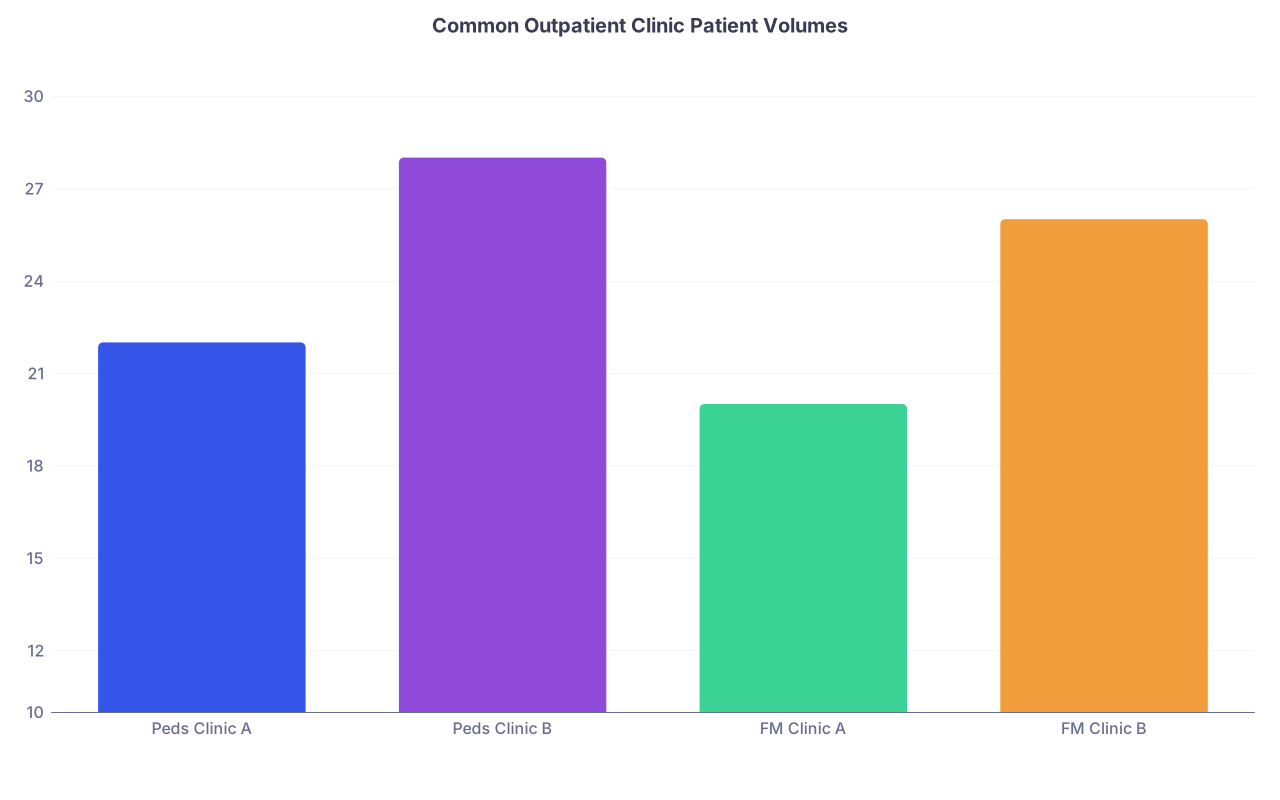
| Category | Value |
|---|---|
| Peds Clinic A | 22 |
| Peds Clinic B | 28 |
| FM Clinic A | 20 |
| FM Clinic B | 26 |
If you want:
- Outpatient only, no inpatient, no OB, 4-day weeks: both Peds and FM can do this. Depends on your market.
- Mixed inpatient/outpatient with some procedures: FM generally offers more adult inpatient exposure; Peds might limit you to pediatric wards/NICU depending on hospital.
- Heavy OB: easier with FM that includes OB training or OB fellowship; Peds won’t give you deliveries (you’ll see newborns afterward).
Do not pick Peds over FM or vice versa solely because “someone said lifestyle is better.” That’s a convenient myth for people who do not want to do the harder work of actually researching jobs, talking to attendings, and understanding market realities.
Mistake #5: Completely forgetting about procedures and hands-on work
Another misalignment I see: students think both Peds and FM are “just clinic” so procedures don’t matter. Then residency hits and they either:
- Get bored out of their minds wanting more hands-on work, or
- Get forced into a job with procedures they never actually wanted and quietly suffer.
Peds procedure load (general outpatient):
- Immunizations (nurses usually), simple skin procedures, maybe some I&Ds, wart treatments
- Less joint injections, fewer chronic pain procedures, rarely OB-related procedures
- Inpatient Peds: LPs are a big deal, IVs sometimes, maybe arterial sticks depending on training site
Family Medicine procedure spectrum can be wide:
- Skin procedures, joint injections, IUDs, Nexplanons, endometrial biopsies, colposcopy, circumcisions, abscesses
- In some settings: colonoscopies, OB deliveries, C-sections (after extra training), inpatient procedures
Not every FM doc does lots of procedures. But the option is much richer. Peds is narrower, and often more limited by child tolerance and parent anxiety.
If you get a visceral joy from:
- Doing joint injections and hearing the patient say “That worked immediately”
- Removing a big lipoma or cyst in clinic
- Placing IUDs, doing OB deliveries, or doing scopes
You’re flirting with regret if you pick a super-outpatient, low-procedure Pediatric path.
On the flip side: if procedures make you anxious and you’d love a life of mostly counseling, growth charts, developmental checks, and some acute complaints, Peds might feel safer and more aligned.
But again—this is about you actually knowing which camp you fall into, instead of assuming “I’ll get used to it.”
Mistake #6: Overlooking how much you care about continuity across generations
People who thrive in FM often say versions of this:
“I like seeing the kid for their 2-year visit and also managing the mom’s blood pressure and the grandma’s osteoporosis.”
People who thrive in Peds often say:
“I love watching kids grow up, I like being an advocate for them, I want to stay in the pediatric headspace.”
Where people blow it is ignoring how much they value cross-generational continuity until too late.
In Pediatrics, your continuity is almost always restricted to the child’s timeline. Once they age out (18–21 depending on practice), you’re done. You may know the family socially, but medically you’re out.
In Family Medicine, continuity is the point. You can:
- See the child from newborn through adulthood
- Manage the parent’s chronic diseases
- Care for grandparents at end of life
If longitudinal relationships across generations are deeply satisfying to you, FM is where that happens routinely.
I’ve watched Pediatricians say years later:
“I didn’t realize how strongly I’d care about what happened when my patients turned 18. Handing them off felt like an abrupt end I never liked.”
You need to decide now which loss would bother you more:
- Losing adult patients entirely (Peds), or
- Rarely getting deeply immersed in pediatric-only systems and diseases (FM)
Neither is universally right. It’s about which absence is going to quietly eat at you year after year.
Mistake #7: Treating fellowship options as an afterthought
Both Peds and FM have fellowship paths. Both sets of options matter more than you probably think.
Pediatrics fellowship landscape:
- NICU, PICU, pediatric heme/onc, cardiology, GI, ID, endocrinology, etc.
- Very hospital-based, often academic, lots of complex, rare disease
- Lifestyle and emotional toll can be heavy (PICU, NICU, heme/onc especially)
Family Medicine fellowship landscape:
- Sports medicine, geriatrics, palliative, OB, addiction, hospitalist, point-of-care ultrasound, academic medicine tracks
- More outpatient and community-oriented, though not exclusively
Here’s the misalignment:
- Students drawn to critical care, very sick patients, tubes/vents—but think they “don’t like adults”—sometimes default to Peds, planning on PICU or NICU. Then they realize caring for critically ill children and devastated parents hits them differently than adults in MICU. It can be brutal.
- Students who imagine doing sports medicine or full-scope OB but choose Peds because “I like kids more” suddenly find their fellowship options more limited than they anticipated.
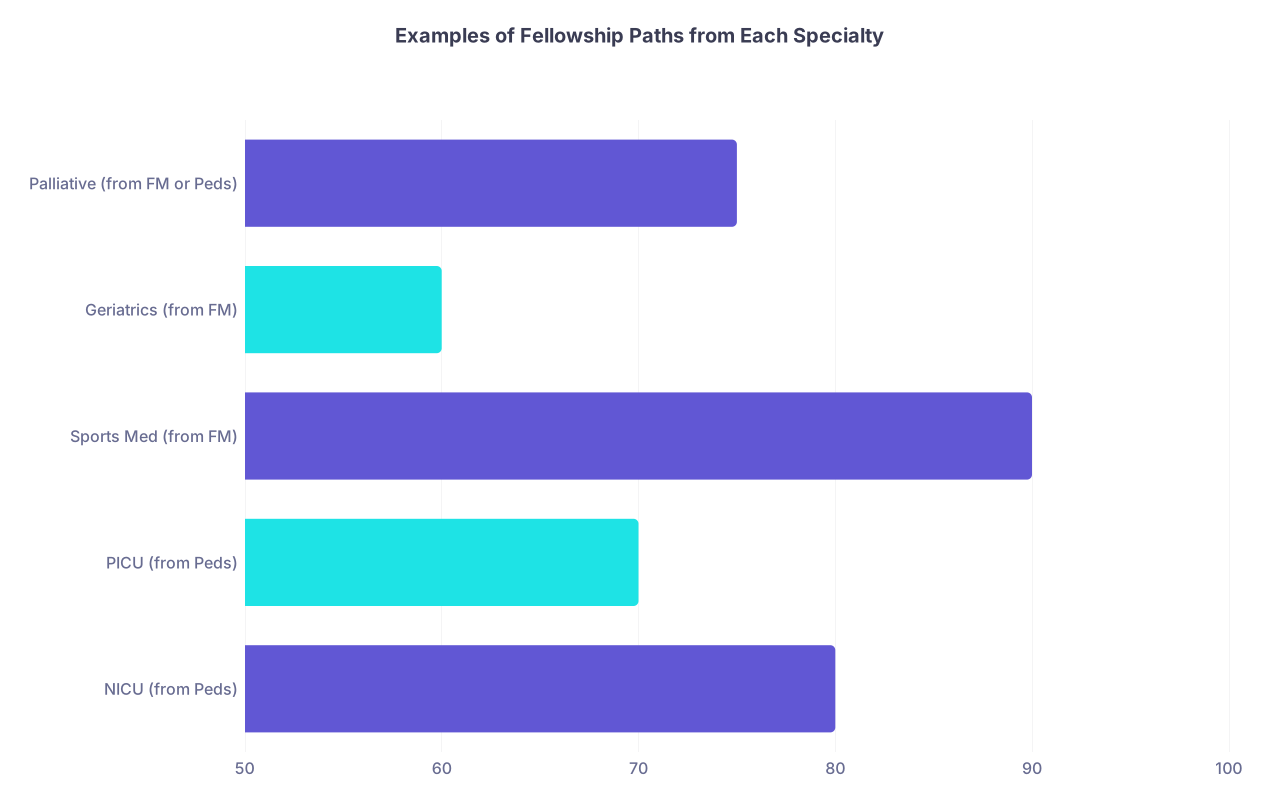
| Category | Value |
|---|---|
| NICU (from Peds) | 80 |
| PICU (from Peds) | 70 |
| Sports Med (from FM) | 90 |
| Geriatrics (from FM) | 60 |
| Palliative (from FM or Peds) | 75 |
(Treat these numbers as “relative availability/fit,” not precise statistics.)
If you have even a 20% suspicion you’ll want fellowship, you must look at:
- Which field gives you access to the types of patients and settings you imagine yourself in long term.
- Whether you’re emotionally equipped for the intensity of pediatric critical illness, or if your brain was actually picturing adult ICU all along.
- Whether you’ll resent giving up adults entirely if you go all-in on pediatric subspecialty.
The wrong move is saying “I’ll figure out fellowship later” and ignoring that half your future possibilities vanish depending on whether you choose Peds or FM now.
Mistake #8: Letting culture and identity drive the bus while pretending it’s about the work
This one’s subtle but powerful. Different specialties have different “vibes.” You know this already.
Broad stereotypes (with grains of truth):
- Pediatrics: collaborative, “nice,” patient, often more female-heavy, lots of child-friendly decor, culture of advocacy and gentleness.
- Family Medicine: broad mix, often strong emphasis on community, social determinants of health, prevention, sometimes more politically or socially activist depending on program.
Students sometimes pick Peds because:
- They like the colorful, kid-friendly environment.
- They identify more with the “soft-spoken, nurturing” culture.
- They feel judged in IM or Surgery settings and feel safer in Peds.
Others pick FM because:
- They like the identity of “the community doctor.”
- They vibe with the residents who talk about policy, rural care, full-spectrum lives.
- They like that FM doesn’t feel as “hierarchical” as some other specialties.
None of that is inherently bad. You should like your people.
The mistake is pretending these cultural pulls are about the content of the work when they’re not. You end up rationalizing:
“I love working with kids” when what you actually mean is “I hate the way attendings talked to me on Internal Medicine and Peds people were nice to me.”
Ask yourself:
- If the culture of the specialty suddenly changed but the content stayed the same, would you still want to do it?
- Are you chasing a group identity more than a set of clinical problems?
If yes, slow down. You are about to choose a decades-long career to escape a few insecure months of clerkship dynamics.
Mistake #9: Failing to pressure-test your choice in the real world
The last and nastiest mistake: making this decision off four-week rotations and online gossip, then sending your ERAS in, crossing your fingers, and hoping it all magically works out.
You would not buy a house without walking through it, inspecting it, checking the neighborhood, and asking about the wiring. Yet I’ve watched people commit to a specialty based on:
- One good or bad attending
- One particularly cute or particularly infuriating patient
- Vague “I like kids” or “I hate chronic disease” feelings
You need to pressure-test.
Here’s what that actually means:
Shadow real attendings in their actual jobs.
Not just residents. Ask: “Can I follow you for a half-day in clinic once this rotation is over?” Then watch what their day actually is—documentation, phone calls, 2-minute lunch, late patient, EMR messages.Ask them the pointed questions:
- “What do you like least about this job?”
- “What did you not understand about this specialty in med school?”
- “Which colleagues do you see burning out, and why?”
- “If your kid were choosing between Peds and FM, what would you tell them?”
Do a mental simulation:
Picture a random Tuesday for yourself in 10 years. Not the heroic day, the boring one.
- As a Pediatrician: 24 well-child checks, some sick visits, explaining vaccines multiple times, one really complex kid with multiple specialists, charting at home after your kids go to bed.
- As a Family Physician: 20–24 mixed-age visits, multiple chronic disease follow-ups, a few acute visits, a Pap smear, some depression/anxiety check-ins, possible nursing home rounds or OB clinic depending on your model.
Which one feels draining in the wrong way?
Pay attention to what you read voluntarily.
Off-service, what do you find yourself Googling because you actually want to understand it better?
- ADHD meds and developmental milestones? Pediatric asthma step-up therapy?
- Adult diabetes regimens, pregnancy guidelines, new hypertension trials?
Your curiosity is a better compass than whatever attending liked you last month.

| Step | Description |
|---|---|
| Step 1 | Interest in Peds or FM |
| Step 2 | Shadow real attendings |
| Step 3 | Ask pointed questions |
| Step 4 | Mental 10 year simulation |
| Step 5 | Notice what you read for fun |
| Step 6 | Commit and own the choice |
| Step 7 | Delay ERAS, get more exposure |
| Step 8 | Consistent pull to one side? |
Do not rush this because the calendar says so. Rushing this is how people end up scrambling for another residency later, or staying stuck and bitter.
How to avoid regretting your Peds vs FM choice
If you’ve read this far, you already know the pattern: most regret comes from lying (or half-lying) to yourself about what day-to-day work you want.
So here’s your short, brutal checklist:
- Don’t pick Pediatrics just because you “like kids” but actually can’t stand prolonged, repetitive conversations with anxious parents.
- Don’t pick Family Medicine if you truly have zero interest in adult chronic disease and will resent every hypertension follow-up.
- Don’t assume lifestyle, variety, or fellowship options are “basically the same” between the two—they’re not.
- Don’t let specialty culture be the main driver while pretending it’s about the medicine.
If you take nothing else from this:
- Be ruthlessly honest about whether you want adults in your life as patients, not just colleagues.
- Pressure-test your assumptions with real attendings living the life you think you want.
- Choose based on the boring Tuesdays of your future, not the single “fun” day of your rotation.
Do that, and you dramatically cut your odds of waking up five years from now thinking, “I knew this wasn’t me. I just didn’t want to admit it.”