
The biggest myth about psych and neuro residencies is that “supportive culture” means people are nice on interview day. It does not.
You are about to make a 4-year decision based on a 6-hour sales pitch. If you misread program culture in psychiatry or neurology, the cost is brutal: burnout, poor training, and a rank list you regret the day you start intern year.
Let me walk you through the 7 most expensive ways applicants misjudge program culture in psych and neuro—and how to protect yourself from each one.
1. Confusing “Chill” With Healthy
A laid‑back vibe is not automatically good culture. In psych and neuro it is especially easy to be fooled by this.
You know the scene: interview day starts late, everyone is “super chill,” residents joke about not working much, the PD brags that they are “not malignant, unlike other specialties.” You exhale and think, finally, somewhere humane.
That reaction is exactly how people get trapped.
Here is the problem: “chill” can mean three very different things.
- Healthy boundaries, good staffing, real supervision.
- Low expectations, weak teaching, nobody pushing anyone.
- Learned helplessness and burnout disguised as dark humor.
I have seen programs where residents proudly say, “We never stay past 4 pm” and then quietly admit later that:
- They are terrified of sick patients because they barely see any.
- They are underprepared for fellowship or boards.
- The outpatient experience is chaos but no one will rock the boat.
Psych and neuro are cognitive, subtle, pattern-recognition specialties. You will not grow in a culture that is too relaxed to challenge you.
Red flags to watch for when “chill” is actually dysfunction:
- Residents shrug off real problems with jokes: “Yeah, our EMR is unsafe, but whatever, we survive.”
- Nobody can describe what makes their graduates strong clinicians, beyond “we’re nice.”
- There is zero mention of feedback, supervision style, or expectations.
- When you ask about graduated autonomy, you get blank stares.
Questions that help you separate healthy from hollow:
- “Tell me about a time a resident was struggling. What did the program actually do?”
- “What are the expectations for reading or independent study here?”
- “How do seniors know when they are ready to handle more independence?”
If all you hear is “We don’t really push anyone” or “Do whatever you want,” be careful. That can feel safe as an MS4 and feel like sabotage two years later.
2. Overvaluing One Charismatic PD or Chair
Psych and neuro applicants fall hard for visionary leaders. The PD who quotes Winnicott. The chair who talks about functional MRI and personalized neuromodulation. The person who “gets” mental health or brain disease the way you wish everyone did.
Do not make the mistake of ranking a program primarily because of one superstar.
Leadership charisma does not equal day‑to‑day culture. Here is what commonly happens:
- New PD is dynamic, gives beautiful talks, says all the right wellness words.
- The core faculty, schedulers, and senior residents still operate like they did 5–10 years ago.
- You arrive expecting transformation and walk straight into old patterns: opaque scheduling, poor communication, passive‑aggressive evaluations.
In psych and neuro, this problem is amplified because programs often market their “mission”: trauma‑informed care, early psychosis, community psych, cutting‑edge epilepsy, neuroimmunology, etc. Applicants fall in love with the story, not the structure.
You must test whether the vision has penetrated the system.
Ask residents questions that force them to connect rhetoric to reality:
- “What has actually changed in the last 2–3 years under this PD?”
- “Can you give me a concrete thing the PD or chair fought for that changed your life on the wards?”
- “When residents give feedback, what is the last major thing that was fixed, not just ‘discussed’?”
If the answers are vague or all about future plans—“We’re going to start…” “We’re hoping to…”—assume you are being sold aspiration, not culture.
And be blunt with yourself: if the PD or chair left tomorrow, would the culture you want still exist? If your honest answer is no, that program is a risk.
3. Believing Residents’ Front‑Stage Performance
Psych and neuro residents are generally good communicators. They are used to reading people, modulating tone, and managing affect in front of patients and families. You will see the polished version on interview day.
Do not take that at face value.
Common mistakes:
- Interpreting uniformly enthusiastic residents as “everyone is happy.”
- Interpreting one visibly stressed resident as “toxic program.”
- Assuming coherence from a sample of 2–3 randomly assigned “resident lunch buddies.”
What you are really seeing is a front‑stage performance:
- Residents were selected to be there.
- They were briefed—explicitly or implicitly—on what not to say.
- They are being watched, even if the PD is not in the room.
So your job is to read the gaps and inconsistencies, not the script.
Specific things to look for:
- Micro-reactions when someone mentions call, consults, or a specific site.
- Whether residents disagree with each other in front of you (healthy) or repeat the same safe lines (scripted).
- How they talk about people below them—MS3s, prelims, nurses, psych techs. That usually mirrors how they are treated from above.
Ask questions that are hard to fake:
- “What is something you wish you could change, and what gets in the way of changing it?”
- “What surprised you in a bad way once you started here?”
- “If your best friend were applying, what kind of person would you warn away from this place?”
And do not ignore the resident who goes quiet. The one who watches everyone else answer. That person’s silence is data.
4. Ignoring How the Program Handles High‑Acuity and Crisis
You cannot judge a psych or neuro program’s culture based on calm days and outpatient clinics. The real culture shows up when things get messy: suicidal patients, agitated folks in restraints, status epilepticus at 3 am, neuro-ICU crashes.
This is where many applicants badly misjudge.
They visit a community-heavy psychiatry program where everyone talks about “therapy,” “recovery,” and “stigma reduction,” and they forget to ask how the program behaves when the ED is overflowing with psych emergencies. Or they visit a neuro program famous for stroke and miss how residents are treated when 3 simultaneous codes roll in.
You must get clarity on these pressure points:
- Who actually shows up at the bedside in crisis—attendings, fellows, no one?
- What is the blame culture like after a bad outcome?
- How are night float and home call structured when things explode?

Concrete questions to ask:
- “Tell me about a recent really hard call night. Who supported you? What happened afterward?”
- “How are near-misses or complications discussed here?”
- “During a psychiatric emergency or major neuro event, what is the expectation for calling attendings or fellows?”
In psychiatry, listen carefully for how they talk about:
- Seclusion and restraints: Is it all policy, no reflection? Or do they acknowledge moral distress and debrief?
- Patient and staff safety: Do they talk about staff injuries as “part of the job” or is there clear, proactive support?
In neurology, dig into:
- How often residents manage unstable patients without adequate backup.
- Whether they are expected to “just figure it out” on night float with multiple ICUs.
If the story is always, “Yeah, it gets crazy, but we get through it,” with no mention of structured support, that is not resilience. That is neglect.
5. Underestimating Site‑to‑Site Culture Differences
One of the most expensive mistakes: assuming “the program” is one thing.
Psych and neuro are notorious for split personalities. The VA feels like one world, the county hospital another, the private hospital a third, and the state psych facility something else entirely.
Applicants hear “We have a great variety of sites” and translate that into “broad exposure.” They do not realize they are also signing up for 4 different micro‑cultures:
- Different nurses and techs.
- Different expectations for documentation and throughput.
- Different levels of hostility or support toward residents.

| Step | Description |
|---|---|
| Step 1 | Residency Program |
| Step 2 | Academic Hospital |
| Step 3 | VA Hospital |
| Step 4 | County Hospital |
| Step 5 | State Psych Facility |
| Step 6 | One culture |
| Step 7 | Another culture |
| Step 8 | Different norms |
| Step 9 | Different safety climate |
This fragmentation matters a lot in psych and neuro, where so much of your learning depends on team communication and longitudinal follow-up.
Red flags:
- Residents describe certain sites as “just survive it” or “we try to be off those rotations.”
- Teaching and supervision are said to be “dependent on the attending you get," especially at outside sites.
- Nobody can clearly explain who is responsible for resident safety at a more chaotic location.
Ask for details rotation by rotation:
- “For each main site, if I shadowed for a week, what would stand out—good and bad?”
- “Is there a place where residents feel particularly unsupported or unsafe?”
- “Who do you call when something at an affiliated site is really not OK?”
You want to hear specifics, not vague reassurances.
And do not ignore commute and isolation. That psych unit 45 minutes away where you work with an outside attending, no co-residents, and no regular PD presence? That is where cultures go unchecked.
6. Letting Research or Reputation Blind You to Day‑to‑Day Reality
This one is deadly in neurology and academic psychiatry, where certain brand names carry enormous weight.
Many applicants anchor on:
- NIH funding rankings.
- Famous labs or investigators.
- The number of fellowship-bound graduates in epilepsy, movement, interventional psych, etc.
Then they downplay or fully ignore how those places actually feel to work in.
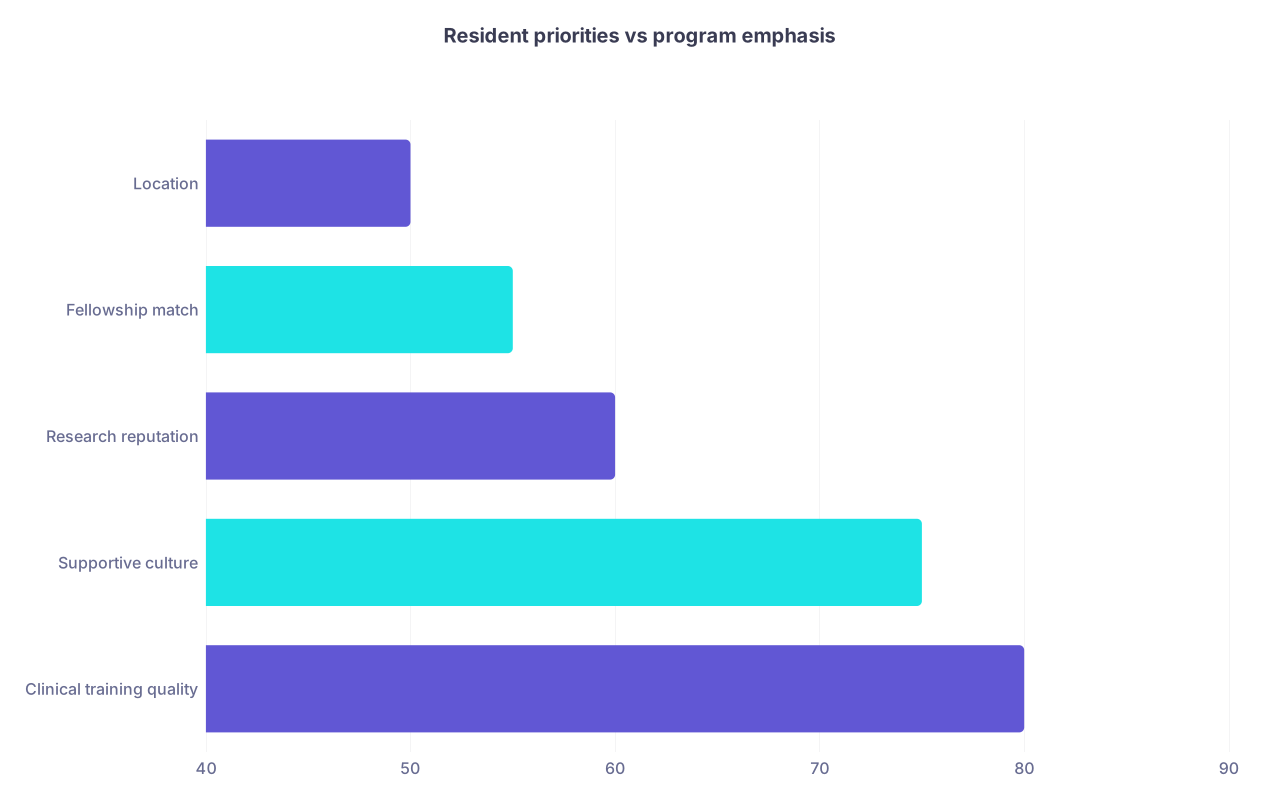
Here is the ugly truth: a program can be world-class academically and quietly chew residents up.
| Category | Value |
|---|---|
| Clinical training quality | 80 |
| Supportive culture | 75 |
| Research reputation | 60 |
| Fellowship match | 55 |
| Location | 50 |
Research and reputation are not inherently bad. But there are distinct danger signs when they dominate:
- Residents frame their worth primarily in terms of productivity: papers, posters, grant connections.
- Clinically heavy rotations are openly devalued—viewed as “service” you must endure to get to the “real” work.
- Mentorship is plentiful for projects, scarce for career and well-being.
In psych specifically:
- Programs heavily invested in interventional psychiatry and neuro-modulation can drift toward procedural volume and metrics, with little reflection on how that feels for residents or patients.
- Residents may be pulled in 3 directions: high inpatient census, outpatient continuity, and research obligations.
In neurology:
- Stroke and ICU service lines may be built to serve institutional metrics, not educational needs.
- Residents become throughput machines so the “big names” can focus on trials and publications.
Questions to keep yourself honest:
- “How does the program protect resident clinic and learning time from being eaten by research or service?”
- “For residents who are not research-focused, what does success look like here?”
- “How are residents treated on rotations that are less ‘prestigious’ but clinically heavy?”
If every story of success is “X matched into Y elite fellowship with 12 papers,” you can predict how non-superstars are valued. Or ignored.
7. Misreading “Wellness” as Proof of Good Culture
No specialty talks more about wellness than psychiatry. Neurology is not far behind now. That creates a very specific trap.
Programs know you are scared of burnout. So they build wellness marketing:
- Scheduled wellness half-days.
- Mindfulness sessions.
- Yoga, snacks, “resilience workshops.”
- Slides about “limited call burden” without hard numbers.
Applicants then equate wellness initiatives with good culture. That is a mistake.
Wellness can be lipstick on a pig. I have seen programs with weekly yoga and monthly “coffee with the PD” where:
- Residents are still charting at midnight from home.
- Evaluations are weaponized to punish people who speak up.
- Vacations get “strongly discouraged” from key rotations, or mysteriously denied.
- Racism or sexism complaints disappear into a black hole of “we’re looking into it.”

Here is how you protect yourself: always ask how wellness is operationalized, not advertised.
Questions that get underneath the surface:
- “In the last 12 months, did anyone’s schedule actually get changed or workload reduced because they were burning out?”
- “How often are residents expected to chart from home?”
- “Can you give an example of something residents complained about that led to a concrete policy change?”
And be specific about time:
- “What are the realistic start and end times on your busiest inpatient psych / neuro-ICU / stroke rotations?”
- “How many weekends do you work as a PGY-2 in psych? As a PGY-3? As a PGY-4?”
- “For neurology residents: how many nights of night float per year, by PGY?”
If they cannot give numbers, or they keep pivoting back to “we care about wellness,” assume the culture is not as healthy as the brochures.
Quick Comparison: Healthy vs Misleading Signals
Use this as a rough filter. If a program is heavy on the right column and light on the left, be very cautious.
| Area | Healthy Signal | Misleading Signal |
|---|---|---|
| Resident tone | Nuanced, mixed, specific | Uniformly glowing, vague |
| Crisis response | Clear backup, debrief, shared learning | “We survive, it’s just busy” |
| Wellness | Schedule changes, protected time | Yoga, snacks, slogans only |
| Leadership | Concrete changes in last 2–3 years | Grand vision, no specifics |
| Sites | Honest about weak sites, plans to fix | “All our sites are great” |
| Expectations | Clear standards, feedback described | “We’re super chill, do what you want” |
How to Actually Test Program Culture (Without Fooling Yourself)
You cannot eliminate all uncertainty, but you can stop making naive mistakes.
A simple mindset shift helps: assume you are being shown a polished version and your job is to find controlled cracks, not perfection.
Three protective habits:
Triangulate everything.
If the PD says one thing, residents say another, and the website says a third, pay attention to the mismatch. That is culture.Probe for negative data explicitly.
Ask, “What frustrates you most about this program?” and then let silence hang. Do not bail them out with suggestions. Just wait.Write your impressions the same day.
Do not trust your memory later, especially after 10–15 interviews. Immediately after each day, jot down:- What felt real vs rehearsed.
- Any gut discomfort you rationalized away.
- The one story that scared you a little.
Those notes will be much more honest than your rank-order rationalizations two months later.
| Category | Value |
|---|---|
| Interview day | 40 |
| Resident word of mouth | 25 |
| Online forums | 15 |
| Away rotations | 10 |
| Program website | 10 |
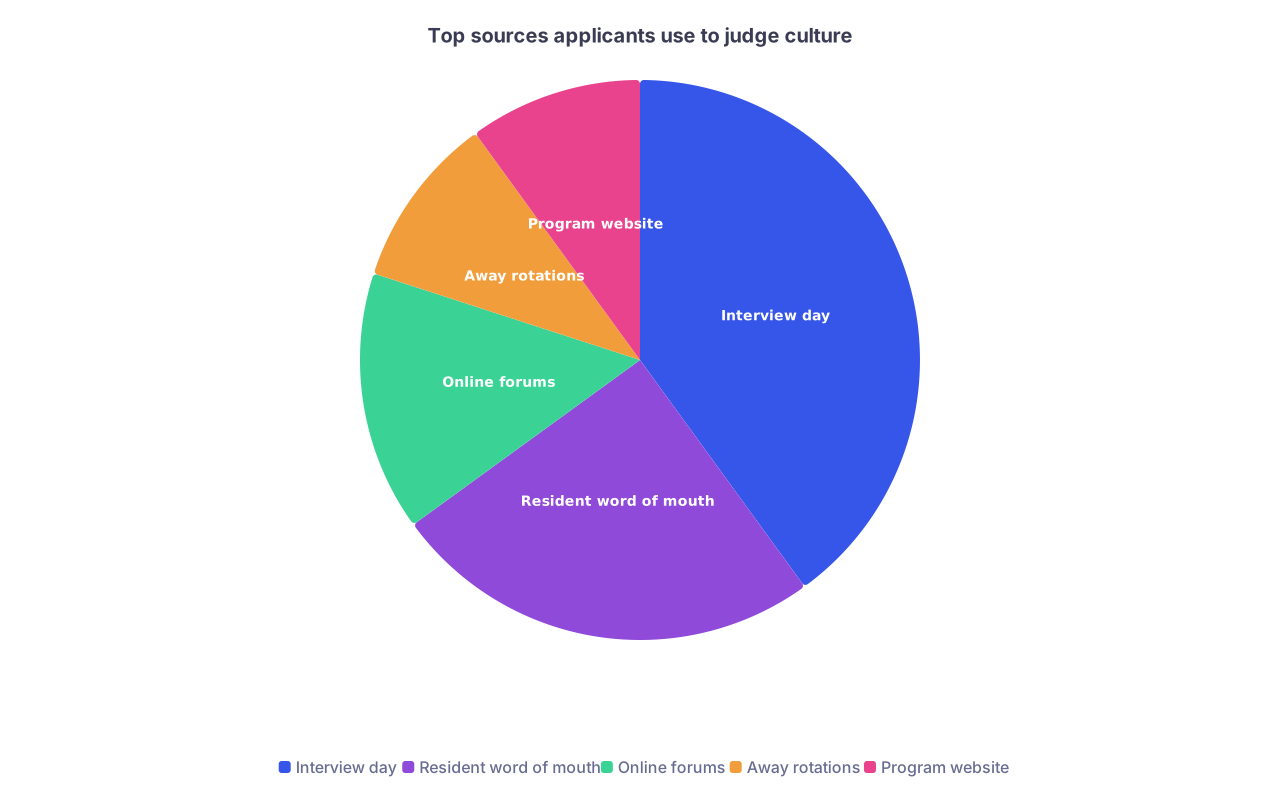
The pie chart above reflects how people usually do it. Interview day dominates. That is exactly why so many people misjudge. Shift more weight to resident word of mouth, away rotations, and the inconsistencies that interview day cannot fully hide.
FAQs
1. How do I compare culture between a strong but “intense” program and a more relaxed one?
Do not just label one “malignant” and the other “nice.” Instead ask:
- At the intense place: Are expectations high but clear, with real teaching and backup? Do seniors and attendings own bad days with you, or blame you?
- At the relaxed place: Are you still seeing enough complexity and volume to become competent? Are attendings engaged or checked out?
If intensity comes with mentorship, transparent expectations, and protected learning, it can build you. If chill comes with drift, apathy, and low standards, it can quietly harm you.
2. What if residents at a program seem divided—some love it, some clearly do not?
Mixed reviews are not automatically bad; they can mean the program is honest and evolving. The real question is: what pattern explains the split?
Common patterns:
- People who want heavy research love it, clinically oriented people feel neglected.
- People with certain personal situations (kids, caregiving) struggle with schedule inflexibility.
- Certain rotations or sites are universally hated but tolerated.
Ask, “Who thrives here, and who tends to be unhappy?” If residents can answer that specifically, you can decide whether you resemble the thriving group or the miserable one.
3. How much weight should I give to anonymous online reviews about program culture?
Use them as smoke detectors, not final verdicts. One bitter review does not damn a program; a chorus all naming the same 2–3 problems deserves attention. Your job is not to fully trust or fully dismiss them. Instead, surface those concerns explicitly on interview day and with current residents and see how people respond. Defensive, vague, or minimizing answers are your warning. Concrete acknowledgment plus specific changes are a better sign.
Key points to remember:
- Do not confuse “chill,” wellness slogans, or charismatic leadership with healthy culture.
- In psych and neuro, pay special attention to how programs handle crisis, fragmented sites, and the day‑to‑day realities underneath research and reputation.
- Always look for specifics, inconsistencies, and honest negatives—those will tell you far more than any brochure or interview script.