
The most dangerous myth in psychiatry residency choice is that “fit” means “I felt comfortable on interview day.”
That belief quietly ruins rank lists every single year.
You are about to choose a specialty where the culture, supervision style, and team dynamics matter even more than the call schedule or name brand. If you get “personal fit” wrong in psychiatry, you don’t just risk being mildly unhappy—you risk burning out, stagnating clinically, or spending four years feeling like you’re practicing the wrong type of psychiatry.
Let me walk you through the mistakes that sabotage people’s psychiatry rank lists—and how to avoid stepping into the same traps.
Misconception #1: “If I Liked the Vibe on Interview Day, the Fit Is Good”
This is the classic trap.
You had a chill Zoom interview. Residents seemed friendly. Someone mentioned they have a “no jerks” policy. You laughed. You felt heard. So you assume: fit = great.
No. Interview day is a staged performance.
Programs can hide a lot in 6–8 hours:
- The one malignant attending who controls half the inpatient service
- The chronic understaffing in the psych ED
- The fact that half the residents are quietly trying to moonlight their way out of financial and emotional exhaustion
What people miss is this: “pleasant social interaction” is not the same as “training environment that matches my personality, learning style, and long‑term goals.”
Here’s how this mistake shows up:
- Ranking a program high because “everyone was so nice” even though you hate inpatient and they are 80% inpatient-heavy
- Ignoring the vague answers about supervision because “they seemed laid back”
- Dismissing your gut feeling about chaos because “the chief resident was really cool”
Do not equate friendliness with fit. Friendly programs can still be structurally misaligned with you.
A better way to think:
Assume interview day is the best version of the program you will ever see. If even that version gives you doubts about workflow, culture, or priorities, do not talk yourself into ranking it high because you had fun in the social.

| Step | Description |
|---|---|
| Step 1 | Interview Day Impression |
| Step 2 | Risk of false sense of fit |
| Step 3 | Also asked hard questions |
| Step 4 | Higher true fit |
| Step 5 | Reconsider ranking |
| Step 6 | Only social vibe? |
| Step 7 | Values and training align? |
Misconception #2: “Psychiatry Is So Chill—All Programs Feel the Same”
This one is lethal. Psychiatry is not one monolithic “chill” specialty.
The variability between programs is enormous:
- Some are psychoanalytic and therapy‑heavy
- Some are pure biologic psychiatry with five different antipsychotics per progress note
- Some are safety‑net hospitals where you’re triaging suicidal patients all night
- Some are suburban, heavily outpatient, with massive emphasis on “efficiency” and RVUs
If you assume “psychiatry is psychiatry,” you’re going to misjudge where you actually belong.
Concrete example I’ve actually seen:
- Student A loves psychodynamic work, wants deep long-term therapy, ranks a big academic program known for consult-liaison and ECT as #1 because “top tier”
- They match there and spend three years miserable on inpatient and consult services, with a 3‑month outpatient psychodynamic block that everyone glorifies but is actually a tiny slice of their training
Or the opposite:
- Student B is very biologically oriented, loves meds management, hates family meetings
- They rank a psychoanalytic, therapy‑centric program high because “the residents were so smart and thoughtful”
- Then they spend four years feeling like an outsider because they’re not as enthusiastic about unpacking dreams in supervision
Do not buy the lie that “fit doesn’t matter because it’s all psych.” The kind of psychiatrist each program tries to produce is very different.
Ask direct questions like:
- “If I finish here and only did what the program naturally pushes me toward, what kind of psychiatrist would I be?”
- “What types of patients do residents see most? Psychosis? Mood disorders? Personality disorders? Addiction?”
- “Where do most grads end up—academia, outpatient, CL, forensics, private practice?”
If the natural output of the program doesn’t match your future self, you are forcing fit. That rarely ends well.
Misconception #3: Confusing “Lifestyle” With “Personal Fit”
Psychiatry is often marketed as a “good lifestyle” field. So applicants chase:
- No overnight call by PGY-3
- Extra vacations
- “We almost never stay late”
There’s nothing wrong with wanting reasonable hours. The mistake is stopping there.
A residency can have an amazing schedule and still be a terrible personal fit. How?
Common patterns:
- You’re underchallenged and bored, not growing clinically
- You want high‑acuity exposure, but everything is outpatient med management with 15‑minute visits
- You value strong teaching, but attendings are checked out and you’re basically a prescription machine
- The program leadership is conflict‑avoidant; serious issues never get fixed, just hand‑waved away
People overvalue:
- Q3 vs Q4 call in PGY‑1
- “We never round past 3 pm”
- “People hang out together after work”
People undervalue:
- Quality of supervision: are attendings actually present, skilled, and invested?
- Feedback culture: do you get real, constructive criticism or just “you’re doing fine”?
- Protection from exploitation by hospital admin: RVU pressure, extra clinics, “voluntary” work
The red flag is this thought:
“This program’s schedule is so good… I can probably tolerate the weak teaching / disorganized leadership.”
Do not sacrifice your training quality on the altar of lifestyle. You’re learning how to handle suicidal patients, complex trauma, psychosis, co-occurring substance use disorders. If you graduate feeling undertrained just because you got out at 2 pm every day, that “great lifestyle” will haunt you.
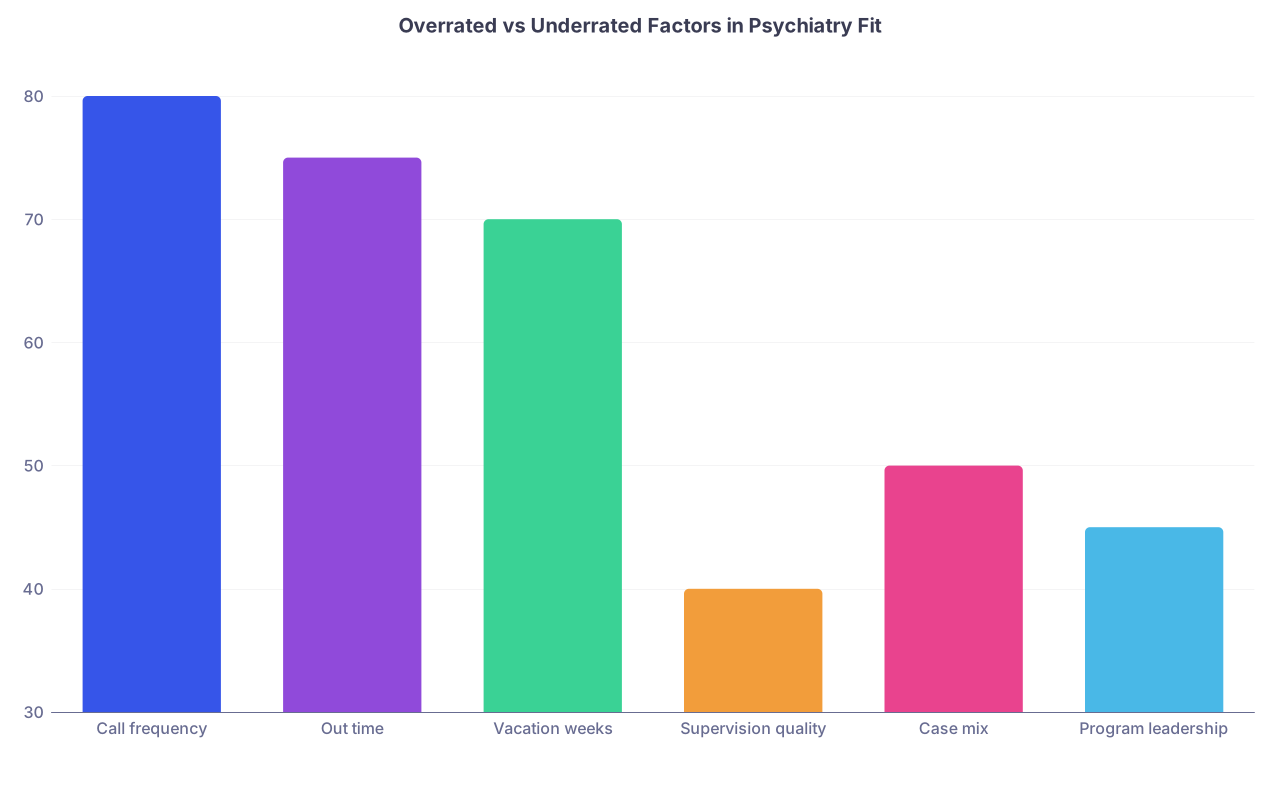
| Category | Value |
|---|---|
| Call frequency | 80 |
| Out time | 75 |
| Vacation weeks | 70 |
| Supervision quality | 40 |
| Case mix | 50 |
| Program leadership | 45 |
(Here: higher numbers = how often applicants obsess over it. Notice what actually matters is often at the bottom of that mental list.)
Misconception #4: “If They’re Flexible, It Must Be a Good Fit”
You’ll hear this line a lot: “We’re very flexible. You can make the program what you want.”
Sometimes that’s true. Sometimes it’s code for: “We have no clear identity, weak structure, and you’ll be constantly fighting to get what you need.”
Flexibility is good only when there’s a solid core.
The mistake: equating unstructured with “supportive of individuality.”
Scenarios to watch out for:
- Electives are wide open, but nobody will help you design them, find preceptors, or protect your time
- “You can tailor your training,” but graduate outcomes are all over the place and a lot of residents finish with gaps in basic competencies
- “We’re not rigid,” but expectations are vague and feedback is inconsistent, so you never know where you stand
Ask these questions directly:
- “What parts of the curriculum are non-negotiable? What does every resident definitely get?”
- “What are the boundaries where flexibility stops—where the answer is no?”
- “Can you give a concrete example of a resident who tailored the program and what that looked like schedule-wise?”
If they can’t answer those with specifics, their “flexibility” might actually be disorganization. You do not want to spend four years in a fog of unclear expectations, especially in psychiatry where boundaries and structure are core clinical skills.
Misconception #5: “Similar Political / Social Views = Good Fit”
This one is subtle but disruptive.
Psychiatry tends to attract people with strong views about:
- Social justice
- Health disparities
- Trauma‑informed care
- Systems of oppression
- Or, on the other end, hard‑line biologic models, “chemical imbalance,” very medication-first approaches
There’s nothing wrong with having strong values. The trap is assuming:
“Everyone here thinks like me, so I’ll fit.”
Or worse:
“People here share my politics, so that’s enough.”
You’re not joining a social club. You’re joining a clinical training environment.
Things that matter more than “they vote like I do”:
- Do attendings tolerate clinical disagreement, or do you get subtly punished for different formulations?
- Can you say “I’m not convinced this is bipolar” without being labeled “difficult”?
- Is there room to discuss countertransference, diagnostic uncertainty, and moral distress—or is there one “correct” narrative?
I’ve seen residents get burned because they thought ideological alignment would feel safe, then realized:
- There was intense pressure to adopt specific language or frameworks, with little tolerance for nuance
- Or the opposite: any mention of structural factors was brushed off as “political,” and they felt silenced
Better questions:
- “How does the program handle disagreement about diagnoses or treatment plans?”
- “Can you share an example of a situation where a resident held a different formulation than an attending, and how that was handled?”
- “How do supervision and didactics handle controversial topics—are multiple perspectives presented?”
True fit in psychiatry isn’t “we’re all on the same side of Twitter.” It’s: “this place lets me think, question, and grow without fear of social exile.”
Misconception #6: “If Graduates Get Great Jobs, It Must Be a Great Fit”
A lot of people anchor on where graduates land:
- Big‑name fellowships
- Competitive academic positions
- “Everyone gets jobs they want”
Those are not bad signs, but they can be misleading for personal fit.
Why? Because graduates may have:
- Completely different personalities
- Different tolerance for chaos, politics, or heavy workloads
- Different life circumstances (no kids vs young family, financial cushion vs heavy debt)
Programs love to show you the star graduates. The ones who matched CL at MGH, did forensics at Columbia, or are junior faculty at the same institution. You rarely hear about:
- The resident who quietly transferred out in PGY‑2
- The one who developed severe burnout or left medicine altogether
- The one who graduated clinically shaky and now feels barely safe in practice
You’re not ranking “objective program power.” You’re ranking “program + you.”
| Signal | Often Overvalued? | Actually Tells You About Fit? |
|---|---|---|
| Big‑name fellowships | Yes | Partially |
| Academic job placements | Yes | Only if you want that |
| Board pass rates | Sometimes | Baseline competence |
| Resident turnover/transfer | No | Huge red flag if high |
| How many residents extend | No | Tells you about support |
| Alumni satisfaction | Rarely asked | Strong fit indicator |
You want to know:
- “How many residents have left the program in the last five years?”
- “Have residents ever needed extra time to graduate? Why and how was that handled?”
- “If I called grads anonymously, what percentage would choose this program again?”
If those answers are cagey, that’s not a good sign.
Misconception #7: Ignoring Your Own Conflict Style and Emotional Needs
Psychiatry is emotionally heavy. You deal with:
- Suicide attempts
- Aggression
- Self-harm
- Abuse histories
- Staff conflicts about safety plans and discharges
Your ability to thrive in a program depends heavily on:
- How you handle conflict
- How you react to criticism
- How you respond to chaotic or unsafe systems
The mistake is pretending these things don’t matter. Or assuming “I’ll just adapt.”
If you:
- Shut down when supervisors are blunt or abrasive
- Need frequent reassurance you’re doing okay
- Get physically ill when there’s constant interpersonal drama
…then a high‑conflict, unfiltered, “brutally honest” culture is going to shred you.
On the flip side: If you:
- Value direct feedback
- Hate passive‑aggressive communication
- Prefer clear expectations and structure
…then a very conflict‑avoidant, “we’re all family, we don’t really give negative feedback” culture will leave you confused, resentful, and constantly second‑guessing yourself.
On interview day, listen carefully for:
- “We’re a family” repeated constantly, with no mention of how conflicts are handled
- Or “We tell it like it is here” said with a proud, slightly aggressive edge
Then ask:
- “How does feedback typically happen here—planned sessions, real-time, written?”
- “Can you think of a resident who struggled and how the program responded?”
- “What happens when a resident feels an attending is out of line or unsafe?”
If you don’t see yourself surviving that environment on your worst month, that’s not your place. No matter how shiny the fellowship match list looks.
Misconception #8: Treating Rank Lists Like a Prestige Contest
This is the ego trap.
You’re tired. You’ve worked for years. Suddenly you have interviews at “big name” psychiatry programs. Your brain quietly says: “I should rank the fanciest place highest. I’ll regret it forever if I don’t.”
Plenty of residents have discovered the hard way:
- Prestige does not protect you from a toxic culture
- Name recognition does not make 28‑hour calls feel shorter
- Academic glamour does not fix poor supervision or constant understaffing
Psychiatry is particularly susceptible to this because:
- A lot of the most famous programs are also the most service‑heavy
- Some coast on reputation and underinvest in resident wellbeing
- Big institutions can be politically complex; if you’re not good at self‑advocacy, you get steamrolled
Yes, reputation matters. But only after baseline safety and alignment are met.
Your mental checklist should be:
- Is this a place where I can safely learn without being abused, gaslit, or ignored?
- Is the clinical training solid for the kind of psychiatry I want to do?
- Can I see myself as myself here, not a contorted version required to survive?
- Among the programs that pass those tests, which one has the best combination of support, opportunity, and yes, reputation?
If you reverse that order, you’re volunteering to be miserable with a prestigious name tag.
How to Actually Assess Personal Fit in Psychiatry (Without Fooling Yourself)
Let’s get concrete. Here’s how to avoid sabotaging your rank list.
Write down who you actually are as a learner:
- Do you like structure or flexibility?
- Do you prefer inpatient intensity or outpatient continuity?
- Do you thrive under pressure or crumble slowly?
- Do you need frequent feedback, or do you prefer autonomy?
Then write down what kind of psychiatrist you actually want to be:
- Heavily therapy‑oriented vs mostly meds management
- Academic vs community vs private practice
- Subspecialty interests: C/L, addiction, forensics, child, geri, etc.
- Population you care most about: SMI, mood, trauma, substance use, etc.
For each program, force yourself to answer:
- “If I do nothing extra and just follow the default path here, what kind of psychiatrist will I become?”
- “On my worst week (exhausted, sick, personal stress), could I still function in this culture without breaking?”
Then—crucially—separate:
- “I liked these people socially”
- From “I would actually grow and survive here”
If you’re honest on those four steps, you’ll dodge the most common fit mistakes.

FAQs
1. What if I liked the people at a program but know the training focus doesn’t match my goals?
Do not rank it high just because you clicked socially. You’re training for a career, not choosing roommates. If the case mix, supervision style, or overall philosophy don’t line up with your long‑term goals, that mismatch will matter far more three years from now than how much you enjoyed the interview social.
2. How do I tell the difference between a “supportive” program and a conflict‑avoidant one?
Ask for concrete examples of how they’ve handled resident struggle or serious disagreement. A truly supportive program can describe difficult situations where they gave honest feedback, set boundaries, and still backed the resident. A conflict‑avoidant program will give vague reassurances and no specifics—everything is “fine,” “we’re family,” and “that doesn’t really happen here.” That’s not reassuring; it’s evasive.
3. Is it a mistake to rank a lower‑tier program over a famous academic one if the fit feels better?
Not if you’re being honest about your needs and goals. A less prestigious program where you’re well‑supervised, emotionally safe, and steadily growing will prepare you far better than a name‑brand program that grinds you down or doesn’t match your style. Regret usually comes from ignoring your own red flags, not from choosing a place where you did your best work.
4. How much weight should I give to resident happiness when judging fit?
Resident happiness is crucial, but you have to interpret it correctly. Ask: “Happy like thriving and well‑supported, or happy like underworked and undertrained?” Watch for whether they speak with substance—about good supervision, meaningful learning, reasonable workload—or just about perks and time off. You want residents who are tired but proud of their growth, not either miserable or weirdly checked out.
Bottom line:
Psychiatry “personal fit” is not about who made you laugh on Zoom or which program has the lightest call. It’s about whether the default training environment matches who you are, how you learn, and the psychiatrist you plan to become. Ignore that, and the Match will feel like a trap. Respect it, and you give yourself four years in a place that actually fits—not just flatters you on interview day.