
It’s mid-February. You just submitted your rank list for internal medicine. You aimed high—university programs, big cities, big names. You scroll through your list and feel…proud. You “bet on yourself.” You didn’t rank any community programs. You told yourself, “I’ll be fine. IM isn’t that competitive. I deserve a strong academic program.”
Four weeks later, you’re staring at the Monday email.
“We are sorry to inform you that you did not match to any position.”
You refresh the page, as if the NRMP is going to change its mind. They don’t. Now you’re scrambling through the Supplemental Offer and Acceptance Program (SOAP), trying to piece together a plan B while your classmates are comparing where they’re going for orientation.
This is exactly how overestimating your competitiveness in internal medicine blows up your match.
Let me walk you through the most common mistakes IM applicants make when they think they’re “more competitive than they are”—and how to avoid being the cautionary tale your school quietly talks about next year.
Mistake #1: Treating Internal Medicine Like It’s Still the “Backup” Specialty
Here’s the lie I hear every year: “It’s just IM, I’ll be fine.”
That sentence has destroyed more match outcomes than a bad Step 2 score.
Internal medicine is no longer the easy safety net people think it is—especially at solid academic, coastal, and big-name programs. The mistake is assuming all IM is the same. It isn’t. There is a gigantic difference between:
- A small community IM program in the Midwest with 12 residents
versus - A major university program in Boston, Chicago, or San Francisco with 30+ residents and multiple fellowships.
Applicants blend these together in their heads and say, “IM is not competitive, so of course I can aim high.” They then rank only the second group.
Let me be blunt:
Yes, there are less competitive IM programs.
No, you are not automatically competitive for every IM program just because your specialty is “internal medicine.”
You have to think of IM as a spectrum, not a category.
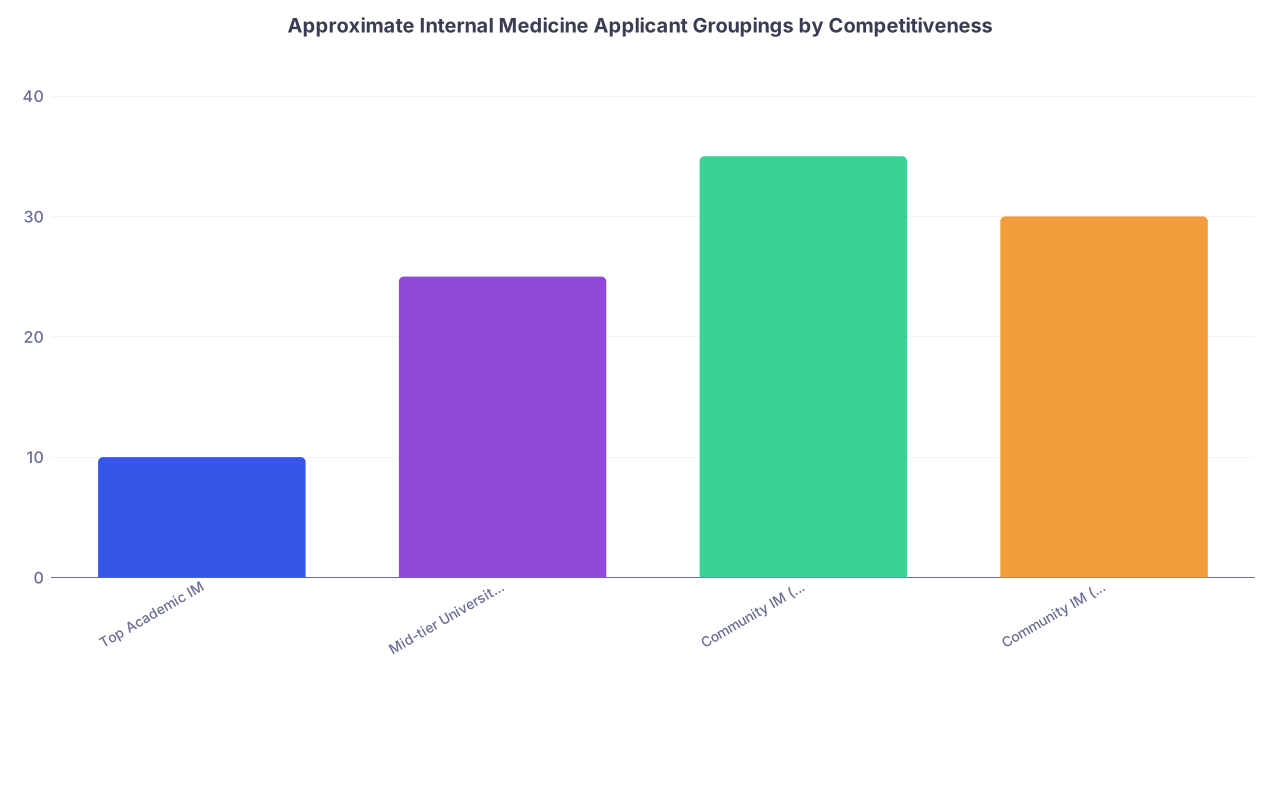
| Category | Value |
|---|---|
| Top Academic IM | 10 |
| Mid-tier University IM | 25 |
| Community IM (Urban) | 35 |
| Community IM (Non-Urban) | 30 |
Those top academic IM programs might as well be a different specialty. They’re pulling from:
- AOA students
- 250+ Step 2 scores (for US MDs)
- Heavy research, often in medicine subspecialties
- Home school students and known-away rotators
If that’s not you, but your rank list looks like you’re competing in that lane, you’re setting yourself up to not match.
How to avoid this:
Stop saying “IM isn’t competitive.” Start asking, “Which segment of IM programs am I actually competitive for?” and build your list from that reality, not from your ego.
Mistake #2: Ignoring the Hard Reality of Step Scores and Academic Flags
Another recurring disaster: the applicant with a 217 Step 2 score insisting they will only rank academic IM programs in big cities because “I did a lot of research.”
I’ve watched this exact applicant pattern end in SOAP more than once.
Here’s the pattern:
- Modest Step 2 score (or a fail on Step 1/COMLEX 1)
- Some research, but mostly case reports or poster presentations
- A few “strong” comments on rotations, but nothing truly standout
- No real understanding that their academic record puts them at risk
And yet…they only apply to or rank:
- Big-name university IM programs
- Prestigious coastal cities
- Highly sought-after locations where everyone wants to be
They assume their narrative, their personal statement, their passion, will carry them. It doesn’t.
Programs are not blind. They filter by scores and red flags before they ever read your story.
Here’s the mistake: overvaluing your interestingness and undervaluing your risk factors.
- Any USMLE/COMLEX failure
- Any repeat year, LOA, or professionalism concern
- Any low Step 2 score, especially <220 for IM
- Being an IMG/DO without strong compensating factors
You might still match very well with these—but not if you pretend they do not matter.
| Profile | Risk Level | Notes |
|---|---|---|
| 245+ US MD, no red flags | Low | Competitive for many academic programs |
| 230–244, no red flags | Moderate | Academic possible, broad list essential |
| 220–229, or minor academic issue | Higher | Need many community and mid-tier programs |
| <220 or exam failure | High | Must be extremely broad and realistic |
If you’re in the “Higher” or “High” risk rows and you’re behaving like you’re in “Low,” you’re overestimating your competitiveness. That’s the trap.
How to avoid this:
Force yourself to do a brutally honest risk assessment: Step 2 score, exam history, school reputation, IMG/DO status, any professionalism flags. Then choose programs that actually match that profile, not the one you wish you had.
Mistake #3: Confusing Positive Feedback With True Competitiveness
Medical students love to collect validations:
“You’re going to make a great intern.”
“We’d be lucky to have you here.”
“Your knowledge base is strong for your level.”
Nice to hear. Completely useless for predicting your match.
I’ve seen students build their whole application strategy on a few flattering eval comments or one attending saying, “You should aim high.” Then they rank almost entirely reaches.
Here’s what people get wrong:
Rotation praise ≠ program director endorsement ≠ interview invite ≠ high rank position.
Literally every year I hear someone say:
“My attending said they’d absolutely take me here if they could,”
…only to not even get an interview at that hospital.
Why? Because:
- Attendings are often not decision-makers
- People are socially polite and avoid giving hard truths
- Your performance on one month doesn’t erase a weak overall file
Your question shouldn’t be, “Did anyone say I was good?”
It should be, “Did anyone with real influence go out of their way to advocate for me?”
And even then, that’s a boost for one program. Not a free pass to aim too high everywhere.
Red flags you’re overreading your feedback:
- You’re using a few glowing comments to justify ignoring your test scores
- You’re assuming your home institution will automatically rank you highly
- You think “I’d be a strong resident” means “I’m competitive at MGH/UCSF/Johns Hopkins”
Those are not the same thing.
How to avoid this:
Ask a program director, APD, or core IM faculty explicitly:
“Given my scores and application, what tier of IM programs should I target? Can you name some specific programs where I’d be a reasonable match?”
If they hesitate, or only list mid/lower tier places, stop pretending you’re a lock for top-tier academics.

Mistake #4: Building a Rank List That’s 80% Reach, 20% Realistic
This is the most obvious way overestimating competitiveness tanks matches.
The applicant is not delusional enough to apply only to Harvard/Stanford type programs. But their rank list is stacked with places they hope for, not places they’re actually competitive.
So they end up with something like:
1–8: Very strong academic university programs in desirable cities
9–12: Mid-tier academic programs still in highly competitive locations
13–15: A few community programs (some in competitive locations)
Then they’re surprised when they don’t match.
The math is the problem. If you barely squeak into the bottom of the interview pool at your reach programs, you are unlikely to land high on those rank lists. You’re filler. A hedge. Not a priority.
Common self-sabotaging thoughts:
- “I didn’t love those community programs, and I want to be happy.”
- “If I rank this lower-tier place, the algorithm might send me there instead of my favorite reach program.”
- “I’d rather SOAP than go to a program where I’d be miserable.”
Let me be clear: SOAP is not some curated second-chance boutique match. It’s chaos. Limited slots, random availability, rushed decisions. You don’t choose SOAP. SOAP happens to you.
Overestimating your competitiveness + under-ranking safer programs = you just volunteered for it.
A healthy rank list should:
- Start with your stretches (fine)
- Have a big middle of realistic, solid programs where you’d fit
- End with genuine safeties you’d actually attend if needed
Not: a skyscraper of aspirations and two bungalows of backup.
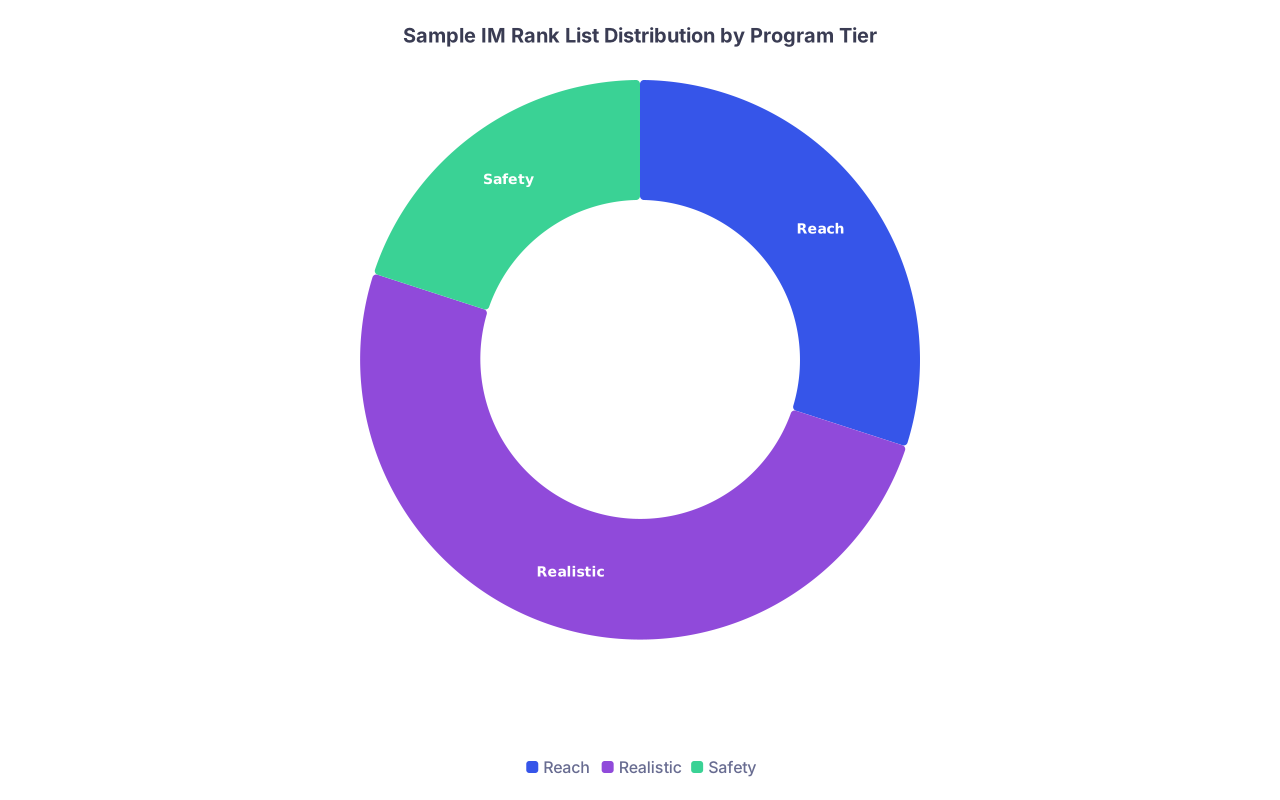
| Category | Value |
|---|---|
| Reach | 30 |
| Realistic | 50 |
| Safety | 20 |
If your personal pie chart is more like 60–70% reach, you’re playing games with your future.
How to avoid this:
Before you certify your list, label every program as Reach / Realistic / Safety. If “Reach” is more than about one-third of your list and you’re not a slam-dunk candidate, you’re asking for trouble.
Mistake #5: Ignoring Program Fit Signals Because “I Really Want This City”
You know who matches terribly? The applicant who falls in love with a zip code.
“I need to be in New York or LA because of my partner/family/whatever, so I’m only ranking there.”
“I can’t see myself anywhere but a big city.”
“I’ll be so depressed in a small town; I’d rather not match.”
I’ve heard all of it. I’ve also watched more than one of these people go unmatched and end up scrambling into programs in locations they never considered, under far worse conditions.
You can absolutely prioritize geography. You cannot pretend geography overrides every objective metric.
Overestimating competitiveness here sounds like:
- “Yes, my scores are below average and I have no home IM department, but I’ll still fill my list with NYC/Boston/LA academic programs because my partner is there.”
- “I only interviewed at 10 programs, but they’re all in this one metro area, so I’ll be okay.”
You’re basically praying that a saturated market magically bends around your needs. It won’t.
If you have geographic constraints, you must be more realistic about competitiveness, not less.
Signals you’re ignoring fit:
- Programs did not respond to post-interview communication
- You got no interview from multiple similar-tier programs in the same city
- Residents at interview day hinted at how competitive their program has become
- Your advisors gently suggested looking outside your dream city—and you didn’t
When a program or region is showing you, “We are selective and have many strong applicants,” and you still stack your list with those places only, that’s you overestimating your pull.
How to avoid this:
If you must target a specific geographic area, increase your number of applications and interviews there broadly—university, hybrid, and community programs. And unless your file is stellar, you need at least some programs outside your ideal footprint on the rank list. That’s just self-preservation.

Mistake #6: Misreading Interview Numbers as Guaranteed Safety
Another classic: “I got 12 interviews, so I’m good.”
For IM, 12 can be very safe…or very risky. Depends where those interviews are and who you are as an applicant.
The trap is thinking quantity alone protects you. It doesn’t.
If your 12 interviews are:
- 8 strong academic programs where you’re average or below average
- 4 community programs you weren’t that excited about and rank low
You’re in danger, especially if you’re not a top-tier applicant.
Also, not all interviews are equal. Problems I’ve seen:
- Interviews went poorly, but the applicant is in denial
- Late-season interviews at programs that rarely rank applicants highly from those dates
- Programs with large numbers of interviewees per spot (some big-name places interview 600+ people for ~40 seats)
Overestimating your competitiveness here usually shows up as:
- Refusing to add or rank “lower tier” interviews high because you assume your academic places will work out
- Ranking a program you genuinely liked (but see as less prestigious) way too low
- Thinking, “I have 10–12 interviews, so statistically I’m safe,” without looking at what kind of programs they actually are
The NRMP charts and surveys are helpful, but people weaponize them poorly. Yes, historically, most US MD IM applicants with ≥10 interviews match. But someone is in that unlucky slice every year. And they all thought “statistics” would protect them too.
How to avoid this:
Be brutally honest:
- Which programs actually felt like good fit?
- Where did interviews go poorly or feel off?
- Where are your true realistic chances highest?
Then rank based on probability + acceptability, not prestige + wishful thinking.
Mistake #7: Assuming Fellowship Dreams Justify Over-Aiming for Residency
This one’s touchy. A lot of IM applicants overreach because they’re thinking three steps ahead.
“I want GI/cards/heme-onc, so I have to* be at a big-name academic program.”
“I’d rather risk not matching than end up somewhere that doesn’t place into competitive fellowships.”
That’s how they justify ignoring:
- Exam failures
- Average or below average scores
- Non-traditional background
- Lack of strong research
Here’s the brutal truth: You cannot do a GI fellowship if you never match into IM.
Your first job is to become an internal medicine resident. Not a hypothetical GI fellow.
And no, being at a mid-tier or community program does not automatically kill your fellowship hopes. It changes the path. Makes some things harder. But you exist outside the binary of Top-10 university or doomed forever.
I’ve seen people match IM at solid but not flashy programs, do strong research, crush in-service exams, get great letters, and match into competitive fellowships later. I’ve also seen applicants overreach, not match, detour through prelims, research years, or entire reapplication cycles—and that will hurt your fellowship trajectory much more than doing IM at a non-elite place.
Overestimating competitiveness because of fellowship dreams is still overestimating competitiveness.
How to avoid this:
Make two separate plans:
- “What programs am I realistically competitive for now?”
- “Within that realistic set, which ones give me decent fellowship opportunities?”
You choose from the intersection of those circles. Not the fantasy land where you’re suddenly a 260-scoring AOA with three first-author IM papers.

| Step | Description |
|---|---|
| Step 1 | Assess Your Profile |
| Step 2 | High risk - prioritize broad list |
| Step 3 | Focus on realistic and safety programs |
| Step 4 | Include mix of reach and realistic programs |
| Step 5 | Add many community and mid-tier IM programs |
| Step 6 | Targeted academic plus solid safety list |
| Step 7 | Build balanced rank list |
| Step 8 | Any exam failures or major flags |
| Step 9 | Step 2 score 230 or higher |
Putting It All Together: A Sanity Check for IM Applicants
You want to avoid tanking your match. Good. That starts with dropping the fantasy that you’re immune to the same forces that affect everyone else.
Here’s a quick self-check. If any of these are true, you’re at high risk of overestimating your competitiveness:
- You’ve said, “It’s just IM, I’ll be fine,” more than once
- You have any exam failure and are still heavily targeting competitive academic centers
- Your rank list is >50% big-name university programs in popular cities
- You’re assuming your home program will rank you highly “because they know me” without explicit PD-level confirmation
- You’re limiting yourself to one metro area with less than ~12–14 interviews as a non-stellar applicant
- You’re ranking community or less prestigious programs way lower despite actually liking them
- You catch yourself saying, “Worst case, there’s always SOAP”
If that stung a little, good. That sting might save you from that Monday email.

FAQs
1. I’m a US MD with a 225 Step 2 and no failures. Can I still match an academic IM program?
Yes, it’s possible. But here’s the mistake people make: they treat “possible” as “likely everywhere.” At 225 with no failures, you are not shut out of academic medicine. Especially at mid-tier university or hybrid programs in less saturated cities.
But you shouldn’t build a rank list that’s 80% coastal name-brand institutions. You need a deep bench of realistic programs: mid-tier universities in smaller cities, strong community programs with good teaching, and some pure safety options. If you treat that 225 like it’s a 245, you’re overestimating. If you accept that you’re in the middle of the pack and plan accordingly, you can absolutely end up at a good academic or academic-adjacent IM program.
2. I only got 8 IM interviews. Should I be worried about not matching?
You should be cautious, not panicked. Eight interviews is not an automatic disaster, but it’s not a cushion either—especially if:
- You’re an IMG/DO
- Your scores are below national averages
- Most of those eight are reach programs in high-demand locations
If you’re a solid US MD with decent scores and those eight interviews are mostly realistic/safety programs that seemed to like you, you might be okay. But you don’t get to be picky with your rank list. You cannot afford to tank multiple programs way down because they weren’t “prestigious enough.” At 8 interviews, you rank all of them in your true order of acceptability and you do not play games with prestige. Anyone in your situation telling themselves, “I’ll probably be fine, IM isn’t that hard to match,” is exactly who ends up on the wrong side of the statistics.
3. My dream is cards/GI, so shouldn’t I prioritize the highest-ranked IM programs on my list?
You should prioritize the programs that give you a real shot at both: matching now and building a competitive fellowship profile later. Overestimating your strength and stacking only the most elite programs at the top—when you’re a borderline applicant—can very easily result in not matching at all. And nothing kills fellowship prospects faster than being unmatched or stuck in a spotty prelim situation.
Smart move: identify programs with proven fellowship placements that are aligned with your competitiveness. This often includes: mid-tier or newer university hospitals, strong community programs with in-house fellowships, and hybrid community–academic programs. Rank those realistically high, not just the famous names. It’s better to be a top performer at a solid program than a ghost applicant who never even got a chance at the elite one.
Open your current program list right now—applications, interviews, or draft rank list—and label each program honestly: Reach, Realistic, or Safety. If “Reach” dominates the page, fix it today, not after that Monday NRMP email.