
You’re a DO MS3 going into MS4. You like thinking through cases, you actually enjoy morning report, and you’ve caught yourself reading NEJM on the treadmill. Academic internal medicine seems like the obvious fit.
But your dean quietly says, “Just remember, it’s more competitive for DOs.”
Your classmates warn you: “Those big-name university programs don’t take DOs.”
You start scrolling program websites at midnight, trying to decode who might actually look at your application.
This is exactly where DO applicants targeting academic IM make their worst mistakes.
Let me walk you through the traps I’ve seen over and over. These are the things that quietly kill otherwise solid DO applications to academic internal medicine programs.
Mistake #1: Chasing Prestige Instead of Realistic Academic Fit
The classic move:
You build a list full of:
- MGH
- Hopkins
- UCSF
- Penn
- Brigham
- Columbia
…with a COMLEX-only record, limited research, and zero idea whether these places have ever taken a DO from your school.
That’s not “aiming high.” That’s lighting application money on fire.
Academic IM is a spectrum:
- At one end: NIH powerhouses with multiple R01-funded faculty, heavy subspecialty fellowships, and deep bias toward MD, high Step 2, and strong research.
- In the middle: Solid university-affiliated and university-based programs with real teaching, fellowships, scholarly activity, and a mixed MD/DO resident body.
- At the other end: Community programs calling themselves “academic” because they have a noon conference and one cardiology fellowship downstream.
The mistake: treating all “university” or “academic” programs as if they’re equally attainable and equally good for your goals.
How this hurts you
- You waste 30–40 applications on programs that statistically will not touch your file.
- You under-apply to realistic academic programs that actually match DOs.
- You risk going unmatched because your list is 70% fantasy.
Here’s what a more grounded view looks like:
| Tier | Typical Features | DO Odds (if solid applicant) |
|---|---|---|
| 1: Elite academic | Top-20 hospital, heavy NIH, big-name | Very low |
| 2: Strong university | University-based, multiple fellowships | Moderate |
| 3: University-affiliated | Large community + university tie | Good |
| 4: Academic-leaning community | Some research, maybe 1–2 fellowships | Very good |
Your job: aggressively target Tiers 2–4 and treat Tier 1 as lottery tickets, not the core of your strategy.
How to avoid this mistake
- Stop sorting by “US News” rank. Useless for residency reality.
- Go to each program’s current resident page. Count DOs. Count them by PGY year.
- No DOs for 3+ years? Assume it’s essentially MD-only unless you’re a unicorn applicant.
- Look at where their grads match for fellowship. Academic enough? Good.
- Build your list anchored in places that have already proven they accept DOs and place into fellowships.
If your application list looks like a med student’s dream poster, not a data-driven plan, you’re doing it wrong.
Mistake #2: Applying Without USMLE Step 2 to Academic IM
This one is brutal and very specific to DOs.
You send applications to university IM programs with:
- COMLEX Level 1 & 2: yes
- USMLE: “Did not take”
And then you wonder why the interview invites are silent.
For many academic IM programs, especially university-based, here’s the unspoken reality:
- They are used to filtering by USMLE.
- They are more comfortable comparing MD vs DO when they have the same exam metric.
- If they have 1,500 applications and can’t interpret COMLEX well, guess what happens to COMLEX-only files?
They get screened out.
Here’s what that looks like in practice:
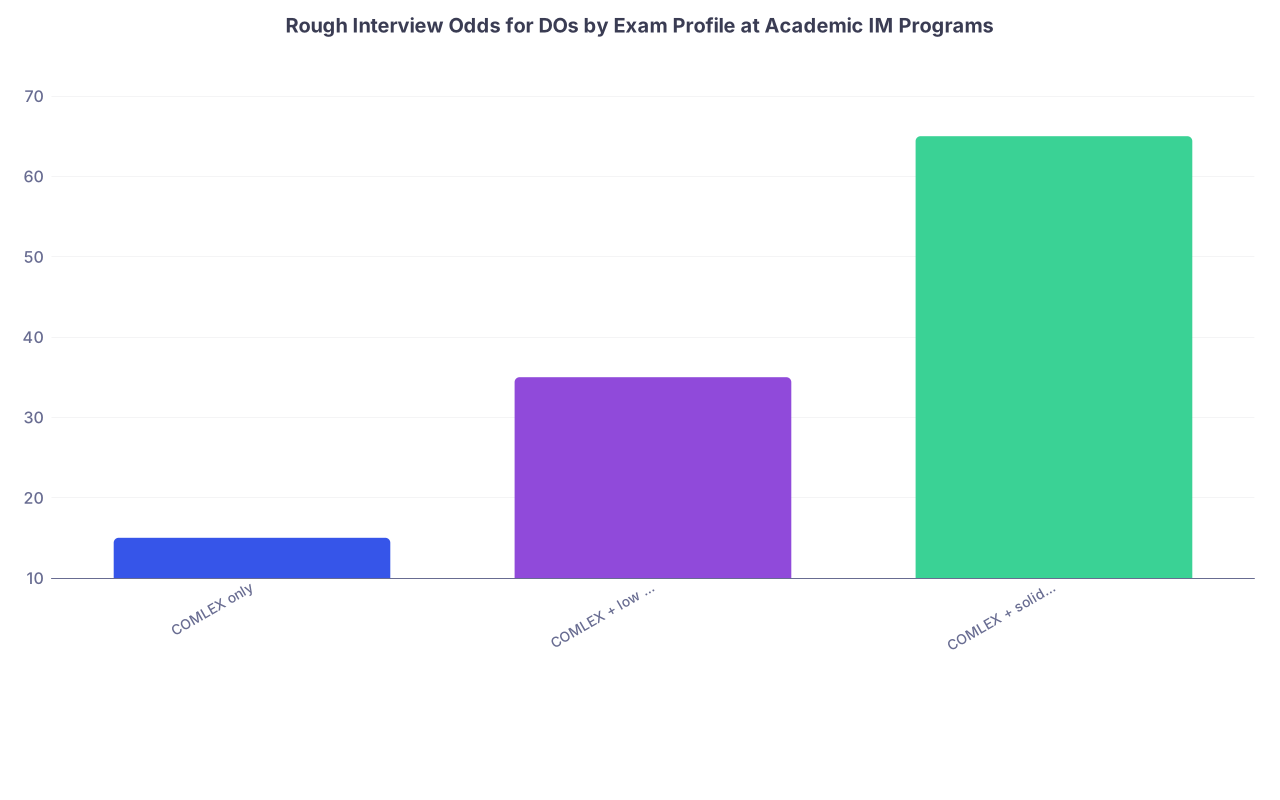
| Category | Value |
|---|---|
| COMLEX only | 15 |
| COMLEX + low Step 2 | 35 |
| COMLEX + solid Step 2 | 65 |
Are there exceptions? Sure. But planning your life around exceptions is how you end up scrambling SOAP for a prelim spot you don’t want.
How to avoid this mistake
- If you’re serious about academic IM, USMLE Step 2 is not optional.
Optional on paper, death sentence in practice at many places. - Aim for a clearly reassuring score. For academic-leaning IM, I like:
- Step 2: 240+ (and higher if you’re aiming at more competitive places)
- If your COMLEX is weaker, Step 2 becomes even more important.
If it’s too late to take Step 2 before applications:
- At minimum, schedule it and put that on ERAS. Some places will wait. Many will not. That’s the risk you’re accepting.
- In that case, your list needs to shift heavier toward:
- University-affiliated community programs
- Known DO-friendly academic centers
- Programs where COMLEX-only DOs are already in the resident photo grid
Do not tell yourself “plenty of DOs match academic IM without USMLE” and then ignore what’s on actual roster pages.
Mistake #3: Having “Academic” Aspirations With Zero Documented Scholarship
Academic IM is not just “hospitalist at a big hospital.” It means:
- Teaching
- Research
- QI / systems work
- Leadership
Yet I constantly see this combination:
- Personal statement: “I want a career in academic internal medicine, focusing on medical education and research.”
- CV:
- 1 poster from M1 anatomy that you barely remember
- Maybe a chart-review project “in progress”
- No QI, no teaching leadership, nothing that screams “future faculty”
Programs are not dumb. If your CV doesn’t match your stated goal, they notice.
Red flags on your application for academic IM
- No publications or abstracts, and you’re at a med school with available research.
- No QI involvement despite being on IM rotations.
- No teaching roles (tutor, TA, near-peer sessions, OSCE prep).
- Generic “interest in research” with nothing concrete.
Academic IM PDs are not asking for a PhD and 10 first-author papers from every DO. But they are asking:
“Has this person actually done anything that suggests they’ll contribute academically?”
How to avoid this mistake
You need at least one of the following to look credible:
- A meaningful research project:
- Retrospective chart review in IM
- Case series
- Multi-author project where you actually did work
- A QI or patient safety project that you can:
- Describe clearly during interviews
- Show impact, even if small
- Real teaching:
- Small-group leader for M1/M2
- Peer tutor for renal, cardio, etc.
- Simulation teaching assistant
And then you need to spell it out:
- In your personal statement: show how these experiences shaped what you want in training.
- In your ERAS experiences: use specific outcomes, not vague “I learned a lot.”
If your CV is bare, your first job is not “add more programs.” It’s “get one real scholarly or QI project moving right now.”
Mistake #4: Ignoring Program Culture Around DOs
One of the dumbest risks DO applicants take is pretending all “academic” programs are equally open to DOs.
They’re not.
Some:
- Have DO faculty
- Take DOs every year
- Actively recruit osteopathic grads
Others:
- Haven’t taken a DO in 7 years
- Have zero DO faculty on the website
- Still quietly think “Step 2 = real test, COMLEX = shrug”
You don’t have to like that this exists. You do have to plan around it.
Signs a program is genuinely DO-friendly
- At least 1–2 DO residents in each PGY class, not just one token DO in PGY-3.
- Program leadership that includes a DO (APD, core faculty, or PD).
- Residents from a variety of DO schools, not just one local one.
- Past fellows who were DOs and matched into solid subspecialties.
Contrast that with the fake-friendly places:
- Website statement: “We welcome applications from DO and international graduates.”
- Resident photos: 45 MDs, 1 IMG, 0 DOs.
- No mention of COMLEX anywhere.
That “welcome” line is boilerplate, not data.
How to avoid this mistake
This is where you actually need to stalk a bit:
- Look at resident lists by year.
- If DO representation suddenly drops off in recent years, that matters.
- Search program name + “DO internal medicine” + “LinkedIn” or “Doximity.”
- Ask upperclass DOs and recent grads where they got traction.
Then classify programs for yourself:
| Category | Resident DO Presence | How to Treat It |
|---|---|---|
| Green | DOs in every class | Core targets |
| Yellow | 1–2 DOs total | Apply if you’re strong |
| Red | 0 DOs for 3+ years | Lottery ticket only |
If half your list is “Red” programs, you’ve made your life much harder than it needs to be.
Mistake #5: Weak, Generic IM Letters When You Need Academic Advocates
For community IM, letters that say “hardworking, reliable, pleasant to work with” might be enough.
For academic IM, that’s the baseline, not a selling point.
The specific mistake DOs make:
- Collecting letters from:
- Community preceptors with no academic title
- Non-IM physicians (FM, EM, neurology) because “they know me best”
- DO attendings unknown to academic circles
- And skipping:
- University IM faculty
- Division chiefs
- Subspecialists with academic roles
Programs will read between the lines:
- Who’s willing to stake their academic reputation on you?
- Does anyone in academic IM think you belong in that world?
What strong letters for academic IM look like
The content:
- Detailed clinical examples, not fluffy adjectives.
- Explicit statements like “I would rank this student in the top 10% of students I’ve worked with in the last 5 years.”
- Evidence of:
- Curiosity
- Ownership
- Ability to teach others
- Engagement with literature / guidelines
The letter writer:
- Internal medicine, ideally academic:
- Ward attendings at teaching hospitals
- Subspecialists (cards, GI, ID) with teaching roles
- At least one letter from:
- Someone clearly “academic” on paper—faculty rank, publications, leadership.
How to avoid this mistake
- Prioritize IM sub-internships at academic centers where letters carry weight.
- Ask for letters while you’re still fresh in attendings’ minds, not 6 months later.
- When you ask, remind them:
- Your interest is academic internal medicine.
- Specific cases or projects you worked on with them.
- Any teaching or research you did that they can mention.
If your letter set is: “FM preceptor, community IM doc, and emergency physician,” you’ve undercut your academic story.
Mistake #6: Writing a Personal Statement That Doesn’t Sound Academic
You say you want academic IM. Then your personal statement reads like you’re applying for community primary care.
Common errors:
- Entire PS focused on “lifelong relationships with patients” and “being the doctor in a small town” with zero mention of:
- Teaching
- Research
- QI
- Lifelong learning at a scholarly level
- Vague line like: “I also hope to be involved in research and teaching” tacked onto the last paragraph with no supporting examples.
- No mention of why academic IM specifically fits you.
Academic PDs are scanning for:
- Will this person sit through and contribute to morning report?
- Are they going to engage in journal clubs, projects, and conferences?
- Do they have any clue what academic careers actually look like?
How to avoid this mistake
You do not need flowery prose. You need alignment:
- One paragraph: a specific patient or clinical moment that pushed you toward IM.
- One paragraph: concrete examples of your academic engagement:
- The project you did
- The teaching you tried
- How you engaged with evidence
- One paragraph: what you want from an academic IM program:
- Strong teaching culture
- Mentorship in research or QI
- Exposure to subspecialties and conferences
And do not lie. If you have zero research, don’t write like a budding physician-scientist. Lean into teaching, QI, or systems instead.
Mistake #7: Underestimating How Many Programs You Need (As a DO Aiming Academic)
I’ve watched DOs with decent stats apply to 25–30 academic-ish IM programs and then panic when November hits and they have 4 interviews.
They built their list like an MD with a 260 Step 2 and home institution support.
If you’re a DO aiming at academic IM, you are playing on “hard mode.” You need to adjust your volume.
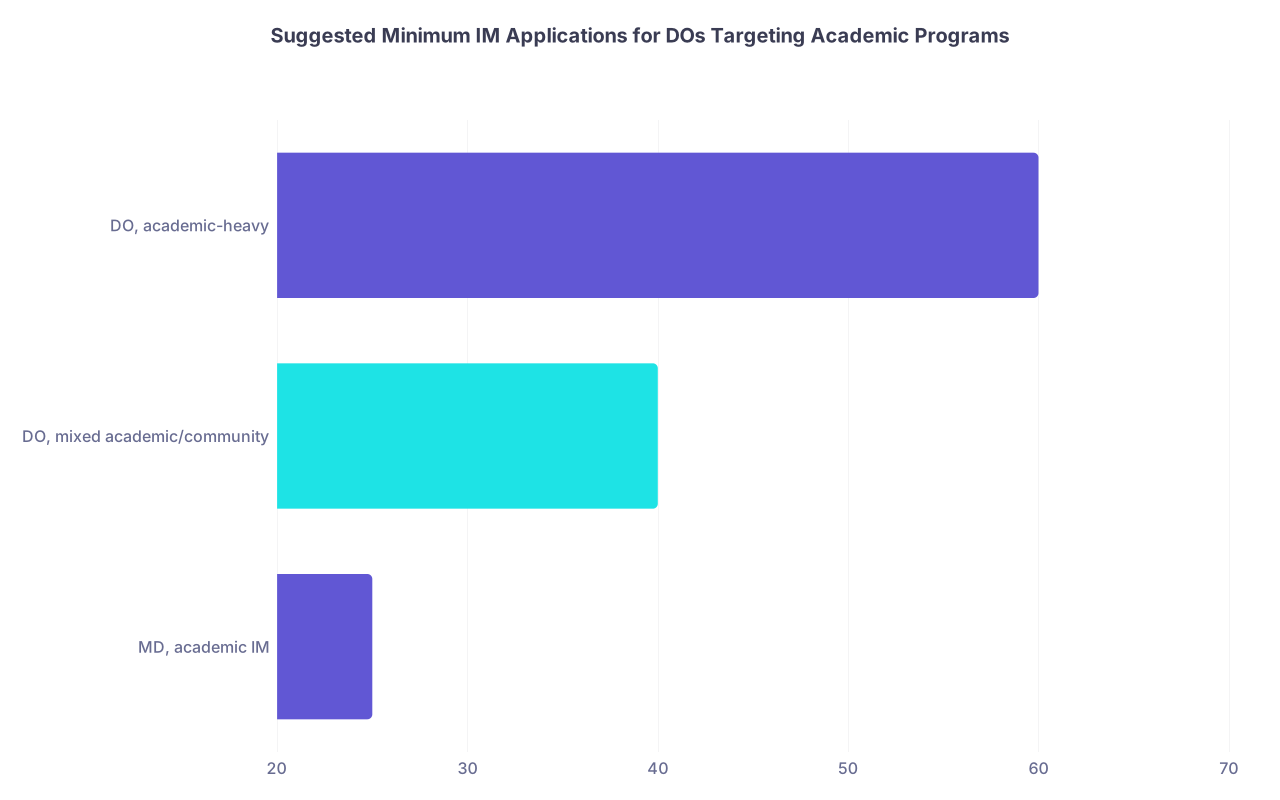
| Category | Value |
|---|---|
| MD, academic IM | 25 |
| DO, mixed academic/community | 40 |
| DO, academic-heavy | 60 |
Rule of thumb I use:
- DO, solid applicant (good Step 2, some scholarship) wanting academic IM:
- 50–70 IM programs total
- Of those:
- ~15–20 true academic/university-based
- ~20–30 university-affiliated / academic-leaning community
- The rest safety/community programs you’d still be willing to attend
The mistake is telling yourself:
“I only want academic, so I’ll just apply to 30 big-name university places and see.”
That’s not strategy. That’s gambling.
How to avoid this mistake
- Build a tiered list:
- 5–8 “reach” academic powerhouses
- 15–25 realistic academic/university-affiliated with DOs present
- 20–30 more DO-friendly programs with at least some academic flavor
- Be honest with yourself:
- If your Step 2 or COMLEX is average, your “reach” category should be small.
- Your bread and butter will be the programs that actually match DOs consistently.
You can still end up at a strong, fellowship-producing, academic-flavored program without a name your non-medical friends recognize. That’s the adult choice.
Mistake #8: Doing the Wrong Rotations (or the Right Ones at the Wrong Time)
Another silent killer for DOs:
- You want academic IM
- You schedule:
- Early FM rotation at a community site
- EM away rotation
- Maybe a late IM sub-I in January
Then you realize that:
- ERAS opened in September
- PDs are reading apps and sending interview invites
- Your best, most academic letter won’t exist until winter
Too late.
Rotation timing traps
- IM sub-I after September: fine for education, bad for letters for this cycle.
- Away rotation at a powerhouse academic IM program with no DOs: often a waste unless you’re stellar and Step 2 is strong.
- Loading up on non-IM rotations in summer/fall when you need IM faces vouching for you.
How to avoid this mistake
If you’re targeting academic IM as a DO:
- Do at least one core IM sub-internship before ERAS submission (July/Aug ideally).
- Preferably at:
- Your home academic affiliate
- Or a regional academic program that takes DOs
Use away rotations strategically:
- Away at a realistic academic program that already has DOs: good.
- Away at a “dream” elite program with no DOs: be honest, it’s mostly for the experience, not the match odds.
Make sure your rotation plan answers this question by September 1:
“Can I get at least 2 strong academic IM letters in time for application release?”
If the answer is no, your rotation schedule is a problem, not just your luck.
Your Next Step Today
You do not need to fix everything at once. But you also cannot keep drifting and hope “it works out.”
Do this right now:
Open three tabs:
- ERAS / program directory or FREIDA.
- A spreadsheet (or notes app).
- One academic IM program website you think you want.
Then:
- Go to that program’s current residents page.
- Count:
- How many DOs?
- In which PGY years?
- Write it down in your sheet:
- Program name
- DO count
- “Green / Yellow / Red” for DO-friendliness
- Add columns for:
- “Has DO faculty?”
- “Fellowships available?”
Do this for 10 programs you’re considering.
If your “dream list” turns into a pile of “Red” programs with no DOs and no DO faculty, you’ve just caught your first big mistake in time to fix it.