The fastest way to quietly sabotage your internal medicine or family medicine application is to overload your schedule with emergency medicine rotations.
Not low scores. Not one weak clerkship. Not a missing research poster. Just a fourth-year schedule that screams: “This person actually wants EM.”
I’ve watched strong IM/FM applicants get downgraded, questioned, or straight-up passed over because their rotations and letters told a different story than their personal statement. They thought more exposure to EM would “broaden their skills.” Programs read it as indecision, poor judgment, or a backup-plan strategy.
You’re about to walk into that same trap if you’re not careful.
The Core Problem: Your Schedule Is a Signal, Whether You Like It or Not
Program directors are not reading your application like a memoir. They’re scanning for patterns.
Here’s what they actually see:
- Your rotation list = what you chose when finally given real control
- Your letters = who you chose to invest your time with
- Your ERAS experiences = what you cared enough to write down
When an IM or FM PD opens an application and sees:
- EM sub-I
- EM away rotation #1
- EM away rotation #2
- EM elective in community ED
- EM research
- EM interest group leadership
…and then a personal statement about “long-term continuity of care” and “love of chronic disease management”?
They don’t think, “What a well-rounded applicant.” They think, “Why are they applying here?”
I’ve literally heard:
- “This is an EM applicant fishing for a backup.”
- “They’re going to bolt to EM at the first chance.”
- “Why would we invest in someone whose actions point at a different specialty?”
You can tell them anything in your personal statement. They believe what you schedule.
Mistake #1: Treating EM Rotations as “Generic Clinical Experience”
Here’s the lie that gets people into trouble:
“If I do more EM, it just shows I’m clinically capable. Programs will appreciate the extra acute care experience.”
No. They won’t. They’ll read EM as career intent.
Emergency medicine isn’t just another generic “medicine” rotation. It’s a specific career path with:
- Its own match process
- Its own away rotation culture
- Its own very obvious signal: multiple EM rotations = EM applicant
So when you’re applying to IM or FM and you load up on EM rotations, PDs don’t think “stronger clinician.” They think:
- “Why not a sub-I in inpatient IM?”
- “Why no FM sub-I in a continuity-heavy setting?”
- “Why spend September in an EM audition and not on our ward service?”
If you want to do internal medicine or family medicine, your schedule needs to say:
“I am building depth in longitudinal, adult or whole-family care, not auditioning for a completely different shop.”
Mistake #2: Overdoing Away Rotations in EM While Claiming IM or FM
Doing one EM elective? Fine. Common. Often helpful.
Stacking away rotations in EM while telling IM or FM you’re “committed” to them? That’s where it starts to look bad.
| Category | Value |
|---|---|
| 1 EM elective | 20 |
| 2 EM rotations | 65 |
| ≥3 EM rotations | 90 |
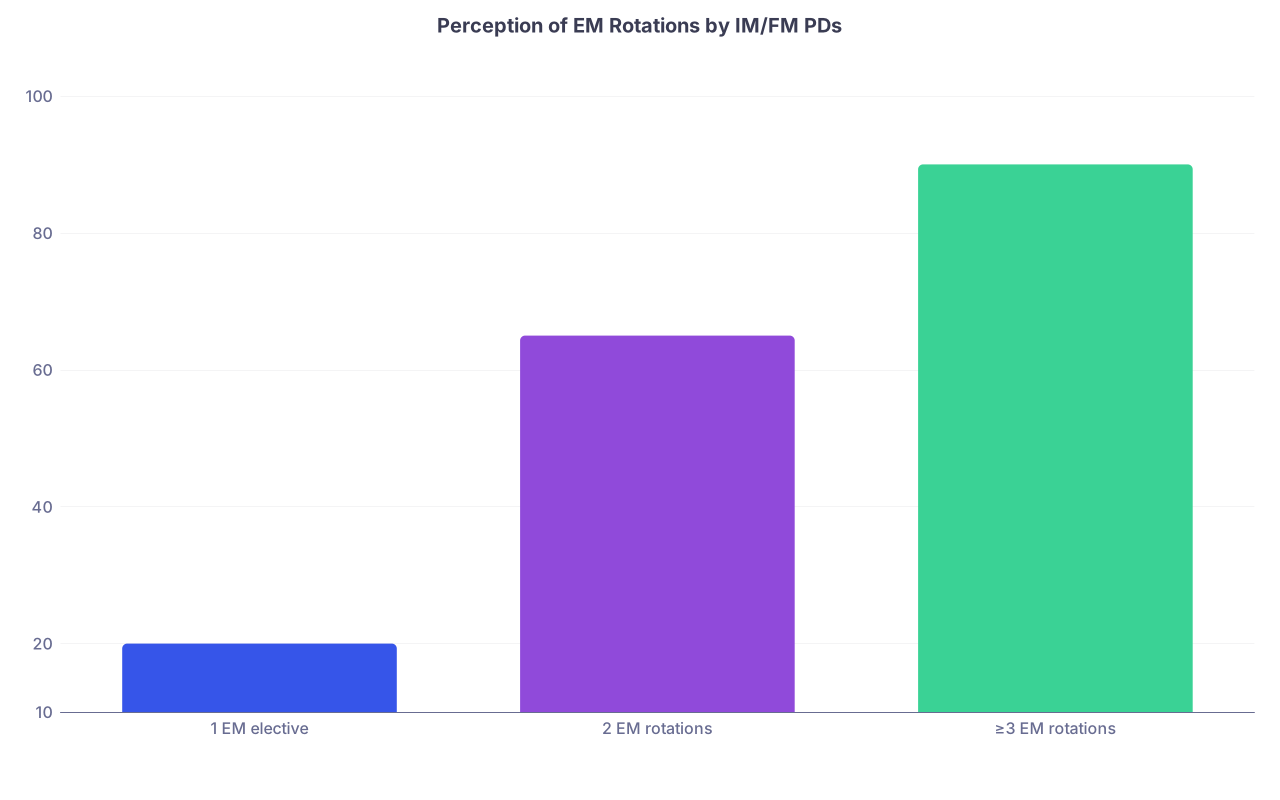
Rough perception (from real conversations, not fairy tales):
1 EM rotation
- Looks like: genuine interest, exploring fit, good acute care exposure
- Usually fine if rest of app is consistent with IM/FM
2 EM rotations
- Looks like: serious EM consideration, probably applied or thought of applying
- Raises questions: “What changed? Why not EM?”
3 or more EM rotations
- Looks like: EM applicant who flipped or is using IM/FM as backup
- Red flag unless there’s a very clearly documented story and strong IM/FM evidence elsewhere
You don’t want PDs having to decode your life story to justify why they should rank you. The more mental work you make them do, the more likely they are to pass.
Mistake #3: Burning Prime Months on the Wrong Audience
EM has its own timeline, and people forget that matters.

| Step | Description |
|---|---|
| Step 1 | Plan 4th year |
| Step 2 | Load July-Sep with EM aways |
| Step 3 | Need IM/FM sub I early |
| Step 4 | Weak IM/FM engagement |
| Step 5 | Strong IM/FM letters early |
| Step 6 | PDs question commitment |
| Step 7 | What is specialty? |
If you:
- Do EM aways in July–September
- Apply to IM or FM
- And only do an IM or FM sub-I or elective in October or later
You’ve just:
- Given your strongest face time to the wrong specialty
- Delayed high-quality IM/FM letters
- Limited your ability to get known by the programs you actually want
PDs notice the timing on your MS4 transcript. When your first IM exposure is late fall or winter, after a string of EM blocks, it reads like: “Plan A didn’t work out.”
They may not say it out loud. But I’ve sat in those meetings. The discussion goes:
- “Didn’t this person do 3 blocks of EM early?”
- “Yeah… and this IM sub-I is in November.”
- “So they probably switched. We need people who are certain about us.”
It’s not always fair. But it’s predictable.
Mistake #4: Getting Your Most Glowing Letters from EM
Another silent killer: your best letters are from emergency physicians.
Letters do two things:
- Validate your clinical competency
- Signal your field alignment
When an IM or FM program sees:
- 2–3 EM letters
- 0 strong inpatient IM or FM sub-I letter
- Maybe one generic “student did fine” medicine letter from M3
They don’t think, “Wow, so many people like this student.”
They think, “Everyone invested in this person is in EM. Why didn’t any internist or family doc fight to write them a letter?”
You need:
- At least one strong letter from an IM or FM sub-I (preferably academic)
- Ideally two: one inpatient, one outpatient or continuity-heavy setting
If you absolutely must use an EM letter (e.g., small school, EM-heavy site, limited options), it should be:
- One of several letters, not the headliner
- Explicitly supportive of your IM/FM choice (“I strongly support their pursuit of internal medicine/family medicine…”)
What you want to avoid: your most specific, enthusiastic letter being from someone in the wrong field.
Mistake #5: Letting Your Story Look Like “Plan B”
You’re allowed to change your mind. People switch from EM to IM or FM every year. The problem isn’t switching. The problem is looking like you fell into it.
Red-flag patterns:
- Multiple EM rotations early → sudden IM/FM app with no narrative
- EM leadership, EM research, EM aways → zero sustained IM/FM engagement
- Personal statement with one vague line: “After much thought, I realized I valued continuity of care” and nothing else
Here’s what programs hate: the “backup” vibe. They want to feel chosen.
If you’ve genuinely pivoted from EM to IM or FM, you cannot just quietly file ERAS and hope no one notices. You have to:
- Write a personal statement that actually walks through the pivot with clarity
- Have at least one letter writer reference your decision and support it
- Build concrete IM/FM experiences (clinic, QI, longitudinal relationships) that aren’t last-minute window dressing
Otherwise, your 3+ EM rotations look like you just didn’t get the EM love you wanted, so you’re fishing for a safe harbor.
Mistake #6: Misunderstanding What IM and FM Actually Prize
Here’s where people get confused. They think:
“But EM made me faster, more decisive, better at managing acute issues. IM and FM should like that.”
They do… as a side benefit. But here’s what IM and FM really care about that EM rotations rarely showcase well:
- Longitudinal commitment to complex patients over time
- Ability to navigate chronic disease management, not just acute decompensation
- Team-based care with nurses, social work, PT/OT, outpatient staff
- Preventive care, screening, guideline-based management
- Comfort with uncertainty over weeks to months, not just hours
EM rotations tend to show:
- Crisis management
- Snapshot decision-making
- Protocolized care
- Turnover, not follow-up
For an IM or FM PD, a year overloaded with EM looks like you trained for the wrong sport.
You want your application to scream:
“I know what your day-to-day actually is, and I still want it.”
That’s hard to do when most of your senior year was spent doing trauma evaluations at 2 a.m.
What a Balanced Schedule Actually Looks Like for IM or FM
Let me be clear:
You can and often should do EM as part of your fourth year. Just don’t let it dominate.
Here’s a cleaner structure if you’re targeting IM or FM:
| Block | Recommended Focus |
|---|---|
| Jul | IM or FM Sub-I (home) |
| Aug | IM or FM Sub-I (away) |
| Sep | EM Elective (1 block) |
| Oct | Outpatient IM or FM |
| Nov | ICU or CCU |
| Dec | Elective (ID, Cards, Rheum, etc) |
Notice:
- One EM elective, not three
- Early, strong IM/FM sub-Is to generate letters and signal priority
- Rotations that scream: “I’m preparing for a career in longitudinal internal or family medicine”
If you’re already in trouble—say you’ve done 2–3 EM rotations—your job is to over-correct:
- Pack the rest of the year with IM/FM-relevant rotations
- Get excellent letters from internists/family docs
- Build a clear, honest narrative that explains the EM exposure and your ultimate choice
The Hidden Cost: Lost Relationship Time With Your Actual Field
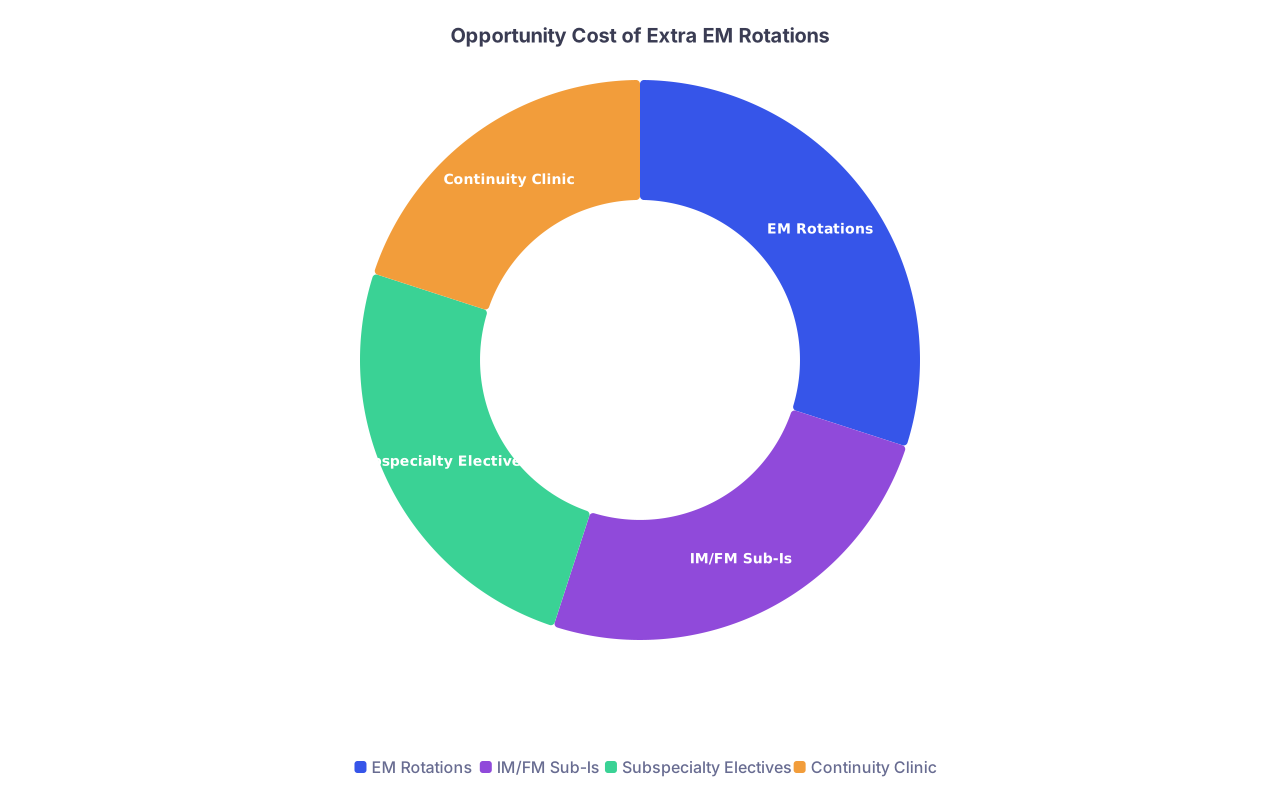
Overloading EM doesn’t just look bad. It steals opportunities.
Every EM block you add replaces something like:
- A second IM sub-I at your dream program
- A continuity FM clinic elective where you actually follow a panel
- A subspecialty elective (cards, endo, geriatrics, palliative) that proves you love the bread-and-butter of IM/FM
- Time to impress the associate PD who runs the ward service
| Category | Value |
|---|---|
| EM Rotations | 30 |
| IM/FM Sub-Is | 25 |
| Subspecialty Electives | 25 |
| Continuity Clinic | 20 |
I’ve seen students spend:
- July: EM at home
- August: EM away #1
- September: EM away #2
Then realize in October that EM isn’t for them. They scramble to do an IM sub-I in November. By then:
- Interview offers are already going out
- They have no strong IM letters ready in time
- The IM program at their home institution barely knows them as a senior
You don’t just lose “experience.” You lose visibility and sponsorship in the field you’re supposedly committed to.
Mistake #7: Believing “More Acute = More Impressive”
A harsh truth: the flashiest, most adrenaline-heavy rotations aren’t always the most valued by IM/FM PDs.
They’re not trying to hire the protagonist of a medical TV drama. They want someone who:
- Will show up for continuity clinic reliably
- Won’t roll their eyes at diabetic foot checks
- Can follow a cirrhotic patient through 3 admissions and tune up their outpatient regimen
- Actually cares about blood pressure, vaccines, cancer screening, and deprescribing
Over-glorifying EM in your MS4 year can subtly communicate the wrong values:
- You get bored on the wards
- You prefer short, intense interactions over long-term relationships
- You see yourself more as a cowboy of acute medicine than a steward of chronic care
I’ve literally heard a PD say:
“This looks like someone who’s going to be miserable in continuity clinic.”
That’s the last sentence you want attached to your name in a rank meeting.
When Extra EM Rotations Might Be Defensible
There are rare scenarios where more EM is understandable, but you still must handle them carefully:
You truly were between EM and IM/FM early on
- Then you need to own that in your narrative, not hide it
- Spell out why you chose IM/FM in the end
- Anchor your story with concrete IM/FM experiences and mentors
Your school has a weird structure (heavy ED exposure by design)
- Then your transcript should show this is institutional, not personal
- You still need elective/sub-I choices that clearly point to IM/FM
You’re in a rural area where EM/FM/IM are heavily blended
- In this case, you must get letters that describe how your EM work directly supported primary care skills
- And you should clearly articulate future practice plans (e.g., rural FM with ED coverage)
But even in these situations, you don’t get a free pass. You have to walk PDs through the logic so they’re not left guessing.
Concrete Rules to Avoid Shooting Yourself in the Foot
Here are the guardrails I’d give any IM or FM–leaning student:
Cap EM rotations at one (maybe two max)
- One home EM elective is plenty to show you can function in the ED
- A second only if there’s a clear reason and your IM/FM exposure is already rock solid
Front-load IM or FM sub-Is in July–September
- You want your strongest letters and impressions in your chosen field
- This also screams commitment to programs reviewing your app early
Ensure your best letters are from IM or FM
- EM letter? Fine as an extra. Not your flagship.
- Your “wow” letter should be from an internist or family physician who saw you act like a budding resident in their world
Align your narrative with your choices, not against them
- If you did a lot of EM, don’t pretend it didn’t happen
- Explain what you learned, why it clarified your choice, and why IM/FM is where you belong
Don’t sacrifice key IM/FM content for another EM month
- If the choice is: “Second EM away” vs “Cardiology/ICU/FM continuity clinic,” choose the latter every time if you’re serious about IM/FM
The One Move You Should Make Today
Open your fourth-year schedule (or draft), right now, and count your EM rotations.
- If you see more than one EM block and you’re serious about IM or FM:
Email your dean’s office or scheduler today and ask what can be swapped into those blocks that will showcase your commitment to internal medicine or family medicine instead.