
What happens when your “light” neurology month turns into the black hole that wrecks your Step studying, your sub‑I timing, and your letter of recommendation strategy—all because you scheduled it wrong?
I’ve watched a lot of students torpedo their chances in neurology not because they’re bad on the wards, but because they were sloppy or naive with scheduling. Neurology is quirky. The timing, the service mix, even which calendar month you pick can quietly make or break how competitive you look.
You want neurology to showcase your brain, not expose your planning gaps. Let’s walk through the biggest scheduling mistakes I see over and over—and how to avoid being the cautionary tale the clerkship director vents about.
Mistake #1: Doing Neurology Too Late to Matter
The most common disaster: students pushing neurology to the far right edge of their clinical calendar.
“I’ll do it after I’ve ‘warmed up’ with other rotations.”
Then suddenly it’s:
- February of fourth year
- ERAS is already submitted
- Program directors have your application in hand
- And your one shining neurology month… hasn’t even started
You just told every neurology program: this specialty wasn’t a priority when it counted.
Why “too late” is a real problem
If you’re even considering neurology, you need:
- Time to decide if you actually like the field
- Time to get letters from neurologists
- Time to schedule a neurology sub‑I (or acting internship)
- Time to potentially do an away rotation (if needed)
Neurology letters requested in December from a rotation starting in November? Useless for most application cycles.
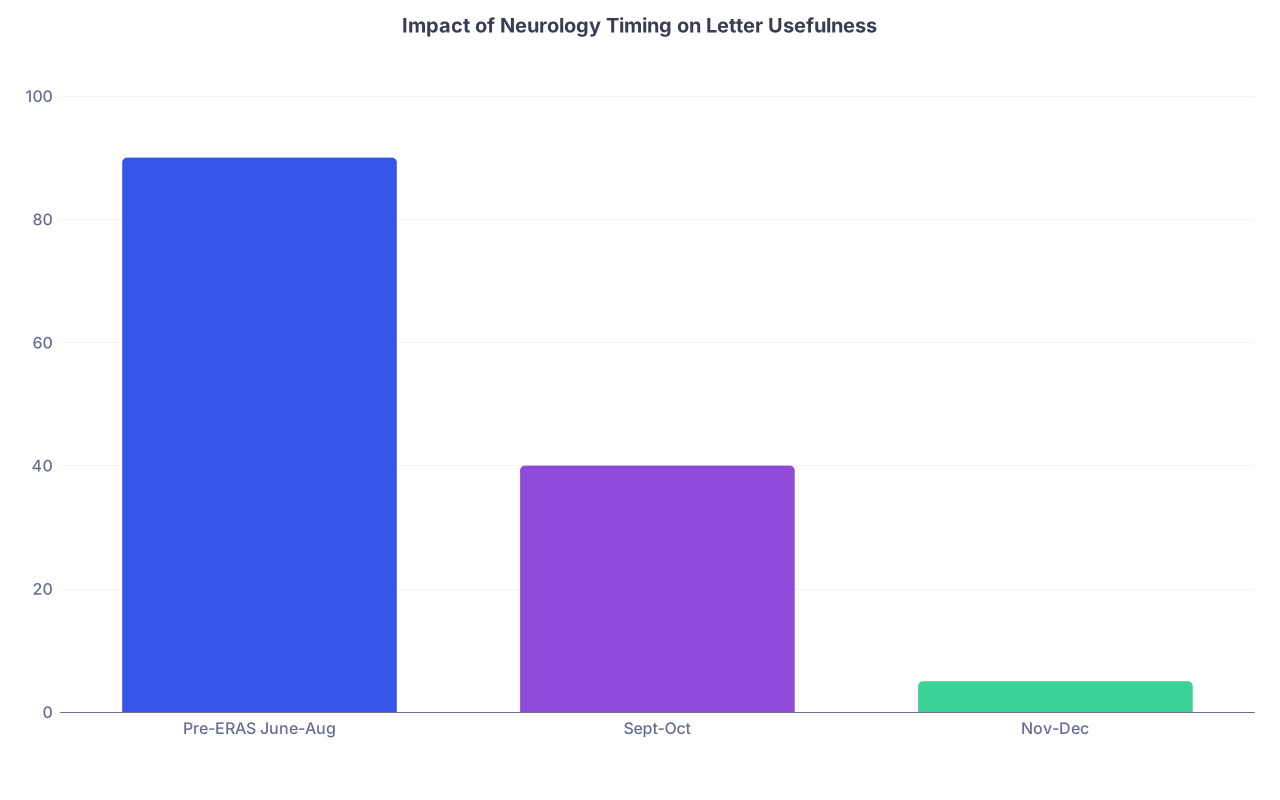
| Category | Value |
|---|---|
| Pre-ERAS June-Aug | 90 |
| Sept-Oct | 40 |
| Nov-Dec | 5 |
You don’t want your strongest neurology letter arriving after rank lists are basically set.
How to avoid this
If neurology is on your radar at all:
- Do core neurology by early 4th year at the latest
Ideal if your school allows:- Late MS3 or very early MS4: April–August range of the application year.
- If your school’s neurology is mandatory 3rd year
- Great. Use that as your “interview” month for future letters and sub‑I offers.
- If you discover neurology late
- You need to be hyper‑aggressive: early 4th year neuro sub‑I before ERAS submission, and email potential letter writers the second you start.
Do not be the person trying to get a “strong neurology letter” from a February rotation for a March rank list. That letter’s going nowhere.
Mistake #2: Ignoring the Mix of Inpatient vs Outpatient
Another rookie error: treating all neurology rotations as interchangeable.
They are not.
A month of sleepy outpatient general neuro clinic is very different from a month on stroke or neuro‑ICU. Programs know that. So do letter writers.
You need to be deliberate.
Where people mess this up
Common scenario:
- Student schedules “Neurology – Outpatient” because they’ve heard it’s “chill”
- They’re exploring neurology as a career
- They leave the month without:
- Running a list
- Calling consults
- Being paged for acute neurologic changes
- Managing status epilepticus, acute stroke, encephalopathy
- Their letter ends up sounding like: “Shows up on time, asks good questions, did fine in clinic.”
Translation to program directors: no real stress test yet.

What you actually need if you’re serious about neurology
At minimum, before you apply neurology, you should have:
- One high-intensity inpatient month
- Acute stroke, neuro‑ICU, or general consult service
- You want to be seen functioning when things are chaotic
- Optional but very helpful: some outpatient exposure
- MS clinic, epilepsy clinic, movement disorders, headache
- Helps you know if you like the bread‑and‑butter outpatient side
Programs will assume you can handle clinic. They won’t assume you can handle:
- 3 stroke codes at once
- Family meetings with delirious or obtunded patients
- Overnight neurology calls and triage
You want direct comments about those situations in your letter.
How to avoid this mistake
When you’re scheduling neurology, do not just click the first “Neuro” option in your school system. Ask:
- Is this primarily inpatient or outpatient?
- Is there a dedicated stroke or neuro‑ICU block?
- How many patients do students carry?
- Will I take any call or night float?
- Where do most students get neurology letters from—this service, or a different one?
If the answer sounds like:
- “Mostly clinics”
- “Students shadow”
- “No call, ever”
That’s not where you want your only neurology month if you’re thinking about matching into the specialty.
Mistake #3: Pairing Neurology with the Wrong Other Commitments
Students constantly underestimate how cognitively and emotionally draining a neurology rotation can be—especially stroke or neuro‑ICU—and they stack it with the worst possible add‑ons.
Here’s what I mean.
Bad scheduling combinations I’ve seen
- Neurology + dedicated Step 2 study
- “I’ll just study at night.”
- Reality: you’re drained from managing delirium, stroke, seizures, and mixed-up family expectations. Your brain is not absorbing UWorld after 10 hours of neuro.
- Neurology + research deadline month
- Manuscript due. Abstract submissions closing. PI breathing down your neck.
- Guess what gets sacrificed? Your clinical performance. And neurologists are observant about attention to detail.
- Neurology + critical personal commitments
- Wedding planning, international travel soon after, major family obligations.
- You think you’ll juggle. You won’t. And your attendance and focus will show it.
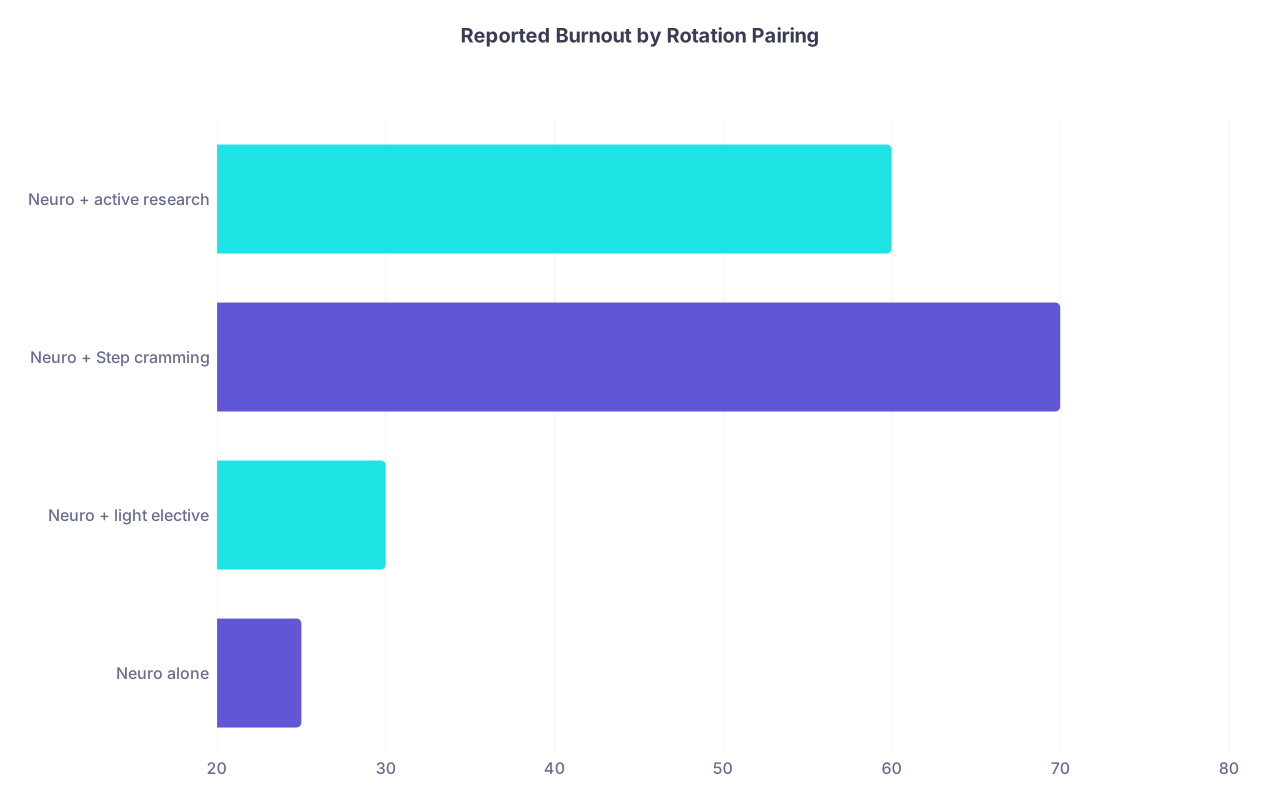
| Category | Value |
|---|---|
| Neuro alone | 25 |
| Neuro + light elective | 30 |
| Neuro + Step cramming | 70 |
| Neuro + active research | 60 |
Why this matters more in neurology
Neurology rotations test:
- Your pattern recognition and diagnostic reasoning
- Your ability to do repetitive, detailed neuro exams accurately
- Your patience with slow‑recovering patients and complicated families
If you’re half‑asleep or mentally checked out, everyone notices. Neurologists are very tuned to subtlety. It’s their whole job.
Burned‑out, overcommitted students:
- Miss exam findings
- Present sloppily
- Forget follow‑up studies
- Look disorganized on rounds
- Do not get strong letters
How to avoid this
When you schedule neurology:
- Don’t pair “career‑deciding” neurology with heaviest external obligations.
If this is the month that will decide your letters and your future specialty, protect it. - Use lighter months for high‑stakes exams.
If possible, do Step 2 during an easier elective or a buffer month, not during neuro‑ICU. - Be honest about your bandwidth.
If you’re already running hot, don’t add a 12‑patient stroke service + night call + research deadline.
You only get one first impression in neurology. Don’t make it during your most overloaded month of the year.
Mistake #4: Not Aligning Neurology with Letter of Recommendation Strategy
If you want a neurology letter that actually helps you match, you can’t treat your neuro rotation like a random calendar block. The timing, the service, and the person you’ll work with all matter.
Students screw this up constantly.
The subtle but deadly timing problem
Here’s how people self‑sabotage:
- Do neurology too early:
- January–March of third year, before you’ve learned how to function on the wards
- You look lost, unsure, slow with notes
- Neurology attendings see you at your clumsiest, not your best
- Or do neurology too late:
- After ERAS is in, letters are uploaded, and interview invitations are going out
Both are bad:
- Too early = weak performance, generic letter
- Too late = robust performance, but letter arrives after it can change anything
Ideal: neurologists see you after you’ve learned how to be a functional MS3, but before letter deadlines.
Picking the wrong service for letters
Some services are great for learning but bad for letters:
- Massive inpatient services where:
- You’re one of several students and interns
- Attendings rotate quickly
- You never have continuity with one faculty member
That setup is fine if you’re just trying to learn. It’s terrible if you’re hoping for a detailed letter.
What you want:
- A rotation where:
- You’re with the same attending or small group of attendings for most of the month
- They see you pre‑round, present, follow plans, talk to families
- You can own 3–5 patients and follow them longitudinally
| Rotation Type | Continuity With Attending | Letter Potential |
|---|---|---|
| Stroke service (huge team) | Low–Moderate | Moderate |
| Neuro-ICU (intense, stable) | Moderate–High | High |
| General inpatient consults | Moderate | High |
| Outpatient subspecialty clinic | High | Moderate–High |
How to avoid this
Plan backward from when letters are due.
Most applications:
- ERAS opens: June
- Submission: mid‑September
- Letters: best if requested no later than mid‑August
So if you want a neuro letter that counts:
- Schedule your key neurology month:
- May–July (ideal) or as close as your curriculum allows
- Before the rotation:
- Identify 1–2 attendings known for strong teaching and mentorship
- Try to be on their service if possible
- During week 2–3:
- Tell them directly you’re interested in neurology and hope to apply
- Ask what you can do to reach “letter‑worthy” performance
- End of week 3 / early week 4:
- Ask if they feel they know you well enough to write a strong letter
- If they hesitate, do not push—find someone else
Students who don’t align scheduling with letter strategy end up with weak, late, or non‑neurology letters. And neurology programs absolutely notice when there’s no valid neuro letter in your file.
Mistake #5: Ignoring Seasonality and Service Intensity
Not every month on a neurology service is the same. Volume, acuity, and staff coverage can swing dramatically with the calendar.
Students often schedule neuro during the worst possible time without realizing it.
Seasonal traps I keep seeing
- July on neurology as first real clinical month
- New residents. New interns. New chaos.
- You’re a brand new clinical student, your senior is a brand new resident, and the ship is… wobbly.
- Great for soft landings? Not really. Great for polished evaluations? Absolutely not.
- End of academic year (May–June) on understaffed services
- Attendings on vacation. Fellows at conferences.
- You may get bounced between temporary preceptors and not be seen consistently.
- Holiday-heavy months
- November–December: clinic cancellations, skeleton crews, weird call schedules.
- Some students love this; they think lighter volume means easier life. True. It also means fewer chances to show what you can do.
Why this matters
Your evaluation and letter quality depend on:
- Continuity with faculty
- Volume and variety of cases
- How well the team is functioning
Schedule at the wrong time and you:
- See fewer patients
- Work with more locums, per diems, or rotating attendings
- Get a one‑paragraph evaluation from someone who barely remembers your name

| Step | Description |
|---|---|
| Step 1 | Choose Neurology Month |
| Step 2 | New team chaos |
| Step 3 | Vacations and transitions |
| Step 4 | More stable staffing |
| Step 5 | Lower volume, fewer clinics |
| Step 6 | Typical patient load |
| Step 7 | Early or Late Year |
| Step 8 | Holiday months |
How to avoid this
When you’re picking specific months:
- Ask senior students:
- “When is stroke service a total zoo versus dead?”
- “Which months are best staffed?”
- Ask residents quietly:
- “If you were me and wanted a strong neuro letter, which month would you choose for this service?”
- Avoid:
- Your very first clerkship month being neurology
- The most chaotic transition months, unless you’re already strong clinically and want a stress test
Think strategically. You want:
- Enough volume to demonstrate clinical growth
- Enough stability to be seen consistently
- Enough staff present to actually write thoughtful evaluations
Mistake #6: Not Coordinating Neurology With Other Key Rotations
Neurology sits at the intersection of multiple specialties. That’s an opportunity—but only if you schedule intelligently.
Here’s where students stumble.
The sequence problem
Bad pattern:
- IM rotation late 3rd year
- Neurology early 4th year
- Sub‑I randomly wedged in wherever there’s space
They end up:
- Struggling on neurology because they never fully internalized inpatient medicine workflow
- Doing a sub‑I after applications, so the “great” evaluation doesn’t actually help
Better pattern if you’re neuro‑curious:
- Internal Medicine (or a solid inpatient rotation)
- Neurology core or elective
- Neurology sub‑I or away rotation
- ERAS submission
This sequence means:
- You already understand vitals, orders, labs, and basic inpatient rhythm before neurology
- Neurologists see you when you’re semi-competent, not brand new
- Your neuro sub‑I evaluation can be turned into a meaningful letter in time
Forgetting how PDs read your timeline
Program directors mentally reconstruct your year.
They notice if:
- You clustered all neuro experiences after ERAS
- You didn’t do any advanced or inpatient neuro experiences
- Your sub‑I is in something totally unrelated (e.g., Derm) while you claim you’re “passionately committed” to neurology
They’re asking: Did this student structure their year like someone serious about this specialty?
If your schedule screams “afterthought,” don’t expect them to ignore that.
How to avoid this
Before you lock anything in, sketch a full-year map:
- Where does:
- Neurology core/elective sit?
- Your neuro sub‑I sit?
- Any away rotations sit?
- IM or other foundational rotations sit?
- Does the order make sense if someone reads it as a story?
Aim for a timeline that looks intentional, not random. Something like:
- Jan–Apr: Core IM / Surgery / Psych
- May–Jun: Core neurology
- Jul–Aug: Neuro sub‑I or away neuro
- Sep: Buffer / lighter elective during ERAS chaos
Instead of:
- Jul: Psych
- Aug: Derm elective
- Sep: Vacation
- Oct: Neurology (decide you love it here)
- Nov: Neuro sub‑I (letter arrives too late)
That second one is how people accidentally self‑select out of competitive programs.
Mistake #7: Assuming “Any Neuro Exposure” Is Enough to Choose the Specialty
One more error that quietly ruins careers: rushing into neurology after a single, badly scheduled month that didn’t show you the full picture.
Or worse—ruling it out after a bizarre, unrepresentative month.
The lopsided experience trap
Examples I’ve actually seen:
- Student only did stroke:
- Thinks neurology is 90% thrombolytics vs thrombectomy and NIHSS marathons
- Has no idea what outpatient epilepsy, MS, movement disorders, and headache look like
- Student only did outpatient clinic during a low-volume month:
- Thinks neurology is “slow, boring, and mostly reassurance”
- Never sees neuro emergencies or ICU-level disease
- Student did neuro-ICU only, on nights:
- Believes neurology is essentially critical care with intracranial pressure monitors
- Doesn’t see bread-and-butter clinic at all
Then they choose—or reject—an entire specialty based on that.

How to avoid this
Before you commit your entire residency path:
- Make sure you’ve seen:
- At least one busy inpatient neuro environment
- Some general neurology outpatient exposure
- Talk to:
- Residents in different tracks (clinic-heavy vs inpatient-heavy)
- Faculty who split time between clinic and hospital
If your only neurology month was an outlier (strange service, terrible team, or pure clinic during the holidays), don’t let that single data point decide your specialty for you.
If needed, schedule:
- A short additional neuro elective (2 weeks) in a different environment before ERAS submission
- Or a targeted outpatient block to see “real life” neurology beyond the chaos of acute stroke
Two or Three Things You Really Need to Remember
Timing is not cosmetic. If neurology is even a possibility, schedule it early enough (and in the right season) to get meaningful letters and to still adjust your path.
Service type and rotation mix matter. Don’t hide in pure outpatient or low-volume clinics if you want to match neurology. You need at least one serious inpatient month where someone can see you handle real responsibility.
Your schedule tells a story. Program directors read your year like a narrative. Build a sequence—IM → Neuro → Neuro sub‑I—that looks like a deliberate preparation for neurology, not an afterthought tossed together at the end.