
The residency timeline does not care that you figured out psychiatry late.
You can discover psych in September and still match. But you do not get to pretend you had a perfectly sequenced third year. So the question is not “is this unfair?” The question is: “Given that I’m here, how do I play this hand well enough to still land a psych spot I’ll be happy in?”
That is exactly what we’re going to sort out.
You’re likely in one of these variants:
- You decided on psychiatry after your psych rotation… which was late.
- Your core psych rotation isn’t until after ERAS opens.
- Your school shuffled your schedule and you will not have a core psych grade or letter in time.
- You did psych early but did not realize you needed a letter, and now it’s too late to get a fresh one before ERAS.
Same core problem: you’re applying to psychiatry without a “proper” psych letter from a core clerkship or home psych department at the time applications go out.
Let me walk you through how to handle this like an adult instead of spiraling.
Step 1: Get brutally clear on your actual constraint
Do not just chant “I don’t have a psych letter.” That’s too vague and keeps you stuck.
Spell out what you do and do not have, and when things will become available.
Make a quick grid. Not a theoretical one. Yours, with real dates.
| Item | Status / Date |
|---|---|
| ERAS application opens | Mid-September |
| First psych experience | e.g., November (after ERAS) |
| Core psych clerkship | e.g., Oct–Nov |
| Psych sub-I / elective | e.g., Dec or later |
| Psych letter from rotation | Not until late Nov/Dec |
| Current letters (non-psych) | IM, FM, maybe research |
This matters because programs do not all behave the same. Some:
- Will review with whatever letters are in when they first open ERAS
- Will keep updating your file as letters arrive later
- Will explicitly say “we don’t require a psych letter to offer an interview”
- Will silently prefer applicants who look more “committed”—i.e., have at least one psych letter
The goal is not: “Have a psych letter by September 15th.” That might be impossible.
The goal is: “Use what I have early; add psych evidence as soon as it exists; and tell a coherent story that makes programs trust I’m serious about psychiatry.”
Step 2: Use non-psych letters strategically, not apologetically
A lot of students in your exact situation waste time obsessing about the label on the letterhead (Psychiatry vs Internal Medicine) and ignore the content. Programs don’t.
I’ve seen weak psychiatry letters that say, “Pleasant, punctual, average student” from a two-week elective. I’ve seen powerhouse internal medicine letters that say, “Top 5% student in my decade of teaching, exceptionally insightful with complex psychosocial patients, would be an asset to psychiatry.” Guess which one carries weight.
If you’re applying without psych letters in time, your immediate job:
- Identify your strongest letter-writers (even if not in psych).
- Tell them plainly you’re applying to psychiatry.
- Ask them to highlight qualities relevant to psychiatry.
Concrete example language you can use when you meet or email them:
“I’ve decided to apply in Psychiatry, but my core psych rotation is later in the year so I won’t have a psych letter in time. Would you be comfortable writing a strong letter that speaks to my clinical reasoning, communication skills, and ability to work with patients with complex psychosocial issues? Those are the aspects that will matter most to psych programs.”
You want at least:
- One solid medicine or family med letter showing you can do bread-and-butter inpatient/outpatient work.
- One letter that highlights your interpersonal skills, curiosity about patients’ stories, and team dynamics. This could be from IM, FM, Peds, Surgery, whatever—if they actually saw those things.
If you have a psych-related research PI or mentor, that can be your quasi-psych letter even if they’re not a clinician. It’s better than nothing, especially if the letter screams commitment and long-term interest in psychiatry.
Step 3: Fix what you can with your schedule—fast
If your schedule isn’t totally cemented, you should be a little obnoxious about moving things.
You want something psychiatry-related done as early as humanly possible, even if it’s not a full core clerkship. Why? Because it gives you:
- Talking points for your personal statement and interviews.
- At least one potential psych letter that can roll in later.
- A real sense of whether you actually like psych beyond a vibes-level impression.
Tactics I’ve seen work:
- Ask your dean’s office to swap your psych core with another clerkship so that psych is earlier.
- If that’s denied (often is), ask for a 2–4 week psych elective or sub-I early in fourth year.
- If your school has a home psych department, ask if you can:
- Do consult-liaison psych for a few weeks
- Join inpatient psych for a short elective
- Shadow/participate in outpatient clinics regularly
You’re not trying to redesign your year. You’re trying to create one meaningful psych experience that can:
- Generate a letter
- Provide concrete stories to prove this isn’t a last-minute fling
You’ll often hear, “Our schedule is fixed.” Okay. Still ask. Still escalate politely. “I discovered I’m committed to psychiatry and I need at least one early experience to confirm that and to have a letter for ERAS” is a valid, professional reason to push.
Step 4: Understand how late letters actually work
Everyone panics about “no psych letter in time” without understanding how much slack there is in the system.
Reality:
- Many programs don’t start seriously reviewing until late September or even October.
- Interviews stretch into January.
- Letters added in October–November still get read and can meaningfully influence decisions.
Your plan should assume a staged file:
Stage 1 — Mid-September:
- Application submitted with:
- Strong non-psych letters
- Personal statement clearly committing to psychiatry
- CV highlighting any mental health–adjacent things (volunteer crisis line, psych-related research, ethics course, etc.)
- You look like: “Late chooser but serious.”
Stage 2 — October/November:
- Psych clerkship or elective finishes.
- Psych letter submitted as soon as it’s written.
- You email a SHORT update to programs that haven’t rejected you yet, if permitted:
- “Since submitting my application, I’ve completed a psychiatry clerkship at [Hospital]. I’ve asked Dr. [X] to send a letter of recommendation on my behalf, which should arrive shortly. The experience has further confirmed my commitment to psychiatry, particularly [brief one-liner, e.g., working with patients with comorbid substance use and mood disorders].”
Stage 3 — Before ranking:
- For programs where you interview, your psych letter is now in the file by the time they’re finalizing rank lists.
- On interview day, you talk about your psych experience with detail and reflection. That matters as much as the letter itself.
Is this as optimal as having two glowing psych letters by September 15th? No.
Is it fatal? No. I’ve seen plenty of people match with psych letters arriving in October or November—as long as the rest of the story hangs together.
Step 5: Rewrite your personal statement and experiences with psych in mind
If you discover psych late, you can’t lean on years of stepwise preparation. So you compensate with clarity and coherence.
Programs want to answer two questions:
- Do you actually understand what psychiatry is (beyond “I like talking to people”)?
- Are you likely to show up and do the work without bailing to a different specialty?
Your personal statement has to do a lot of work for you. Specifically, it should:
- Acknowledge the late realization without making excuses.
- Show a pattern in your prior experiences that lines up with psych.
- Demonstrate you understand the real day-to-day of modern psychiatry, not a TV version.
Something like:
“I came into third year expecting to pursue internal medicine. What surprised me was how often my most meaningful clinical encounters centered less on adjusting a medication dose and more on sitting at the bedside of patients withdrawing from substances, or those whose chest pain was clearly rooted in unrelenting anxiety. I realized that the part of medicine that kept me engaged the longest was understanding why patients made the choices they did, and how their stories shaped their health.
My formal psychiatry training comes later in my fourth year, but the path here is not sudden. As an undergraduate, I volunteered for two years on a crisis text line. Throughout my clinical clerkships, I have consistently gravitated toward complex psychosocial cases—whether that was managing depression in a patient with uncontrolled diabetes on my internal medicine rotation, or working with a patient with postpartum anxiety on OB/GYN. Psychiatry gives me the chance to focus on this dimension of care in a sustained, rigorous way.”
Then in your activities descriptions:
- Reframe seemingly “non-psych” experiences:
- IM: emphasize dealing with delirium, depression, adherence issues.
- Surgery: the pre-op anxiety, chronic pain with psychological overlay.
- FM: longitudinal relationships, mental health screening, substance use.
You’re building a case that your values and habits have always leaned psych, even if you named it late.
Step 6: Choose your psych programs with your profile in mind
You don’t have the luxury of pretending you’re a generic psych applicant.
Some program types are more forgiving to late deciders and non-traditional files:
Community and hybrid community–university programs
Often more flexible, more open to strong generalists who found psych later.Programs in less competitive regions (Midwest, South, smaller cities)
Less obsessed with “perfect” psych pedigrees.Home program (if you have one)
They know you, and they know your school’s rotation timing was out of your control.
More rigid:
- Very top-tier academic programs in big coastal cities often want clear, early psych commitment and research. Doesn’t mean don’t apply. Just means don’t pin your entire sense of worth on those.
Aim for a broad but thoughtful list. Not “spray and pray,” but something like:
- A core of programs where your stats are comfortably above their usual floor and they aren’t fanatical about psych letters.
- A handful of reaches if you really want them.
- Enough “safeties” that actually fit your values.
You’re not just making up numbers; pay attention to how psych intensity and selectivity vary:
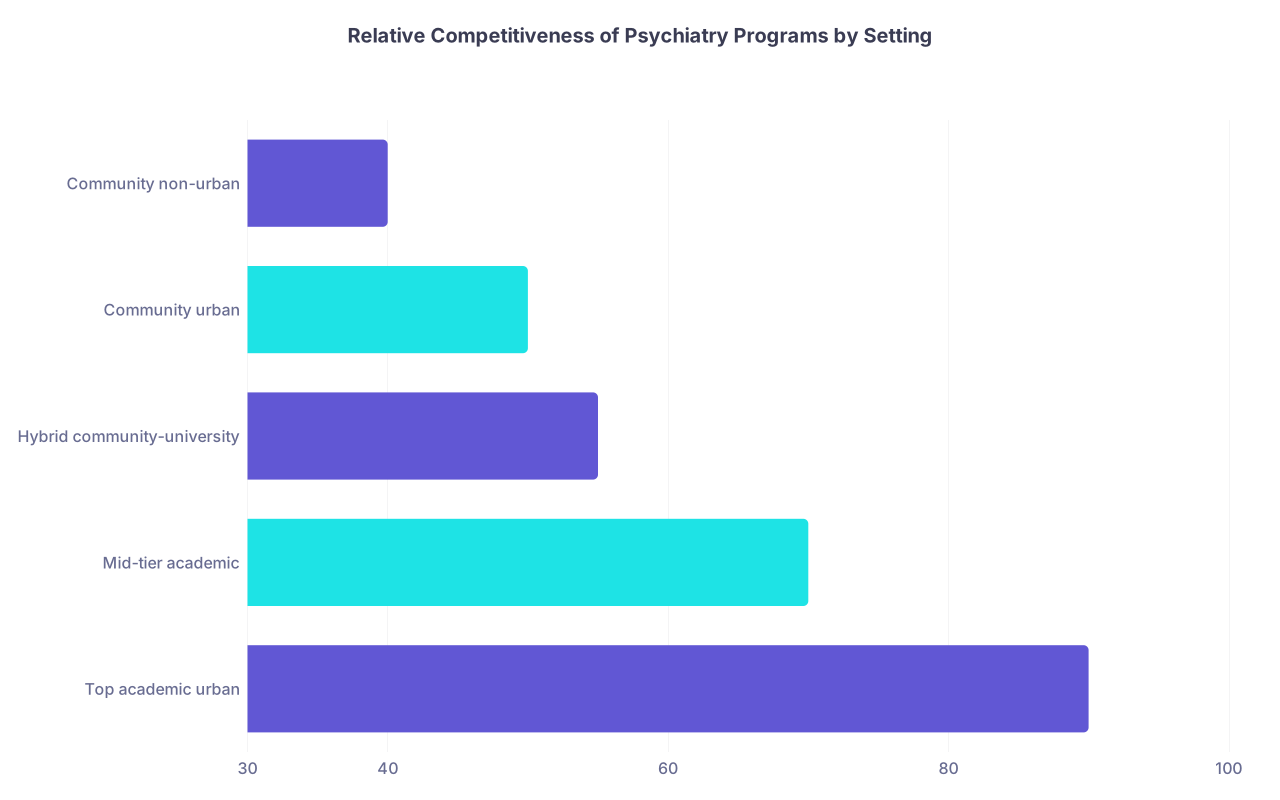
| Category | Value |
|---|---|
| Top academic urban | 90 |
| Mid-tier academic | 70 |
| Hybrid community-university | 55 |
| Community urban | 50 |
| Community non-urban | 40 |
(Think of those numbers as “relative competitiveness index,” not match chances.)
Late-psych applicants with decent Step 2 (or shelf) performance, no major red flags, and thoughtful applications do match every year. But the ones who do not often made the same mistake: they applied like they were generic mid-tier applicants when they weren’t.
Step 7: Own the timing in interviews without sounding defensive
If you do this right, the “You discovered psych late?” conversation can actually help you—not hurt you.
What programs are listening for:
- Are you running from something (hard procedural fields, poor evals)?
- Or are you running toward something (a consistent pattern you finally named)?
Answer framework you can adapt:
Start with honesty and brevity about timing.
“I solidified my decision to apply in psychiatry during the latter part of third year.”Link it to longstanding themes.
“Looking back, it fits with what I’ve been drawn to for a long time—crisis counseling, working with patients with complex social situations, and enjoying the long conversations more than the quick procedures.”Explain your concrete steps once you decided.
“Once I realized that, I met with our psych clerkship director, rearranged my schedule to get an early sub-I, and sought out outpatient psych clinics to make sure this was the right fit. I’ve also adjusted my research and reading accordingly.”Address the elephant (letters) but don’t dwell.
“Because of my school’s schedule I didn’t have a core psych evaluation by September, so my initial letters are from internal medicine and family medicine attendings who saw me work closely with patients with depression, substance use, and anxiety. My psych letter from my sub-I is now in ERAS as well.”
Then stop talking. Do not over-apologize or keep explaining. Confidence, not excuses.
Step 8: Mitigate risk with smart backup planning
If your test scores are borderline, your clinical evals are mixed, and you’re late to psych without a core letter, you need to be honest about risk.
That doesn’t mean abandon psychiatry, but you might need to:
- Apply more broadly within psych.
- Consider dual-apply (e.g., FM + Psych) if your advising office strongly recommends it. This is touchy and has to be done carefully so you don’t sabotage both, but for some students it’s the rational move.
- Build real contingency plans for a SOAP year if needed.
I’m not saying you must dual-apply. Plenty of late psych deciders with solid applications match fine. But you shouldn’t let optimism blind you to the fact that you’re not applying from a position of maximum leverage.
Step 9: What to do if you truly have zero psych contact before ERAS
There’s a worst-case version of your situation that I’ve seen:
Psych core is in like January–February. No psych elective available earlier. Zero.
If that’s you, then you’re not just “late on letters.” You’re applying to psych without having done psych at all. Programs will notice.
You have two main options:
Still apply this year, but:
- Lean very heavily on:
- Crisis line, counseling center, social work, public health, addiction-related experiences.
- Strong letters from attendings who saw you manage mental health issues in other settings.
- Be crystal clear in your personal statement and interviews that you understand it’s not ideal and that you’re committed anyway.
- Accept that you may need to go through SOAP or reapply.
- Lean very heavily on:
Take a year off (research year, MPH, mental health–related work) and apply the following cycle with:
- Real psych rotations.
- Multiple psych letters.
- A much more conventional file.
What I’ve seen go badly is people trying option #1 with a fantasy that it’s the same as a normal application. It’s not. If you choose to apply with zero psych exposure, you’re betting on your narrative and overall strength to carry you. Sometimes that works. Sometimes it doesn’t. You should go in with eyes open.
Step 10: Talk honestly with your psych department
Last thing. Do not make this a solo project.
Your home psych department (if you have one) has almost certainly dealt with your exact scenario before. The students who do best do not just submit ERAS and hope.
You should:
- Email or meet with the clerkship director or residency program director early.
- Say directly:
- “I decided on psychiatry after the usual psych rotation timing. I won’t have a core psych letter in time. I’d like your advice on how to maximize my chances this cycle and whether there are ways to get early exposure or support from the department.”
- Ask:
- Can I do a short psych elective or sub-I early?
- Are there faculty willing to meet and maybe supervise a brief clinic experience?
- How does your own program view late psych letters?
Sometimes they’ll say, “We can’t fix the schedule, but we’ll note in your MSPE that your psych rotation is later because of curricular structure, not because you were avoiding it.” That helps.
Sometimes they’ll quietly vouch for you with their network. That helps even more.

| Step | Description |
|---|---|
| Step 1 | Realize you want Psych late |
| Step 2 | Audit what you have now |
| Step 3 | Secure strong non psych letters |
| Step 4 | Push for early psych elective or sub I |
| Step 5 | Submit ERAS with current letters |
| Step 6 | Complete psych rotation |
| Step 7 | Add psych letter to ERAS |
| Step 8 | Update programs if allowed |
| Step 9 | Interview and explain timing confidently |
The bottom line if you’re discovering psych late
- You can compensate for late psych letters with strong non-psych letters, targeted schedule tweaks, and a clear, honest narrative that connects your path to psychiatry.
- Letters arriving in October or November are still useful; your real job is to get at least one meaningful psych experience and letter into your file before programs rank.
- You’re not doomed, but you’re also not generic—treat your application strategy like a slightly higher-risk profile and plan accordingly: smart school list, honest advising, and no magical thinking about what your file looks like on paper.