
It is 3:15 p.m. in continuity clinic. You are on your seventh hypertension follow-up of the day. The EMR is lagging, your preceptor wants another HCC code, and the patient in front of you is mostly here because “my daughter said I should come.”
You’re thinking: I miss the ICU.
You remember last month on MICU. Pressors. Vent settings. Actual team collaboration. You were tired but engaged. Now you are counting the minutes till sign-out and wondering if you picked the wrong specialty.
You did not necessarily pick the wrong specialty. But you do need to pick the right internal medicine environment.
This is the situation: you like sick patients, procedures, and high-acuity decisions, and clinic days feel like slow suffocation. You’re trying to figure out how that should drive your residency choice and long-term career.
Let me walk you through this, step by step, like we’re sitting in the workroom between admissions.
Step 1: Be Honest About What You Actually Like
First thing: dissect what “I love the ICU” and “I hate clinic” actually mean for you. Those phrases get thrown around a lot, and they mean different things for different people.
ICU love usually means some mix of:
- You like sick, unstable patients.
- You like clear problems and immediate feedback (you titrate something, numbers change).
- You like team-based decisions and rounds that feel like actual medicine.
- You like nights more than you thought you would.
- You like procedures or at least the procedural vibe.
- You like defined admissions and discharges, not open-ended “follow up in 6 months.”
Clinic hate usually means some mix of:
- You dislike 15-minute visits stacked all day.
- You hate documentation bloat and prior auths.
- You feel drained by chronic, lifestyle-driven conditions with slow progress.
- You don’t enjoy counseling conversations repeated 10 times a day.
- You’re annoyed by no-shows and last-minute “oh by the way” complaints.
That combination points to a few patterns:
- You are probably more inpatient than outpatient.
- You may be procedure-leaning (but not necessarily a “proceduralist”).
- You need variety and acuity, not pure maintenance care.
None of that disqualifies you from internal medicine. It just means you need to be deliberate about:
- What kind of IM residency you pick.
- What kind of job you aim for after.
- How much clinic you can realistically tolerate and in what form.
Step 2: Recognize the Hard Truth – You Cannot Completely Escape Clinic in IM Training
You are going to have clinic in internal medicine residency. Period.
The questions are:
- How much?
- What kind?
- How much does the program actually protect inpatient time?
In the U.S., ACGME requirements mean you must have continuity clinic. Some programs call it “firm,” some “ambulatory block,” some “+2,” but you can’t delete it from your life.
What you can control:
Structure of clinic time:
- Traditional 4+1 (4 weeks inpatient, 1 week clinic).
- X+Y variants (6+2, 3+1, 4+2, etc.).
- Longitudinal (1 half-day per week, every week, no matter what rotation you’re on).
Clinic type:
- VA continuity clinics (often slower pace, more time per patient).
- Resident-run clinics vs. high-volume private-attending “add-on” clinics.
- Specialty clinics count as “ambulatory” in some programs (heart failure, transplant, HIV, etc.).
Ambulatory intensity:
- Some programs are very inpatient-heavy (think big academic quaternary centers).
- Some are community-based with a strong outpatient focus where residents carry large clinic panels.
You want the first and second levers working in your favor.
Step 3: Understand the Main IM Environments if You’re ICU-Heavy
You’re basically choosing between a few archetypes.
| Program Type | ICU / Inpatient Focus | Clinic Intensity | Typical Fit |
|---|---|---|---|
| Big Academic (Tertiary) | High | Moderate | Future intensivist |
| County / Safety Net | High acuity mix | Moderate | Hospitalist / ICU mix |
| Community IM (Outpatient) | Lower ICU exposure | High | Primary care focused |
| Hybrid Community-Academic | Variable | Variable | Flexible, depends a lot |
1. Big academic / tertiary-care IM programs
Think places like:
- MGH, BWH, UCSF, Duke, Michigan, Penn, etc.
- But also the regional academic powerhouses: strong MICU, subspecialty services, transplant units.
Typical pattern:
- High ICU exposure.
- Strong subspecialty rotations (CCU, ECMO, transplant, step-down).
- Clinic is there, but often more controlled, with academic preceptors and residents not being used as RVU machines (usually).
Upsides for you:
- You can stack ICU electives.
- You’ll see the sickest patients.
- You’ll be surrounded by people who “get” loving critical care.
- Easier path to pulmonary/critical care or another ICU-tied fellowship.
Downsides:
- Still plenty of clinic.
- Many of your advisors will like clinic and may push you toward a balanced career when you’re already dreading it.
2. County / safety-net systems
Think:
- LA County, Cook County, Parkland, Bellevue, major county-affiliated programs.
- Or large safety-net hospitals linked to state universities.
Vibe:
- High volume, high acuity, lots of un- or under-insured.
- Sometimes chaotic; you learn a ton; you see everything.
- Outpatient can still be heavy but often more flexible in structure.
Upsides:
- Sick, real-world ICU patients. Not all tertiary-referral zebras.
- You’ll be comfortable managing very sick patients with limited resources.
- Good prep for hospitalist or critical care careers.
Downsides:
- Clinic can still be a beast; lots of uncontrolled chronic disease.
- System frustrations (social determinants, limited resources) can be draining if you already dislike chronic care settings.
3. Community IM, outpatient-heavy
If the website is talking nonstop about “primary care training,” “longitudinal clinic experience,” “PCMH,” and “value-based care,” and barely mentions MICU or subspecialty critical care, that’s a flag for you.
These programs may be great for someone who wants to be a clinic-based internist. That is not you.
Reality check:
- You will get some ICU, but usually less complex, less volume, and maybe supervised by hospitalists rather than intensivists.
- Clinic panels tend to be larger.
- Attendings might be heavily outpatient-focused and expect the same from you.
Can you survive here? Yes. Should you willingly choose it if clinic drains you? Probably not.
Step 4: Use ICU vs Clinic Preference to Plan Your Career, Not Just Residency
If you love ICU and hate clinic, you have a few main paths after IM:
Pulmonary/Critical Care or straight Critical Care (where available)
- Most ICU time, least clinic (though pulm clinic still exists).
- Mix varies by job: academic intensivists may have minimal outpatient; community pulmonologists often have lots of clinic.
Hospitalist, ICU-leaning
- Some hospitalist groups staff the ICU or co-manage it with intensivists.
- You can find jobs where your schedule has dedicated ICU weeks built in.
- Zero continuity clinic; inpatient only.
Hybrid: Hospitalist + ICU moonlighting / locums
- Be a full-time hospitalist and pick up ICU shifts at smaller hospitals.
- Good if you want more ICU but don’t want to commit to fellowship.
Non-clinic subspecialties (with caution)
- Cards, GI, heme/onc, etc. all have clinic. A lot of it.
- Interventional fields (EP, interventional cards, advanced GI) still have clinic; not a loophole.
If clinic truly drains you, the cleanest long-term options are:
- Critical care–heavy careers.
- Pure inpatient hospital medicine.
So the question for residency becomes: Which program best sets me up for one of those?
Step 5: How to Evaluate Programs If You’re ICU-Heavy and Clinic-Averse
Do not rely on generic impressions like “good reputation.” You need data.
Here’s how to interrogate programs, nicely.
A. On the website / basic research
Look for:
- Number of ICU months: PGY-1, PGY-2, PGY-3.
- MICU vs CCU vs SICU vs Neuro ICU exposure.
- Required vs elective ICU time.
- Clinic structure: 4+1, 6+2, weekly clinics, etc.
- Mention of “residents used as primary care workforce” (translation: heavy clinic).
Red flags for you:
- “We pride ourselves on strong outpatient-focused training” as the lead message.
- Tons of ambulatory blocks, minimal ICU talk.
- Little mention of critical care or ICU electives.
B. Questions to ask on interview day
You need to be direct but not obnoxious. Examples:
To residents:
- “How many ICU months did you do each year?”
- “Is it possible to do more ICU as an elective?”
- “What does a typical clinic week look like? How many patients? How rushed do you feel?”
- “Does the program allow specialization of clinic, like heart failure or transplant or HIV clinic, instead of pure bread-and-butter primary care?”
- “For grads who went into pulmonary/critical care or hospitalist work, did they feel prepared for high-acuity ICU jobs?”
To program leadership:
- “I’m very interested in critical care and inpatient medicine. How would your program support that interest during residency?”
- “What flexibility is there in ambulatory rotations if I want more subspecialty or ICU exposure?”
Pay attention not just to content, but to tone. If someone smirks when you say you hate clinic, or immediately fires back about “well-rounded internists all loving continuity,” that’s a mismatch.
Step 6: Picking Between Two Specific Offers: A Concrete Framework
Let’s say you’re choosing between:
- Program A – big academic center, 4+1, 7 months ICU total, continuity clinic mostly at the VA, strong pulm/crit fellowship.
- Program B – community-based university affiliate, 6 months ICU total, weekly half-day clinic, heavy primary care emphasis, no in-house pulm/crit fellowship.
Both are “solid.” But you love ICU and dread clinic.
If I were you, I would choose:
- Program A. Almost every time.
Why:
- More ICU months.
- Cleaner X+Y structure so you’re not leaving ICU in the middle of an intense block to do a random clinic half-day.
- VA clinic is generally less insane than private-attending clinics. More time per patient, more teaching.
- In-house pulm/crit fellowship means more intensivist mentors, more ICU culture, more research or elective options.
Use that logic. Weight:
- Total ICU exposure.
- ICU quality (closed-unit with intensivists vs open med-surg run by hospitalists).
- How much clinic disrupts your inpatient rotations.
- How many graduates do what you want to do.
Step 7: Coping Tactically With Clinic During Residency
Even in a good program for you, you’re going to have clinic. So manage it like a rotation you do not love but still need to pass.
Things that help:
Pick the least painful clinic assignment
- If you can choose, lean toward:
- VA clinics.
- Subspecialty clinics with clear medical problems (HF, transplant, HIV, ID).
- Avoid high-volume private primary care settings if you have any say.
- If you can choose, lean toward:
Treat clinic like a skill, not your identity
- Your goal is competence, not passion.
- Learn the algorithms, EMR shortcuts, template use, and how to quickly address 1–2 key issues rather than every possible chronic problem at once.
Create small wins
- Focus on one teaching goal per half-day:
- “Today I’m going to get really comfortable adjusting insulin.”
- “Today I’ll optimize my HTN management approach.”
- This keeps your brain engaged even if you don’t love the environment.
- Focus on one teaching goal per half-day:
Aggressively protect your ICU time
- Do not let elective ICU months get swapped away casually.
- If your program allows, stack ICU subspecialties: CCU, MICU, transplant ICU, step-down, etc.
Step 8: What If You Actually Picked the Wrong Specialty?
I’m going to say this out loud: sometimes “I hate clinic” is actually “I should have done anesthesia, EM, or surgery.”
How do you know?
Red flags:
- You not only dislike clinic, but also dislike routine floor medicine.
- You’re happiest only on high-acuity, time-pressured services.
- You crave procedures way more than longitudinal anything.
- You find yourself resentful, not just bored, during most non-ICU rotations.
If that is you, then:
- ICU-heavy IM environments might still be okay if you’re aiming firmly for critical care and are willing to tolerate 3 years of IM first.
- Or you may want to explore transfer to EM, anesthesia, or a surgical prelim-to-categorical pathway.
But do not make that call based solely on hating PGY-1 clinic. Everyone hates PGY-1 clinic. You’re bad at it, the EMR is winning, and the preceptor is picky. That’s universal. Wait until late PGY-2 or early PGY-3 to judge if it’s a personality mismatch or just growing pains.
Step 9: How This Plays Out on Your Actual Rank List
When you’re ranking IM programs and you love the ICU, do this:
- Make a column: “ICU-heavy / hospitalist / crit-care friendly.”
- Another column: “Outpatient/primary-care heavy.”
- Another: “Clinic structure that will not make me miserable.”
Then weight them. Honestly.
If you’re deeply ICU-driven:
- It is rational to place a slightly lower “name brand” program ABOVE a more prestigious one if the former delivers more ICU, better ICU culture, and a more tolerable clinic structure.
I’ve seen people rank:
- “Top-10 name with weak ICU and brutal longitudinal clinic” higher because of ego and “prestige,” then be miserable.
- Meanwhile, their classmate at a “mid-tier” but ICU-saturated program ends up a happy intensivist with better hands-on skills.
You’re not picking a bumper sticker. You’re picking where you’re going to spend three of the most intense years of your life.
Step 10: Long-Term: Can You Actually Avoid Clinic Forever in IM?
If you want minimal clinic long-term, this is reality:
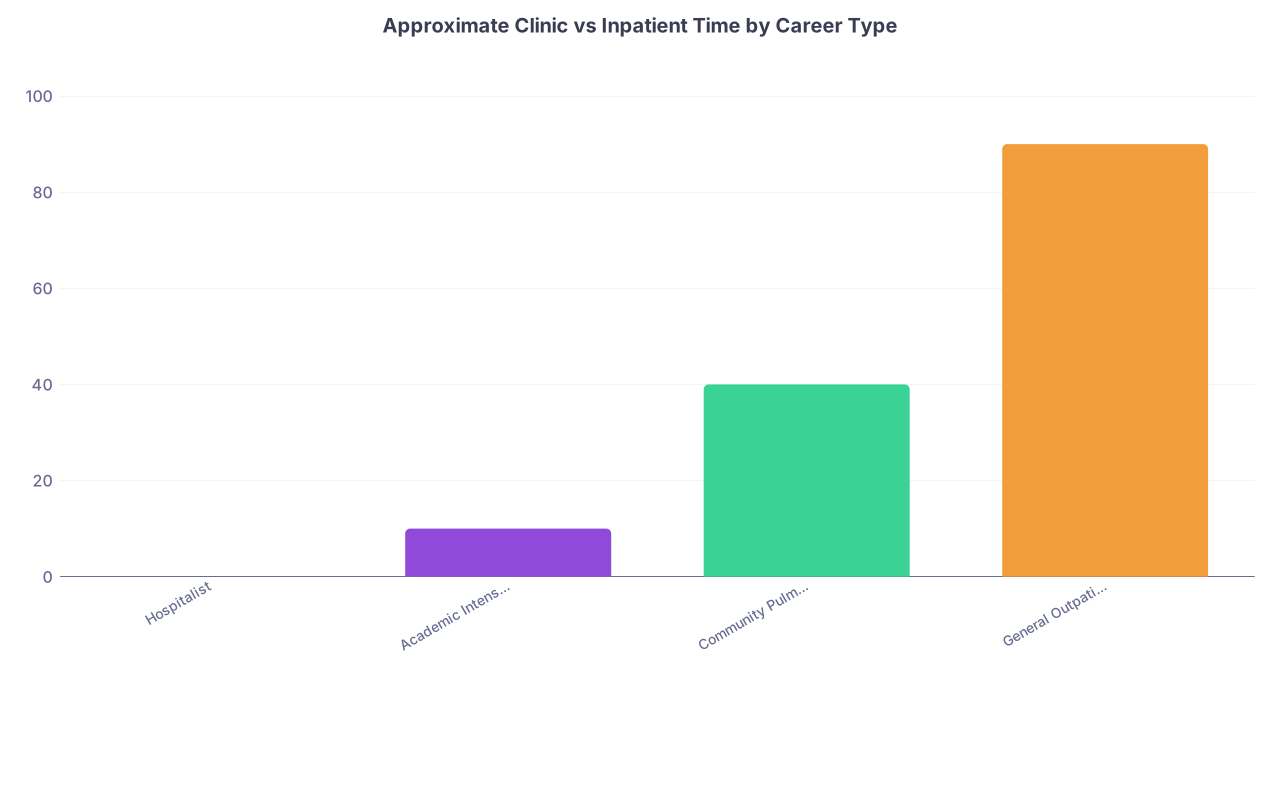
| Category | Value |
|---|---|
| Hospitalist | 0 |
| Academic Intensivist | 10 |
| Community Pulm/Crit | 40 |
| General Outpatient IM | 90 |
Very rough, but you get the idea.
- Hospitalist: essentially 0% clinic. Pure inpatient.
- Academic intensivist: maybe 5–20% clinic depending on the job. Some have almost none.
- Community pulm/crit: can be 40–60% clinic easily.
- General outpatient internist: clinic is your entire life.
If your internal monologue is, “If I have to do more than half-day clinic per week for the rest of my career, I’ll burn out,” then you should be actively steering toward:
- Hospitalist roles with ICU responsibility.
- Critical care–heavy faculty positions with minimal outpatient.
And you should choose a residency that makes those options realistic, not aspirational.

| Step | Description |
|---|---|
| Step 1 | IM Residency |
| Step 2 | Extra ICU Electives |
| Step 3 | Academic Intensivist |
| Step 4 | ICU Hospitalist Job |
| Step 5 | Standard IM Career |
| Step 6 | Love ICU? |
| Step 7 | Fellowship? |

Quick Reality Check: Common Misconceptions
Let me knock out a few persistent myths that confuse residents in your shoes.
“If I hate clinic, I should not do IM at all.”
- False. Plenty of hospitalists and intensivists essentially never touch clinic.
“Pulm/crit means I’ll just be in the ICU all day.”
- Also false. In many community jobs, you’ll have large pulmonary clinics. You need to choose ICU-heavy roles.
“Fancier program = better fit for critical care.”
- Not necessarily. What matters is ICU volume, autonomy, and culture. Some medium-name programs train incredible intensivists.
“Since I’m good at clinic, maybe I should just do outpatient even though I hate it.”
- Being good at something you dislike is how people quietly burn out in their 40s. Do not optimize for your attending’s compliments; optimize for your own 10-year sustainability.

Putting It All Together
If you’re in this spot right now—energized by ICU, drained by clinic—your job is not to force yourself to love outpatient care. Your job is to make smart structural choices:
Choose an IM residency with:
- Robust ICU experience.
- Reasonable, preferably block-structured clinic.
- A culture that respects inpatient- and critical-care–oriented careers.
Use residency to:
- Build ICU skills.
- Confirm whether you want fellowship or high-acuity hospitalist work.
- Become competent (not necessarily passionate) in clinic so you can pass boards and be employable, even if you never plan to be in a primary-care office.
And then build a career that matches who you are on your best MICU day, not who you are mid-afternoon in continuity clinic staring at another A1c of 9.5.
You do not need to love all of medicine equally. You just need to be honest about what energizes you and pick an environment that gives you more of that, not less.
With that sorted, you’ll survive clinic, thrive in the ICU, and walk out of residency with options that actually match the doctor you want to be. From there, the fun part starts: choosing between hospitalist and intensivist gigs that fight over you. But that is a problem for future you.