
Primary care residents do not scatter randomly across the map. They follow very predictable geographic patterns, and the numbers are blunt about it.
If you are choosing a primary care specialty—internal medicine, family medicine, pediatrics, or med-peds—your odds of matching in a given region are not just about your Step scores or letters. They are strongly tied to where you trained, where you have ties, and how realistic your understanding is of geographic “stickiness” in the Match.
Let me walk through what the data actually show, specialty by specialty, and what that means for your strategy.
The Big Picture: How “Sticky” Is Geography in the Match?
First, zoom out. Across all specialties, NRMP and AAMC data consistently show that:
- Around 45–55% of residents stay in the same state as their medical school.
- About 60–70% remain in the same broad U.S. Census region (Northeast, Midwest, South, West).
- Primary care specialties are usually more geographically sticky than the surgical and highly competitive fields.
The directional pattern is simple: the less competitive and more location-abundant a specialty is, the more freedom you technically have to move. But paradoxically, the more people actually stay. Family medicine is a clear example. People go into it for roots, proximity to family, and lifestyle. They do not generally roam the country hunting prestige.
To make this more concrete, here is a simplified, data-informed snapshot using typical ranges seen in NRMP/AAMC reports for primary care specialties.
| Specialty | Same State as Med School | Same Region as Med School |
|---|---|---|
| Internal Medicine | 45–55% | 65–75% |
| Family Medicine | 50–60% | 70–80% |
| Pediatrics | 45–55% | 65–75% |
| Med-Peds | 40–50% | 60–70% |
These are ranges, not exact single-year numbers, but the pattern is consistent over multiple Match cycles: primary care is heavily regional.
And yet applicants still routinely make the same mistakes:
- Overestimate their ability to “break into” a new region without any prior ties.
- Underestimate how much their home institution and region “pull” them.
- Ignore the mismatch between applicant density and positions in a region (huge in the Northeast and California).
Let’s drill down by specialty.
Internal Medicine: The Regional Gravity Well
Internal medicine (categorical) is the workhorse of residency training. It is also the most numerically robust specialty in the Match—tens of thousands of positions.
The idea that IM is “everywhere, so I can go anywhere” is only half true. Yes, positions are spread across all regions. But the applicant pool is not evenly distributed, and the geography of where people actually go is lopsided.
Using NRMP/AAMC trend data as a guide, a typical internal medicine cohort looks roughly like this:
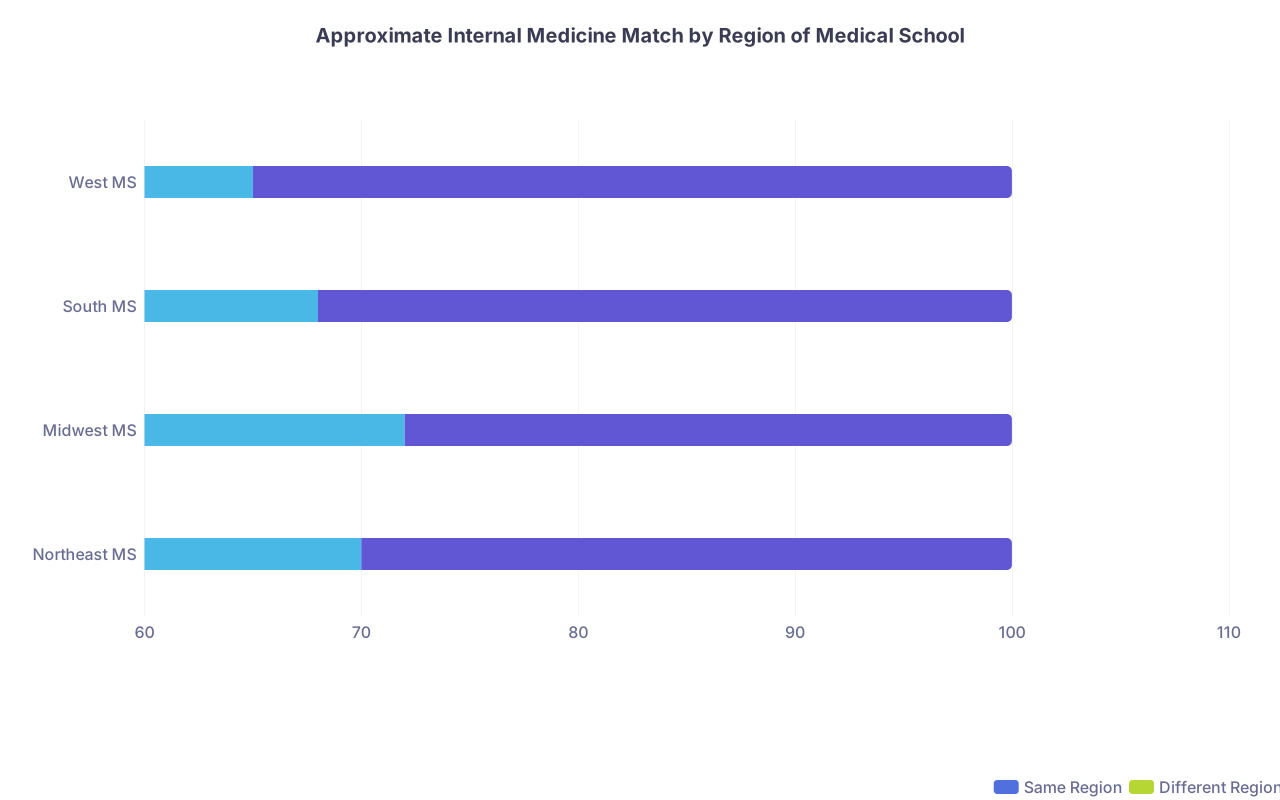
| Category | Same Region | Different Region |
|---|---|---|
| Northeast MS | 70 | 30 |
| Midwest MS | 72 | 28 |
| South MS | 68 | 32 |
| West MS | 65 | 35 |
Interpretation is straightforward: about two-thirds to three-quarters of IM residents stay in the same broad region as their med school.
Where IM Applicants Actually End Up
A few reliable patterns:
Northeast saturation.
The Northeast has a high concentration of medical schools and academic IM programs. It also has more applicants per slot. If you trained in the Midwest and want Boston, NYC, or Philly, you are swimming against applicant density and a strong local-preference bias. Programs can easily fill with people who trained nearby.Midwest: net importer in primary care.
Midwest programs—especially community and mid-tier academic IM—tend to be more open to out-of-region applicants. Lower cost of living and slightly less “must-have” brand appeal means they recruit from the coasts more often than the reverse.The South: plenty of positions, but regional preference.
Southern programs often have many IM slots, but a strong preference for applicants with regional ties or commitment, especially in smaller cities and rural-adjacent programs. I have seen applicants from New England match in Alabama or Mississippi, but almost always with a clear tie story.The West: bottleneck.
California in particular is a geographic bottleneck. Too many applicants, not enough slots. West Coast students (especially California) can disperse nationally. Non–West Coast students have a harder time moving in. This is one of the most consistent directional flows in the data.
Practical implications for IM
You are fighting three forces at once: region-of-origin bias, local med school pipelines, and regional applicant density.
If you want to change regions for IM:
- You need either strong performance (Step scores, grades, letters) or strong ties, preferably both.
- You should over-apply to that target region to counter the lower baseline probability.
- You should not ignore regions that are net importers (Midwest, parts of the South) if you value probability over prestige.
Family Medicine: The Most Locally Anchored
Family medicine is, by far, the most geographically “anchored” primary care specialty. The numbers are brutal about this.
Year after year, AAFP and NRMP reports show:
- More than half of FM residents train in the same state or adjacent state to where they went to medical school or grew up.
- Same-region match rates in FM are usually at the upper end among all specialties, often pushing toward the 75–80% band.
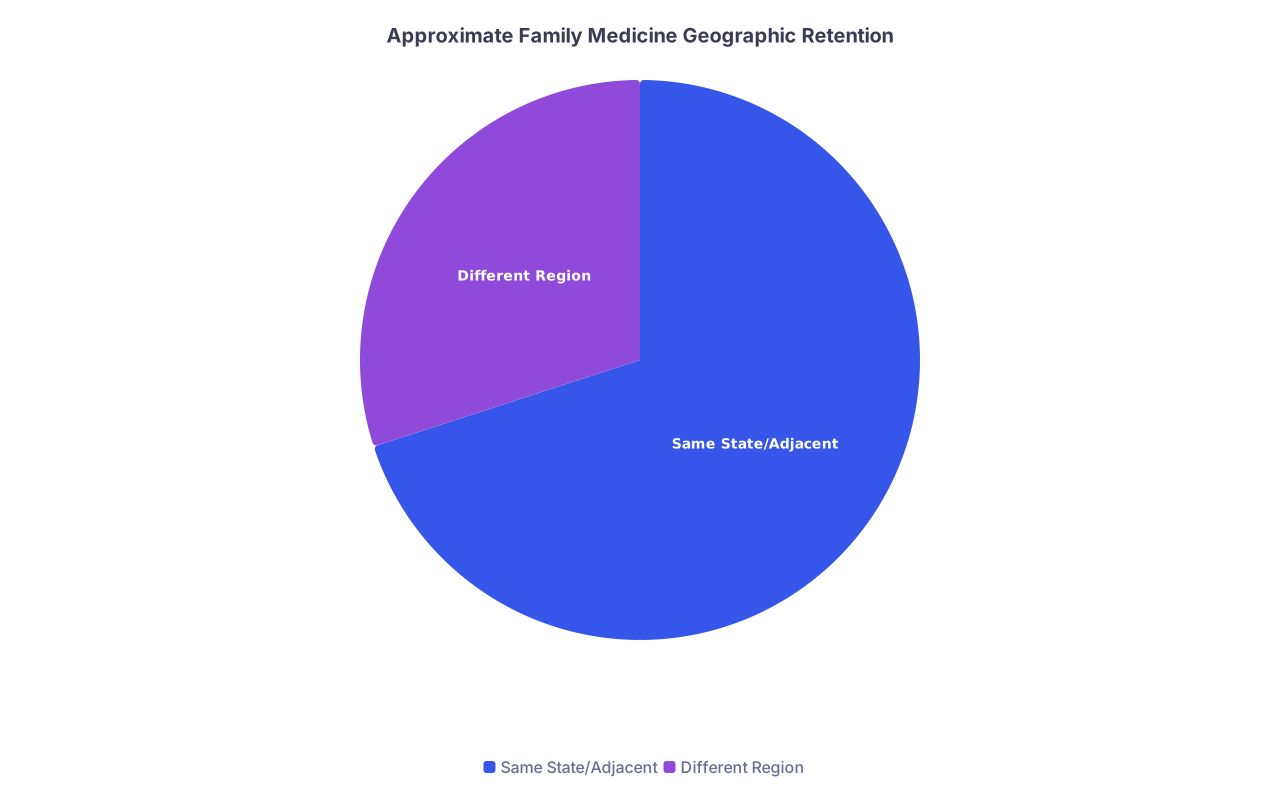
| Category | Value |
|---|---|
| Same State/Adjacent | 70 |
| Different Region | 30 |
Again, exact percentages vary by year and data source, but the direction is consistent: family medicine is local.
Why FM is so geographically sticky
Three main drivers:
Applicant motivation.
A large fraction of FM applicants pick the specialty for community roots, proximity to family, and long-term life plans. They are not chasing elite brands; they are chasing stability and geography. That self-selection shows up clearly in the match patterns.Program mission and recruitment behavior.
Many FM programs are explicitly mission-driven to serve local or regional populations. They prefer people who already understand the community and are likely to stay. I have sat in FM rank meetings where “local ties” carried more weight than an extra 10 points of Step 2 score.Distribution of programs.
FM has a high proportion of community, small-city, and rural programs. These are structurally dependent on local or regional applicants. A med student from San Francisco can match family med in rural Iowa, but it happens less often than the reverse.
Regional winners and losers in FM
If you simplify based on repeated patterns:
- Midwest and South: High density of FM programs, especially in smaller cities and rural settings. These regions are net exporters of FM-trained physicians to underserved areas but often net importers of applicants from nearby states.
- Northeast and West Coast: Fewer FM positions relative to applicant demand, especially if you include MD + DO + international grads. Urban coastal FM programs are disproportionately competitive because they combine geography plus lifestyle.
That is why someone from an East Coast MD school can match FM in the Midwest fairly easily. But the reverse—Midwest applicant aiming at a limited number of FM slots around Boston or San Francisco—is statistically rougher.
Strategic takeaways for FM
If you are aiming for family medicine:
- Staying in your region is the default outcome, not the backup plan.
- Moving to a high-demand urban coastal area from far away usually requires:
- Ties (family, previous residence, significant other).
- Electives or away rotations in-region.
- A clear narrative about long-term plans in that area.
- If you are flexible on geography, you will be in the strongest negotiating position of basically any specialty. A geographically flexible FM applicant can match very broadly.
Pediatrics: Academic Hubs and Regional Loyalty
Pediatrics sits somewhere between IM and FM in terms of geographic stickiness. It is moderately competitive overall, with a strong academic core clustered in major cities.
NRMP data over many cycles tell a similar story:
- Roughly half of pediatric residents match in the same state as their med school.
- Around two-thirds to three-quarters stay in the same region.
The more academic and subspecialty-heavy the program (think CHOP, Boston Children’s, Texas Children’s), the more national and international the applicant pool becomes. But the mid-tier and community pediatric programs remain regionally driven.
| Program Type | Geographic Draw |
|---|---|
| Top academic children’s hospitals | National / International |
| Large university-affiliated peds | Regional with national outliers |
| Community pediatrics programs | Mostly regional/local |
Where peds applicants actually go
There are a few consistent patterns:
Children’s hospitals as regional magnets.
Major children’s hospitals draw from multiple regions, but still show a bias toward their own region’s schools. Not because they cannot fill with outsiders, but because of existing pipelines and letters from known faculty.Regional training, national subspecialization.
Many pediatric residents train regionally but then move for fellowship. The geographic data for fellowship placement are more diffuse than for residency. If you plan PICU, heme/onc, or NICU, your big geographic move often happens at the fellowship stage, not residency.West Coast peds scarcity.
Same story as IM and FM: relatively fewer large pediatric programs in the West compared with applicant interest, especially in California. If you trained in the West, moving east is easier than moving in the opposite direction.
Med-Peds: Smaller Numbers, Sharper Patterns
Med-peds is numerically small, which exaggerates geographic patterns. A couple of dozen programs shifting their recruitment philosophy can move national percentages.
What actually happens:
- Many med-peds programs are at large academic centers in the Midwest and Northeast (Indiana, Cincinnati, Michigan, Minnesota, Case, etc.).
- Applicants tend to be more academically oriented, often with an interest in complex chronic disease, hospital medicine, or subspecialty care.
- Geographic patterns still exist, but because the applicant pool is smaller and more self-selected, you see more national mobility per individual than in FM.
If you mapped med-peds residents by where they went to medical school versus where they train, the lines would cluster around academic hubs rather than spreading evenly.
Applicant Density vs Position Density: The Real Constraint
You cannot talk about geographic match patterns without acknowledging the mismatch between where positions are and where applicants want to go.
Broad strokes from repeated NRMP and AAMC data:
- The Northeast and California: Very high density of medical students and residency applicants relative to available primary care positions.
- Large swaths of the Midwest and South: More balanced, sometimes even an excess of unfilled primary care positions, especially in FM.
Here is a stylized comparison for primary care residency slots per 100 graduating U.S. MD/DO students by region (rounded, illustrative, not exact figures):
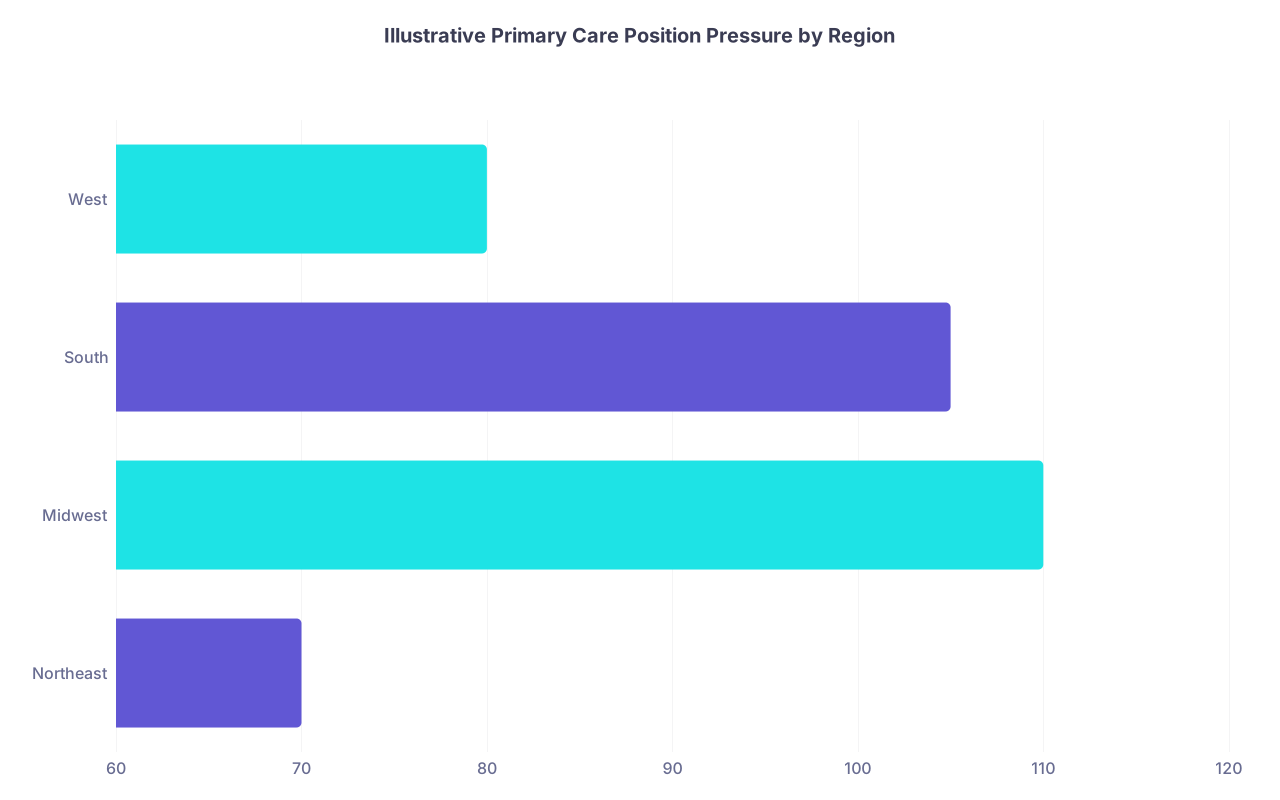
| Category | Value |
|---|---|
| Northeast | 70 |
| Midwest | 110 |
| South | 105 |
| West | 80 |
A value under 100 means more applicants than positions in-region; over 100 means more positions than local graduates.
This is why:
- An East Coast student matching primary care in the Midwest is common.
- A Midwest student matching primary care in the Northeast is possible, but statistically uphill, especially without ties.
- West Coast, especially California, behaves like the Northeast in this respect: high pressure, limited slots.
Ties, Name, and Scores: What Actually Moves the Needle
The question you care about is not the aggregate statistics; it is: Can I move where I want to go?
The data and real-world behavior line up around a few levers.
1. Geographic ties
Programs treat “ties” as a risk adjustment variable. Are you likely to stay? Do you understand the area? Will you be miserable in January in Minnesota if you grew up in Miami with no ties north of Atlanta?
Ties that actually matter:
- Grew up in the state or region.
- College in-region.
- Spouse/partner/family in the area.
- Prior work or military service in the region.
- Substantive away rotation or research year in-region.
Simply “liking the city” is weak evidence. Everyone likes Boston in June. Programs know this.
2. School brand and network
Applicants from schools with a long-standing pipeline to a region punch above their geographic weight. A midwestern student from a school that traditionally sends residents to New England programs will have an easier time moving there than someone from an unconnected school.
You can see this indirectly in program rosters: clusters of residents from the same few schools, often repeated over multiple years.
3. Performance metrics
In primary care, pure score-based competitiveness is less dominant than in dermatology or orthopedic surgery, but it still interacts with geography:
- For “destination” cities (Boston, NYC, San Francisco, Seattle, Denver, etc.), better metrics open doors, especially for out-of-region applicants.
- For programs in highly desirable locations, a 10–15 point Step 2 advantage over the program’s average will not erase an absence of ties, but it absolutely improves your odds of getting a look.
The important nuance: in many bread-and-butter FM and IM programs outside the high-demand cities, geography and fit will routinely outrank a marginal score difference.
How to Use Geographic Data to Build a Smarter Rank List
You cannot control regional applicant density or program bias toward local students. You can, however, design an application and rank strategy aligned with the actual data instead of wishful thinking.
Here is a compact framework, drawn from what I have seen working repeatedly:

| Step | Description |
|---|---|
| Step 1 | Identify Target Region |
| Step 2 | Apply Broadly in Region |
| Step 3 | Add Importer Regions |
| Step 4 | Increase Number of Applications |
| Step 5 | Standard Application Spread |
| Step 6 | Include Mix of Program Tiers |
| Step 7 | Build Rank List with 70-80 Percent in Realistic Regions |
| Step 8 | Do you have strong ties? |
| Step 9 | Region Highly Competitive? |
Applied specifically:
- If you have strong ties to a competitive region (e.g., grew up in NYC, med school in Boston), you can and should load your application and rank list heavily to that region. But still include some positions in net-importer regions as a safety valve.
- If you have no ties to a highly popular region, you must:
- Apply more broadly than your peers who are staying home.
- Include a substantial number of programs in regions that are historically more open to outsiders (Midwest, parts of the South, non-coastal West).
- Be honest about how many programs in your dream city are realistically within reach.
A useful rule of thumb I give primary care applicants:
- Aim for at least 70–80% of your rank list in regions where:
- You either have ties, or
- The programs are known net-importers of out-of-region residents.
The other 20–30% can be “reach” locations.
Looking Ahead: Turning Data into a Personal Map
Geographic match data do not care about your personal narrative. They are just patterns. But you can align your narrative with those patterns instead of fighting them.
The next step is not memorizing regional percentages. It is mapping your specific history and goals onto this framework:
- Where have you already created natural ties?
- Where are the applicant-to-position ratios in your favor?
- Which regions are you willing to consider but have not yet explored on your radar?
Once you overlay your own story on the national data, the vague question of “Where should I apply?” turns into something much sharper: a constrained optimization problem with known parameters.
With that clarity, your specialty decision in primary care becomes only the first step. The real leverage comes from how you align your geography, your performance, and your story with the invisible currents that actually move people in the Match. And once you have that map, then we can talk about targeting specific programs and tiers within those regions—but that is a conversation for another day.