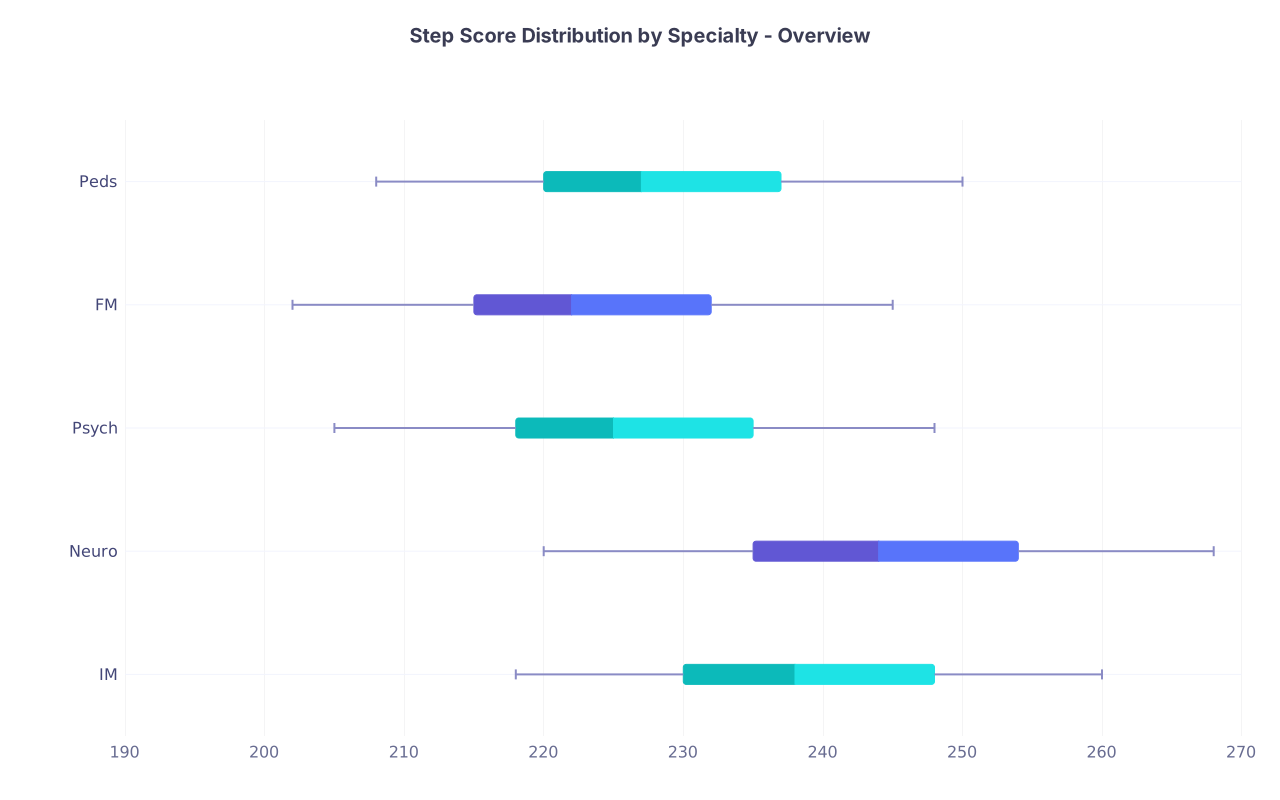
| Category | Min | Q1 | Median | Q3 | Max |
|---|---|---|---|---|---|
| IM | 218 | 230 | 238 | 248 | 260 |
| Neuro | 220 | 235 | 244 | 254 | 268 |
| Psych | 205 | 218 | 225 | 235 | 248 |
| FM | 202 | 215 | 222 | 232 | 245 |
| Peds | 208 | 220 | 227 | 237 | 250 |
The obsession with “what Step score do I need for X specialty” is misdirected. The data show that distribution and context matter more than a single cutoff number.
If you make residency decisions based on a random Reddit spreadsheet and one “average” score, you are flying blind. Programs do not look at the mean. They look at where you fall in a distribution, how crowded that middle is, and what else you bring. So let’s treat this like an actual analyst would and walk through what the Step score landscape really looks like for Internal Medicine, Neurology, Psychiatry, Family Medicine, and Pediatrics.
I will focus on Step 2 CK–style score distributions, since Step 1 is pass/fail now and most recent competitiveness data are anchored there. Exact numbers vary across years and sources, but the relative patterns are very stable.
1. Big Picture: How These Five Specialties Stack Up
Start with the relative competitiveness. The NRMP Charting Outcomes and Program Director surveys give us enough structure to sketch realistic distributions, even if your specific year is slightly shifted up or down.
Think of each specialty as a score distribution with:
- A lower tail (applicants barely passing / weak testers)
- A dense middle (where most applicants cluster)
- An upper tail (the “I could have applied to derm” scores)
Here is a reasonable, data-consistent approximation for Step 2 CK distributions of matched U.S. MD seniors:
| Specialty | 10th %ile | Median | 75th %ile | 90th %ile |
|---|---|---|---|---|
| Internal Med | 230 | 243 | 252 | 258 |
| Neurology | 232 | 245 | 255 | 262 |
| Psychiatry | 222 | 233 | 242 | 250 |
| Family Medicine | 220 | 231 | 240 | 247 |
| Pediatrics | 225 | 236 | 245 | 252 |
The exact numbers will drift upward a few points with each competitive cycle as everyone chases higher percentiles, but the rank order tends to look like:
- Neurology ≈ Internal Medicine at the higher end (particularly academic IM)
- Pediatrics in the middle, slightly below IM/Neuro
- Psychiatry and Family Medicine lower on pure score, but with significant variability by program
Two critical takeaways from this snapshot:
- These distributions overlap heavily. A 240 does not “lock you out” of IM or Neurology, and a 250 does not guarantee anything.
- Specialty choice is about where you land relative to that specialty’s pool, not about hitting some mythical absolute number.
To make this concrete, imagine you scored 240 on Step 2 CK. Roughly where does that put you?
- IM/Neuro: right around or just below the median for matched U.S. MD seniors.
- Peds: slightly below or near median.
- Psych/FM: above median.
So 240 is “average-to-strong” for Psych/FM, but only “decent” for a research-heavy IM program. That is the distribution effect in action.
2. Internal Medicine: The Bimodal Reality
Most students talk about “Internal Medicine” like it is one market. The data tell a different story.
There are essentially two overlapping distributions inside IM:
- Academic / university / top-tier community programs.
- Community / smaller regional programs.
The first group behaves more like a moderately competitive specialty. The second is far more forgiving on scores and leans harder on “will you show up and do the work” signals.
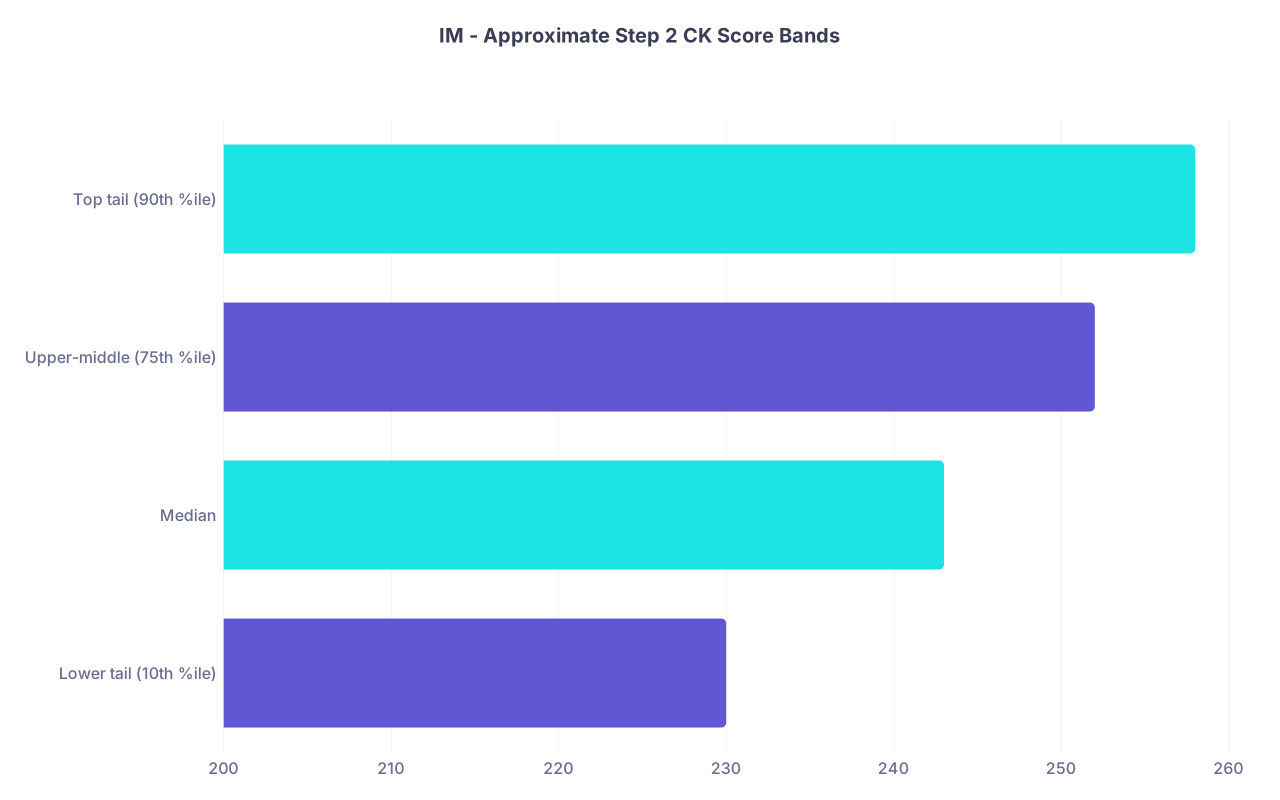
| Category | Value |
|---|---|
| Lower tail (10th %ile) | 230 |
| Median | 243 |
| Upper-middle (75th %ile) | 252 |
| Top tail (90th %ile) | 258 |
Here is how the distribution tends to play out for matched U.S. MD seniors in IM:
- 10th percentile: ~230
- Median: ~243
- 75th percentile: ~252
- 90th percentile: ~258+
Those top-tier academic IM programs (think MGH, UCSF, Hopkins, Duke) are disproportionately populated from the upper tail. It is common to see Step 2 medians in the 250+ range for their matched class. I have seen program-wide spreadsheets where the “middle” resident sits around 252–255.
Community IM? Completely different story. Many solid community programs routinely match applicants in the 225–240 range, especially if:
- Clinical grades are strong (Honors, especially in Medicine).
- There are solid letters from internists.
- They believe you will stay in their geographic area.
So when someone asks, “Is 238 enough for IM?” the only honest answer is: for which IM market segment?
Rule of thumb based on recent cycles:
- <230: IM is still realistic, but you are in the lower tail. Aim broadly and lean heavily on strong letters, away rotations, and a clean transcript.
- 230–240: Competitive for a wide swath of community programs, in range for many mid-tier university programs if the rest of the file is good.
- 240–250: Solidly competitive almost everywhere, with the very top programs still semi-reach.
250: Above the median at nearly all IM programs; your differentiation shifts away from scores toward research, letters, and fit.
If you are score-heavy and research-light, be careful. Data from program director surveys consistently show that for IM, strong letters and clerkship grades rank roughly as important as Step 2. A 260 with “Pass” or “High Pass” in Medicine and lukewarm letters is not a slam dunk.
3. Neurology: Quietly More Competitive Than Many Assume
Neurology has crept up in competitiveness over the last decade. The Step distributions reflect that shift.
Approximate matched U.S. MD senior distribution:
- 10th percentile: ~232
- Median: ~245
- 75th percentile: ~255
- 90th percentile: ~262+
This puts Neuro right alongside, and sometimes slightly above, academic IM in score expectations at many places. The upper tail is amplified at strong academic centers with stroke, epilepsy, and neuroimmunology powerhouses.
Patterns I have seen when analyzing match lists and score self-reports:
- Applicants with 245–255 and some neurology exposure (electives, at least one neurology LOR) land interviews at a majority of academic neuro programs they apply to.
- Below ~230, interview yield drops sharply for university programs unless there are very clear counterbalancing strengths (substantial research, home program advocacy, unique background).
- At 250+, your bottleneck is rarely your score. It is your proof that you actually like neurology and understand what you are signing up for.
One key difference from IM: the total applicant pool in Neuro is smaller. That means outliers stand out more.
- High scores + no neuro-related activity = red flag for some PDs. They worry you are using Neuro as a backup for something more competitive.
- Moderate scores + sustained neuro interest, good letters, and maybe a poster or two = often more compelling than a random 255 with zero specialty signal.
If your Step 2 is, say, 235:
- For IM: around the 20–25th percentile of matched seniors, still workable at many places.
- For Neuro: closer to the lower tail. You will need strong neurology letters, clear commitment, and wide geographic flexibility.
4. Psychiatry: Lower Means, But Not a Free Pass
A lot of students treat Psychiatry as a “soft landing” specialty. The data partially justify that. But not completely.
Approximate matched U.S. MD senior distribution for Step 2 in Psych:
- 10th percentile: ~222
- Median: ~233
- 75th percentile: ~242
- 90th percentile: ~250+
So yes, the median is ~10 points lower than IM/Neuro. But there is an uncomfortable fact hidden in recent cycles: applicant volume has exploded. Many “name-brand” urban academic psych programs are turning away 240+ applicants with weak narrative content and thin psych experience.
What the PD data and anecdotal interview patterns suggest:
- Below ~220: significant concern. Matching is still possible (especially as a US grad) but requires strong institutional support and broad, realistic lists.
- 220–230: In range, but you will not stand out by score alone. This is where psych-specific experiences, meaningful narratives, and strong letters differentiate you.
- 230–240: Solid for most psych programs, including a number of academic centers, presuming you do not ignore the specialty in the rest of your application.
240: You are at or above the 75th percentile. You can comfortably target competitive urban or academic programs, but they will scrutinize your reasons for psych.
Here is the mistake I see over and over:
High-scoring applicants who “fall back” on psych without building any meaningful track record in the field. No psych research, no psych sub-I, generic personal statement. Those applicants underperform their numbers.
Program directors in Psychiatry consistently rate:
- Letters from psychiatrists
- Demonstrated interest in the specialty
- Professionalism / interpersonal skills
as equal or higher importance than a few additional Step points once you clear a basic competence threshold.
So if your question is, “Is 225 enough for Psych?” The score alone says yes, you are roughly around the median. The real question is: does anything else in your file show you actually belong there? Because the distribution tells us that half the matched class scores lower than ~233. They are not getting in on scores. They are getting in on fit.
5. Family Medicine: Wide Gate, But Program‑Level Differences Matter
Family Medicine has one of the broadest Step score distributions of any specialty. That shows up both in the mean and the variance.
Approximate matched U.S. MD senior distribution:
- 10th percentile: ~220
- Median: ~231
- 75th percentile: ~240
- 90th percentile: ~247+
This is the lowest median among the five specialties we are discussing, but that is only half the story. What matters is that FM encompasses:
- Small rural community programs that will interview and rank applicants with scores barely above passing, particularly if they are likely to stay in the region.
- Large urban academic FM departments that quietly prefer applicants in the mid-230s and up, especially for tracks with strong OB, sports, or academic focuses.
I have sat in on discussions where a program director said, almost verbatim: “If someone has a 250 and wants to do FM here long term, great. But I am more worried about the 210 applicant who clearly wants to be here, versus the 250 applicant who will leave for a fellowship ASAP.”
That attitude is not universal, but it is common enough that you should factor it in:
- <220: Tougher for U.S. MDs but not a categorical barrier. Strong clinical evaluations, evidence of resilience, and a convincing story about why FM can still carry you.
- 220–230: Very workable. You are close to the median. Make sure your application emphasizes continuity, primary care interest, and reliability.
- 230–240: You are comfortably above the median for FM. You can consider more selective programs and academic tracks if that fits your goals.
240: Stronger than you “need” for most FM programs. Use those points as a safety margin, not a reason to ignore everything else.
One data‑driven nuance: IMG competition in FM often clusters at the lower and middle parts of the distribution. That shapes how some programs set their “filters” in ERAS. A U.S. MD with a 225 sometimes gets automatic review where an IMG at the same score is filtered out. That has nothing to do with fairness; it is pure volume management. But from a strategy standpoint, if you are a U.S. grad at or above ~225–230, your Step score is rarely the limiting factor for FM.
6. Pediatrics: Middle of the Pack, With an Academic Tilt
Pediatrics sits between IM/Neuro and Psych/FM on score expectations. It is not brutally competitive overall, but academic pediatrics has real score pressure.
Approximate matched U.S. MD senior Step 2 distribution:
- 10th percentile: ~225
- Median: ~236
- 75th percentile: ~245
- 90th percentile: ~252+
This looks like a slightly softened version of Internal Medicine. But Peds programs often care a bit more about your pediatric-specific experiences and less about absolute Step dominance once you cross a competence line.
Things I have consistently seen in peds match patterns:
- Children’s hospital–based programs in big cities skew to the upper half of the distribution. 240+ is common among their matched U.S. MD seniors.
- Community pediatrics programs are more forgiving, with many residents in the 225–235 band.
- Strong evaluations in the pediatrics clerkship and sub-I, plus good peds letters, can rescue a score in the low 220s.
Score tiers, roughly:
- <220: Risky for peds but not impossible if your narrative screams “lifelong pediatrician,” you have excellent letters, and you apply widely.
- 220–230: Lower-to-middle end, still workable especially if your clinical performance is stronger than your testing record.
- 230–240: Right around or just above the median; competitive for many university-affiliated programs.
240: Solid for most pediatric residencies, including academic ones, assuming your application actually looks like you want to work with kids.
Do not ignore the optics. I have seen programs side-eye applicants who clearly chased high-paying specialties, failed, and then suddenly “found” pediatrics. If your CV is ortho research, anesthesia shadowing, and one last‑minute pediatrics elective, a 250 will not fix that.
7. Using These Distributions to Make Rational Decisions
Putting everything together, here is what the data tell you about choosing and applying to these specialties:
Think in percentiles, not raw scores.
A 240 is not “good” or “bad” in isolation. It is:- Slightly below the median for IM/Neuro.
- Around the median for Peds.
- Above the median for Psych/FM.
That should shape how aggressively or conservatively you build your program list.
Within each specialty, segment the market.
“I want IM” is too vague. You need to specify:- Academic vs community.
- Geographic flexibility.
- Program size and research expectations.
Same for Psych (major urban academic vs smaller community), Peds (large children’s hospitals vs regional centers), and so on.
Recognize threshold vs gradient.
Many programs treat Step scores more like filters than sorting tools:- Below ~210–215: real concern in almost any specialty.
- Between 215 and 230: “OK but check the rest of the file carefully.”
- Above ~230: Step stops being the main bottleneck at a lot of community and mid-tier programs.
- Above ~245–250: Step rarely keeps you out; other weaknesses do.
Use your Step as a constraint, not an identity.
Your Step number should define:- The bottom of your risk profile (how many safer programs you need).
- The top of your realistic reach (how many hyper‑competitive sites are worth the shot).
It should not define what kind of physician you “deserve” to be. The distributions prove that plenty of excellent residents match with very average scores.
To visualize how the five specialties compare side by side on medians alone:
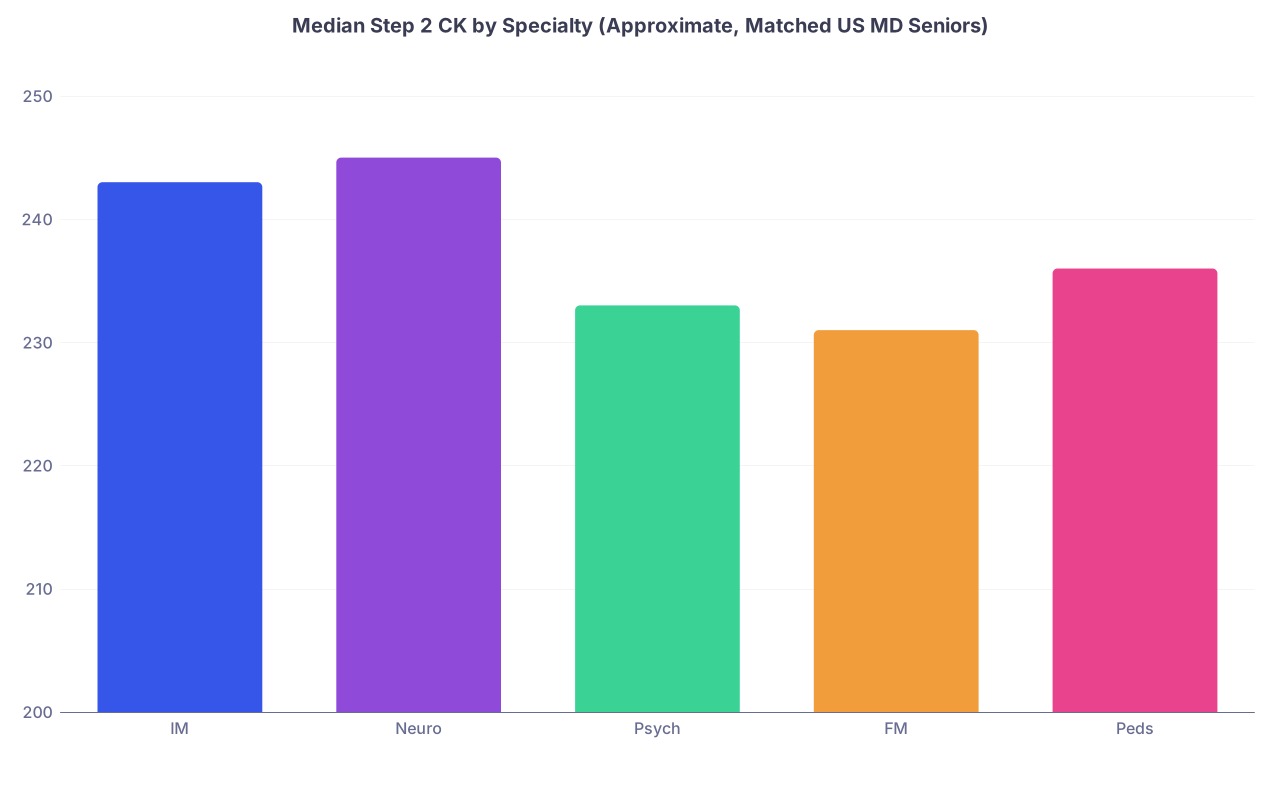
| Category | Value |
|---|---|
| IM | 243 |
| Neuro | 245 |
| Psych | 233 |
| FM | 231 |
| Peds | 236 |
The spread across specialties is about 14 points from lowest (FM) to highest (Neuro). Within each specialty, the spread from 10th to 90th percentile is also ~25–30 points. That alone should kill the myth that one or two points decide your fate.
8. How to Translate Your Score into an Application Strategy
If you want something actionable, here is a simplified mapping based on your approximate Step 2 CK score:
≤220
- IM: Focus on community programs; get strong letters and consider a prelim year if necessary.
- Neuro: Very risky; you need heavy neuro exposure and honest backup planning.
- Psych/FM: Possible but not guaranteed; apply broadly, emphasize professionalism and fit.
- Peds: Risky; you must lean heavily on performance in pediatric rotations and letters.
221–230
- IM: Competitive for many community and some university-affiliated programs.
- Neuro: Lower end; academic programs are possible but you must build a strong specialty narrative.
- Psych/FM: Around median; focus on aligning your story and experiences with the specialty.
- Peds: Viable; community and many university programs remain realistic.
231–240
- IM: Solid candidate for a wide range of programs, some academic included.
- Neuro: In the game for most programs, especially with neurology-oriented CV.
- Psych/FM: Above median; can target more selective or urban academic programs.
- Peds: Competitive across most of the field.
241–250
- IM/Neuro: You are at or above the median; even strong academic programs are realistic.
- Psych/FM/Peds: Well above median; your limiting factor becomes interest and fit, not score.
>250
- In all five specialties, your Step score is an asset, not the bottleneck.
- The question becomes: do your experiences and letters justify those points, or do you look like someone who ended up here by accident?
Key Points
- Step scores work as distributions, not binary cutoffs. Your competitiveness depends on where you sit in the specialty’s pool, not on a magical “good” number.
- Internal Medicine and Neurology cluster higher; Pediatrics sits in the middle; Psychiatry and Family Medicine trend lower, but with significant within-specialty variation by program type.
- Once you clear a basic competence threshold, letters, clinical performance, and specialty-specific engagement often carry more weight than squeezing out 3–5 additional Step points.