
The conventional wisdom that “FM hospitalists make much less than IM hospitalists” is exaggerated, outdated, and in many markets flat‑out wrong. The data show something more nuanced: training background shapes where you work and what options you have as a hospitalist far more than it dictates your paycheck.
If you are choosing between family medicine (FM) and internal medicine (IM) residency with an eye on a hospitalist career, you are not choosing between $180k vs $320k. You are choosing between different probability distributions of job types, schedules, and ceilings.
Let me walk through the numbers.
1. Big-picture: FM vs IM into hospitalist work
Start with supply and flow. Who actually becomes a hospitalist?
National workforce surveys (e.g., Society of Hospital Medicine [SHM], AAMC, and large group reports) consistently show:
- Hospitalists are still majority IM-trained.
- FM makes up a substantial but minority share, especially outside academic centers and in rural/community hospitals.
Reason: credentialing norms, comfort with complexity, and historical bias. Many hospital bylaws were written in an era where “adult inpatient medicine = IM.” A lot of those rules still exist.
Broad, reasonable ballpark distributions (adult hospitalists only, excluding pediatric hospitalists):
- IM background: roughly 70–80 %
- FM background: roughly 15–25 %
- Other (med-peds, neuro, subspecialty moonlighters): the remainder
Those ratios skew even harder toward IM at:
- Tertiary/quaternary referral centers
- Academic medical centers
- Hospitals with large resident teams
FM is much more prevalent as a hospitalist background in:
- Small community hospitals
- Rural or critical access hospitals
- Health systems that use FM as “full spectrum” docs (clinic + inpatient + sometimes OB)
So even before talking about income, the data say: if you want maximum hospitalist job flexibility, especially in urban/academic environments, IM gives you a larger feasible set.
2. Income: FM vs IM hospitalist compensation
You care about the number on the contract. Fine. Let’s quantify it.
Sources to triangulate:
- MGMA, AMGA, and SHM compensation reports
- Large staffing groups (Sound, SCP, TeamHealth, Envision, etc.)
- Public job postings with listed salary ranges
- Academic vs community salary surveys
Numbers vary regionally, but after adjusting for outliers, the signal is consistent.
For adult hospitalists (full-time, 7-on/7-off or equivalent, non-academic community setting, no intensivist role), realistic 2024-ish ranges:
- IM-trained hospitalist:
- Typical base + wRVU/bonus total: $260,000–$330,000
- Rural high-paying outliers: $340,000–$380,000
- FM-trained hospitalist:
- Typical base + wRVU/bonus total: $250,000–$320,000
- Rural high-paying outliers: $330,000–$370,000
The overlap is enormous. When you filter by actual job ads rather than anecdotes on Reddit, you see plenty of FM and IM postings at essentially identical pay within the same system.
The persistent myth that FM hospitalists are paid like outpatient FM ($220k) while IM hospitalists get $300k simply does not hold up as a general rule. What actually happens is more subtle:
- In health systems that pay all hospitalists on one grid, FM vs IM makes little or no difference.
- In systems with legacy differential pay scales, IM sometimes gets a 5–10 % edge in base.
- The big differences (±$50–70k) usually track with:
- Nocturnist vs day
- Academic vs community
- High-intensity vs low-intensity service
- Geographic desirability
To make this concrete, here is a simplified comparison based on aggregated survey + job-board data:
| Background | Academic Hospitalist (urban) | Community Hospitalist (urban/suburban) | Rural Hospitalist (community) |
|---|---|---|---|
| IM | $210k–$260k | $260k–$320k | $300k–$360k |
| FM | $200k–$250k | $250k–$310k | $290k–$350k |
The pattern: within any column, the spread between FM and IM is on the order of $10k–$15k, not $80k. In some cases, there is literally no difference; the system simply lists “hospitalist – MD/DO, board certified in IM or FM.”
The much bigger effect is practice setting.
To show that more clearly:
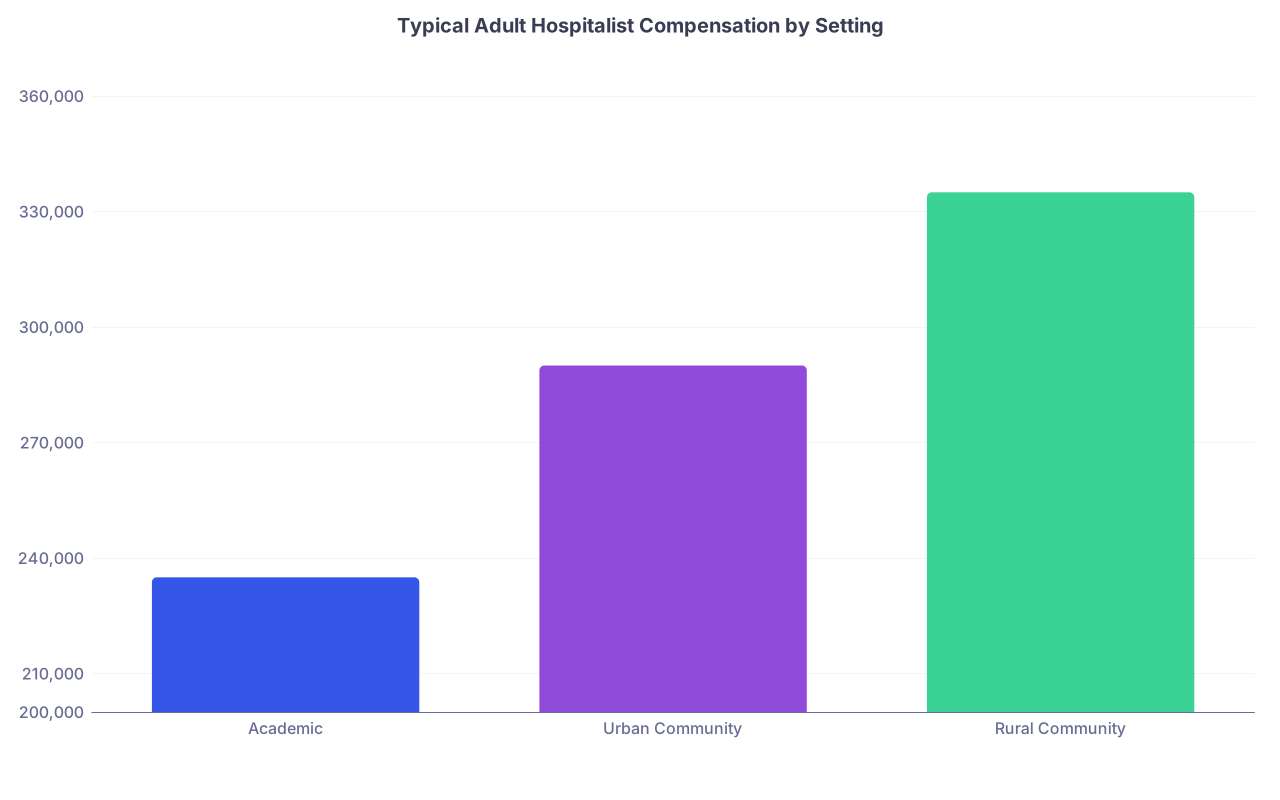
| Category | Value |
|---|---|
| Academic | 235000 |
| Urban Community | 290000 |
| Rural Community | 335000 |
Training background explains a modest slice of the compensation variance. Setting explains far more.
3. Practice setting access: what FM vs IM actually buys you
Here is where the divergence is real. If you do FM and want to be a pure adult hospitalist, your job map is simply more constrained in certain geographies and systems.
Academic medical centers
If you want:
- University hospital
- Resident teaching
- Tertiary/quaternary referral center
- Complex subspecialty-heavy case mix
Then IM is the default and, in many places, the only accepted background.
Typical credential rule I have seen in bylaws: “Hospitalist physicians must be ABIM-certified or eligible in Internal Medicine.” Occasionally “or Med-Peds.” FM is often excluded.
In the data:
- Academic centers: IM accounts for >90 % of adult hospitalist positions.
- FM hospitalists in academic settings exist, but often:
- In satellite community campuses
- On non-teaching services
- In health systems that are less rigid about historical divisions
That academic/non-academic divide carries pay consequences (see earlier table). Academic hospitalist roles routinely underpay relative to community by $40–70k, but offer other trade-offs: lifestyle, schedule predictability, teaching, location in major cities.
Urban and suburban community hospitals
This is where the lines blur.
Large non-academic systems (HCA, Ascension, Tenet, etc.) and private groups running hospitalist services in metro/suburban hospitals often take:
- IM, FM, Med-Peds, DO or MD – as long as you are board certified and comfortable with adult inpatients.
Internal credentialing committees may still favor IM for ICU co-management or for higher-acuity “stepdown/ICU-lite” services. But I have repeatedly seen FM and IM hospitalists on the same team, same schedule, same pay structure.
The constraint: sometimes FM docs are not credentialed to manage certain ICUs or high-acuity units, especially without prior hospitalist experience. That can limit:
- Extra pay for ICU coverage
- Ability to pick up lucrative moonlighting within the same system
But for a straightforward floor-based hospitalist role, FM is very often acceptable.
Rural and critical access hospitals
At the rural end of the spectrum, the market cares far more about “can you cover our hospital and maybe some clinic” than “are you ABIM vs ABFM.”
Here:
- FM often has more leverage because you can credibly say:
- “I can help with inpatient, ED fast track, outpatient clinic, and maybe low-risk OB.”
- Systems that still run a traditional “full-spectrum” model (clinic + inpatient + maybe OB and nursing home) often prefer FM over IM.
Income spreads here are wide because of isolation, recruitment difficulty, and call intensity. But again, that differential does not track cleanly with FM vs IM. It tracks with how many hats you wear.
4. Work scope: adult-only vs full-spectrum and the FM hedge
Another crucial difference that never shows up in the simple “FM vs IM pay” debate: optionality.
IM hospitalist = adult-only by design. Period. You cannot pivot into peds or OB because of training gaps and credential limitations.
FM hospitalist = you may start in primarily adult inpatient work, but you retain:
- Ability to take outpatient FM roles (adult + peds) later
- Eligibility for smaller hospitals that want a blend of clinic and inpatient
- In some geographies, the chance to incorporate procedures, OB, or ED shifts
Career data show a non-trivial percentage of hospitalists burn out or shift roles within 5–10 years. Anecdotally, I have seen plenty of people go:
- IM → outpatient IM, geriatrics focus, or admin
- FM → split practice (clinic + 0.3–0.5 FTE hospital), or full outpatient, or urgent care
The FM training gives you more credible options in pediatrics and full-spectrum community roles. That does not change your early hospitalist pay much. It changes the shape of your career trajectory.
5. Scheduling, shifts, and intensity differences
Here is where perception biases creep in.
In many mixed-specialty hospitals, the distribution often looks like this:
IM-trained hospitalists: more likely to:
- Work on higher-acuity adult floors
- Cover stepdown or limited ICU
- Serve as admitting doc from the ED
- Be tapped as “lead” or “chief” hospitalist earlier
FM-trained hospitalists: more likely to:
- Work on lower-acuity floors
- Split between inpatient and clinic in smaller markets
- Be shunted away from the sickest ICU cases, especially early on
Do systems mandate this? Not always. But hiring patterns and informal bias push the averages this way.
In pay terms, this can show up as:
- Extra stipend for ICU nights that IM get offered more frequently
- Leadership stipends for medical director roles that skew IM because of academic linkages or perceived clinical depth
Those stipends may run $20–60k on top of base, which can widen the IM advantage in specific settings. But again, that is a subset of jobs, not the entire market.
6. Income ceilings, subspecialty doors, and long-term options
If your question is purely: “What is my maximal lifetime earning potential if I start as a hospitalist and later pivot?” then IM usually wins, for structural reasons:
- Subspecialty fellowships: Cards, GI, Heme/Onc, Pulm/Crit, etc. – overwhelmingly IM pipelines.
- High-earning procedures: Many are tied to these subspecialties.
- Academic leadership roles in hospital medicine often grow out of IM departments with fellowships and grant structures.
The income ladder looks like this:
- Starting hospitalist (IM or FM) in community: mid-to-high $200s
- Hospitalist director / section chief: often $300–$400k in some systems
- Procedural subspecialist (GI, cards, etc.): median $450k–$700k+ depending on field and location
FM does not close those doors; they were never open there. FM has its own subspecialty world (sports, palliative, geriatrics, OB, etc.), but the super-high-earning inpatient subspecialties route through IM.
So if your medium- to long-term plan is:
- “Do 3–5 years of hospitalist, then cards or GI.”
You must do IM. That is not negotiable.
If your long-term plan is unknown, the data suggest:
- A significant share of hospitalists leave pure hospital medicine or scale back hours by years 7–10.
- Having more viable outpatient and full-spectrum options (FM) is a legitimate hedge against burnout.
- Having more fellowships and subspecialty ladders (IM) is a different kind of hedge.
Both are rational, but in different directions.
7. Where exactly does FM get boxed out?
Let me be concrete about scenarios where FM vs IM makes a hard difference.
You are FM and want:
- Pure nocturnist role at a tertiary academic center with residents, open ICU, and high acuity.
- Hospitalist position at a big-name academic IM department (think: major university flagship hospital).
- Significant research time or funded academic track inside hospital medicine.
In many institutions, you are simply not eligible or are at a strong disadvantage. Their ads say “ABIM-certified in Internal Medicine” and they enforce it.
On the other hand, you are FM and want:
- 7-on/7-off adult hospitalist job in a 150–300 bed community hospital in the Midwest, South, or Mountain West.
- Mix of clinic and hospital coverage in a small city where they are desperate for generalists.
- A rural critical access hospital role with excellent pay and broad scope.
You will find that FM is very acceptable and often preferred. Some of the highest offers I have seen in those settings were to FM-trained physicians who were willing to do a bit of everything.
Here is a simple structural comparison:
| Setting / Feature | IM Background | FM Background |
|---|---|---|
| Academic tertiary hospitalist | High access | Low access |
| Urban community adult hospitalist | High access | Moderate-high |
| Rural community / critical access | High access | High access |
| Mixed clinic + hospital roles | Moderate | High |
| Future subspecialty fellowship options | High | Very low |
Pay follows access. If you restrict yourself to academic jobs, IM and FM both earn less in absolute terms, but FM may be partially locked out. If you open yourself to rural, both can earn high, but FM often has a broader job set.
8. Representative real-world patterns
Let me sketch three very typical trajectories I have seen multiple times. Not hypotheticals; this mirrors actual CVs.
Case 1: IM hospitalist, academic → subspecialty
- IM residency at a university program.
- Hospitalist at same institution: academic track, $230k, strong teaching load, moderate nights.
- After 3 years, matched into GI fellowship.
- Fellowship then GI attending in same system: comp roughly triples compared to original hospitalist salary.
FM could not replicate this path because GI fellowship entry flows through IM (or peds for pediatric GI).
Case 2: FM resident → community hospitalist
- FM residency in a community program with strong inpatient exposure.
- Hired by a 250-bed community hospital in the South as adult hospitalist: $285k, 7-on/7-off.
- Works 4–5 years; then:
- Moves to same system’s outpatient clinic, mostly adults but some kids, salary ~ $250k, more regular hours.
During those 4–5 years, the FM and IM hospitalists at that site are essentially indistinguishable in salary or schedule. Background matters less than willingness to do nights and weekends.
Case 3: FM full-spectrum → rural hybrid role
- FM residency with OB experience.
- Hired by a critical access hospital in the Midwest: 0.5 FTE inpatient (hospitalist service + ED backup), 0.5 FTE clinic + some OB.
- Total compensation: $330–360k, housing stipend, loan repayment.
This job would basically never go to IM. They want someone who can handle newborns, low-risk deliveries, clinic panels, and adult inpatient.
9. Strategic choice: FM vs IM if hospitalist is your target
Let me strip this down to decision points, because you are likely trying to choose a residency path.
Choose IM for hospitalist work if:
- You want maximal flexibility across:
- Academic vs community
- Urban vs rural
- ICU / higher-acuity roles
- You are seriously considering an IM subspecialty fellowship later.
- You want to keep doors open at big-name academic centers and high-prestige hospitals.
- You are drawn to complex adult inpatient medicine and do not care about peds or OB.
Choose FM for hospitalist work if:
- You are comfortable restricting yourself mainly to:
- Community hospitals
- Rural/critical access hospitals
- Systems that explicitly hire FM hospitalists
- You like the hedge of having a very credible outpatient, urgent care, or full-spectrum option if you bail out of hospitalist work later.
- You are interested in small-town or rural practice where FM is king and hospital work is just one component.
- You are not chasing IM subspecialties and you are fine not working in the main academic tertiary center.
From a pure income statistics perspective, the expected early-career compensation as a hospitalist is surprisingly similar. The distributions overlap heavily.
From a practice setting perspective, IM wins breadth in academic and urban adult-only environments; FM wins breadth in full-spectrum and rural settings.
10. The bottom line: what the data actually say
Summarize it in hard terms.
- Median community hospitalist pay: roughly the same band ($260k–$320k) for both FM and IM, with a small typical IM edge when both are hired for identical roles in the same system.
- Income variance: mostly driven by setting (academic vs community vs rural) and night/ICU duties, not your residency letters.
- Practice access: heavily IM-skewed in academic and tertiary centers; mixed in urban community hospitals; equal or FM-favored in rural/full-spectrum environments.
- Long-term upside: higher for IM if you count subspecialty and academic ladders; more flexible sideways for FM if you want to exit hospitalist work into clinics, urgent care, or full-spectrum roles.
If your picture of “hospitalist after FM vs IM” is still colored by decades-old stories of FM earning $180k and IM earning $300k, discard it. The market corrected a long time ago. Now you are mostly choosing where you will be allowed to practice and how constrained your future pivot options will be.
With that clarified, your next step is not another Reddit thread. It is to pull the job postings for three cities and three rural regions you might actually live in, filter for “FM or IM – hospitalist,” and see what the offers look like. That is where the true signal lives, and that is where your real residency decision should be anchored.