
Most “categorical IM” programs are quietly running two residencies under one roof – and you need to know which one you’re actually signing up for.
Let me be blunt: if you want to be a hospitalist and you treat all internal medicine programs as interchangeable “IM = hospitalist gateway,” you will get burned. Some programs are basically hospitalist factories with a fig-leaf of continuity clinic. Others are de facto fellowship pipelines where hospitalist training is an afterthought, no matter how many times they say “we love hospitalists” on interview day.
You need to distinguish general IM from hospitalist‑focused IM tracks. And not just “does this program produce hospitalists,” but: how intentionally is it designed for hospitalist work, what trade‑offs you’re making, and how to compare one hospitalist‑focused track to another.
Let me break this down specifically.
1. What Actually Counts as a “Hospitalist‑Focused” IM Track?
Most programs will say they support hospitalist careers. That is cheap. I am talking about something more concrete: structural, curricular, and pathway‑level differences.
At minimum, a true hospitalist‑focused track has three features:
- A defined pathway or track with explicit criteria.
- Deliberate inpatient‑oriented curriculum (electives, didactics, QI, leadership).
- Measurable outcomes: a significant proportion of graduates going directly to hospitalist jobs in decent systems.
Inside that, you will see several flavors:
- Dedicated “Hospitalist Track” within categorical IM.
- “General Internal Medicine / Hospital Medicine Pathway.”
- “Academic Hospitalist Pathway.”
- “Medical Education / Hospitalist Leadership Track” with heavy inpatient emphasis.
The label is less important than the structure. Let’s talk structure.
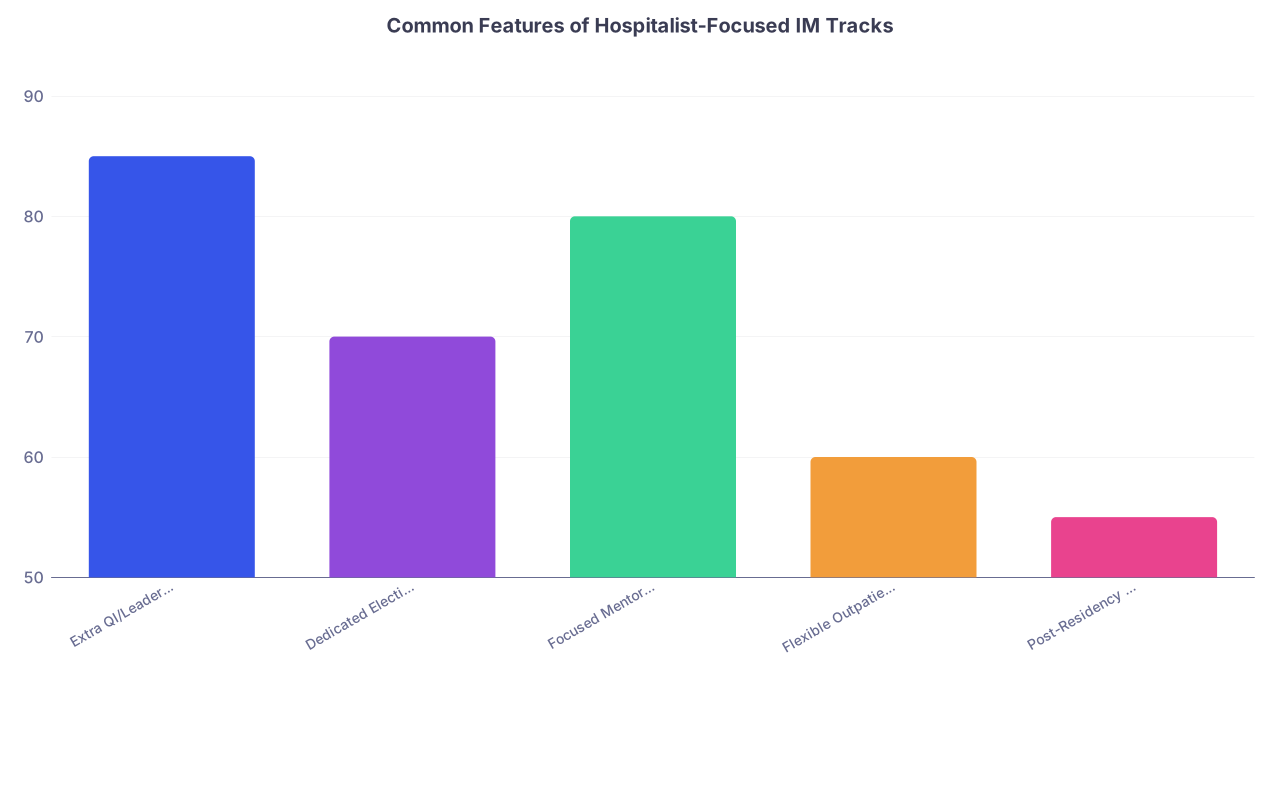
| Category | Value |
|---|---|
| Extra QI/Leadership | 85 |
| Dedicated Electives | 70 |
| Focused Mentorship | 80 |
| Flexible Outpatient Req | 60 |
| Post-Residency Job Pipeline | 55 |
Those percentages are roughly what I see when I review program materials and talk to leadership. Some talk a big game but have very little built.
Key point: a “hospitalist track” that is just a lunch lecture series and a certificate at graduation is lipstick on a categorical pig. You want concrete, schedule‑level differences.
2. The Core Question: Is the Culture Hospitalist‑Friendly or Fellowship‑Obsessed?
Before you chase fancy track brochures, you need to read the culture. I have seen highly marketed hospitalist tracks buried in programs where anyone not going to cards/GI/onc is treated as “non‑traditional.”
You can usually size this up quickly with a few targeted questions and some data.
A. Ask the graduation outcomes question properly
You do not ask: “Do your residents get hospitalist jobs?” Everyone will say yes. Instead:
- “For the last 3 graduating classes, roughly what percentage went:
– Directly into hospitalist roles
– Directly into subspecialty fellowship
– Other (primary care, industry, chief year, etc.)?”
If they cannot give you numbers, that is a red flag. If the answer is basically “80–90% fellowship” and they spin that as a positive for you, understand what you are walking into.
B. Look at who gets attention and airtime
On interview day and on the website:
- Are recent chief residents now hospitalists, or almost all fellows?
- Do they highlight “Our residents matched: Cards at X, GI at Y, Heme/Onc at Z” and barely mention hospitalists?
- Are there named hospitalist faculty in leadership (APD for Hospital Medicine Track, Director of Hospital Medicine Education, etc.)?
Programs that genuinely care about hospitalist training will put hospitalist graduates front and center. You will see alumni listed with “Hospitalist – Kaiser San Diego,” “Academic hospitalist – University of Colorado,” “Nocturnist – Community Hospital in Ohio,” and so on.
C. Listen to resident language during breaks
This is where you get the real story. I have heard everything from:
- “Honestly, if you tell them you want to be a hospitalist, they kind of stop pushing you academically.”
- To: “Most of us plan hospitalist careers. They help with negotiations, job search, even reviewing contracts.”
You want the second environment, not the first.
3. Structural Markers of a Real Hospitalist‑Focused Track
Now we get concrete. When a program says they have a hospitalist track, I go hunting for five structural markers.
1. Longitudinal Hospitalist Mentorship
Is there a named person or small group who:
- Meets with you at least twice a year to talk hospitalist career planning.
- Reviews your CV from a hospitalist employer’s perspective.
- Guides you toward QI/operations projects that actually matter for hospitalist interviews.
If the answer is “you can talk with any of our hospitalists” without structure, that is weaker. Nice, but not a track.
2. Distinct Elective Options and Requirements
Hospitalist work is not just “more wards.” It is systems, flow, complex acute care, and efficiency. High‑yield electives and experiences:
- Dedicated “Hospital Medicine” elective or sub‑I under the hospitalist group rather than general wards.
- Night float or nocturnist shadowing electives with debriefs on triage, cross‑cover, rapid response.
- Bed management/throughput or “operations” elective embedded with the hospital’s throughput team.
- Palliative care, medical consults, perioperative medicine (enormous for hospitalists).
- QI/Patient safety rotation with a deliverable project.
Ask explicitly: “What rotations are unique to the hospitalist track versus standard categorical residents?”
3. QI / Systems / Leadership Built In
Modern hospitalist jobs expect:
- QI participation.
- Committee work.
- Basic comfort with metrics, LOS, readmissions, throughput.
You want a track that:
- Requires or strongly supports ONE significant QI or systems project tied to hospital medicine.
- Has didactics in:
– Clinical documentation and coding basics.
– Discharge efficiency, handoff quality.
– Sepsis pathways, order sets, standardization.
If they talk generically about “everyone does QI” without naming examples involving hospitalists, the track is probably thin.
4. Flexed Outpatient Requirements
This is controversial, but I will be honest: a serious hospitalist‑focused track often slightly reduces longitudinal clinic in PGY‑2/3 to open space for inpatient‑heavy experiences.
You are still an internist. You still need outpatient competence. But a week‑a‑month continuity clinic model is sometimes replaced with:
- 2 weeks of clinic blocks interspersed with inpatient blocks.
- Or fewer continuity clinics in senior years offset by more consult/ED triage/hospitalist electives.
You want to know exactly what changes. Not vague “more inpatient exposure.”
5. Formalized Career Support and Pipelines
The best hospitalist tracks I have seen offer:
- CV and cover letter workshops focused on hospitalist applications.
- Panels with local and national hospitalist groups (Sound, SHM, academic hospitalists).
- Early introductions to employers that historically hire from the program.
Ask: “Do you track where your hospitalist graduates go, and do you have standing relationships with any hospitalist groups?”
If they say, “Residents just apply widely and figure it out,” that is fine, but a true track usually has more structure.
4. Comparing Hospitalist‑Focused Tracks: What Actually Matters
Different programs will package things differently. To compare them intelligently, boil it down to a few dimensions.
| Factor | Why It Matters |
|---|---|
| Percent grads to hospitalist roles | Shows real culture and track impact |
| Track-specific rotations | Determines how different your training actually is |
| Hospitalist-focused mentorship | Critical for projects, letters, job search |
| QI/operations opportunities | Huge for academic and leadership roles |
| Post-residency hospitalist placement | Indicates reputation with employers |
A. Outcome Metrics
If a program runs a “hospitalist track” but still sends 70–80% of residents to subspecialty fellowships, that is not automatically bad. But you should ask:
- “Of residents who enter the hospitalist track, how many:
– End up as hospitalists vs. change their mind to fellowship?
– Get hospitalist jobs aligned with their preferences (region, schedule, academic vs community)?”
A strong track will have:
- A sizable group of residents selecting it (not just 1–2 token people).
- High success in getting graduates decent first jobs, often in the same health system.
B. Schedule Reality vs Marketing
You want to see actual sample schedules, not a glossy paragraph. In particular:
- How many months of wards per year?
- Are there extra senior ward months in PGY‑3 for hospitalist track residents?
- How much ICU time, and is any of it “hospitalist‑style” open ICU vs closed intensivist model only?
- How many elective blocks can be directed toward hospitalist‑relevant things?
If Program A gives you 2 extra blocks of inpatient‑focused electives and Program B just slaps a “hospitalist” label on your standard senior ward months, they are not equivalent.
C. Academic vs Community Tilt
You need to decide if you want to be:
- A pure clinical hospitalist (high volume, focus on efficiency, less research/teaching).
- An academic hospitalist (teaching residents/students, QI, maybe scholarly work).
- A hybrid.
Academic tracks will emphasize:
- Teaching skills.
- Scholarship in QI/education.
- Conferences (SHM, regional meetings).
Community‑oriented tracks may give you:
- More exposure to high‑throughput, lower‑resource settings.
- Realistic workflow: 16–20 patients per day, minimal trainees, heavy dispo pressure.
Ask where their hospitalist graduates are actually working. The track’s hidden bias will show up in that list.
D. Procedural vs Non‑Procedural Orientation
Some hospital medicine jobs still involve:
- Central lines, paracenteses, thoracenteses, sometimes intubations.
- Others have none – all procedures are farmed out.
If you want procedural comfort, compare:
- Procedure rotations (procedure service, ICU exposure where residents actually perform procedures).
- Dedicated ultrasound training (POCUS) with credentialing pathways.
- Hospitalist‑led procedure services you can join in PGY‑3.
Many programs say “our residents get procedures in the ICU” but then you discover fellows do almost everything. Do not rely on slogans. Ask current residents plainly: “As a senior, how many lines/taps are you actually doing, if you want them?”
5. How To Interrogate Programs Without Sounding Like an Interrogator
You do not need to grill people aggressively, but you do need to be very specific. Here is how I would approach it.
Ask program leadership
You can phrase things like this:
- “Can you walk me through what is concretely different for a resident who enrolls in your hospitalist track versus a standard categorical resident?”
- “Are there any specific rotations or experiences that only hospitalist track residents do?”
- “Do hospitalist‑track residents have protected time for a QI or systems project?”
- “Is there a dedicated hospitalist faculty member who meets with track residents on a set schedule?”
Watch for vague answers that sound like: “Our residents can pursue hospitalist interests through our broad range of electives.” That is generic. You want specifics.
Ask residents currently in the track
This is honestly the most important data point. Sample questions:
- “What did you actually have to change on your schedule when you joined the track?”
- “Does the track give you any advantage in getting a job, or was that mostly on you?”
- “If you could go back, would you still choose the track or just do categorical?”
- “What are the downsides? Less flexibility? Fewer chances to explore other fields?”
Residents are usually very honest if you ask one‑on‑one outside of formal presentations.
6. Hidden Trade‑Offs You Need to Be Aware Of
Hospitalist‑focused training is not a free lunch. There are trade‑offs, some obvious, some subtle.
Trade‑Off 1: Narrowing too early
Plenty of MS4s swear they want to be hospitalists forever, then change their mind after a great ICU or nephro rotation. If your track locks you into:
- Extra ward time at the expense of subspecialty electives.
- New clinic expectations that make building a subspecialty application harder.
Be careful. The ideal track allows you to bail out gracefully if you pivot toward fellowship. Programs differ sharply here.
Trade‑Off 2: Less outpatient continuity
If the track reduces clinic exposure, you might:
- Feel less comfortable managing multi‑year chronic outpatient issues.
- Be disadvantaged if you decide to pursue outpatient‑heavy fellowships (endocrine, rheum, allergy).
Some hospitalist employers also like seeing that you did not entirely abandon clinic, because hospitalists frequently coordinate with outpatient teams.
Trade‑Off 3: Academic vs lifestyle mismatch
Heavily academic hospitalist tracks can:
- Push you into QI projects, committees, and teaching that are great if you want an academic job.
- But may not translate into the kind of community job you actually want (7‑on/7‑off with minimal extras).
Conversely, if your goal is an academic hospitalist role, but your “hospitalist track” sits in a community program with minimal scholarly infrastructure, you may end up under‑prepared for an academic CV.
Trade‑Off 4: “Service resident” risk
This is real. Some programs quietly use “hospitalist‑interested residents” as:
- Extra service coverage on high‑census inpatient teams.
- The ones who get tapped whenever there is a shortage on wards.
If residents complain that the track is code for “more scut, less support,” that is a problem.
Ask current residents directly: “Do you feel the hospitalist track adds value, or does it just increase your ward months?”
7. Practical Comparison Example: How To Choose Between Two Offers
Let me illustrate with a hypothetical, because that is often easier to see.
Program X – Big-Name Academic Center
- 70% of graduates match competitive subspecialty fellowships.
- Has a branded “Academic Hospitalist Pathway.”
- Pathway components:
– 2 electives: Hospital Medicine Consults and QI/Patient Safety.
– Longitudinal QI project with a hospitalist mentor.
– Teaching‑skills workshop series. - Schedules are fairly rigid; still heavy continuity clinic.
- Most hospitalist graduates stay in the same health system in academic roles.
Program Y – Mid-Sized Community-Academic Hybrid
- About 50% graduates go to fellowship, 40% to hospitalist roles, 10% other.
- “Hospitalist Track” includes:
– 3 extra months of senior hospitalist service with autonomy.
– Night hospitalist elective.
– Required peri‑op/consults rotation.
– Slightly reduced clinic in PGY‑3 in exchange for an operations elective. - Many graduates join regional community hospitalist groups with 7‑on/7‑off, some academic.
Which is better for you? Depends.
- If you want academic hospitalist work with teaching and QI publications, Program X likely wins.
- If you want to be a high‑functioning community hospitalist quickly, seeing sick patients with a lot of autonomy and real throughput pressure, Program Y may be superior even if its name is less famous.
You compare tracks by mapping them to your actual career picture, not by prestige.
8. Concrete Signals on Websites and in Brochures
Before interviews, you can already sort programs into: “serious about hospitalists” vs “marketing language only.” Here is what to look for.
Strong signals
- Dedicated web page for “Hospitalist Pathway” or “Hospital Medicine Track” with:
– Named director.
– Clear objectives.
– Specific rotations and sample schedules.
– Description of QI/operations projects. - List of recent graduates and their positions, including hospitalist roles (with hospital/group named).
- Mention of Society of Hospital Medicine (SHM) involvement, attendance at SHM conferences.
- Hospitalist faculty holding key education roles (APD, core faculty, firm leaders).
Weak or fake signals
- One sentence: “We support careers in hospital medicine and primary care.”
- Generic statement that “residents can tailor electives to their interests, including hospital medicine.”
- No named hospitalist track leadership.
- Outcomes section lists only fellowship matches, not hospitalist jobs.
You can weed out a surprising number of “pretend” hospitalist tracks with ten minutes on their website.
9. Timelines and When This Actually Matters
You do not need to lock into a hospitalist focus in MS3. But by the time you are building your rank list, you should be honest with yourself.
- If you are 80–90% sure you want to be a hospitalist, then rank programs by:
– Inpatient training quality.
– Hospitalist culture and track structure.
– QI/operations exposure. - If you are truly 50/50 between fellowship and hospitalist work, prioritize:
– Balanced programs that treat both paths as legitimate.
– Tracks that allow late entry (PGY‑2) or flexible commitment.
A quick mental model: imagine yourself as a PGY‑3 who just decided “fellowship is not worth it; I want to be a hospitalist.” Does this program’s structure and culture make that an easy, respected pivot? Or are you the “backup plan” resident who missed out?
That is the difference between a real hospitalist‑friendly IM environment and a fellowship‑first one.

| Step | Description |
|---|---|
| Step 1 | Identify IM Programs |
| Step 2 | Review Track Structure |
| Step 3 | Deprioritize on Rank List |
| Step 4 | High Priority Program |
| Step 5 | Good if Hospitalist Plan is Firm |
| Step 6 | Strong Hospitalist Culture? |
| Step 7 | Flexible if Plans Change? |
10. How To Use This During Interview Season
Let me give you a simple, ruthless checklist you can keep in your notes after each interview.
For every program, after the day is over, ask yourself:
- Could I name at least one hospitalist faculty leader involved in resident education?
- Did I see or hear about at least two hospitalist‑specific rotations or electives?
- Did at least one resident in the group discussion say they are going into hospital medicine, and sound supported in that choice?
- Did leadership provide any numbers for how many graduates become hospitalists?
- Did I hear a single concrete QI/operations project tied to hospital medicine?
If you are scoring 0–1 “yes” answers, that program is not hospitalist‑focused, whatever they say. If you are at 4–5 “yes,” you have found a serious option.
FAQ (Exactly 5 Questions)
1. If there is no formal hospitalist track, can a standard categorical IM program still prepare me very well to be a hospitalist?
Yes, absolutely. Some excellent programs never bothered to formalize a track but still produce great hospitalists. The key is whether the core inpatient training is strong (high‑acuity wards, real responsibility), there is robust QI and systems exposure, and hospitalist careers are treated as first‑class outcomes. You can “DIY” a hospitalist pathway by choosing electives wisely (consults, peri‑op, palliative, ED triage, ICU with real procedures) and seeking mentorship from hospitalist faculty. A formal track helps but is not mandatory.
2. Does choosing a hospitalist-focused track hurt my chances if I later decide to apply for fellowship?
It can, but it does not have to. If the track substantially decreases subspecialty elective time or research opportunities, you might be less competitive for highly research‑heavy fellowships like cards or GI at top‑tier academic centers. On the other hand, if the track mainly adds QI, teaching, and operations experiences while leaving room for subspecialty rotations and a scholarly project, you can still build a reasonable fellowship application. This is why you must ask: “If I change my mind and want fellowship, what changes for me?” Programs that say “no problem, several residents have done exactly that” are safer.
3. Should I prioritize more ICU time if I want to be a hospitalist?
You want enough ICU time to be comfortable managing critical care issues, reading vents, and doing basic procedures if your job will expect that. However, a career hospitalist is not an intensivist. At some point, another month of MICU is less valuable than an ED observation elective, a hospitalist consult service, or a QI rotation. A good balance for hospitalist‑bound residents is strong PGY‑1 ICU exposure, at least one senior‑level ICU month with some autonomy, and then using additional elective time to see high‑volume inpatient medicine outside the unit (sepsis on the floor, complex discharges, peri‑op co‑management).
4. How important is name recognition of the residency for getting a hospitalist job?
Name helps, but less than people think. Hospitalist hiring heavily prioritizes clinical performance, references from attendings they trust, your ability to manage a busy census safely, and your track record with QI/systems. A mid‑tier but clinically intense program with a strong hospitalist track can easily outproduce a famous fellowship‑factory program for hospitalist readiness. That said, big academic names sometimes open doors at certain elite hospitalist groups or academic centers. You use prestige as a tiebreaker, not the main driver.
5. What red flags suggest a hospitalist-focused track is mostly a label with little substance?
Biggest red flags: no clear written description of track components; residents cannot describe how the track changed their schedule; no named track director; program leadership cannot give numbers on hospitalist outcomes; the “track” starts late (PGY‑3 only) and consists only of a few talks or a certificate; residents quietly describe it as “just more wards with no extra mentorship.” If what you see is basically the standard residency with a different name on it, assume the track is marketing, not meaningful training.
With these filters and questions in hand, you are no longer just “hoping” a program will prepare you for hospitalist life. You are methodically choosing the places that already do. Once you are there, the real work becomes shaping your PGY‑2 and PGY‑3 years into the exact hospitalist career you want—but that is a conversation for another day.