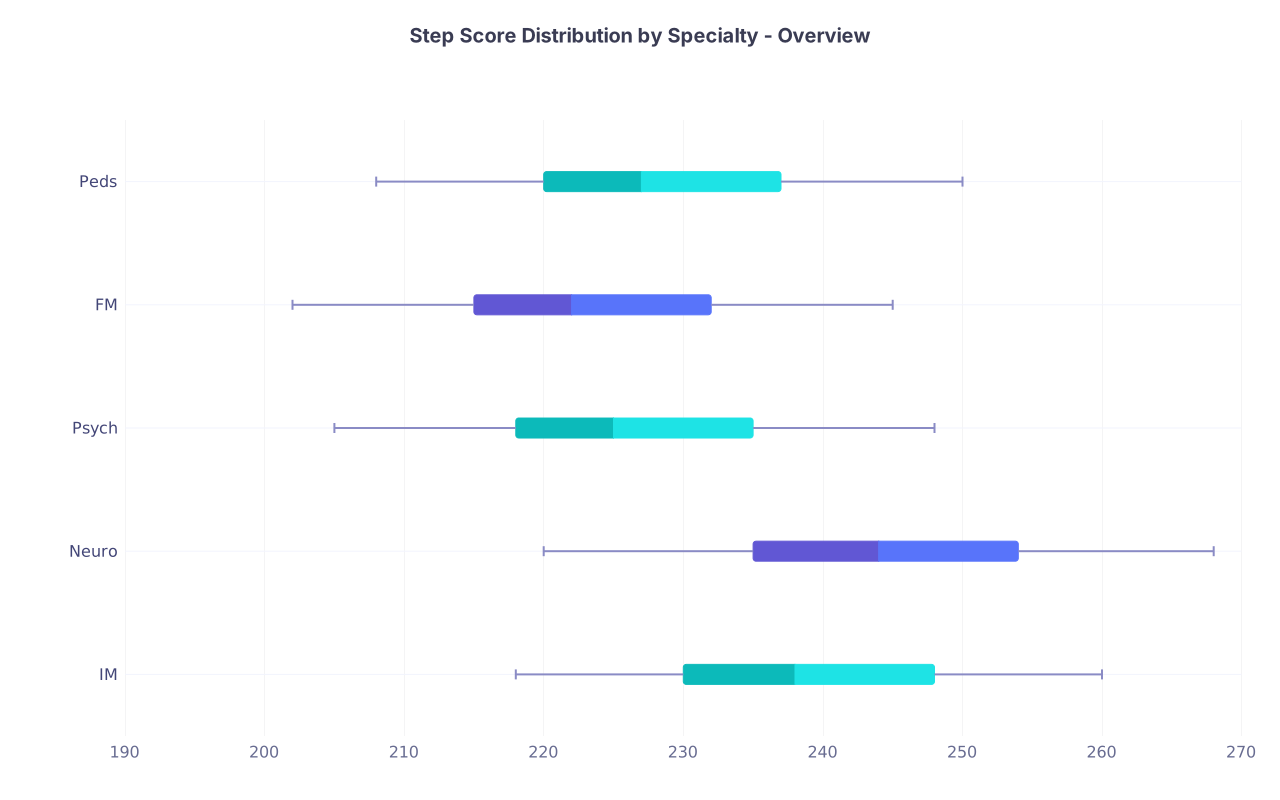
The biggest mistake neurology applicants make is treating “neurocritical care exposure” as a vague bonus instead of a hard, checkable feature of a residency.
If you want real neuro ICU skills—not just a couple of consults on floor patients who get sicker—you have to dissect programs ruthlessly.
Let me break this down specifically.
Why Neurocritical Care Exposure Actually Matters
This is not just about “I might want to do neurocritical care fellowship someday.”
Neuro ICU exposure changes how you think as a neurologist. Even if you end up pure outpatient movement disorders in suburbia, your time in a neuro ICU will shape:
- How comfortable you are with acute neuro emergencies: status epilepticus, malignant MCA, myasthenic crisis, GBS respiratory failure, ICH with herniation risk.
- How well you communicate with ED, neurosurgery, and anesthesia when something is crashing at 3 a.m.
- Whether you freeze or act when an inpatient deteriorates.
I have watched residents from neuro-heavy ICUs calmly manage status epilepticus with stepwise escalation while their peers from weaker programs fumble after the second AED and start dialing for help that is too late. That difference did not come from a board review book. It came from structured exposure.
You are evaluating three things:
- Volume – how many true neurocritical patients you see.
- Ownership – whether neurology actually runs those patients.
- Structure – whether learning is systematic or random “you were on call when it happened.”
If any of those three are weak, your neurocritical care “exposure” will be more brochure than reality.
First Filter: Does the Program Have a Real Neuro ICU?
Start here. Do not skip this and get distracted by glossy “stroke center” language.
You want to know:
- Is there a dedicated neuro ICU (or NSICU) with geographically cohorted patients?
- Who runs it: neurology, neurosurgery, anesthesia/critical care, mixed?
- How many beds and what case mix?
If a program cannot clearly tell you whether they have a neuro ICU, you already have your answer.
What a Strong Neuro ICU Looks Like
At a solid academic neurology residency, you should hear phrases like:
- “We have a dedicated 8–24 bed neuro ICU.”
- “Staffed by neurointensivists from neurology/critical care.”
- “Neurology residents are the primary team on all neuro ICU patients.”
- “There is 24/7 in-house intensivist or critical care fellow coverage.”
That is a very different animal from:
- “Our neuro patients go to the medical ICU or surgical ICU depending on etiology.”
- “Neurosurgery primarily manages the neuro ICU; neurology is consult only.”
- “Residents get exposure through cross-coverage and stroke call.”
Consult-only is not the same as ownership. If you are not writing the note that sets the vent, the pressor targets, and the ICP strategy, you are not actually learning neurocritical care. You are practicing “please consider” medicine.
How to Quantify Neurocritical Care Exposure: The Hard Questions
On interview day, you do not ask, “Is there good neurocritical care exposure?” Everybody will say yes.
You ask specific, uncomfortable questions that force details.
1. Number and Type of Required Neuro ICU Rotations
Ask: “How many months of dedicated neuro ICU do neurology residents complete, and in which years?”
Reasonable baselines (categorical neurology, 4-year program):
- PGY-2: at least 1 month neuro ICU
- PGY-3: another 1 month
- Optional or additional: senior neuro ICU, elective neurocritical care, night float in neuro ICU
If all they can offer is “some time as a PGY-4 elective,” you will not build real competence.
You should also ask what is neuro ICU versus general ICU:
- Neuro ICU = primary service is neurocritical care; patients are neuro-driven (stroke, SAH, TBI, status, neuromuscular respiratory failure, CNS infections).
- MICU/SICU time is nice but secondary. It is general critical care, not explicitly neuro.
Ideal structure:
- At least 2 blocks (2–3 months) of true neuro ICU by end of PGY-3.
- Optional extra time if you are fellowship-bound.
| Level of Exposure | Required Neuro ICU Months | Resident Role |
|---|---|---|
| Weak | 0–1 | Mostly consultant |
| Moderate | 1–2 | Mixed consult/primary |
| Strong | 2–3+ | Primary team |
2. Who Actually Owns the Patients?
Ask: “On a neuro ICU month, are neurology residents the primary team, or consulting only?”
You want “primary.” Full stop.
Red flags:
- “Neurosurgery runs the unit, and neurology is consulted when needed.”
- “Anesthesia critical care is primary; neurology manages just the neuro part.”
- “Residents write consult notes, but ICU attendings place orders and run the daily plan.”
That environment teaches you to make suggestions, not decisions. If you want to be a neurointensivist, it is a big handicap.
3. Overnight Neurocritical Care
Daytime is scripted. Overnight is where patterns burn into your neurons.
Ask:
- “On call, who responds to neuro ICU emergencies? Neurology resident, ICU resident, both?”
- “Are there dedicated neuro ICU night float blocks or just general call with ICU cross-coverage?”
- “How many intubations/central lines/art lines do typical neurology residents log, if any?”
I do not care if you want procedures or not. Exposure to the process—intubation decisions, hemodynamics, peri-intubation neuro risks—changes how you frame brain emergencies.
If the answer is: “We never go to the bedside at night; ICU takes care of that,” your “exposure” is chart review the next morning.
Neurocritical Care vs Stroke: Do Not Confuse the Two
A program can have a massive stroke volume and still provide mediocre neurocritical care training.
I see applicants constantly fooled by:
- “Comprehensive Stroke Center”
- “1000+ stroke admissions per year”
- “24/7 stroke team and telestroke”
Those sound great. But stroke ≠ neurocritical care.
Neurocritical care is:
- Malignant MCA infarction with craniotomy or hemicraniectomy.
- Aneurysmal SAH: vasospasm management, EVDs, triple-H or modern variants.
- Refractory status epilepticus and anesthetic coma.
- TBI with ICP monitoring, decompressive craniectomy decisions.
- Myasthenic crisis and neuromuscular respiratory failure.
- Massive ICH with herniation risk, blood pressure titration, reversal strategies.
You want a mix of stroke and non-stroke critically ill neuro patients. If all the “neuro ICU” patients are just post-tPA or post-thrombectomy with mild deficits under “monitoring,” you will not learn the depth of neurocritical thinking.
Ask: “Roughly what proportion of the neuro ICU census is stroke versus TBI, SAH, status, neuromuscular, CNS infection?”
If they say “90% stroke,” that is a hint.
Signs of a Strong Neurocritical Care Culture
You can usually feel this in the first 20 minutes if you know what to look for.
Presence of Fellowship-Trained Neurointensivists
Ask directly: “How many faculty are fellowship-trained neurointensivists, and what are their departments?”
Best case:
- Multiple neurointensivists with backgrounds in neurology ± internal medicine, critical care.
- They attend in a dedicated neuro ICU.
- They are visibly proud of their unit and enthusiastic about teaching.
Mediocre case:
- One neurointensivist spread thin across services.
- ICU run mostly by anesthesia or surgical critical care, neurology enters for “neuro consults.”
No neurointensivists at all? Then neurocritical care is an add-on, not a core function.
Structured Teaching, Not Just “See Sick People”
Ask: “What is the formal teaching structure on neuro ICU?”
You are looking for:
- Daily or near-daily bedside rounds that are true teaching, not just checkbox sign-outs.
- Didactic curriculum: ICP management, cerebral perfusion pressure, SAH protocols, status algorithms, prognostication, brain death examination, organ donation.
- Multidisciplinary culture: neurosurgery, ED, radiology, anesthesia regularly interact.
If the answer is: “Residents learn on the job; we do not really have formal neuro ICU lectures,” realize you will plug gaps on your own during board review and fellowship apps.
Multimodal Monitoring and Advanced Therapies
You do not need a toy shop. But some level of modern neurocritical care tech suggests a robust environment.
Things to ask about, not because you need to master them all, but to gauge sophistication:
- Use of ICP monitors, EVDs, parenchymal bolts.
- Continuous EEG monitoring in the unit.
- Management of targeted temperature, refractory ICP protocols, vasospasm detection (TCD, perfusion imaging).
- Regular neuroimaging rounds reviewing CT/MRI, CT perfusion, angiography in the ICU context.
You are not just counting gadgets. You are looking for a culture where people think deeply about brain physiology, not just “keep MAP above 65.”
How Neuro ICU Exposure Fits into the Overall Neurology Training
You do not want a program that is “fantastic neuro ICU, terrible everything else.” That is rare but it exists.
The right question is: “How does neuro ICU training integrate into the rest of neurology?”
Good signs:
- Stroke rotations have meaningful overlap with neuro ICU, but not redundancy. You see hyperacute management in stroke, longitudinal critical care in neuro ICU.
- General inpatient wards call the neuro ICU team early for deteriorations; there is shared teaching.
- Outpatient and specialty clinics (epilepsy, neuromuscular, MS) occasionally feed into the ICU, and you are part of that trajectory.
Weak integration looks like silos:
- Neuro ICU is “the place where everything is crazy,” unrelated to what you do in clinic.
- Stroke and neuro ICU constantly fight for ownership of patients with unclear workflows.
- Residents complain that ICU rotations are exhausting but not educational.
You want the ICU to feel like an advanced lab where you apply all the neuro pathophysiology you learned on the floor, not a random punishment block.
Community vs Academic: Can You Get Good Neurocritical Care Outside a Big Center?
Short answer: yes, but you must be more deliberate.
Academic, tertiary centers tend to have:
- Formal neuro ICU units.
- Established neurocritical care fellowships.
- Research in SAH, TBI, status, multimodal monitoring.
- Higher census of complex cases.
Strong community or hybrid programs can still deliver:
- Good stroke and limited but solid neuro ICU exposure.
- ICU time largely in MICU/SICU with scattered neuro patients.
- Enough sick neuro that you are not clueless as an attending.
If your long-term goal is neurocritical care fellowship, you are handicapping yourself if you pick a program with no dedicated neuro ICU and no neurointensivists. You can compensate with away rotations and aggressive electives, but it is an uphill climb.
If your goal is outpatient neuro but you want to be competent with emergencies, a moderate-exposure program might be completely fine. The key is that you know which category you are choosing.
What to Look For on Interview Day and During Second Looks
Let us get tactical. If you are serious, this is what you actually do.
In Morning Report / Case Conference
Pay attention to:
- How they discuss neuro ICU cases. Are they routine and detailed, or “rare, weird monsters” trotted out for drama?
- Do residents know the ventilator modes they are describing or just say “the patient was on the vent”?
- Do attendings casually use concepts like cerebral perfusion pressure, autoregulation, osmotherapy strategy, timing of decompression?
If everything is “they were intubated and then got worse,” that tells you the level of sophistication.
On the Hospital Tour
If they do not physically walk you through the neuro ICU, ask to see it. Politely, but firmly.
Observe:
- Size and layout. Four beds tucked in the corner of MICU versus a visible, busy neuro ICU.
- Who is on the whiteboard: are neurology residents and attendings clearly listed as primary?
- Monitors, EEG towers, EVDs––a real neuro ICU looks different from a generic step-down.

Questions to Ask Residents (Not Faculty)
Residents have no incentive to sell you something that will make their own lives harder. Use that.
Ask PGY-3/4s:
- “On neuro ICU, do you feel like you actually run the unit, or are you there as a consultant?”
- “What kinds of emergencies do you handle independently at night before calling backup?”
- “How comfortable do you feel managing status epilepticus, SAH, and malignant infarcts now compared to PGY-2?”
- “If someone wanted to do neurocritical care fellowship, how well-prepared would they be from here?”
If the senior says, “Honestly, if you want neurocritical care, you should probably go to Program X down the road,” listen.
Pipeline to Neurocritical Care Fellowship
If you even think you might be interested in neuro ICU as a career, this section matters a lot.
Key signs that a program is a good launchpad:
- They have their own UCNS- or ACGME-accredited neurocritical care fellowship.
- Or: They regularly place residents into fellowships at recognized centers (Columbia, MGH, Penn, Hopkins, Mayo, etc.).
- Faculty are involved in national neurocritical care societies, multicenter trials, or consensus guidelines.
Ask the PD or chief residents:
- “Where have your residents matched for neurocritical care fellowships in the last 5–10 years?”
- “What percentage of residents showing interest in neuro ICU end up matching into it?”
- “Are residents involved in neuro ICU–related QI or research projects?”
If the answer is vague or they cannot recall a single recent neuro ICU fellow match, that tells you the pipeline is thin.
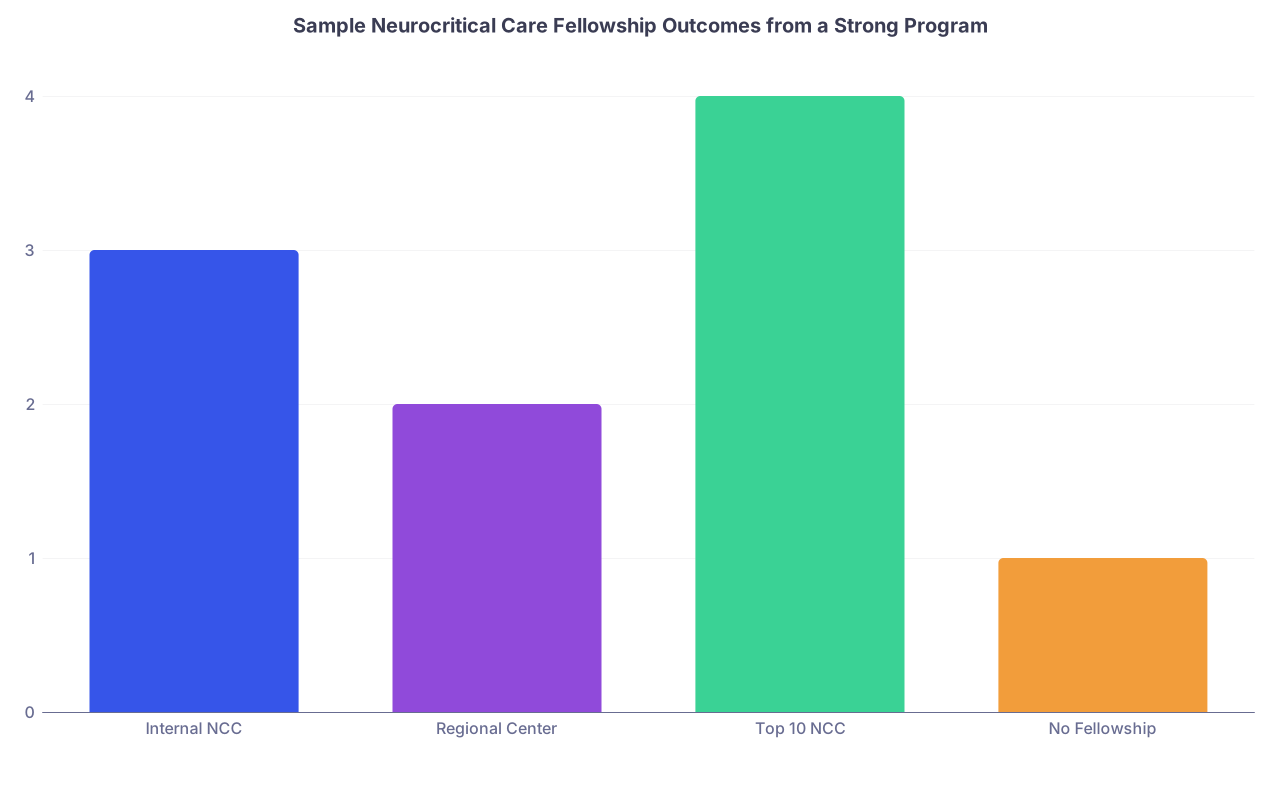
| Category | Value |
|---|---|
| Internal NCC | 3 |
| Regional Center | 2 |
| Top 10 NCC | 4 |
| No Fellowship | 1 |
You do not need those exact numbers. You need proof that “I want neurocritical care” is not a foreign language at that institution.
A Quick Reality Check: Trade-offs You Cannot Avoid
Every residency choice is a trade-off. Chasing maximal neurocritical care exposure may mean:
- More overnight call.
- More emotionally heavy cases: brain death, withdrawal of care, bad-outcome strokes in young patients.
- Less time in cushy outpatient electives.
Be honest with yourself:
- If high-intensity environments drain you, a neuro ICU–heavy program might burn you out fast.
- If you light up hearing about complex SAH protocols, you will be bored stiff in a program where “ICU” means “check troponins and trend lactate.”
The smart move is not chasing what looks impressive on paper. It is aligning your actual personality and long-term career path with the ICU intensity and exposure level.
Putting It All Together: A Simple Evaluation Framework
When you finish your interviews, sit down and grade each program’s neurocritical care exposure on three axes, 1–5 scale.
Structure
- 1: No dedicated neuro ICU, consult-only, no required rotations.
- 3: Some dedicated time, mixed primary/consult, 1–2 months total.
- 5: Multiple structured months, neurology primary, night and day exposure.
Culture & Faculty
- 1: No neurointensivists, minimal teaching.
- 3: One or two interested faculty, some didactics, moderate engagement.
- 5: Several neurointensivists, strong teaching culture, visible leadership in field.
Pipeline & Outcomes
- 1: No recent neuro ICU fellowships, no fellowship on site.
- 3: Occasional placements, some research/QI.
- 5: Regular fellowship matches, own fellowship, strong national presence.
| Domain | Weak (1) | Moderate (3) | Strong (5) |
|---|---|---|---|
| Structure | No unit, consult | 1–2 months mixed exposure | 2–3+ months, neurology primary |
| Culture | No NCC faculty | Some NCC, limited teaching | Multiple faculty, robust teaching |
| Pipeline | No NCC matches | Occasional NCC fellowships | Regular matches, or in-house NCC |
You will immediately see patterns. Programs that felt “similar” on interview day will separate right out on paper.
FAQ: Neurocritical Care Exposure in Neurology Residencies
1. If my program has no dedicated neuro ICU, can I still match into neurocritical care fellowship?
Yes, but you will need to be proactive. That means maximizing general ICU time, arranging away rotations at a strong neuro ICU center during PGY-3, doing neurocritical care–related research or QI, and finding external mentors. Applicants from neuro-ICU–light programs do match, but the bar is higher and you must show you understand what the field actually involves.
2. How many months of neuro ICU do I really need as a resident?
If you are fellowship-bound, I like to see at least 3 months total of true neuro ICU by the end of residency, ideally split across junior and senior years. For residents not planning fellowship, 1–2 solid months, plus meaningful exposure on stroke and ICU consults, is usually enough to be safe and competent with common emergencies.
3. Do I need to do a lot of procedures (intubations, lines) as a neurology resident?
It is helpful but not mandatory for fellowship. What matters more is that you understand indications, risks, hemodynamics, and the neurologic implications of each procedure. Many neurointensivists trained in environments where anesthesiology or critical care fellows did most of the procedures, and they did fine. That said, programs that allow neurology residents to gain some procedural competence tend to have a stronger critical care culture overall.
4. Is a separate stroke service a good sign or a bad sign for neurocritical care?
It depends on how it is structured. A separate stroke service that handles ward-level and step-down strokes, while the neuro ICU team manages critically ill strokes and other neuro emergencies, is ideal. A stroke service that keeps all stroke patients (including intubated SAH, malignant edema, complex ICH) and leaves the “neuro ICU” with scraps is a problem. You want clarity: who owns which patients, and does neuro ICU see the sickest ones?
5. Should I prioritize overall program reputation or neuro ICU strength if I want neurocritical care fellowship?
If you are choosing between a big-name program with weak neuro ICU and a mid-tier program with an excellent, resident-run neuro ICU and strong fellowship pipeline, I would take the latter for someone dead-set on neurocritical care. Fellowship directors care about your skills, letters, and demonstrated exposure. Going to a “name” place that does not train you in what you want to do is a poor trade.
6. How can I tell if neuro ICU exposure is just “window dressing” in a program brochure?
Look for specifics. If the website uses buzzwords but cannot tell you: number of beds, who is primary, how many required months, how many neurointensivists, and where recent grads went for fellowship, it is marketing fluff. On interview day, if no resident can clearly describe what they did on neuro ICU, or they say “you see some of those patients on general wards too, it is all mixed,” assume the exposure is thin.
Key takeaways:
- Do not confuse stroke volume with true neurocritical care training; ask pointed questions about who owns the neuro ICU and how much time you actually spend there.
- If you even might want neurocritical care fellowship, you should strongly favor programs with dedicated neuro ICUs, neurointensivist faculty, and a visible fellowship pipeline.
- Grade programs explicitly on structure, culture, and outcomes; treat neuro ICU exposure as a concrete feature, not a vague impression from glossy brochures.