
The belief that “psychiatry has great lifestyle” is one of the most oversimplified, over-marketed, and misunderstood ideas in medical training.
The lifestyle myth: mostly marketing, partially math
Let me be blunt: psychiatry does not magically give you work‑life balance. What it gives you is potential for balance that you can easily destroy with the wrong practice setting, the wrong employer, or the wrong expectations.
The story you hear in med school goes like this:
Psych → 9–5, no nights, no weekends, minimal call, low stress, lots of time for hobbies.
Reality looks more like this:
Your hours, stress, and satisfaction depend far more on practice environment (academic vs community vs outpatient vs inpatient vs telehealth vs consult‑liaison) and payment model (RVU, salary, private practice, locums) than on the word “psychiatry” on your badge.
Let’s anchor this to actual data instead of hallway folklore.
What the numbers actually say
Most residents hear anecdote: “my friend’s cousin is a psychiatrist and plays golf on Wednesdays.” I prefer surveys and workload data.
1. Weekly hours: psychiatry vs other fields
Pulling from large US physician surveys (Medscape Physician Lifestyle/Compensation, AAMC data, and multiple specialty‑specific workforce reports), the pattern is consistent over years:
| Specialty | Avg Hours/Week | Typical Call Intensity |
|---|---|---|
| Psychiatry | 40–48 | Low–Moderate |
| Family Medicine | 45–55 | Moderate |
| Internal Med | 50–60 | Moderate–High |
| General Surgery | 60–70 | Very High |
| EM | 40–46 (shifts) | High acuity, no pager |
| Orthopedics | 55–65 | High |
Where does psychiatry land?
Lower than most procedural specialties and hospital‑based internal medicine. Similar to EM on raw “hours”, but with very different fatigue profile since you’re not doing nights in a resuscitation bay.
But notice that range: 40–48 hours. That’s not guaranteed 8–4. It includes:
- Outpatient psychiatrists doing 32–36 clinical hours and going home.
- Hospital psychiatrists who “only work” 44–50 hours but are emotionally cooked by constant high‑acuity cases and safety issues.
- Academic psychiatrists whose clock hours look okay but whose inbox, notes, admin, and teaching bleed into evenings.
So yes, on average psychiatry has fewer hours than the workhorses (surgery, OB, heme‑onc, hospitalist). But the data doesn’t justify the fantasy version of “easy job, tons of free time.”
2. Burnout rates: the uncomfortable surprise
Here’s where the myth really cracks. People assume psychiatry = lowest burnout. The numbers disagree.
Across multiple Medscape burnout reports and specialty‑specific surveys, psychiatry lands mid‑pack. Not the worst, not the best.
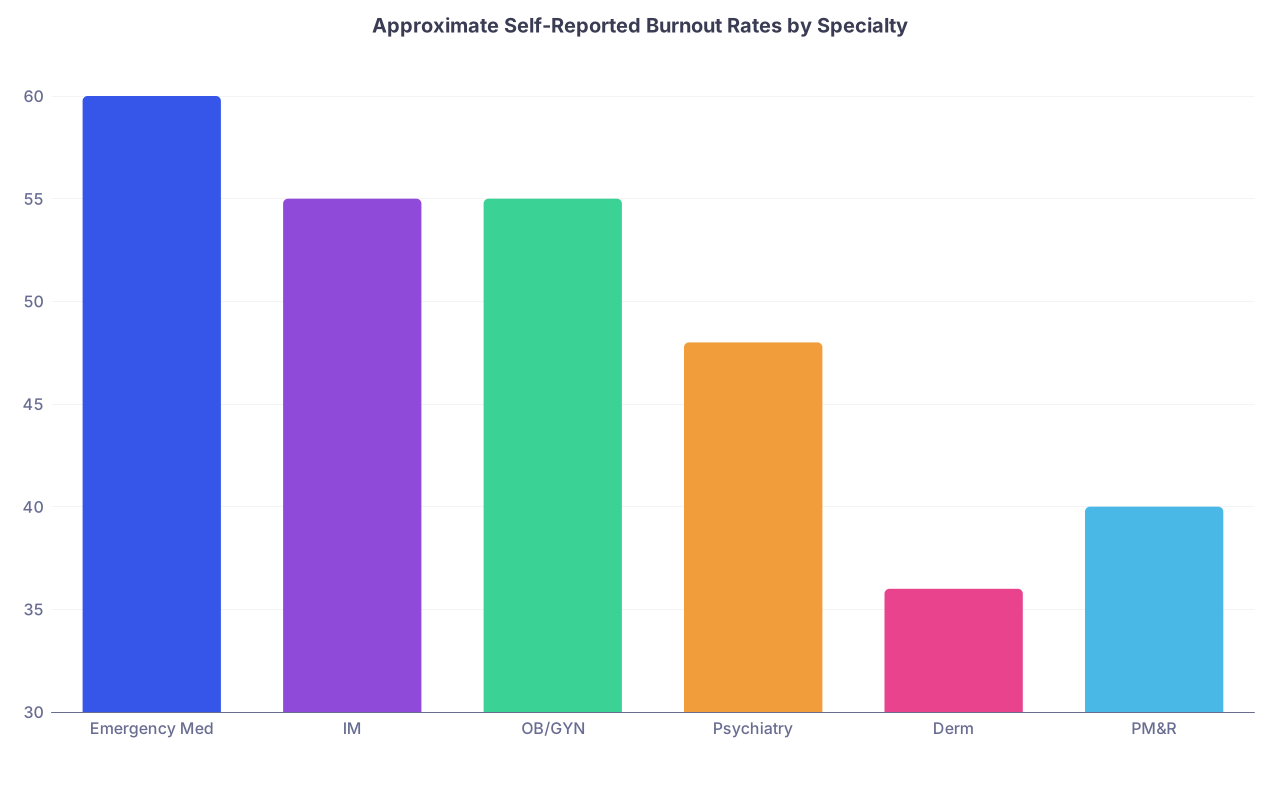
| Category | Value |
|---|---|
| Emergency Med | 60 |
| IM | 55 |
| OB/GYN | 55 |
| Psychiatry | 48 |
| Derm | 36 |
| PM&R | 40 |
Does psychiatry have better burnout numbers than EM, IM, or OB/GYN? Usually yes.
Is it some magical burnout‑proof sanctuary? Absolutely not.
And I’ve watched the same pattern year after year: MS3s who say, “I want psych because I don’t want burnout,” then match into systems with:
- 30‑minute new evals for massively complex patients
- 10–15 minute med checks stacked all day
- Constant prior auth fights
- No therapy support, no social work, just “fix this with meds”
They’re shocked when they feel just as drained as their IM friends—just in a different way.
3. Resident life: psych vs the rest
Residents love to generalize from training. “Our psych seniors are always home early.” Yes—and that’s partially structural.
On average:
- Psychiatry residents work fewer nights and in‑house 24‑hour calls than IM, surgery, OB.
- Night float and call in psych often means crises, admits, supervision calls—but not cross‑covering 60 floor patients with endless pages.
- Duty hour violations are less frequent, not nonexistent.
But it’s not universal. I’ve seen:
- County psych programs where the PGY‑2 is covering a huge psych ED, detox, and inpatient unit all night.
- Academic programs where consult‑liaison psych is slammed, and residents effectively run a mini‑ED for all “behavioral” problems in the hospital.
- Forensic and CL rotations with heavy emotional toll and tough cases that follow you home mentally even when the clock stops.
So yes, compared to surgical residencies, psych residency is generally more humane. Compared to some cushy advanced radiology or pathology tracks? Less clear.
The actual levers that determine your lifestyle in psychiatry
If you want to understand lifestyle in psych, forget the label. Look at the structure of the job. There are a few levers that matter much more than the specialty name on paper.
1. Outpatient vs inpatient vs C‑L vs ED
This one alone can make your life feel like two different specialties.
- Outpatient, mostly med management, control over schedule → most likely to be “balanced” if you resist RVU pressure.
- Inpatient acute psych → more crises, more unpredictability, more late notes, more safety concerns; hours might still be officially “8–5” but that doesn’t reflect the emotional load.
- C‑L or ED psych → constant interruptions, high acuity, some of the hardest cases in medicine (delirium, suicidality, capacity evaluations).
I’ve seen colleagues who did 3 years inpatient and were absolutely done with psychiatry. Same people moved into a 3‑day‑a‑week outpatient/telepsych mix and suddenly rediscovered why they went into the field.
2. Who owns you: RVUs vs salary vs private vs locums
You want to understand lifestyle? Follow the money.
| Model | Lifestyle Risk | Typical Pressure Source |
|---|---|---|
| Academic salary | Moderate | Teaching/admin/relative RVUs |
| RVU heavy | High | Volume and visit length |
| Private practice | Variable | Self-imposed workload |
| Telepsych/locums | Variable | Contract terms |
RVU‑driven outpatient psych is where lifestyle goes to die. Why?
Because complex patients plus short visits plus documentation burden equals:
- Endless inbox and refill messages
- Rushed visits that feel ethically uncomfortable
- Pressure to see more patients just to keep income stable
Contrast that with a salaried state hospital job. Maybe the pay is lower, maybe the bureaucracy is worse, but your workday actually ends. You go home.
Private practice and telepsych? Pure choose‑your‑own‑adventure. I know psychiatrists working:
- 0.6 FTE, three short days per week, full benefits, and very comfortable incomes.
- 1.5 “FTE” in practical terms—multiple jobs, weekend moonlighting, “just one more contract” syndrome—completely fried.
Same specialty. Different choices.
3. Boundaries and emotional exposure
Psychiatry is cognitively lighter on your back than, say, running a trauma list. But emotionally? It can be brutal.
You sit for hours a day with people’s suicidality, trauma, abuse, psychosis. You hear the worst moments of human experience repeatedly, then drive home and try to pretend you’re fine.
Work‑life balance is not just about hours. It’s about whether you have the mental space and boundaries to not ruminate on your patients all night.
The psychiatrists I’ve seen burn out the fastest:
- Have poor boundaries (“Of course you can text me if you feel bad, here’s my personal number”).
- Feel solely responsible for patient outcomes in a broken system.
- Work in settings with no therapy, no case management, just meds and a prayer.
The ones who sustain a good life:
- Say no to unsafe caseloads.
- Keep clear contact rules and stick to them.
- Accept that in psychiatry, you are never going to fix everything—and that is not failure.
Where psychiatry really does have an edge
Having ripped apart the fairy tale, let me also be fair. Psychiatry, structurally, offers some genuine, data‑backed lifestyle advantages—if you use them wisely.
1. Flexibility over the long game
Psychiatry is one of the easiest specialties to “downshift” later:
- Part‑time options are plentiful.
- Telehealth actually works clinically for many conditions.
- You can scale up or down number of days or patient load without destroying your practice.
That’s not true for a lot of procedural fields where fixed OR block time, surgeries, and follow‑ups lock you into a minimum.
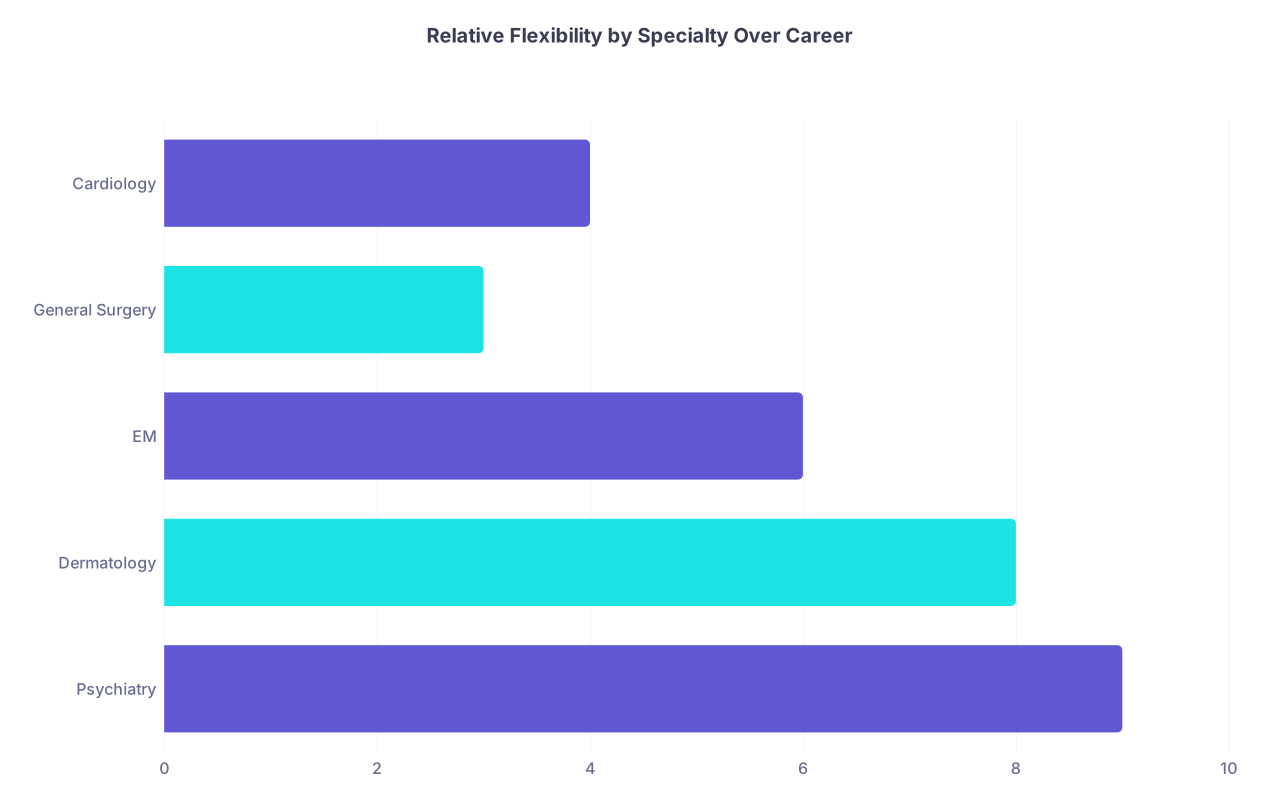
| Category | Value |
|---|---|
| Psychiatry | 9 |
| Dermatology | 8 |
| EM | 6 |
| General Surgery | 3 |
| Cardiology | 4 |
(Think of these values as “flexibility scores” on a 1–10 scale based on schedule control, part‑time viability, and telework potential.)
Psychiatry lands near the top for a reason.
2. Night and weekend call can actually be optional
Not at the start. As a resident, you’ll do your share. Early career, you might still be in call pools or ED coverage.
But mid‑career? There are plenty of jobs with:
- No nights
- No weekends
- No call
Or call that is truly light—phone only, rare need to come in, compensated decently.
Try finding that in OB, trauma surgery, or interventional cardiology without dramatically shrinking your income and options.
3. Physical demands are low, career longevity is high
Psych doesn’t wreck your back, your hands, or your joints the way some procedural specialties do. You can do meaningful clinical work at 65 or 70 if you want to.
That means you can afford to throttle down at various life stages without having to “cram” all your earnings and prestige into a brutal 20‑year window.
The dangerous trap: choosing psych only for lifestyle
Here’s the part nobody says aloud on interview day:
If you go into psychiatry because you dislike medicine and just want an easy life, you are setting yourself up to be miserable—and your patients unsafe.
You still need:
- Comfort with medical complexity (lithium, clozapine, metabolic issues, neurocog disorders).
- Tolerance for uncertainty and chronic illness.
- Patience for slow progress and frequent relapses.
You also need to be okay being the person everyone else dumps on:
- “Behavioral” problem? Call psych.
- Capacity question? Call psych.
- Difficult family expectations? Call psych.
If you don’t actually like the work—listening, pattern recognition, motivational interviews, long‑term relationships—the hours won’t save you. A 40‑hour‑per‑week job you hate is not “good lifestyle.” It’s just a slower bleed.
So, does psychiatry truly offer better work‑life balance?
Here’s the honest conclusion, stripped of marketing:
- Compared to high‑acuity procedural fields and hospital‑based IM, psychiatry generally has fewer hours, fewer nights, and more control over schedule.
- Compared to the fantasy version of “psych is easy, all outpatient, done at 3 pm,” reality is far rougher. Burnout is common, documentation and system pressures are real, and emotionally it is heavy work.
- The big determinant of your lifestyle is not “psych vs not psych.” It is the combination of practice setting, employer, payment model, and your own boundaries.
If you actually like the core work of psychiatry and are strategic about job selection, yes—psychiatry can offer an excellent, sustainable work‑life balance over a 30‑year career.
If you are hoping to hide out from medicine with minimal effort and maximal free time, no—psychiatry will not save you. It will just give you a different flavor of dissatisfaction.