The conventional wisdom about “always ranking your home program highly” in primary care is lazy, outdated, and often wrong.
For family medicine, internal medicine, and pediatrics, the mythology around matching at your home institution is especially thick. Students whisper it on wards like it’s a natural law: “Home programs always rank their own students to match,” “If you don’t match at home, something is terribly wrong,” “You should do everything to stay where you trained.”
Let me break it to you gently: a lot of that is nonsense.
This does not mean home programs never help. They do. But the idea that primary care home institutions are some kind of default safety net, or that prestige there will define your future, is badly oversold.
Let’s go myth by myth and look at what actually happens.
Myth #1: “You’re Strongly Favored to Match at Your Home Institution in Primary Care”
You’re not “strongly favored.” You’re familiar.
There’s a difference.
In primary care fields (family med, IM, peds), programs commonly interview most of their own students who apply. That creates the illusion of favoritism. You’re on their radar. Attendings know your name. PD has heard about you from clerkship directors.
But national data doesn’t support the fairy tale that home students automatically match there.
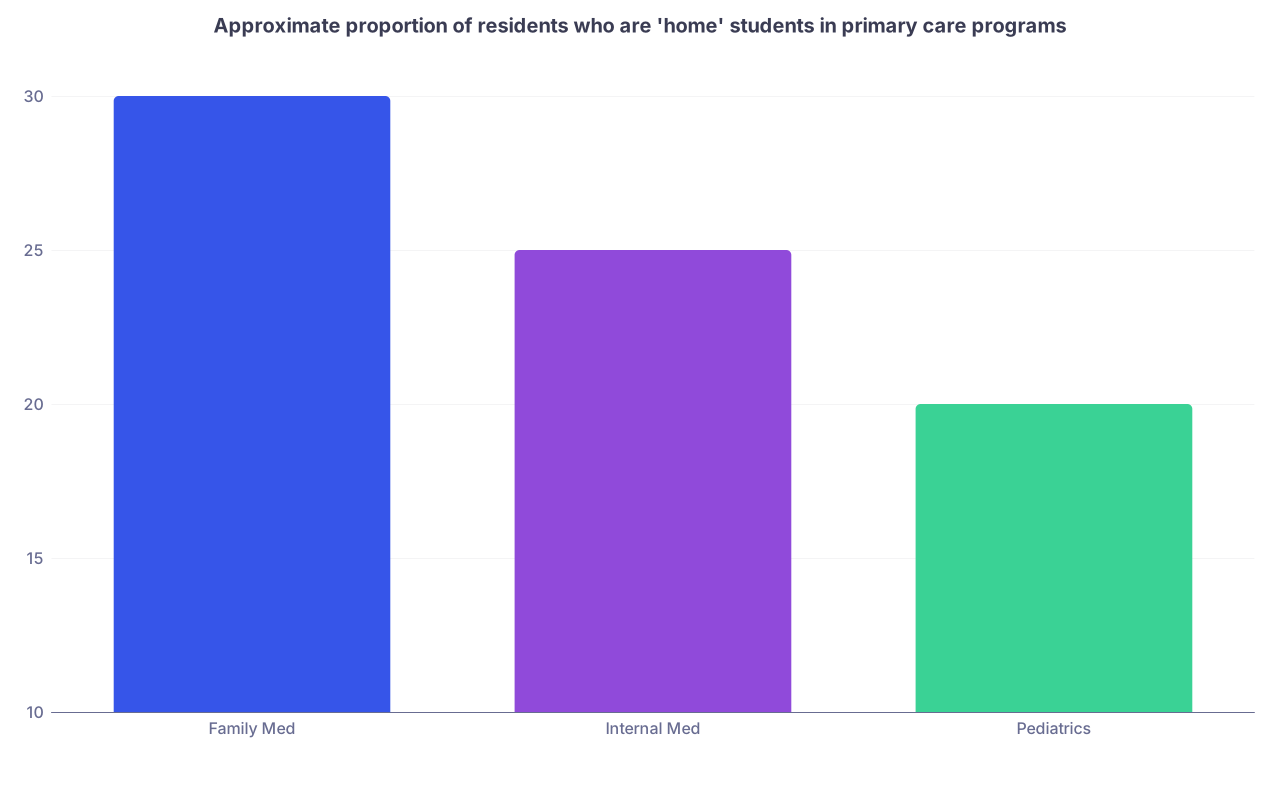
| Category | Value |
|---|---|
| Family Med | 30 |
| Internal Med | 25 |
| Pediatrics | 20 |
Those are rough but reasonable ballpark estimates pulled from program surveys and NRMP reporting: many programs have a noticeable minority of “home” students, not a majority.
What usually happens in primary care academic programs:
- They like having some home students each year.
- They do NOT want all home students. That’s inbreeding.
- They balance home, regional, and “imported” residents from other med schools.
I’ve watched PDs in IM and peds say this nearly word for word:
“We want a couple of our students, but we don’t want six of the same med school in one class.”
Your real “advantage” at home is this:
- Your file is rarely ignored.
- Your letters are interpreted with more context.
- People remember your attitude on the wards.
That helps you get an interview and helps them judge you more accurately. It does not guarantee that when they stack their final rank list, you land near the top.
If you were a mid-pack clinical performer with shaky professionalism, your home program will see that more clearly than anyone. Familiarity can hurt you as easily as it helps.
Myth #2: “If You Don’t Match at Your Home Program, It Means You Were Red-Flagged”
This one causes a lot of quiet panic.
Here’s the story I’ve heard from students over and over:
“I’m going into primary care, I go to Big State Med, I interviewed at our IM program, loved it, ranked it #1. I matched at my #2 instead. I must have some terrible secret in my file.”
No. Not necessarily. Often not at all.
Residency ranking is not a referendum on your worth. Programs have to build a balanced class:
- Mix of career interests (hospitalist, primary care clinic, subspecialty).
- Mix of academic vs community-leaning.
- Mix of geographic backgrounds and diversity goals.
- Balance of couples matches and single applicants.
- “Fit” with what they’re trying to emphasize (research-heavy vs clinically heavy, etc.).
You might be:
- Very strong clinically.
- Great team player.
- Loved by residents.
…and still end up behind other home or external applicants because:
- They needed someone with research in a niche area.
- They prioritized candidates with strong ties to their service area.
- They wanted more future hospitalists, and you wrote a love letter to outpatient.
- You were in a crowded “cluster” of similar applicants and they could only take two.
| Reason | What it actually means |
|---|---|
| Class composition needs | They balanced skills/interests, not just scores |
| Too many similar home applicants | You were in a crowded cluster |
| Diversity or regional goals | They prioritized geographic/life experience mix |
| Slightly better external candidates | It was a marginal preference, not a rejection |
| Rank list games (anticipating matches) | They assumed you’d match elsewhere |
Could not matching at home sometimes signal a concern? Yes. If:
- You didn’t get a home interview at all while many peers did.
- You know you had professionalism write-ups.
- You had major conflicts with residents/faculty there.
But simply matching elsewhere in primary care when you interviewed at home? That is common, normal, and often unrelated to red flags.
Myth #3: “You Should Always Rank Your Home Institution #1 in Primary Care”
No, you should not. You should rank where you’ll actually thrive.
This “always rank home first” mantra is especially harmful in primary care. Why? Because in primary care, fit and training environment matter even more than prestige, and the differences between programs are huge.
Here’s the problem: students often conflate comfort with fit.
You know the EMR. You know the call rooms. Your best friend is an intern there. That comfort is seductive. But check what you actually want out of primary care training:
- Do you want heavy inpatient IM with lots of ICU exposure, or a lighter, ambulatory-heavy experience?
- Do you care about community medicine, migrant health, FQHC-based continuity clinics?
- Are you aiming for subspecialty fellowship (cards, GI, heme/onc) or generalist practice?
- Do you want a program that genuinely supports part-time academic careers, education tracks, or global health?
Many home institutions are tertiary academic centers with skewed patient populations, huge subspecialty presence, and less community exposure. Great if you want cards or GI fellowship. Less great if you actually want to become the backbone primary care doc in a normal town.
I’ve watched students ignore an outstanding, community-driven FM or IM program that matched their goals perfectly, purely because “home would be easier, and everyone expects me to rank it high.”
Here’s the cold truth:
The match algorithm favors your preferences, not the program’s ego.
Ranking a home institution first when you actually prefer somewhere else is just you sabotaging your own training.
Myth #4: “Primary Care Home Programs Are Safer or More ‘Secure’ Matches”
This is the psychological comfort myth.
Students think: “Primary care is less competitive; plus my home program knows me; so if things go sideways, I’ll surely match there.”
Reality: some primary care home programs are extremely competitive. Especially:
- Strong academic IM programs with lots of fellowship placement.
- Prestigious children’s hospitals in pediatrics.
- Well-known urban family medicine programs with robust community partnerships.
Those programs are not “safety” anything. They’re targets for hundreds of applicants nationwide, often including MD, DO, and sometimes international grads with serious credentials.
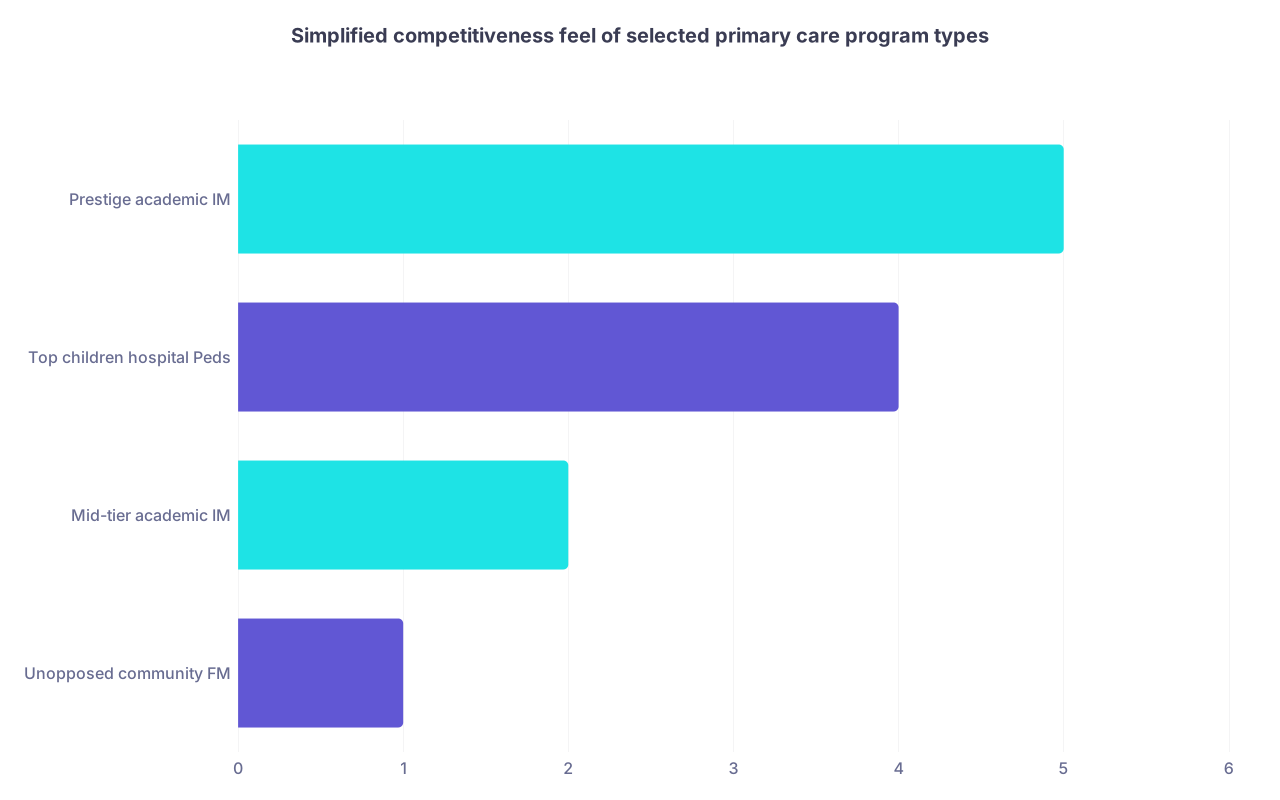
| Category | Value |
|---|---|
| Unopposed community FM | 1 |
| Mid-tier academic IM | 2 |
| Top children hospital Peds | 4 |
| Prestige academic IM | 5 |
(Scale 1–5: 1 = least competitive feel, 5 = most. This is directional, not exact.)
Home status doesn’t override that.
Also, programs in primary care fields have quietly become more selective as more US grads flock to them for lifestyle and job security. So the “I’ll just fall back on my home IM or FM program” idea is less and less reliable.
What actually makes a program “safer” for you:
- Your numbers and clinical comments are clearly above their historic averages.
- You’ve shown sustained interest that aligns with that program’s mission (not just “I’m here already”).
- Multiple champions in that department will go to bat for you.
And even then, you still cannot assume anything is guaranteed.
Myth #5: “Matching at Home Is Always Best for Your Career in Primary Care”
This one gets repeated by people who haven’t looked at actual outcomes in a while.
For academic-heavy specialties like derm or neurosurgery, specific big-name programs can change the entire trajectory of your career. In primary care? The reputation of your residency matters far less than people think, especially compared with:
- Your own clinical competence.
- Your ability to connect with patients.
- How well you use opportunities (QI projects, teaching, local leadership).
- Where you choose to practice and who you work with.
Being at your home institution can help if:
- It’s a strong academic center and you want subspecialty fellowship.
- You already have ongoing research you can continue.
- You’ve got mentors there deeply invested in your career.
But those same benefits can often be found elsewhere, sometimes in places that are actually a better match for your long-term plan.
I’ve seen this exact pattern:
- Student from Big Academic U, going into IM.
- Matches at home, gets drowned in subspecialty consult rot, minimal continuity clinic ownership.
- Three years later, they want to do bread-and-butter primary care but feel underprepared for running a real outpatient panel.
Meanwhile, their classmate from the same med school:
- Went to a less “prestige” but very outpatient-focused program.
- Graduated with real experience managing huge primary care panels.
- Had no trouble landing a job they love, in the city they chose, making the same or more money.
Primary care is brutally egalitarian post-training. Patients do not care where you trained; employers mostly care that you are competent, easy to work with, and board-certified. Your home institution’s brand doesn’t carry the same long-term weight it might in narrow procedural subspecialties.
Myth #6: “If You Want to Stay Local, You Have to Match at Your Home Institution”
Wrong frame.
You don’t have to match at your med school’s program to stay in the same city or region. In primary care, you usually have options:
- Community IM/FMs in the same metro area.
- Affiliated but technically separate peds or combined medicine-peds programs.
- Neighboring-city programs 30–60 minutes away.
Primary care residency is often regionally clustered. You can stay close to family, partners, or support systems without chaining yourself to your own med school.
If your top priority is geography, you should be thinking like this:
- “I want to be in the Pacific Northwest” → apply and rank multiple IM/FM/peds programs across that region.
- “I want to stay near this city” → identify every primary care program within a reasonable commute radius, not just your home one.
That’s a much healthier, data-driven strategy than emotionally fixating on a single home program as your “must-match.”

| Step | Description |
|---|---|
| Step 1 | Do you truly like home program more than others? |
| Step 2 | Rank home at or near top |
| Step 3 | Compare training fit, not comfort |
| Step 4 | Rank home according to true preference |
| Step 5 | Rank better fit programs above home |
| Step 6 | Does home align with your career goals? |
How to Think Rationally About Your Home Institution (Primary Care Edition)
Strip the emotion and ask:
- If this weren’t my home program, and I just interviewed here as an outsider, where would I rank it?
- Does the training environment match my actual goals (outpatient vs inpatient, academic vs community, fellowship vs generalist)?
- Would I be limiting my growth by staying in the same system and same habits for 7+ continuous years?
- Are there clear, specific advantages (mentors, projects, support) that I’d genuinely lose by going elsewhere?
Then rank accordingly. Even if that means putting home at #3 or #5. The algorithm will still protect you if you’re competitive there; you don’t “insult” them by being honest.
FAQs
1. Is it a bad sign if I didn’t even get an interview at my home primary care program?
It can be, but context matters. If:
- Most of your classmates applying to that specialty got home interviews, and
- You had no clear explanation (late application, schedule issues, dual-apply confusion),
then yes, your home department might have concerns about your fit or performance. That’s a reason to seek honest feedback from a trusted advisor or mentor. But if the program is small, very competitive, or had limited interview slots and you were a weaker paper applicant (lower Step 2, weaker comments), it might be a straightforward selectivity issue rather than a mysterious “red flag.”
2. Does matching away from my home institution hurt my chances for subspecialty fellowship in IM or peds?
Not automatically. Fellowship directors care about:
- The reputation and rigor of your residency program.
- Your letters from respected faculty.
- Your research or scholarly work.
- Your performance and board scores.
Being from the same institution can help if you already have strong research ties there, but plenty of residents match into top fellowships from “non-home” programs. If you’re fellowship-focused, choose residency based on its fellowship placement record and mentorship in your field of interest, not just home loyalty.
3. If I’m on the fence, is there any rational reason to prefer my home primary care program?
Yes, a few that are actually defensible:
- You already have deep mentorship relationships there and know they’ll advocate for you.
- You have personal or family constraints that make moving truly disruptive.
- You’ve seen the residents’ day-to-day reality up close and genuinely like the culture.
- The program’s strengths directly match your goals (e.g., strong community FM track, robust hospitalist pipeline, specific global health path).
Those are real, logical reasons. Just don’t confuse them with inertia, fear of change, or the myth that staying home is “safer” or more prestigious for primary care.
Key points:
- Home institution in primary care is an opportunity, not a guarantee or a destiny.
- Not matching at home is common and often says nothing scary about you.
- Rank based on fit and goals, not mythology about loyalty or “safety” at your home program.