
Only about 3% of U.S. residency positions are Med‑Peds, yet the myths about the specialty are louder than the data.
If you ask a random MS3 what Med‑Peds is, you’ll usually get some combo of: “too long,” “brutal call,” and “you’ll be stuck in primary care forever.” All confidently delivered by people who’ve never spent a day on a Med‑Peds service.
Let’s dismantle that.
What Med‑Peds Actually Is (And Is Not)
Med‑Peds is a 4‑year ACGME‑accredited combined residency in Internal Medicine and Pediatrics. Not “half of each.” Not “watered down.” Graduates are board‑eligible in both IM and Peds.
There are two big structural facts people routinely get wrong:
- It’s 4 years. Not 5. Not 6.
- It meets all requirements for categorical ABIM and ABP certification. You are not “less than” a categorical graduate in either.
To make this less abstract, let’s compare the training lengths people love to complain about.
| Path | Total Years of Residency |
|---|---|
| Categorical Internal Medicine | 3 |
| Categorical Pediatrics | 3 |
| Med‑Peds | 4 |
| IM + Peds done separately | 6 |
| Family Medicine | 3 |
Four years looks pretty different when you remember the true alternative to Med‑Peds is six years if you tried to do both separately. The “too long” narrative only survives if you pretend the comparison is against a single categorical.
Myth #1: “Med‑Peds Takes Forever Compared to Everything Else”
Let me be blunt: If your primary goal is “be out of training as fast as possible,” you’re not choosing Med‑Peds. Or IM. Or Peds. You’re looking at 3‑year specialties and probably avoiding fellowships. That’s fine. Just be honest about what you’re optimizing for.
The actual myth is more subtle: people act like Med‑Peds is some outlier in duration. It’s not.
Here’s what the competitive crowd is really doing in IM and Peds:
- IM → Cardiology: 3 + 3 = 6 years
- IM → GI: 3 + 3 = 6
- IM → Heme/Onc: 3 + 3 = 6
- Peds → NICU: 3 + 3 = 6
- Peds → Peds Cards: 3 + 3 = 6
Plenty of Med‑Peds grads do a 3‑year adult fellowship or a 3‑year peds fellowship after their 4 years. So yes, they’re at 7 years post‑MD. That’s one extra year compared with an IM or Peds fellow. One. Not some massive black hole of training.
Let me show you the “pain” in context.

| Category | Value |
|---|---|
| IM Hospitalist | 3 |
| Peds Hospitalist | 3 |
| Med-Peds Hospitalist | 4 |
| IM + Cards | 6 |
| Peds + NICU | 6 |
| Med-Peds + Fellowship | 7 |
That extra year for Med‑Peds buys you:
- Full adult board eligibility
- Full pediatric board eligibility
- Flexibility for the rest of your career that’s hard to quantify in a chart
The better question is not “Is Med‑Peds long?” It’s “Is one extra year a bad trade for double board eligibility and broader options?” For some people, yes. For others, it’s the best deal in the building.
Myth #2: “Med‑Peds Call is Worse Than Categorical IM or Peds”
This one is usually based on vibes or one overheard horror story, not data.
Reality: Most Med‑Peds programs share the same call structure as their categorical IM and Peds colleagues because they’re literally on the same services.
- On IM months, you follow the IM call/shift pattern.
- On Peds months, you follow the Peds call/shift pattern.
- On Med‑Peds services (like a Med‑Peds continuity clinic or combined transition care clinic), the schedules are built to match overall duty hours.
There isn’t a secret third call schedule designed to break Med‑Peds residents.
Where the myth comes from:
- Med‑Peds residents do a higher total number of months of inpatient over 4 years than a 3‑year categorical. So the absolute number of call nights is higher across your whole residency.
- They’re often the “go‑to” problem‑solvers for complex patients (adult congenital heart disease, sickle cell transitioning from peds to adult, cystic fibrosis across ages), which can make call feel heavier when you’re the one getting looped in.
But on a per‑rotation basis? You’re not magically doing more nights than your peers on that same rotation.
Here’s a rough comparison from a pretty standard academic setup:
| Track | Total Inpatient Months | Typical Nights/Year (PGY2-3 equivalent) |
|---|---|---|
| Categorical IM (3 yrs) | ~18–20 | 50–70 |
| Categorical Peds (3 yrs) | ~16–18 | 40–60 |
| Med‑Peds (4 yrs) | ~24–28 | 60–90 |
So yes, over four years you probably work more nights than a 3‑year resident. Because you’re there one extra year and you’re doing a legitimate double program. That’s not a “Med‑Peds is abusive” problem. That’s arithmetic.
What’s usually missed: that extra year also spreads responsibility. Plenty of Med‑Peds PGY4s will tell you PGY3 feels like the real peak of pain; PGY4 has more leadership, a bit more control, and often more elective time.
If you’re worried about call, you should be comparing specific programs, not broad stereotypes. Some IM and Peds programs are brutal. Some are very humane. Med‑Peds usually matches the culture of its parent departments.
Myth #3: “Med‑Peds = Primary Care Forever”
This one is flat‑out wrong and outdated.
Historically, yes, Med‑Peds was pitched hard as primary care for underserved populations, especially in community and rural settings. That legacy lingers. But training and job data over the last decade show a very different picture.
Current reality (varies by program, but pattern is clear):
- A sizable chunk of Med‑Peds grads go into hospital medicine (adult, peds, or both).
- Another big portion go into fellowships: adult cards, pulm/crit, ID, rheum, heme/onc; or peds subs like NICU, peds cards, peds hospitalist.
- A minority go into classic outpatient continuity primary care for all ages—and those who do are heavily recruited.
Let’s visualize the rough spread from multiple Med‑Peds program outcomes reports (numbers vary but trend is consistent):
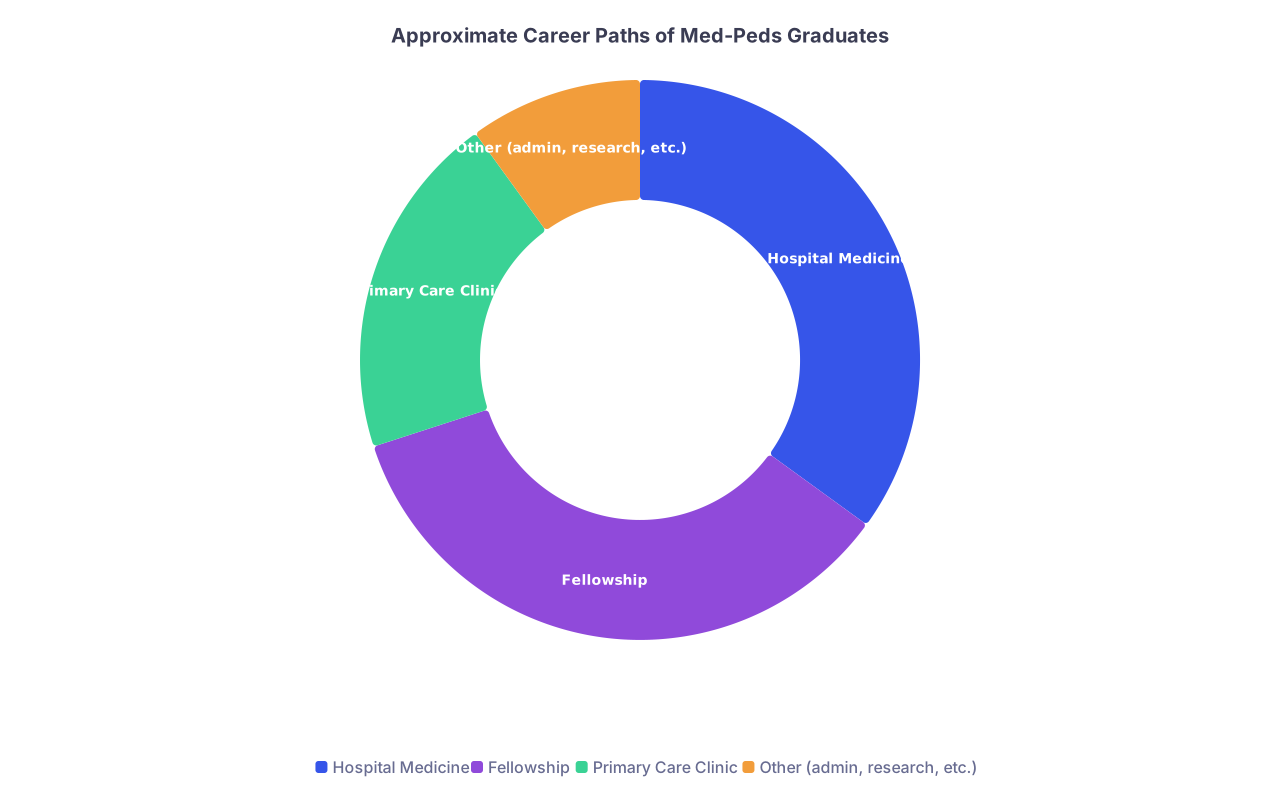
| Category | Value |
|---|---|
| Hospital Medicine | 35 |
| Fellowship | 35 |
| Primary Care Clinic | 20 |
| Other (admin, research, etc.) | 10 |
The real kicker: Med‑Peds grads are heavily represented in complex care and transition clinics at big academic centers. Think:
- Adult congenital heart disease
- Sickle cell disease across lifespan
- Cystic fibrosis (peds and adult care under one roof)
- Cancer survivorship clinics
- Complex neurodevelopmental conditions aging out of pediatrics
These are not “simple primary care” roles. They’re subspecialized, just not always in the old‑school fellowship sense.
Saying “Med‑Peds locks you into primary care” in 2026 is like saying “pathologists spend all day looking through a microscope and never touch a computer.” It might have been sort of true in 1985. It’s lazy now.
Myth #4: “You Won’t Be as Good at Either Adult or Peds”
This one stings because it’s usually said by people who should know better—sometimes even by faculty who trained before combined programs matured.
Let’s walk through the structure. A typical Med‑Peds resident graduation portfolio includes:
- Almost as many adult ward months as a categorical IM resident
- Almost as many peds ward, NICU, and PICU months as a categorical Peds resident
- Full continuity clinic requirements for both populations
To make space, they trim in a few places: slightly fewer elective months, a bit less redundancy in sub‑subspecialty rotations, some efficiency in how requirements overlap. You’re not losing “core” rotations; you’re losing some of the margin.
Program directors know this. That’s why top academic hospitals keep hiring Med‑Peds people into competitive fellowships and faculty roles.
Look at how specialty boards view them:
- ABIM and ABP don’t give you asterisks on your certificate because you did Med‑Peds. You’re board‑certified. Full stop.
- Fellowship PDs in IM or Peds subspecialties routinely accept Med‑Peds applicants and don’t consider them second‑tier.
When I’ve seen residents underperform, it’s almost never because of the combined structure. It’s because of the same factors that hurt categorical residents: poor ownership, low curiosity, weak fundamentals. The dual training magnifies strengths and weaknesses. It doesn’t create them.
If you’re the type who loves pattern recognition, physiology, and complex chronic disease? Med‑Peds actually plays to that strength. You’re forced to integrate adult and pediatric frameworks daily. That’s not dilution. That’s cross‑training.
Myth #5: “Med‑Peds Limits Your Career Options Compared to IM or Peds”
The reality is almost the opposite: Med‑Peds narrows some ultra‑specific niche paths but opens a ton of others.
What you can do with Med‑Peds:
- Adult hospitalist, peds hospitalist, or true combined Med‑Peds hospitalist
- Outpatient primary care for all ages, or for adults only, or kids only
- Any adult IM fellowship that accepts Med‑Peds (which is most of them)
- Any pediatric subspecialty that accepts Med‑Peds (again, many do)
- Hybrid roles: half adult ID, half peds ID; or adult and peds rheum; etc.
- Transition‑of‑care clinics and lifespan clinics that are basically built for Med‑Peds people
- Public health, admin, QI leadership where understanding both systems is an advantage
What’s realistically harder:
- Some ultra‑narrow, highly procedure‑driven peds subs where programs strongly prefer straight Peds (e.g., peds interventional cardiology down the line)
- Very identity‑driven adult fields where the culture is “we hire our own,” especially at places that don’t see a lot of Med‑Peds grads
But for 90% of medicine, Med‑Peds keeps doors open, not closed.
Let’s lay out a simplified comparison of breadth of typical roles:
| Training | Adult-Only Roles | Peds-Only Roles | Lifespan / Combined Roles |
|---|---|---|---|
| IM | Many | None | Very limited |
| Peds | None | Many | Very limited |
| Med‑Peds | Many | Many | Many |
FAQ (Exactly 5)
1. Do Med‑Peds grads get worse fellowship spots than categorical IM or Peds residents?
No. Competitive adult and pediatric fellowships routinely take Med‑Peds graduates. Your fellowship prospects hinge on the same variables as everyone else: performance, letters, research, interview, and institutional reputation. At several major centers, Med‑Peds residents are actually over‑represented in certain fellowships (ID, pulm/crit, rheum, peds hospitalist) because their training background fits those fields well.
2. Can I still do only adult medicine or only pediatrics after Med‑Peds?
Yes. Many Med‑Peds graduates end up practicing exclusively adult or exclusively pediatric medicine. Boards and credentialing do not force you to see both. Hospitals hire you based on their needs and your preferences. The dual training gives you options; it doesn’t trap you into a mandated 50/50 split.
3. Is Med‑Peds more competitive than categorical IM or Peds?
On paper, Med‑Peds tends to sit between categorical IM and Peds competitiveness and below the hyper‑competitive surgical subs. It’s a small field, so some top programs are selective simply because there are very few spots. But if you’re a reasonable applicant for solid university IM and Peds programs, you’re typically a reasonable applicant for Med‑Peds. The limiter is usually fit, not raw stats.
4. Will hospital credentialing or insurers treat me differently as Med‑Peds?
In practice, no. You’ll be credentialed as an internal medicine physician and/or pediatrician based on your boards and your job description. Insurance panels recognize both. Where nuance comes in is how your job is defined: a hospital may hire you as an adult hospitalist, a peds hospitalist, or a combined Med‑Peds hospitalist. That’s a function of local need, not your legitimacy as a physician.
5. If I think I want Med‑Peds, should I still apply to categorical IM and Peds?
If you’re early and unsure, yes, many students apply to a mix of Med‑Peds plus either IM, Peds, or both. If you’re absolutely certain Med‑Peds is your path and you have strong application support, a pure Med‑Peds list is reasonable. Just do not do this blindly—talk to Med‑Peds program directors and residents beforehand and let them sanity‑check your strategy.
Key points:
- Med‑Peds is 4 years, not forever, and the call burden is higher only because you’re there longer, not because you’re secretly being punished.
- Career options are broad: hospitalist, fellowship, primary care, combined roles—you are not boxed into anything unless you choose to be.
- The real question isn’t “Is Med‑Peds too long or too hard?” It’s “Do I actually want the flexibility and complexity that come with dual training?”