
Why do so many med students say, “I’d love peds… but I can’t afford it”?
Let’s tear that apart. Because a lot of what you’ve heard about pediatrics salaries is flat-out wrong, wildly oversimplified, or 20 years out of date.
You’re not choosing between “rich” (ortho, derm) and “poor” (peds, FM). You’re choosing between different risk profiles, practice models, and long-term curves. And pediatrics looks very different when you stop fixating on starting salary screenshots from anonymous forums.
Myth #1: “Pediatrics is the lowest‑paid specialty, full stop”
This is the classic hallway myth: “If you go into peds, you’ll never make real money.”
Let’s go to actual data, not vibes.
Most recent surveys (MGMA, Medscape, Doximity—numbers vary by year but the pattern is consistent) generally show:
- Primary care pediatrics clustered at the lower end of physician compensation.
- But not uniquely and dramatically lower than every other cognitive field.
- And with huge spreads based on practice type, region, and subspecialization.
Here’s a rough reality check snapshot based on typical ranges (not gospel, but ballpark):
| Specialty | Common Range (USD/year) |
|---|---|
| Pediatrics (general) | 190k–260k |
| Pediatric subspecialty | 230k–400k+ |
| Family Medicine | 220k–280k |
| Internal Med (outpt) | 230k–300k |
| EM (community) | 330k–450k |
| Ortho Surgery | 550k–800k+ |
If you cherry‑pick a single national average for “pediatrics” and compare it to “radiology,” sure, peds looks low. But that’s the wrong comparison. The fair comparison for general pediatrics is other outpatient, mostly cognitive, mostly insurance‑dependent specialties: family medicine, general internal medicine, geriatrics.
In that cluster, pediatrics is usually:
- Slightly lower on average than FM/IM
- But not by some six‑figure canyon
- And with more variation by geography and practice model than by specialty label
So the blunt statement “pediatrics is the lowest paid” hides more than it reveals. The better question is: what kind of pediatrics job, where, and in what structure? Because that’s where the real money differences live.
Myth #2: “You’ll never catch up financially if you choose pediatrics”
This one sounds logical at first: “Lower salary → less loan payoff → worse long‑term wealth.”
Except the math does not support the level of doom people attach to it.
Let’s be concrete and mildly ruthless with numbers.
Assume two fresh attendings:
- Dr. Peds: General outpatient pediatrics
- Starting salary: $210k
- Grows to $260k by year 10
- Dr. Gas: Anesthesiology
- Starting salary: $380k
- Grows to $450k by year 10
Same $300k loans, 6.5% interest. Similar cost of living. Both not idiots with money, but not FIRE cultists either.
At year 10, yes, Dr. Gas has more cumulative earnings. But here’s the part applicants love to ignore:
Lifestyle and burnout risk feed directly back into earnings.
The anesthesiologist who bails to part‑time at 45, or shifts to low‑pay outpatient for sanity, or takes early retirement after a malpractice nightmare, loses a lot of those “high-income” theoretical dollars. The pediatrician who stays full‑time, stable, and reasonably content to 65 quietly catches up.Cost of living arbitrage.
That $260k general peds job in midwestern suburbia, with a 3‑bedroom house for $350k and low taxes, often beats a $380k job in coastal metro where your “extra” $120k vaporizes into rent, childcare, and taxes.Spending habits destroy more wealth than specialty choice.
I’ve seen surgeons in their 40s with credit‑card debt and pediatricians maxing all retirement accounts with paid‑off houses. The data on physician bankruptcy and financial distress does not single out pediatrics as uniquely doomed. It nails over‑leveraged lifestyle inflation.
To visualize the effect of small but steady saving differences:
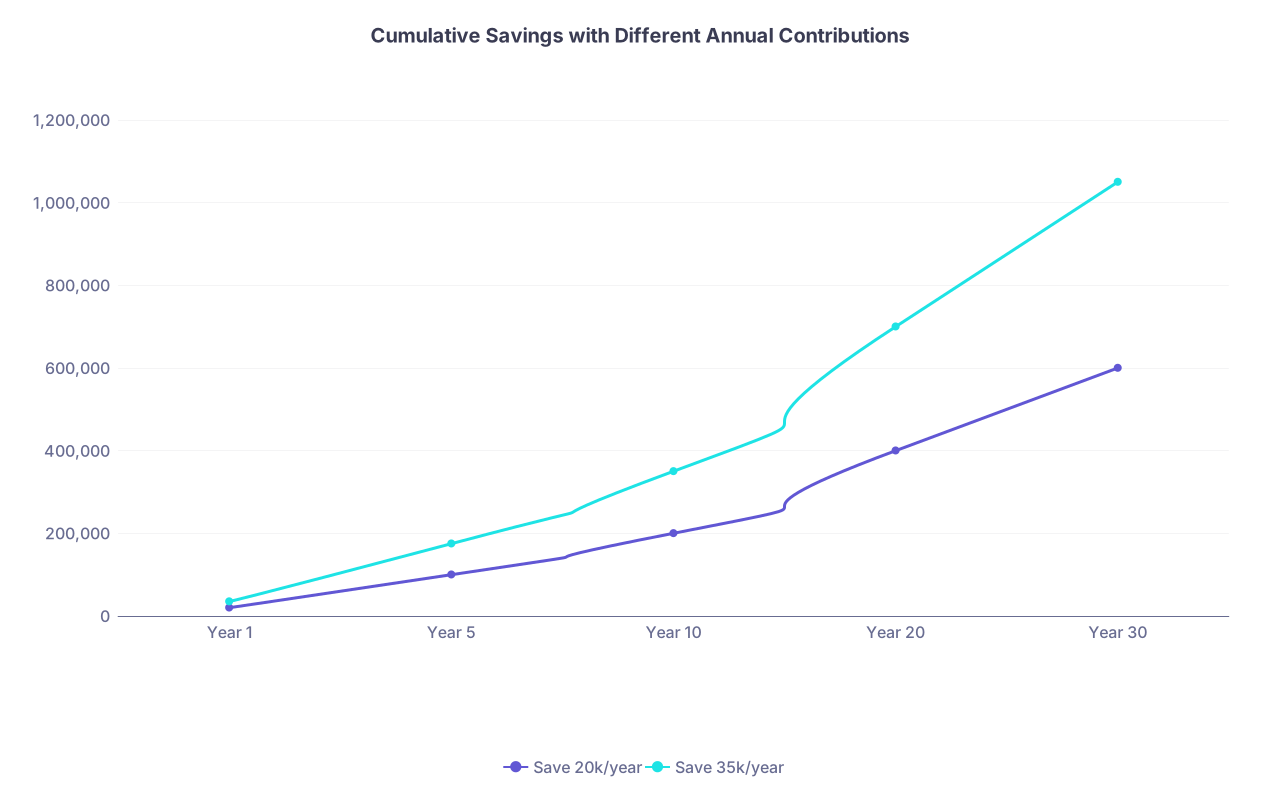
| Category | Save 20k/year | Save 35k/year |
|---|---|---|
| Year 1 | 20000 | 35000 |
| Year 5 | 100000 | 175000 |
| Year 10 | 200000 | 350000 |
| Year 20 | 400000 | 700000 |
| Year 30 | 600000 | 1050000 |
Even modest consistent differences in savings rate dwarf “specialty penalties” over 20–30 years. A pediatrician who reliably saves $35k/year will destroy the net worth of a higher‑paid physician saving $10–15k/year.
The honest statement is this:
- Pediatrics will not maximize your peak income potential.
- Pediatrics does not doom your lifetime wealth potential—your behavior does.
If your financial plan relies on “I need ortho money to atone for my spending,” you don’t have a specialty problem; you have a budget problem.
Myth #3: “Pediatric subspecialties pay just as poorly as general peds”
This is flat wrong and often repeated by people who looked at one academic salary scale and generalized it to the entire field.
We need to separate three different worlds:
- Academic peds (especially at big children’s hospitals)
- Community‑based subspecialty practice
- Hybrid/private models (multispecialty groups, hospital-employed but RVU heavy)
Here’s what you actually see in the wild:
Pediatric cardiology, critical care, neonatology, EM, hospitalist
These often pay substantially more than general pediatrics, especially in non‑coastal, non‑elite academic centers. Mid‑career comp in the high 200s to mid‑300s is not unusual.Endocrinology, rheum, ID, heme/onc (in some markets)
These can cluster near (or sometimes below) general peds in pure academic positions, but that’s not the only practice model available.
To give you a rough comparison of relative typical ranges:
| Role | Typical Range (USD/year) |
|---|---|
| General Pediatrics | 190k–260k |
| Pediatric Hospitalist | 220k–320k |
| Pediatric EM | 270k–400k+ |
| PICU / NICU | 260k–400k+ |
| Pediatric Cardiology | 280k–400k+ |
Are there low‑pay, high‑abuse peds subspecialty jobs? Absolutely. Especially in top‑tier academic centers where prestige is supposed to be your “compensation.”
But the blanket claim “peds subspecialties pay the same as general peds” is lazy. The spread is huge, and a peds critical care doc in a non‑coastal community setting can out‑earn a lot of internal medicine subspecialists.
So if you love peds but worry about money, one rational path is:
- Do categorical pediatrics.
- Keep an open mind to higher‑paying subspecialties (PICU, NICU, EM, cardiology, hospitalist).
- Avoid locking yourself into a low‑RVU, prestige‑only academic track unless that’s genuinely your priority.
Myth #4: “Peds is a dead end unless you do administration or leave clinical work”
You’ll hear this one from bitter people in the wrong job.
The reality: pediatrics has more non‑clinical or semi‑clinical ladders than many realize. Not all pay cardiology‑money, but some get very close—or higher—when you factor hours and predictability.
Common paths I’ve seen real pediatricians take:
Medical director / service line lead in hospital or large group
Think NICU director, hospitalist chief, quality/safety roles. Often comes with stipend + protected time + credibility to negotiate.Public health / population health roles
Medicaid organizations, children’s hospitals, integrated systems love pediatricians who can think at the population level. These can pay surprisingly well when you hit director/VP levels.Industry (pharma/biotech/devices/health tech)
Pediatric trials, vaccines, rare diseases, digital child health. These roles almost always recruit from academic peds and can quickly outpace clinical salaries.Urgent care / telemedicine heavy practice
Flexibility plus higher visit volumes often means RVU upside. I’ve seen “urgent care only” pediatricians with effective incomes above many generalists.
This isn’t fantasy. I’ve watched more than one mid‑career peds hospitalist move into system‑wide quality leadership or health plan CMO roles and suddenly clear $400k+ with fewer nights and weekends than they had as attendings.
Is peds a golden escalator to corporate millions? No. But “dead end” is just inaccurate.
Myth #5: “The only way to make decent money in peds is to kill yourself with volume”
There’s a grain of truth here. The RVU system systematically undervalues preventive and counseling work—core parts of pediatrics. So plenty of peds clinics respond by:
- 15‑minute slots for everyone
- Double‑booking sick visits
- Waiting rooms that look like airport delays with viral exanthems
But that’s not the only model. Practices that refuse to think creatively end up in that treadmill. Others do something smarter:
- Blend in urgent care / walk‑in hours with higher‑reimbursing visits.
- Layer services: simple procedures, behavioral health integration, asthma clinics, lactation consults.
- Use NPs/PAs strategically to offload lower‑acuity follow‑ups while the physician handles complex or higher‑RVU work.
- Negotiate better contracts based on quality metrics, patient satisfaction, and access.
And yes, some go full subscription/direct primary care (DPC) for pediatrics. That’s not mainstream, but there are pediatricians quietly making $250k+ on smaller patient panels with far less chaos.
The bigger point: pediatrics is structurally underpaid per unit of cognitive work, but it’s not locked into the worst‑possible implementation of that structure. The practices that copy‑paste old models get crushed. The ones that design for efficiency and mix of visit types do much better.
Myth #6: “Early career peds salaries predict your whole life”
First‑year pediatrician offers can look depressing compared with surgical subspecialty PGY‑1 attending offers. You’ll see:
- $180–210k first‑year guarantee in some markets
versus - $350–450k for EM/ortho/rads fresh out
Here’s what students miss: early career salaries are the most distorted, least stable numbers in the entire equation.
Why?
- Loans loom large, so small differences feel seismic.
- You’re usually on starter contracts with lower RVU thresholds, weaker negotiating leverage, and more hand‑holding.
- You have no idea yet what you actually value—so you chase the wrong metric (base salary) and ignore call structure, tail coverage, bonus formulas, and schedule control.
Most pediatricians I’ve seen had incomes that:
- Jumped after the initial guarantee years when RVU productivity kicked in.
- Shifted again when they changed employers/markets (huge effect).
- Shifted a third time if they added admin roles, leadership, or side work.
Anchor your life plan on one early offer, and you’re planning off the noisiest data point. Bad idea.
The Real Pediatric Earnings Story: Risk, Flexibility, and Ceiling
So what does the full picture look like?
Floor: You will almost certainly be in the bottom half of physician salaries as a general pediatrician, especially in high‑prestige academic coastal jobs. That’s real.
Ceiling: With the right subspecialty, market, and roles, you can absolutely reach mid‑300s or more. Not derm money, but comfortably high‑income by any sane societal standard.
Risk profile: Pediatrics has a pretty favorable malpractice climate compared to OB, surgery, EM. That’s stress, premiums, and “sleep at night” value you don’t see on salary tables.
Geographic advantage: Children’s hospitals and pediatric shortages in certain regions mean leverage. You can often negotiate more on schedule, loan repayment, or non‑RVU perks than colleagues in hyper‑saturated adult fields.
Longevity: The single biggest financial asset you have is the ability to work—full‑time, consistently—for 25–30+ years. Peds tends to burn people out less brutally than some high‑acuity, high‑RVU fields, especially in outpatient settings. That alone adds up.
Here’s the pattern I’ve seen over and over:
A motivated pediatrician in a sane practice, saving 20–25% of take‑home, who works full‑time to 60–65, is financially fine. Mortgage paid. Kids through college. Retirement funded. Not private‑equity yacht money, but not “I regret my specialty” money either.
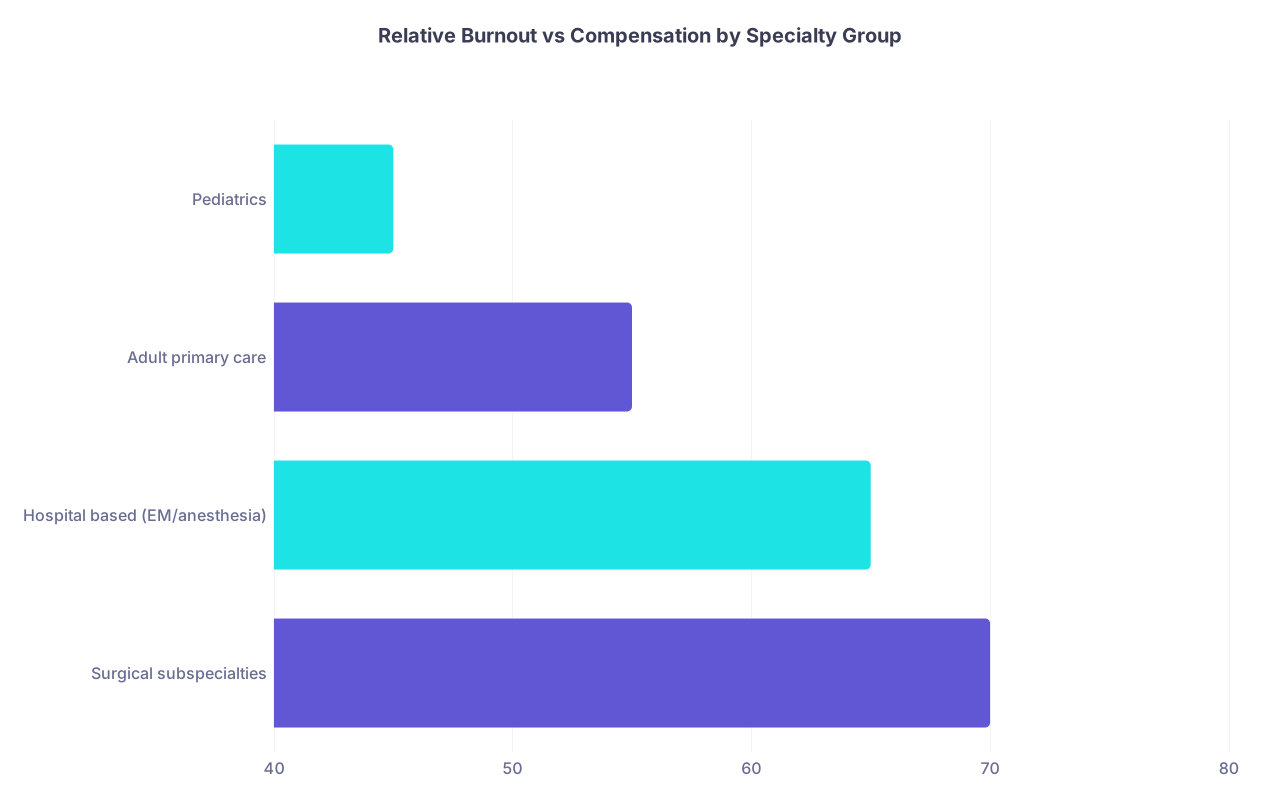
| Category | Value |
|---|---|
| Surgical subspecialties | 70 |
| Hospital based (EM/anesthesia) | 65 |
| Adult primary care | 55 |
| Pediatrics | 45 |
Illustrative burnout percentages, not exact; point is trend.
When you add burnout risk to the equation, pediatrics actually becomes even more financially rational than people think. Lower risk of flame‑out, substance issues, or early exit from practice isn’t sexy, but it’s real money over decades.
FAQs
1. If I care about money at all, should I just avoid pediatrics?
No. If your primary, overriding life goal is to maximize income at all costs, then yes—go chase ortho, derm, radiology, anesthesia. But if you:
- Actually like working with kids
- Can tolerate being in the lower half of physician earners
- Are willing to be intentional with budgeting and saving
…you can be both a pediatrician and financially secure. The “peds = poverty” narrative is exaggerated and mostly repeated by people who never learned basic money management.
2. Is it smarter to do internal medicine and just see a lot of kids?
Not if you actually want to be a pediatrician. IM outpatient panels are overwhelmingly adult; the systems, clinics, and referral patterns aren’t built around kids. If you do IM to “keep the door open” to more money but your heart is in pediatrics, you’re setting yourself up for a career mismatch. If you like adult medicine and want some flexibility, then sure, IM is a defensible choice. But doing IM as a workaround for peds salary anxiety is usually a bad strategic play.
3. What are the highest‑paying paths within pediatrics?
Generally: pediatric EM, NICU, PICU, cardiology, and some hospitalist groups in the right markets. Hybrid roles (clinical + medical director, quality leadership, service line chief) can also bump comp substantially. The key is avoiding chronically under‑reimbursed pure academic jobs in expensive cities unless you’re doing that eyes wide open for non‑financial reasons.
Key takeaways:
Pediatrics earns less on average—but not “you’ll be broke” less. Subspecialization, practice type, and region matter more than the word “pediatrics” on your badge. And over a 30‑year career, your savings behavior, burnout risk, and job choices will shape your wealth far more than the difference between a $230k and $280k starting salary.