
Is Rural FM Only for Underserved Missionaries? The Reality of Practice
Is rural family medicine basically a life sentence of under-resourced clinics, “mission work,” and permanent martyrdom… while your classmates in the city actually get to have careers?
Let’s cut through the romantic marketing and the doom posts on Reddit at the same time.
There’s a very persistent myth floating around med schools and urban residencies: rural FM is only for people who want to “serve the underserved,” live in the middle of nowhere, accept low pay, and sacrifice their personal life “for the community.” If you do not identify as a missionary type, you are told rural is not for you.
That story is wrong. And it actively screws residents who might actually thrive in rural settings but get scared off by a caricature.
I’m not here to sell you on rural FM. I am here to show you what the data and on-the-ground reality look like, so if you say no, it is an informed no—not a fear-based one.
What Rural Practice Actually Looks Like (Not the Brochure Version)
First, define rural. Because people toss that word around like it’s binary.
You’ve got:
- Small towns of 5–20k with a critical access hospital, Walmart, and an Applebee’s
- Really remote frontier areas with a single-road-in, single-road-out clinic
- “Rural-adjacent” communities 45–90 minutes from a medium city, where half your patients commute
Most US “rural family medicine” jobs are in that first or third group, not the Alaskan-bush-plane fantasy you might be picturing.
The stereotype says rural FM = chronically under-resourced, unsafe, and lonely. Reality is a bit more nuanced:
- Many rural jobs are attached to stable health systems or FQHCs with grants, loan repayment, and decent infrastructure.
- Some are one-doc shows where you are the clinic, the ER backup, and the de facto health department.
- A minority are frankly toxic meat-grinder setups where they dangle big money for unsustainable workloads.
I’ve seen all three. The mistake is thinking they’re all the same “mission job.”
Let’s talk numbers for a second.
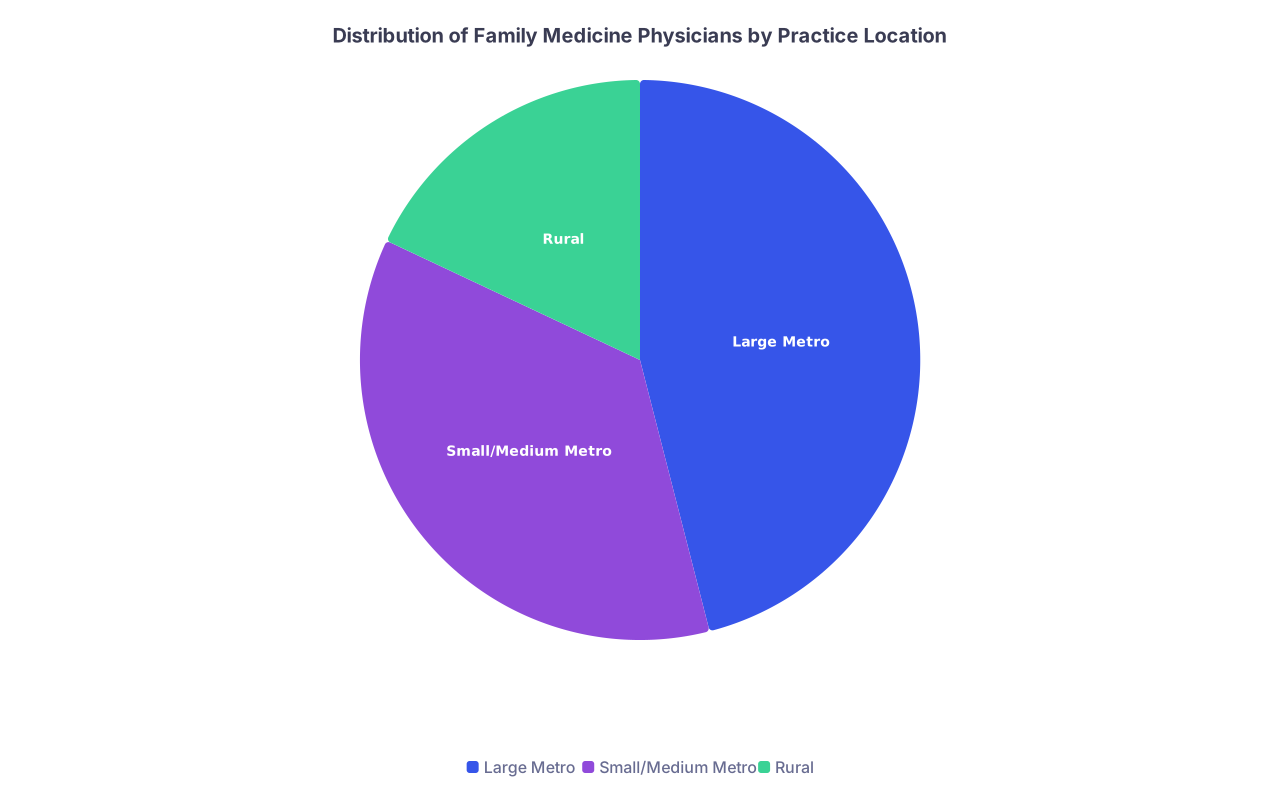
| Category | Value |
|---|---|
| Large Metro | 46 |
| Small/Medium Metro | 36 |
| Rural | 18 |
Those proportions bounce a bit depending on the definition and dataset, but the pattern holds: roughly 15–20% of FM docs are rural. That’s a lot of people. They’re not all martyrs. Many are just… living their lives, paying their mortgage, raising kids, and seeing patients.
The missionary narrative mainly benefits two groups:
- Academic centers that want you to stay nearby
- Systems that want to justify underpaying “mission-driven” physicians
You do not have to buy into that.
Money, Loans, and the “Martyr Discount” Myth
Here’s where the mythology really falls apart.
You’ve probably heard: “Rural jobs pay less, but you get loan repayment.”
Reality: often the opposite.
Yes, many FQHCs and rural clinics qualify for NHSC or state loan repayment. But base salaries in rural FM are often higher than in saturated suburban markets, sometimes much higher.
| Setting | Typical Base+Bonus Range (USD) |
|---|---|
| Urban academic FM clinic | $190k–$230k |
| Large suburban health system FM | $220k–$260k |
| Rural hospital-employed FM | $240k–$300k |
| Remote rural / hard-to-recruit | $260k–$330k+ |
These numbers vary by region and year, but the pattern repeats in MGMA and AAFP survey data: rural FM often pays more, not less, especially when you add:
- Signing bonuses
- Relocation
- Loan repayment (federal NHSC, state programs, or employer-backed)
The “if you go rural you’ll be broke but fulfilled” line is not supported by compensation data.
Here’s what’s really happening:
- Urban markets are saturated. New grads line up for lifestyle jobs. Leverage is weak.
- Rural markets are chronically short. They have to pay to get you there and keep you there.
If you’re carrying $250–400k in loans and you want them gone in 7–10 years, a well-structured rural job plus loan repayment can do more for your net worth than a “prestige” urban clinic job that pays $40–60k less per year and offers no repayment.
Now, is money everything? No. But pretending rural FM equals financial martyrdom is just false.
Scope of Practice: Cowboy Medicine or Real Generalism?
Another myth: rural FM is just chaotic “do everything” cowboy medicine where you’re intubating in the parking lot and delivering babies between well-child checks.
Sometimes. Usually not.
Scope is highly variable, and that’s the whole point.
Rural FM can mean:
- Pure outpatient clinic with light hospital call
- Full-spectrum: OB, inpatient, ED coverage, nursing home, procedures
- Hybrid setups where you do outpatient plus some ER shifts and low-acuity inpatient
The data backs this up. Rural FM docs are more likely than urban counterparts to:
- Do OB and deliveries
- Admit and manage inpatients
- Perform procedures (scopes, colpos, joint injections, skin surgery, etc.)
But “more likely” does not mean “mandatory.” The idea that rural FM = forced full-spectrum for everyone is wrong.
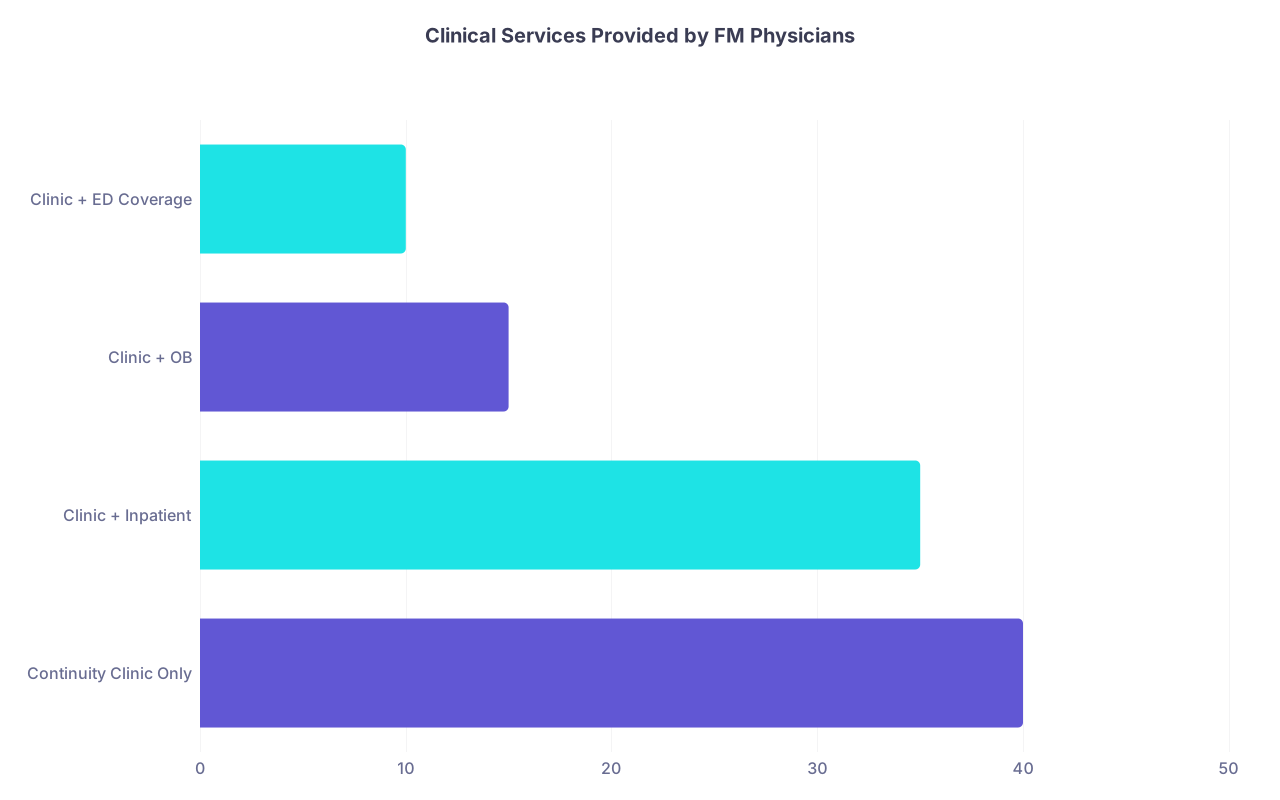
| Category | Value |
|---|---|
| Continuity Clinic Only | 40 |
| Clinic + Inpatient | 35 |
| Clinic + OB | 15 |
| Clinic + ED Coverage | 10 |
Those proportions are approximate and vary by region, but look at that first bar: lots of rural FM jobs are clinic-only or clinic-majority. The extra scope is an option and negotiating point, not an automatic expectation.
Here’s the crucial nuance nobody tells you in med school:
- In urban settings, scope is limited by specialists eager to take anything remotely complex.
- In rural settings, scope is elastic and constrained mostly by your training, comfort, and the availability of backup.
If you’re trained in OB and want to do C-sections, there are rural hospitals that will throw you a parade. If you never want to do a delivery again, there are also rural clinic-only jobs that will not force OB on you.
The missionary myth paints rural FM as “you must do all the things because the poor community needs you.” The real story is far more transactional: communities and hospitals want services; you offer what you are trained and willing to provide; compensation and schedule adjust accordingly.
Lifestyle: Isolation, Burnout, or Hidden Stability?
Here’s the emotional part people gloss over.
You hear: “You’ll be isolated. You’ll burn out. Your spouse will hate you.”
Sometimes true. Often lazy and incomplete.
The risks are real:
- Fewer colleagues means less backup and more personal responsibility.
- Boundaries blur when your patients are also your neighbors, kids’ teachers, and the person behind you in the grocery line.
- Social and dating options can be limited, especially for single physicians or those from underrepresented backgrounds in very homogenous towns.
But there’s another side.
Rural FM often trades the constant friction of urban practice (traffic, long commutes, overcrowded panels, endless admin, EMR metrics) for a different set of pressures that some people actually find more tolerable.
For many rural FM docs I’ve spoken with, quality of life looks like:
- 5–10 minute commute
- Cost of living that makes a physician salary actually feel like a physician salary
- Easy access to outdoor activities instead of fighting for parking near a crowded urban trail
- A level of community recognition and trust that simply doesn’t exist when you’re doctor #34 in a massive clinic
Is that for everyone? Obviously not.
But the assumption that rural automatically means worse lifestyle is lazy. The reality is: rural FM usually amplifies whatever you personally value—or hate.
If you:
- Crave anonymity
- Need a ton of niche restaurants, arts, and nightlife
- Have a partner whose career depends on a big metro
Then yes, rural life may be a poor fit.
If you:
- Hate commuting
- Value lower housing costs, space, and quiet
- Like the idea of being the go-to physician for a community
Then rural can be an upgrade, not a downgrade.
Mission, Identity, and the “Good Person” Trap
Let’s tackle the missionary elephant in the room.
Academic and policy conversations love to frame rural practice as a moral project: “serving the underserved,” “answering a calling,” etc. There’s nothing wrong with genuinely feeling that way.
But the system also uses that moral framing to manipulate physicians.
I’ve heard this pitch, almost verbatim, to graduating residents:
- “This community really needs someone like you.”
- “We’re looking for someone mission-driven, not focused on money.”
- “We can’t match those big-city offers, but you’d be making such a difference.”
Translated: “We’re going to guilt you into accepting worse pay and support than the market actually requires.”
You’re allowed to care about underserved populations and care about your compensation, boundaries, and life. Those are not mutually exclusive.
The truth:
Rural FM is not only for people whose primary identity is “underserved missionary.” It is for:
- People who like broad clinical work
- People who prefer smaller systems and fewer layers of bureaucracy
- People who want non-urban lifestyles
- People who want strong negotiating leverage and financial upside
- And yes, people who are deeply mission-driven, too
You do not have to drape yourself in moral language to justify wanting a rural job that also pays well and respects your time.
Training Path: You Don’t Need a Hyper-Niche Rural Track (But It Helps If You Want Scope)
Let’s talk residencies.
There’s this idea that only graduates of rural tracks or small-town residencies can safely work in rural settings. Also wrong.
Are rural-focused FM programs (like those in Oregon, Washington, North Carolina, Kansas, etc.) valuable? Absolutely. They often give more OB, inpatient, and procedural experience. If you want broad scope, they’re a strong signal and a practical advantage.
But:
- Plenty of standard academic FM grads go rural and thrive.
- What matters far more is your procedural exposure, comfort with acuity, and mentorship in your first job.
If you think rural FM might be on your radar:
- During residency, chase the harder rotations, not just the cushy clinics. That means inpatient, ED, OB, ICU, procedures.
- Seek out elective time in rural or semi-rural hospitals to see what real jobs look like.
- Talk to graduates from your program who went rural and ask what they wish they’d trained more on.
You don’t need a “Rural Medicine” stamp on your diploma. You need competence, humility, and a clear understanding of your own limits.

| Step | Description |
|---|---|
| Step 1 | FM Residency |
| Step 2 | Rural-focused FM program |
| Step 3 | Standard FM program |
| Step 4 | Strong full spectrum prep |
| Step 5 | Electives in rural sites |
| Step 6 | Wide scope rural job |
| Step 7 | Clinic focused rural job |
| Step 8 | Rural Track? |
Notice what’s missing from that diagram: “Join because you are a missionary.” Not required.
How to Tell a Good Rural Job from a Disaster
This is where all the myths crash into reality. Rural FM is not inherently good or bad. Individual jobs are.
You want a quick screen? Ask about:
- Call structure and backup: Who’s on with you? Can you call specialists? Tele-hospitalist?
- Actual patient volume, not just “average”: How many per day? New vs follow-up?
- How many docs have left in the last 5 years and why: If they dodge this, that’s your sign.
- Scope specifics: OB optional or expected? ED coverage? Nursing home responsibilities?
- Protected time: For admin, teaching, QI. Or are you expected to “handle that after clinic”?
- Compensation clarity: Base, bonus structure, RVU thresholds, loan repayment terms in writing.
The missionary narrative often hides these concrete questions under vague language about “serving” and “community needs.” You cannot afford that. Ask like a professional, not a volunteer.
Bad rural FM jobs absolutely exist: unsafe staffing, exploitative call, no backup, leadership that lives 3 hours away and has never covered a night in the hospital. But that’s not a rural problem. That’s a bad-job problem.
Your leverage is actually stronger in rural hiring because they need you. Use it.
The Reality: Who Rural FM Is Actually For
Strip away the myths and here’s the uncomfortable but honest answer.
Rural FM is usually a good fit if:
- You want broader clinical work than “20 outpatient visits a day and nothing else.”
- You’re okay being seen and recognized in your community instead of anonymous.
- You value lower cost of living, short commutes, and some degree of quiet.
- You’re willing to engage with a system that’s imperfect but more flexible than a giant health empire.
Rural FM is usually a bad fit if:
- You need dense urban culture, anonymity, and lots of peers your age.
- You hate being “on” in public and prefer strict separation of work and life.
- Your partner’s career is locked to a big metro.
- You want hyper-specialized clinical work with narrow scope.
Notice what’s not on either list: “desire to be a missionary.” That’s optional.
So, Is Rural FM Only for Underserved Missionaries?
No.
Rural family medicine is:
- A spectrum of practice environments with generally broader scope and higher leverage than urban FM
- Often better compensated than its urban counterparts, especially when you factor in loan repayment and cost of living
- A lifestyle choice that amplifies your preferences—good or bad—rather than a moral calling reserved for martyrs
If you walk away from rural FM, do it because you know exactly what you’re saying no to. Not because someone in an urban academic office told you it’s only for saints willing to work for less.