
The biggest mistake future geriatricians make is pretending all geriatric pathways are interchangeable. They are not. Internal medicine, family medicine, and psychiatry build three very different brains under the same “I like old people” umbrella.
Let me break this down specifically.
Step 1: Understand What “Geriatrics” Actually Is
Before you compare IM vs FM vs Psych, you need a clear definition in your head of what you are aiming for. “I like grandmas” is not a career plan.
Geriatrics is fundamentally about three things:
- Managing multimorbidity and polypharmacy in the context of aging physiology.
- Protecting function: cognition, mobility, independence, and dignity.
- Coordinating care across settings: hospital, clinic, SNF, rehab, home, hospice.
Different primary specialties approach those three pillars from different angles:
Internal medicine geriatrics:
Think high-acuity, complex inpatient older adults, consults, and academic systems of care. Heavy on pathophysiology, guidelines, and hospital-based practice.Family medicine geriatrics:
Think longitudinal, community-based, full-context care: elders plus their families, homes, and primary care networks. Breadth across ages, heavy outpatient, a lot of “real life.”Geriatric psychiatry:
Think cognition, behavior, mood, capacity, and neuropsychiatric complications of aging. Less CHF titration, more managing dementia-related agitation and delusions without chemically restraining someone.
If your brain lights up more at “which heart failure guideline do I follow in this 88‑year‑old with CKD and orthostatic hypotension?” you are on a different track than someone who loves “how do I safely treat this 79‑year‑old with psychosis and Lewy body dementia?”
So keep that three‑pillar model in your head as we compare.
Step 2: The Training Structures – IM vs FM vs Psych to Geriatrics
Let us get concrete about what the training actually looks like.
| Pathway | Length (US) | Credential | Typical Practice Mix |
|---|---|---|---|
| IM → Geriatrics | 3 + 1 yrs | IM + Geriatrics fellowship | Hospital, consults, clinic, SNF |
| FM → Geriatrics | 3 + 1 yrs | FM + Geriatrics fellowship | Outpatient, SNF, home health, primary care |
| Psych → Geriatric Psych | 4 + 1 yrs | Psychiatry + Geriatric Psychiatry fellowship | Inpatient psych, memory clinic, LTC psych, consults |
Now, what actually changes your day-to-day life is the residency foundation before fellowship.
Internal Medicine → Geriatrics
Structure: 3 years categorical IM + 1-year ACGME geriatrics fellowship.
What IM gives you:
- Comfort with high-acuity medicine: sepsis, AKI, decompensated CHF, delirium on top of all that.
- Strong hospital and consult identity: you are the person called when the older adult on Ortho’s service gets acutely confused.
- Solid grounding in subspecialty interfaces: cards, renal, heme/onc, ID—critical in older adults.
Geriatrics fellowship on top of IM usually emphasizes:
- Complex inpatient consults (delirium, goals of care, capacity).
- Nursing home and rehab medicine.
- Outpatient consultative geriatrics and co-management clinics.
- Interdisciplinary team leadership (SW, PT/OT, pharmacy, nursing).
The IM foundation means you are trained to think: “what is reversible here, what is evidence-based, what is the medical risk if we do X vs Y?”
Family Medicine → Geriatrics
Structure: 3 years FM + 1-year geriatrics fellowship.
What FM gives you:
- Broad outpatient primary care focus across the lifespan.
- More exposure to OB/peds and procedures, though you will not use most obstetric skills in geriatric-heavy careers.
- Stronger training in community medicine, home care context, and continuity with families.
Geriatrics fellowship after FM looks structurally similar to IM-geriatric fellowships, but the flavor is different:
- More emphasis on continuity primary care for older adults.
- More comfort with home visits and community resources.
- Often a larger proportion of time in SNFs and assisted living facilities.
The FM foundation trains you to think: “what matters most to this person and their family over the next few years, and how do I create a whole-life plan around that?”
Psychiatry → Geriatric Psychiatry
Structure: 4 years psychiatry + 1-year geriatric psychiatry fellowship.
What Psych gives you:
- Deep training in mental status exams, capacity evaluations, and longitudinal psychopharmacology.
- Heavy experience with systems issues: DID this patient actually take their meds? Are they safe at home? Who is their proxy?
- Skill in non-pharmacologic behavioral management and psychotherapy techniques.
Geriatric psych fellowship adds:
- Dementia subtypes and neuropsychiatric syndromes.
- Capacity, guardianship, and ethics at a much more advanced level.
- Facility psychiatry, LTC psych, and complex polypharmacy in cognitively impaired older adults.
The psychiatry foundation trains you to think: “what is driving this behavior, what is reversible, and what is the least harmful way to manage it?”
Step 3: What Your Day Actually Looks Like – Compare Real-World Roles
This is where students usually have the rosiest, least accurate mental images. Let us fix that.
IM-based Geriatrician – Typical Practice Patterns
Common settings:
- Academic hospital with a dedicated Geriatrics consult service.
- Co-management of older adults on Ortho/trauma, Oncology, or Surgery services.
- VA systems with geriatric clinics and CLCs (Community Living Centers).
- Mix of outpatient geriatrics clinics + SNF medical director role.
Your day might look like:
- Morning: new consults on delirious post-op hip fractures, advanced CHF with repeated admissions, goals-of-care meetings.
- Midday: interdisciplinary rounds with PT/OT, pharmacy, SW on a geriatric unit.
- Afternoon: outpatient clinic with complex polypharmacy, cognitive evaluations, frailty assessments, and advanced care planning.
- One afternoon a week: SNF visits as medical director.
Psych issues are part of the work, but you are not deeply manipulating psychotropic regimens for treatment-resistant bipolar disorder. You are mostly managing delirium, depression, anxiety, behavioral issues in dementia—often in partnership with psych.
FM-based Geriatrician – Typical Practice Patterns
Common settings:
- Community primary care with a large geriatric panel.
- SNF and ALF medical director roles.
- Home-based primary care (VA HBPC, private groups, ACO-based programs).
- Occasional academic roles, especially in community-based geriatric clinics.
Your day might look like:
- Morning: outpatient clinic. Medicare wellness visits, chronic disease management, cognition screening, family meetings, slow thorough visits.
- Late morning: quick drive to a nearby SNF for rounds on post-acute rehab and long-term care patients.
- Afternoon: home visits, telehealth geriatrics consults, and transitional care visits after hospital discharges.
Less ICU, less acute inpatient management, more slow, longitudinal chaos: family conflict, social determinants, conflicting specialist recommendations, and endless med lists from multiple prescribers.
Geriatric Psychiatrist – Typical Practice Patterns
Common settings:
- Inpatient geriatric psych units.
- Memory disorders clinics (often jointly run with neurology or geriatrics).
- LTC facilities and nursing homes as consulting psychiatrist.
- Integrated roles on consult-liaison (C‑L) psychiatry services with a geriatric focus.
Your day might look like:
- Morning: rounding on a geriatric psych unit—managing severe agitation, psychosis, major depression with passive suicidality in dementia, complicated by Parkinsonism or strokes.
- Midday: C‑L consults—capacity evals, suicidal ideation in medically ill older adults, delirium vs primary psychosis.
- Afternoon: memory clinic with detailed cognitive assessments, parsing Alzheimer disease vs vascular dementia vs LBD, adjusting meds and nonpharmacologic care plans with caregivers.
You will know heart failure and CKD exist; you will not be the one titrating GDMT. You call medicine or geriatrics for that.
Step 4: The Core Skill Sets Each Pathway Refines
This is where the foundation specialty really matters: it changes how you think about the same 85‑year‑old in front of you.
How IM Shapes a Geriatrician
Internal medicine drills into you:
- Diagnostic rigor: ruling out reversible causes, worrying about zebras enough to not miss them.
- Comfort with inpatient complexity: pressors, vents, dialysis, invasive lines (at least early in training).
- Familiarity with specialist language: you can parse cardiology notes and oncology trial data easily.
As a geriatrician with an IM base, you tend to:
- Be very comfortable with complex medical decision-making.
- Take the lead on co-management in the hospital.
- Feel at home in academic environments, quality improvement, and systems work (e.g., delirium prevention protocols, frailty screening in pre-op clinics).
Weak spots:
- Less pediatric or OB exposure—not relevant for geriatrics, but it means your training lens is adult-focused from the start.
- Sometimes less emphasis on home context, family systems, and broad community resources compared to FM.
How FM Shapes a Geriatrician
Family medicine instills:
- Whole-family, whole-life thinking: you are trained to see the patient’s kids, caregivers, and living situation as part of the treatment plan.
- Comfort with breadth: minor procedures, mental health basics, palliative principles, and community resources all woven in.
- Strong continuity mindset: you learn to optimize care over years, not months.
As a geriatrician with an FM base, you often:
- Excel in outpatient continuity and relationship-based care.
- Are very comfortable navigating messy real-world settings: ALFs, home care, under-resourced communities.
- Take leadership roles in SNFs, ACOs, and population health efforts aimed at “high utilizers.”
Weak spots:
- Less rigorous exposure to high-end tertiary subspecialty medicine at some (not all) FM programs.
- Less total time in large academic hospital inpatient medicine compared to IM residents at the same institution.
How Psychiatry Shapes a Geriatric Psychiatrist
Psychiatry trains you to:
- Live and breathe mental status exams and nuanced interviews.
- Understand psychopharmacology, side effect profiles, and drug–drug interactions very deeply, especially CNS-active agents.
- Be comfortable with slow, longitudinal detective work around behavior, trauma, and family dynamics.
As a geriatric psychiatrist, you:
- Become the go-to person for any question about dementia-related agitation, mood disorders in older adults, capacity, and guardianship.
- Learn how to design behavioral plans in facilities so staff do not default to chemical or physical restraints.
- Carry significant medicolegal weight in guardianship hearings, capacity evaluations, and risk management.
Weak spots:
- You will rely heavily on medicine and geriatrics colleagues for decisions about non-psychotropics, fluid status, and complex non-psychiatric management.
- If you crave doing medical procedures or managing sepsis, you will be frustrated. That is not this job.
Step 5: Personality and Cognitive Style – Who Fits Where?
You already know enough about yourself to answer some of this honestly. Let me map the fit.
Better Fit for IM → Geriatrics
You are likely an IM-geriatrician at heart if:
- You enjoy pure internal medicine rotations a lot more than clinic-only FM months.
- You like being the medical “adult in the room” on interdisciplinary teams, especially in the hospital.
- You like guidelines and trial data and enjoy wrestling with “we have no good evidence in 90‑year‑olds, but here’s the best extrapolation.”
- You see yourself comfortable in academic hospitals, VAs, or large health systems.
Typical student signal: On wards, you are the one happily managing eight-med-problem patients while others groan.
Better Fit for FM → Geriatrics
You lean FM-geriatric if:
- You prefer continuity clinic over tertiary-referral ICU.
- Social dynamics, family systems, and the home context interest you as much as the pathophysiology.
- You like community settings, rural or suburban medicine, and do not need the prestige of a giant academic center to feel validated.
- You want the option to retain some non-geriatric practice (e.g., seeing a few adults under 65, doing some women’s health, or continuing palliative-focused work).
Typical student signal: You enjoy your FM rotation more than IM even if the medical complexity is a bit lower, because the continuity and context feel right.
Better Fit for Psych → Geriatric Psychiatry
You are a geriatric psychiatrist in disguise if:
- You are fascinated by psychiatry on rotations—especially older adults with “weird” presentations.
- You find capacity evals, guardianship cases, and “is this delirium, dementia, or psychosis?” puzzles fun rather than annoying.
- You care deeply about caregivers, family stress, and the suffering around behavioral and cognitive decline.
- You are content letting someone else manage the furosemide, but you want to decide how much quetiapine is safe—or whether to use it at all.
Typical student signal: On inpatient med, you keep asking for psych consults. On psych, you gravitate to the older, “difficult” patients that others try to avoid.
Step 6: Competitiveness, Training Sites, and Jobs
People worry way too much about theoretical competitiveness and not enough about fit and job realities.
Residency and Fellowship Competitiveness
Broad strokes, U.S.:
- Categorical IM: Variable, but plenty of positions. Academic university programs more competitive; community IM widely available.
- FM: Generally less competitive than IM; lots of spots, especially in community programs.
- Psychiatry: Increasingly competitive, but still accessible with solid stats and a coherent story.
Geriatrics fellowships:
- Geriatrics (IM or FM-based): Historically underfilled. If you are a decent resident genuinely interested, you will match somewhere good.
- Geriatric Psychiatry: Some programs competitive, especially at big-name academic centers, but overall much more accessible than, say, child & adolescent psych at the top institutions.
So: choose the base specialty you actually want to live in for 3–4 years. Do not overthink fellowship competitiveness; geriatrics is not derm.
Job Market and Lifestyle
Here is the blunt version.
Geriatricians (IM or FM): High demand, especially in VAs, ACOs, SNFs, and academic centers trying to build geriatric consult models.
Downsides: Reimbursement is still stupidly misaligned; cognitive work is undervalued compared to procedures. You are paid okay, but not cardiology money.Geriatric Psychiatrists: Extremely high demand. You can basically write your ticket in many regions.
Downsides: Emotional load is high. Behavioral disturbances, caregiver burnout, institutional pressure to “make them easier to manage.”Lifestyle:
- IM-based geriatrics can be more inpatient-heavy with call, but typically less brutal than general medicine hospitalist work once you are subspecialized.
- FM-based geriatrics often means clinic + facilities; call is more phone-based, fewer middle-of-the-night emergencies.
- Geriatric psychiatry tends to have good lifestyles compared to other hospital-based specialties, though facility crisis calls and behavioral emergencies can spike stress.
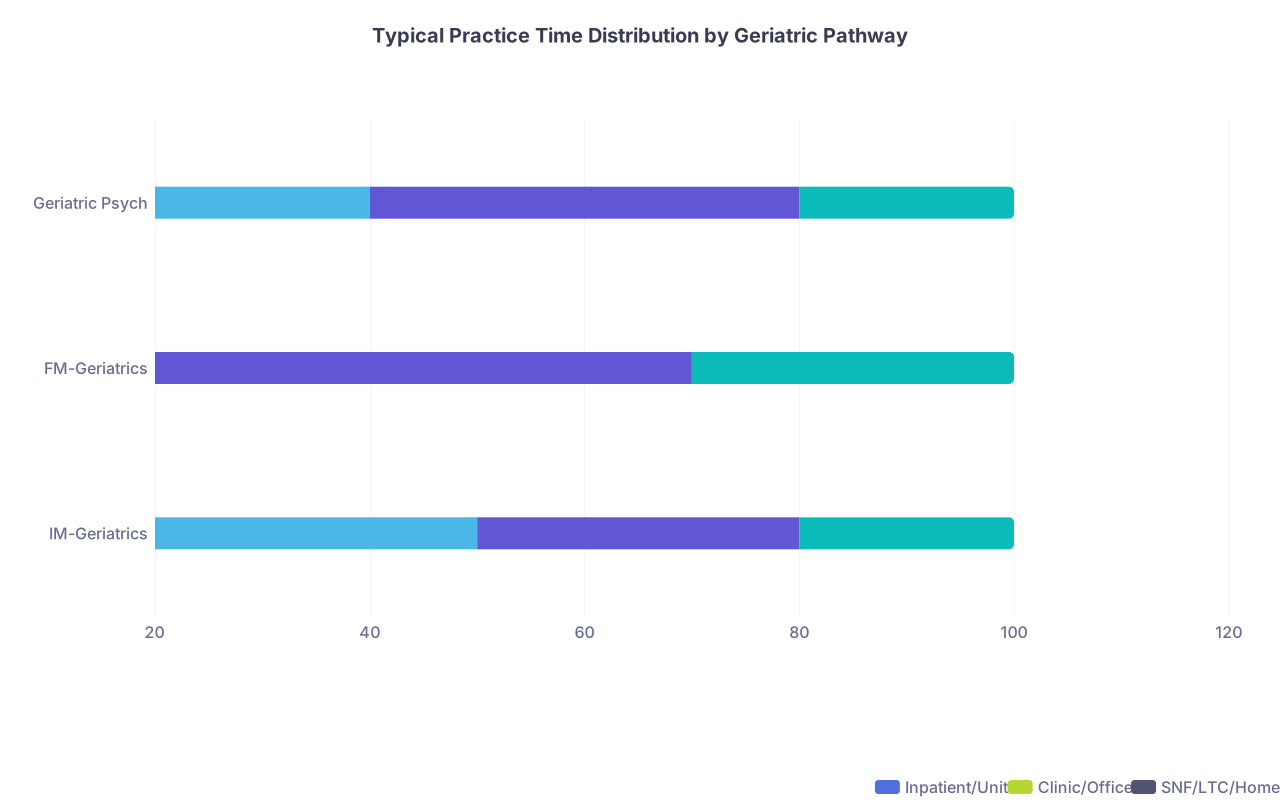
| Category | Inpatient/Unit | Clinic/Office | SNF/LTC/Home |
|---|---|---|---|
| IM-Geriatrics | 50 | 30 | 20 |
| FM-Geriatrics | 20 | 50 | 30 |
| Geriatric Psych | 40 | 40 | 20 |
Step 7: Training Experience – What Your Residency Years Will Actually Feel Like
This is where people underestimate the grind. You do not get to “skip” your base specialty experience just because you plan geriatrics later.
IM Residency Experience (en route to Geriatrics)
Three years of:
- Lots of inpatient ward months, ICU, night float.
- Subspecialty consults (cards, GI, renal, heme/onc, ID).
- Some continuity clinic, but the culture is inpatient-dominant at many programs.
It is intense. You will treat a ton of 70–90‑year‑olds with sepsis, NSTEMI, COPD exacerbations, etc. You will also treat young alcoholics, middle-aged diabetics, and everything else.
If you fundamentally dislike inpatient internal medicine, this will be a slog. Geriatrics fellowship does not erase that.
FM Residency Experience (en route to Geriatrics)
Three years of:
- Heavy continuity clinic from PGY1 onward.
- Inpatient adult medicine, but usually fewer months of high-acuity tertiary care compared to IM.
- Some OB, peds, and emergency medicine built in.
- Many programs with strong nursing home or home visit tracks.
You will see plenty of older adults—but also lots of well-child checks, prenatal visits, sports physicals, etc. If that sounds miserable, accept that.
The flip side: if you like the idea of being grounded in outpatient culture early, FM feels much more psychologically sustainable for some people than academic IM.
Psychiatry Residency Experience (en route to Geriatric Psych)
Four years of:
- Inpatient psych units, C‑L psychiatry, outpatient clinics.
- Required neurology and some EM/inpatient medicine early on, but far less overall medical training than IM or FM.
- Lots of time learning therapy models (CBT, psychodynamic basics, supportive therapy) and psychopharm nuance.
You will not be “just doing geri psych” in residency. You will manage young first-break psychosis, substance use disorders, personality disorders, and everything else. If you hate that idea, do not pick psych as your base.
Step 8: How to Decide – Concrete Questions to Ask Yourself
Do not decide this in the abstract. Use your experiences.
Here is the mental checklist I walk students through:
On IM and FM rotations, did you enjoy the medical optimization piece of older adults? Titrating meds, ordering diagnostics, interpreting labs.
- Yes, and I liked the hospital: IM → geriatrics.
- Yes, but I prefer clinic and long visits: FM → geriatrics.
On psych rotations, did older adults with behavioral disturbances and confusion fascinate you or just exhaust you?
- Fascinate: psychiatry with later geri psych fellowship is a serious contender.
- Just exhaust: you want some psych exposure but not a psych career.
How much do you care about procedures or acute high-stakes resuscitation?
- Care a lot: IM will scratch that itch more (at least during residency).
- Minimal interest: FM or psych might be more psychologically sustainable for you.
Can you tolerate 3 intense inpatient-heavy years of IM residency?
- If you are already burnt out by 3rd-year clerkships and dread another ramp-up, FM or psych will likely feel more balanced.
What setting do you see yourself in 10 years? Picture it in detail.
- Major academic center, doing research/education and hospital consults: IM geriatrics fits best.
- Community, home visits, SNF leadership, flexible outpatient practice: FM geriatrics fits best.
- Memory clinic + geriatric psych unit + LTC consults: geriatric psychiatry.

| Step | Description |
|---|---|
| Step 1 | Like psych more than medicine? |
| Step 2 | Consider Psychiatry |
| Step 3 | Prefer inpatient or outpatient? |
| Step 4 | Internal Medicine |
| Step 5 | Family Medicine |
| Step 6 | Later Geriatric Psych |
| Step 7 | Later IM-Geriatrics |
| Step 8 | Later FM-Geriatrics |
Step 9: Strategic Planning – What You Should Do in Medical School
You are not choosing your fellowship in MS2. You are building evidence you understand what you are getting into.
Concrete moves:
Do geriatrics electives from more than one angle:
- A hospital-based geriatrics consult month (IM flavor).
- A community or home-based geriatrics elective (FM flavor).
- A memory clinic or geriatric psych month (Psych flavor).
Join or seek out:
- A geriatric interest group.
- A research project on delirium, polypharmacy, dementia care, or long-term care outcomes.
Pay attention on core rotations:
- On IM: did you like the 85-year-old with CHF and CKD more than the 40-year-old with DKA?
- On FM: did you love long Medicare visits or dread them?
- On Psych: were you drawn to the older confused patient, or did you prefer young depression/anxiety?
Talk to actual attendings with the careers you are considering:
- IM-geriatrician at a teaching hospital.
- FM-trained geriatrician in a community practice or SNF-heavy role.
- Geriatric psychiatrist at an academic center.
Ask brutal questions: “What sucks about your job?” If they cannot answer that in under 30 seconds, they are either lying or not very reflective.

Step 10: Myth Busting – Common Bad Assumptions
Let me quickly flatten a few myths I hear all the time.
“If I want geriatrics, I should do FM because it is easier.”
Wrong framing. FM is not a consolation prize. It is a different specialty with a different culture and scope. Pick it because you like its model of care, not because you fear IM.“Psychiatry is less ‘real medicine,’ so I will lose my skills.”
If your joy is in managing hypertension and heart failure, do not go into psych. If your joy is in managing cognition, mood, and behavior, those are real medicine. You are just trading procedures and lab trends for thought work and behavioral complexity.“I can do geriatrics without a fellowship.”
Technically yes, especially in FM. But formal geriatrics or geriatric psych training gives you credibility, deeper skill sets, and better positions in academic and system-level work. And yes, you actually learn things you will use daily.“Geriatrics is depressing.”
Parts of it are. So is oncology. So is critical care. Geriatrics also has a lot of wins: preventing falls, preserving independence, helping families navigate incredibly hard transitions. The question is whether you find meaning in that, not whether it is “cheerful.”

Key Takeaways
- Internal medicine, family medicine, and psychiatry lead to very different geriatric careers because they shape how you think: IM for complex medical decision-making, FM for longitudinal community care, Psych for cognition/behavior/capacity.
- Choose your base residency based on the clinical environment and patient problems you like right now, not on an abstract idea of “geriatrics later.” You cannot skip the core identity of your chosen specialty.
- If you are serious about geriatric work, get real exposure from each angle—IM consults, FM community geriatrics, and geriatric psych or memory clinic—then commit to the pathway that matches your actual day-to-day preferences, not your fantasy.