Urban underserved family medicine tracks are not just “FM but with more Spanish and social work.” They are structurally different ecosystems. If you do not understand the clinic design, panel logic, and hidden curriculum, you will choose blindly—and that is how people burn out or end up in the wrong program.
Let me break this down like you actually have to make a rank list in three weeks.
1. What “Urban Underserved FM” Actually Means (Not the Brochure Version)
Most programs will slap “urban underserved” on their website if they are within 10 miles of a bus route and see Medicaid. That is not what you are looking for.
An authentic urban underserved FM track usually has three non-negotiables:
The core continuity clinic is a safety-net setting:
- FQHC / FQHC look-alike
- County hospital clinic
- Public health department clinic
- Large nonprofit community health center with >50–70% Medicaid / uninsured
The clinical mission is explicit:
- Homelessness, newly arrived immigrants/refugees, justice-involved patients, undocumented communities, behavioral health comorbidity, substance use, complex social determinants.
The track infrastructure is built-in, not “we’ll help you find your own experiences”:
- Dedicated faculty leads
- Defined curriculum block or longitudinal series
- Protected time for community, advocacy, or street medicine
If you are hearing “We see a lot of underserved patients” but you cannot get direct answers to where residents’ continuity clinic actually is, walk away. Or at least lower it in your rank list.
2. Clinic Structures: Where You Actually Live as a Resident
Clinic structure is the backbone of your residency life. Especially in FM. The hospital is a rotation; your clinic is your home base, even if it is a chaotic one.
Major Clinic Models You Will See
| Model | Typical Setting |
|---|---|
| Hospital-owned residency clinic | County or public hospital |
| FQHC residency track | Federally Qualified Health Center |
| Hybrid hospital–FQHC | Split clinic sites / joint venture |
| Community health center with teaching track | Large nonprofit CHC |
| “Token” underserved half-day | Academic center add-on |
Let me walk through the ones that matter.
2.1 Hospital-owned County / Safety-net Clinic
Structure:
- Clinic owned by the public or county hospital system.
- Residents often share space with NP/PA, attendings, sometimes internal medicine clinics.
What it looks like day to day:
- You walk from inpatient wards directly to clinic—same building or campus.
- Scheduling and EMR are hospital-driven (Epic, Cerner, etc.).
- Panels pulled from hospital’s patient base: uninsured, Medicaid, dual-eligible, limited English proficiency, frequent ED users.
Upsides:
- Easier integration with inpatient teams, OB, ED.
- Strong exposure to high-acuity complex patients.
- Often good specialist backup in-house (ID, cards, heme-onc).
Downsides:
- You are a service line in a bureaucracy. Clinic processes can be glacial to change.
- Social work and care coordination vary wildly—some counties are excellent, others are a wasteland.
- Residents sometimes feel like back-up PCPs for the hospital’s “no one else will take them” population, with no meaningful panel curation.
Key question to ask:
- “How many of my clinic patients are paneled directly to me versus to ‘resident clinic’ as a pool?”
If no one can answer that, they probably do not think in terms of true continuity.
2.2 FQHC-based Residency Track
Structure:
- Residency continuity clinic sits inside an independent FQHC, sometimes with its own board, CEO, and revenue streams.
- Department of Family Medicine contracts with the FQHC for teaching.
What it looks like:
- You are in a community clinic building, not a hospital.
- Workflows revolve around value-based care, UDS measures, and HRSA grants.
- Strong emphasis on integrated behavioral health, enabling services, and care managers.
Upsides:
- This is usually where the most serious, mission-driven urban underserved work is happening.
- Team-based care is real: behavioral health huddles, community health workers, medical-legal partnership, etc.
- Graduates are highly employable in safety-net and community health center worlds because they understand FQHC metrics, billing, and workflows.
Downsides:
- Fragmentation—your inpatient rotations may be at a distant hospital with a different EMR and culture.
- FQHC finances are fragile; leadership turnover can dramatically change your experience mid-residency.
- Sometimes you are the “cheap primary care workforce” to hit organizational metrics; you need strong faculty advocates.
Red-flag answer:
- “Residents see the same patients as all the attendings; we just put them on the first available.”
That means no one is safeguarding continuity.
2.3 Hybrid Hospital–FQHC Model
Structure:
- You split time between a hospital-based clinic and a community health center or FQHC, OR the hospital owns an FQHC-branded clinic.
Typical patterns:
- PGY-1 more time in hospital clinic, PGY-2/3 gradually transition to community site.
- Or half your clinic sessions at each site, with two different panels.
Pros:
- Exposure to both environments, better sense of your future options.
- Sometimes better specialty access via the hospital when you are at the FQHC.
Cons:
- Panel confusion. Patients lost between sites. Multiple EMRs.
- You can end up with “fake continuity” if patients bounce between locations.
Question for residents:
- “How many sites do you personally see your continuity patients at? One EMR or more? How often do patients get booked into the wrong location?”
2.4 The “Token Underserved Half-day” (Avoid)
Structure:
- Main residency clinic is a cushy academic or private-like setting.
- “Underserved experience” = one half-day per week at a free clinic or satellite.
This is not an urban underserved FM track. It is seasoning. Good for exposure. Not for training your core skill set.
If the website screams “urban underserved” but the structure is this, you are not getting what you think.
3. Patient Panels: Size, Complexity, and How They Are Actually Built
You will hear panel numbers thrown around without context. A “1,200-patient panel” in suburban FM is not the same as a 1,200-patient panel in a refugee-heavy FQHC.
3.1 What a Resident Panel Really Is
At minimum, a panel is:
- Patients attributed to you who:
- Have chosen you (or were assigned) as PCP
- Are scheduled preferentially with you for continuity
- Are part of your preventive and chronic disease responsibilities
Urban underserved adds complications:
- High no-show rates (20–40%).
- Unstable contact info.
- Frequent ED/hospital use.
- Insurance churn (Medicaid cycles, periods uninsured).
- Language and literacy barriers.
That means your panel size targets and expectations must be adjusted.
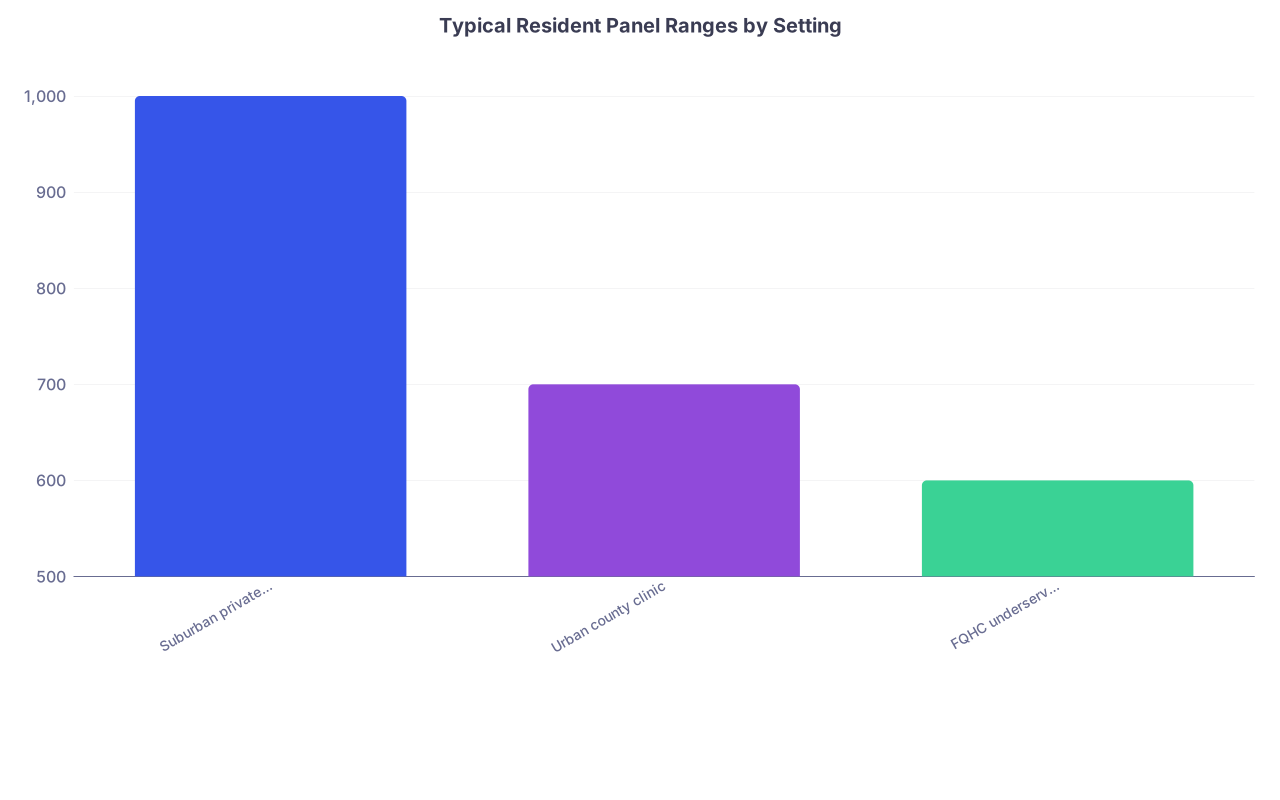
| Category | Value |
|---|---|
| Suburban private-like FM | 1000 |
| Urban county clinic | 700 |
| FQHC underserved track | 600 |
Seriously: anyone trying to give you 1,000+ medically and socially complex patients as a resident in an underserved track is either lying about what “panel” means or setting you up to drown.
3.2 How Panels Get Assigned (and Where Programs Hide Their Philosophy)
There are a few archetypes:
“Resident of the day” pool
- All patients booked with whatever resident has continuity that session.
- Minimal ownership, high chaos.
- Great for “throughput”, terrible for relationship-building.
True PCP attribution
- Each patient has a specific named resident PCP.
- Scheduling prioritizes that resident; only seen by others if urgent or resident unavailable.
- Missed appointments trigger outreach workflows to get back to PCP.
Hybrid
- Patients may be paneled, but clerks and schedulers ignore PCP fields when searching for “next available.”
- Looks good on paper, functionally a pool system.
When you interview, ask:
- “What percent of your clinic sessions are with your own paneled patients?”
- “If a patient calls with a non-urgent issue, will they be offered the next available slot, or the first slot with me specifically?”
- “Do you have any say in what kind of patients get paneled to you—pediatrics-heavy, OB-heavy, complex adult?”
Watch residents’ faces when they answer. You will know.
3.3 Visit Volumes and Template Structure
Urban underserved tracks often run higher visit complexity with lower volumes per session—if leadership understands reality.
Common patterns:
- PGY-1: 4–6 patients per half-day
- PGY-2: 6–8 per half-day
- PGY-3: 8–10 per half-day, sometimes more
But complexity matters:
- Double-booked 20-minute slots + interpreter + chronic disease management + social crisis = a mess.
- 15-minute slots for new refugee arrivals with zero prior records = malpractice waiting to happen.
You want to see:
- Longer visit times for complex care (30–40 minutes) at least for new patients and annual visits.
- Flexible templates: acute slots vs continuity vs procedures.
- Built-in team-based care that offloads some work (RN chronic care visits, behavioral health warm hand-offs, pharmacist visits).
Red flag:
- “We see 12–14 per half-day by the end of residency; you will learn to be efficient.”
That might be fine in a stable insured population. In a high-needs, language-challenged environment, it is fantasy or exploitation.
4. Curricula: What “Urban Underserved” Training Should Actually Teach You
If the curriculum is just “usual FM rotations + a community medicine lecture series,” that is not a true track. You want structural and longitudinal differences, not just themed PowerPoints.
4.1 Core Components of a Real Urban Underserved FM Curriculum
You should be able to identify, on paper and in resident interviews, at least these elements:
Structural competency and health equity
- Not just social determinants as a buzzword, but concrete teaching on:
- Housing systems
- Public benefits (Medicaid, SNAP/WIC, disability)
- Immigration status and care implications
- Carceral system and post-release care
- Insurance churn and how it wrecks continuity
- Not just social determinants as a buzzword, but concrete teaching on:
Addiction medicine and harm reduction
- MAT for OUD (buprenorphine, methadone partnerships).
- Alcohol use disorder care beyond “cut down.”
- Familiarity with harm reduction: naloxone distribution, syringe service programs, safe consumption space debates.
High-yield mental health care in primary care
- Co-located behavioral health, integrated care models.
- Brief interventions you can actually deliver in 15–30 minutes.
- Crisis management pathways for suicidality, psychosis, and severe trauma.
Language and cross-cultural care
- Interpreter use as a skill, not an afterthought.
- Exposure to refugee health, torture survivors, asylum documentation (in some programs).
- Clear policy: no patient’s child as interpreter, no Google Translate for consent.
Community engagement / advocacy
- Longitudinal project with a community partner, not just a “quality improvement” poster.
- Training in how to show up at city council meetings, write op-eds, testify, or work with coalitions.
If your “urban underserved” track cannot show you where these items live in the didactic schedule and clinical rotations, they are selling branding, not substance.
4.2 Common Track Structures
Most programs bend one of three ways:
Longitudinal track overlaying the full residency
- You match into FM; in PGY-1 you can “opt into” the underserved track.
- Added continuity experiences: street medicine, homeless clinic, refugee clinics, jail medicine, domestic violence shelters.
- Monthly or quarterly seminars and a 2–3 year longitudinal project.
Dedicated curriculum pathway you match into from the start
- NRMP-listed track (e.g., “Family Medicine – Urban Underserved”).
- Different clinic sites, different faculty, sometimes different inpatient emphasis (more time on medicine, psych, ID).
- Often capped spots (e.g., 2–4 residents per year).
4th-year fellowship / chief-style track
- Some programs pair standard 3-year FM with an extra PGY-4 “underserved” fellowship year focusing on leadership, systems, and advanced procedures, often with heavy clinic.
- This is for people headed towards leadership in FQHCs or academic-community hybrids.
You care about:
- Whether you have to commit before you really understand what you want.
- Whether the track meaningfully changes your rotation schedule and clinic site.
- Whether funding is guaranteed or relies on fragile grants.
4.3 How Clinic, Panels, and Curriculum Interlock
The strongest programs align three things:
- Clinic structure: FQHC or county clinic that actually serves vulnerable populations and lets you build a real panel.
- Panels: Intentionally sized and curated for complexity; continuity protected.
- Curriculum: Didactics and projects tied to what you see in clinic.
Example of good alignment:
- You have 600–700-patient panel in an FQHC, high rates of homelessness and SUD.
- You have a recurring MAT half-day and addiction consult experience.
- Didactics cover waiver training, harm reduction, and integrated behavioral health, while your QI/advocacy project looks at ED utilization for overdose from your panel.
Example of poor alignment:
- Clinic: mostly insured suburban mix, a sprinkling of Medicaid.
- Track: one evening clinic downtown once a week at a free clinic.
- Curriculum: a “health disparities” lecture series using national data.
You will graduate with decent FM training but not as a robust urban underserved physician.
5. Examining Real-World Examples (Patterns You Will Recognize)
I will not name specific programs, but you will see these archetypes on the trail.
5.1 The Mature FQHC Track
Signs:
- The FQHC has its own residents’ room, precepting room, and teaching faculty that have been there for years.
- Residents talk about “our patients” by neighborhood and community, not just by disease.
Clinic:
- Integrated behavioral health, on-site dental, maybe pharmacy and legal-aid clinics.
- Multilingual staff; interpreters are routine, not a special request.
- Leadership metrics: colorectal screening, A1c control, hypertension, depression screening, ED diversion.
Panel:
- 500–700 per resident by PGY-3, heavy social complexity.
- Clear PCP attribution, resident names are used by patients (“I see Dr. Patel for everything”).
- RN case managers, CHWs doing outreach for missed visits.
Curriculum:
- A defined urban medicine/health equity track with seminars on housing, immigration, carceral health.
- Required MAT clinic, optional advanced addiction rotation.
- Community advisory board that residents present to, not just hospital QI committees.
This is where people who want to be career FQHC or community health physicians should aim.
5.2 The County Hospital Workhorse
Signs:
- Big public hospital, ED overflowing, inpatient services heavy.
- “Our mission is to serve everyone regardless of ability to pay” plastered everywhere.
Clinic:
- Hospital-based FM clinic, often overcrowded.
- Patients are medically complex; many with advanced disease due to access barriers.
- Social services usually present but overwhelmed. You learn to improvise.
Panel:
- May or may not be clearly defined.
- Residents often carry a “panel” on paper, but actual scheduling is chaotic.
- High rate of being the de facto PCP for patients discharged to “follow up in 1–2 weeks with FM resident clinic.”
Curriculum:
- Strong inpatient and acute care skills (you will be comfortable with sick people).
- Urban underserved content is often experiential rather than didactic; you live it, but formal teaching may lag.
- Some have good partnerships with shelters, jails, or HIV clinics; others not.
Good fit if:
- You want to be a broad, gritty clinician not scared of sick, uninsured patients.
- You are OK building your own conceptual framework for inequities if curriculum lags behind reality.
5.3 The Academic “Branded” Underserved Track
Signs:
- University name recognition, glossy website.
- “Health equity” page with high-polish diversity statements.
Clinic:
- Main clinic: tertiary academic medical center, well-resourced, EMR optimized, mostly insured patients.
- Underserved “experience”: satellite half-day at a community clinic, free clinic evenings, or mobile van.
Panel:
- Primary panel lives at the main academic clinic. You have a core of stable, mostly English-speaking, insured patients with some Medicaid and Medicare.
- The underserved work is episodic, not panel-based. You are “helping out,” not providing full-scope continuity.
Curriculum:
- Excellent lectures, journal clubs, and academic speakers on disparities.
- Strong research opportunities on health equity, but not always tied to your own patients.
- Advocacy opportunities often at policy and population level more than ground-level continuity care.
Good for:
- People headed for academic careers, policy, or research in health equity, who still want some urban exposure.
Not ideal if you insist on being a frontline, continuity-driven safety-net doctor.
6. How to Interrogate Programs: Specific Questions That Expose Reality
You are not going to see “we are disorganized and use you as cheap labor” on the website. You have to ask surgical questions.
6.1 Clinic and Panel Questions
Ask residents, not just faculty:
- “Where is your continuity clinic, physically? Do you have more than one site?”
- “What percentage of patients in your panel have Medicaid or are uninsured?”
- “How many patients are on your panel right now, and how does that feel in terms of workload?”
- “How many of your clinic patients would know your name as their PCP?”
- “In a typical half-day, how many are your own paneled patients versus random add-ons?”
Ask faculty or PD:
- “Do you track continuity metrics by resident (e.g., percent of visits with assigned PCP)?”
- “What is the no-show rate in resident clinic? How do you handle it?”
- “Do residents have any control over their panel composition—peds-heavy, OB-heavy, complex adults?”
You are listening for specifics. Numbers, not vibes.
6.2 Curriculum and Track Structure Questions
- “Is the urban underserved track its own NRMP code, or is it an internal pathway?”
- “If I decide late (PGY-1 or later) that I want urban underserved, can I still join the track?”
- “What rotations are unique to the track—clinic sites, electives, street medicine, addiction?”
- “Tell me about a recent resident project in the track that made a real change in the community or clinic workflow.”
And very simply:
- “What does graduating from this track prepare me to do that regular FM graduates from your program cannot do as well?”
If they cannot answer cleanly, the track is probably a marketing layer.
7. Choosing the Right Fit for Your Actual Career
You are not picking a vibe; you are choosing your skill set three years from now.
Here is the hard truth: not everyone actually wants to spend their life dealing with homelessness, immigration trauma, psychosis, and polysubstance use in an underfunded system. And that is fine. But if you do want that, you need a program that is structurally aligned with it.
Simplify your thinking:
If you want to work in an FQHC or community health center long term:
- Strong preference for FQHC-based or FQHC-integrated tracks.
- Explicit training in value-based care, UDS metrics, grant-funded services, and team-based workflows.
- Panels around 500–700 in residency, but complex.
If you want county/public hospital safety-net work, maybe combined inpatient/outpatient:
- County hospital FM with strong continuity and actual PCP attribution.
- Expect hectic inpatient months and sometimes less-polished clinic systems, but huge breadth.
If you see yourself in policy, advocacy, or academic health equity research:
- Academic medical centers with robust health equity institutes, research mentorship, and urban or safety-net satellites.
- You may sacrifice some raw frontline continuity work for more structured academic output.
If you are not sure, but you know you care about inequity:
- Hybrid programs where you can test the waters early, but still have the option to dial intensity up or down.
One last practical point: look at where graduates go. A program that calls itself an “urban underserved track” but sends most of its grads to suburban groups or fellowship pipelines might be misaligned.
](https://cdn.residencyadvisor.com/images/articles_svg/chart-common-post-graduation-paths-from-urban-underserve-2040.svg "Common Post-Graduation Paths from Urban Underserved FM Tracks")
| Category | Value |
|---|---|
| FQHC/CHC primary care | 35 |
| County/safety-net hospital clinic | 20 |
| Academic health equity/teaching | 20 |
| Suburban or mixed-practice FM | 15 |
| [Fellowship (addiction, OB, sports, etc.)](https://residencyadvisor.com/resources/choosing-medical-residency/sports-medicine-pathways-through-fm-vs-peds-residency-planning-details) | 10 |
8. A Quick Visual of How Training Should Flow

| Step | Description |
|---|---|
| Step 1 | Match into FM or Urban Track |
| Step 2 | Assigned Safety-net Clinic Site |
| Step 3 | Build Resident Panel |
| Step 4 | Longitudinal Underserved Curriculum |
| Step 5 | Community or Advocacy Project |
| Step 6 | Team-based Care Experience |
| Step 7 | Advanced Skills - Addiction, Behavioral Health |
| Step 8 | Graduation and Job Placement |
This is the mental model you should carry. If any of those nodes are weak or missing, the “urban underserved” label loses meaning.
Key Takeaways
- Urban underserved FM tracks are defined by clinic structure and panel reality, not marketing language. FQHC or county-based continuity with true PCP attribution is the gold standard.
- A legitimate track aligns clinic environment, panel design, and a focused curriculum—structural competency, addiction, mental health, language/culture, and community engagement are non-negotiable.
- You should interrogate programs with specific, uncomfortable questions about panels, continuity, no-show rates, and graduate outcomes; the answers will tell you exactly how serious they are about underserved care.