Most people overcomplicate FM vs IM for outpatient primary care. You’re really choosing between “lifelong generalist for everyone” and “complex adult medicine nerd.”
If you want to live in clinic and do primary care, both family medicine (FM) and internal medicine (IM) can get you there. But they don’t get you there in the same way, with the same patients, or with the same career ceiling.
Let’s break it down like a grown‑up decision, not a Reddit thread war.
1. The Core Difference: Who You Want to Own
Strip away all the fluff. The core split is simple:
- Family Medicine = cradle to grave, all-comers
- Internal Medicine = adults only, deeper on complex medical disease
If you picture your ideal clinic panel and it includes:
- Kids with ADHD or asthma
- Prenatal visits (even if you’re not delivering)
- Teen sports physicals
- Young adults, middle‑aged, older adults
- A bit of women’s health, procedures, maybe some simple derm
That’s FM. Full spectrum, age-wise.
If your ideal panel is:
- Adults with 3–10 chronic diseases
- Heart failure, cirrhosis, HIV, rheumatologic disease
- Tons of med reconciliation, risk/benefit conversations
- Cancer survivorship, post‑ICU follow‑ups, complex polypharmacy
That’s IM. Depth in adult internal disease.
Here’s the important part: both can be excellent outpatient primary care. The better question is: what patients do you want to take full responsibility for without calling someone else?
2. Training Differences That Actually Matter
Forget what the websites say. Here’s how FM vs IM residency feels when you’re living it.

Breadth vs Depth
Family Medicine residency:
- Heavy on:
- Outpatient continuity clinic (all ages)
- OB and women’s health (varies by program)
- Newborn nursery
- Basic pediatrics (acute + chronic)
- Simple office procedures (skin, joint injections, IUDs, vasectomies at some places)
- Inpatient:
- FM-run inpatient service at many community hospitals
- Some ICU exposure, but less intense than IM
- Mindset: “How do I manage 90% of this myself and know when to punt the rest?”
Internal Medicine residency:
- Heavy on:
- Inpatient wards
- ICU
- Subspecialty consult services (cards, GI, rheum, ID, etc.)
- Outpatient:
- Continuity clinic with adult patients only
- Some dedicated ambulatory blocks, but not usually the core focus
- Mindset: “What is the underlying pathophysiology and how do we optimize complex disease management?”
If you’re already sick of inpatient and cross-cover chaos as a student, FM’s outpatient focus will feel like fresh air. If you love puzzling through complex inpatient cases, IM will feel more like home.
Procedural Identity
FM procedures (varies a lot by program):
- Skin biopsies, excisions, cryotherapy
- IUDs, Nexplanons, endometrial biopsies
- Joint injections, trigger point injections
- Simple laceration repair, basic office ortho
- Possibly vasectomies, colposcopy, early pregnancy care in stronger procedural programs
IM outpatient procedures:
- Typically fewer office procedures in standard primary care practice
- You can still do joint injections, skin biopsies, etc., but it’s less baked into the training culture
- More likely to refer to derm/ortho/OB for anything even slightly complex
If you like using your hands in clinic, FM programs generally support that identity more.
3. Career Paths: Where Each Degree Actually Takes You
Here’s the blunt truth: if your long‑term goal is outpatient primary care, both paths are valid, but they tilt you in different directions.
| Feature | Family Medicine | Internal Medicine |
|---|---|---|
| Typical patient ages | All ages | Adults only |
| Usual job titles | Family physician, primary care | Internist, primary care |
| Specialty options | Sports, OB, geri, peds-lite | Cards, GI, pulm, rheum, etc. |
| Academic hospital jobs | Less common but possible | More common |
| Narrow outpatient niche (e.g. HIV, renal) | Harder | Easier with fellowship |
If You Want Pure Outpatient Adult Primary Care
Either is fine. But there are nuances.
FM advantages:
- Marketable in rural and suburban settings where “family doctor” is the default
- Employers love that you can see kids and adults — easier to fill clinic slots
- Often more flexible for part‑time, lifestyle‑focused outpatient jobs
IM advantages:
- Better positioned for:
- Academic primary care roles
- Hybrid outpatient + inpatient “hospital follow-up” clinics
- Direct referral networks with subspecialists you trained with
- Often preferred (not always) at big academic centers for adult-only clinics
If you know you never want to see a kid again, IM is probably cleaner. If you want the option to see kids, even a little, don’t pick IM and then regret it. You can’t add peds later as an IM doc.
If You Want Subspecialty Options As a Backup
Internal medicine wins here, easily.
IM opens doors to:
- Cards, GI, pulm/crit, ID, rheum, endo, heme/onc, nephro, allergy, etc.
- Academic fellowships at big-name places
FM fellowships exist (sports, geri, OB, palliative, addiction, EM, hospitalist tracks), but:
- They don’t carry the same “subspecialist” weight as IM fellowships
- They’re often more like focused skills add-ons for primary care, not an entirely new identity
So if you’re 60–70% sure about outpatient adult primary care but want a “serious” subspecialty escape hatch, IM is safer.
4. Day-to-Day Life in Outpatient Practice: How They Differ in Reality
This is what most students actually care about: what is my clinic week going to feel like in 10 years?
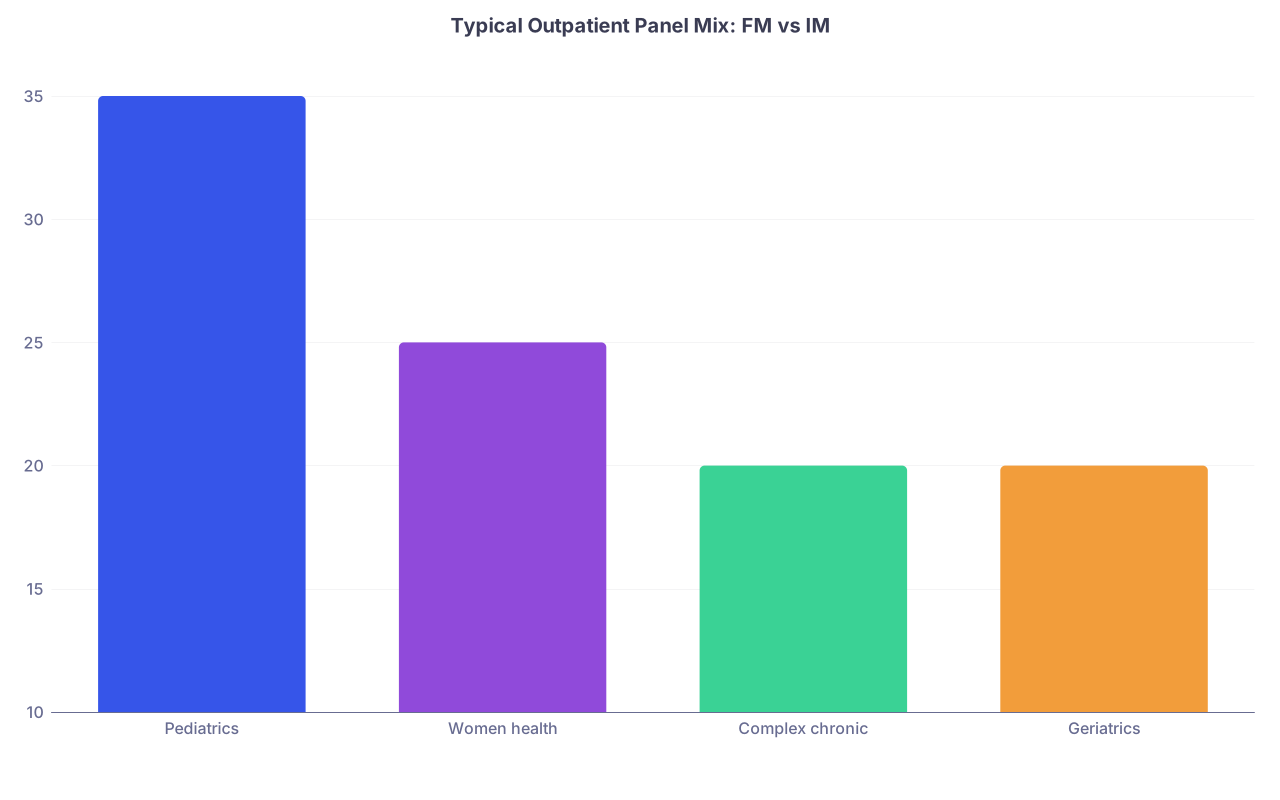
| Category | Value |
|---|---|
| Pediatrics | 35 |
| Women health | 25 |
| Complex chronic | 20 |
| Geriatrics | 20 |
(Think of the above as a family medicine panel mix; IM would lop off peds and shift more to complex chronic/geri.)
Typical Family Medicine Outpatient Panel
You might see in a given day:
- 9:00 – 2-month well child
- 9:20 – ADHD med follow-up (teen)
- 9:40 – Middle-aged woman with depression and uncontrolled diabetes
- 10:00 – Prenatal visit
- 10:20 – Elderly man with CHF follow-up
- 10:40 – Procedure slot: skin biopsy or IUD insertion
Your brain is constantly context-switching between ages, systems, and life stages. If that sounds energizing, FM fits. If that sounds like chaos, maybe not.
Typical Internal Medicine Outpatient Panel
A day might look more like:
- 9:00 – 68-year-old with CHF, CKD, and AFib
- 9:20 – 55-year-old with uncontrolled diabetes, neuropathy, CKD stage 3
- 9:40 – 72-year-old with COPD, recent hospitalization follow-up
- 10:00 – 45-year-old with uncontrolled HTN and obesity
- 10:20 – 60-year-old post-MI med reconciliation
- 10:40 – 80-year-old with polypharmacy, falls, and cognitive decline
Fewer age jumps, more disease complexity. You’re living in the land of guidelines, risk scores, and med lists the size of CVS receipts.
5. Competitiveness, Lifestyle, and Pay: The Boring but Real Factors
Competitiveness
Right now (and yes, this changes):
- Both FM and categorical IM are accessible for the majority of solid US grads
- IM is more competitive than FM, but nowhere near derm/ortho/ENT
- Prestige-obsessed people lean IM. That’s just reality.
If your application is weaker and you’re dead‑set on outpatient primary care, FM gives you a wider margin. You can still end up in a great outpatient job.
Lifestyle in Residency
Both have rough call and ward blocks. No magic lifestyle specialty here.
But:
- FM generally has more outpatient orientation and less time in the ICU
- IM at big academic centers can be brutal on inpatient rotations (long ward months, high acuity, more nights)
If inpatient drains you, a strong outpatient-focused FM program will probably feel more aligned with who you are.
Money in Outpatient Practice
For straight outpatient primary care:
- FM vs IM pay is often similar in the same system and region
- Some regions pay IM slightly more for adult-only; others don’t care
- Biggest income swings come from:
- Location (rural often pays more)
- RVU-heavy practices
- Side gigs (urgent care, procedures, telemedicine)
You won’t reliably “earn way more” as an IM outpatient vs FM if the job is essentially the same—same clinic, same employer, same template.
6. How to Actually Decide: A Simple Framework
Here’s the decision tool I give students when they corner me in the hall.

| Step | Description |
|---|---|
| Step 1 | Want outpatient primary care? |
| Step 2 | Pick other specialty |
| Step 3 | Want to see kids and maybe prenatal? |
| Step 4 | Family Medicine fits better |
| Step 5 | Only adults |
| Step 6 | Want strong subspecialty options? |
| Step 7 | Internal Medicine |
| Step 8 | Either FM or IM works |
Now answer these questions honestly:
Do you want kids and adolescents as part of your regular panel?
- Yes → Strong push toward FM
- No → Lean IM
Do you care about having deep options for subspecialty training later?
- Yes → IM
- No / Not really → FM or IM, go with the vibe of training
Does broad variety (newborn to geri, procedures, OB, psych, sports, etc.) energize you or exhaust you?
- Energize → FM
- Exhaust → IM
Are you drawn to complex inpatient pathophysiology and high‑acuity medicine?
- Strong yes → IM probably a better match
- Meh → FM likely a better long‑term fit
Where do you picture yourself practicing?
- Small town or rural, being “the doctor” for a community → FM
- Large urban academic center, adult-only clinics → IM
If you answer these honestly and still feel stuck, you’re probably in a true “either one is fine” zone. Then you decide based on program culture, geography, and your gut feeling on interview day.
7. Red Flags and Common Mistakes
I’ve watched people get burned by these patterns:
- Choosing IM “for the prestige” when they actually love full-spectrum outpatient care and kids → they end up fighting the culture of their own training.
- Choosing FM because “I don’t know what else to do” without accepting they actually want subspecialty‑level depth → 5 years later, they’re restless and boxed in.
- Assuming FM = only rural practice or low-academic → wrong. There are academic FM departments doing legit research and urban underserved work.
- Assuming IM primary care = easier job → not when your panel is 70-year-olds with 10 chronic problems and 20 meds.
Don’t pick a residency that fights your personality every day. Residency is too long for that.
FAQ (exactly 7 questions)
1. If I do Internal Medicine, can I still see kids in primary care later?
No. As an IM-trained physician, you’re boarded in adult medicine. You cannot independently practice as a pediatric primary care doctor. You might see older teens in some systems, but not true pediatrics. If you want routine care for kids as a core part of your job, you need FM (or peds, obviously).
2. Is Family Medicine “less respected” than Internal Medicine?
Among people who actually understand what FM docs do? No. Among some subspecialists and prestige-obsessed students? Yeah, sometimes. But in real communities, health systems, and primary care groups, FM is absolutely respected. If you’re highly status-driven and want deep inpatient/academic clout, IM will feel more aligned. But that’s a values question, not a “real” quality gap.
3. Which is better if I want to work in a big academic medical center doing primary care?
IM is more common in that setting, especially for adult-only academic primary care clinics. But many academic centers have strong family medicine departments with outpatient practices and teaching responsibilities. Look at specific institutions: some are IM-heavy; others have powerhouse FM departments.
4. Does one give better lifestyle than the other in outpatient practice?
Not consistently. Lifestyle is determined more by your job structure (panel size, visit length, call setup, admin support, employer) than by FM vs IM. In many health systems, FM and IM outpatient docs have virtually identical schedules and call. The myth that one is reliably cushier than the other just doesn’t hold.
5. Is it easier to match into FM or IM as an international medical graduate (IMG)?
Generally, FM is more IMG-friendly than categorical IM at many university programs. But plenty of IM community programs are also IMG-heavy. Check recent NRMP data and individual program websites. If you’re an IMG wanting outpatient primary care, FM usually offers more spots and less competition overall.
6. Can a Family Medicine doctor do mostly adult-only primary care if they want to?
Yes. Many FM-trained physicians choose to structure their practice as mostly or entirely adult-only, especially in urban or subspecialty-leaning systems. The FM training just gives you the option to see kids; it doesn’t force you to. IM, on the other hand, removes that option entirely.
7. If I’m truly 50/50, should I “default” to one over the other?
If you’re honestly neutral on kids vs adults and not chasing subspecialty training, I’d lean slightly toward Family Medicine for outpatient‑only goals. It gives you broader flexibility (kids, procedures, OB options, rural/urban versatility) without closing many doors for standard primary care jobs. But at that point, the specific program culture, location, and how you feel on interview day should probably drive the final call.
Bottom line:
Pick FM if you want full-spectrum outpatient care, kids to geriatrics, and procedural variety with strong flexibility.
Pick IM if you want to own complex adult medicine, keep real subspecialty doors open, and probably sit closer to the academic/inpatient world—even if you end up outpatient.
And don’t overthink it: if the patients and the daily work excite you, you picked the right one.