
The belief that you must train at a big-name university internal medicine program to match a competitive fellowship is exaggerated—and often just wrong.
Here’s the clean version: you do not strictly need a university IM residency to match cards, GI, heme/onc, or any other “hot” fellowship. But the further you get from academic centers, the more you have to manufacture what a university program would normally hand you: research, strong letters, visibility, and high-end clinical exposure.
If you want a simple rule of thumb:
- University IM makes competitive fellowships easier, not mandatory.
- Strong community IM can absolutely get you there.
- Weak community programs will make your life harder than it needs to be.
Let’s lay out how this actually works instead of trading Reddit myths.
The Real Question: What Do Competitive Fellowships Actually Care About?
Forget labels for a second. Fellowships don’t care if your badge said “university” or “community.” They care about outputs.
For most competitive IM subs (cards, GI, heme/onc, pulm/crit, sometimes rheum):
They look at:
Clinical caliber
- Strong attending evaluations
- How you performed on ICU, cards, onc, etc.
- Procedural exposure where relevant (right heart caths, bronch, etc.)
Academic profile
- Research: abstracts, posters, manuscripts
- Presentations at regional/national meetings
- Any niche focus (e.g., HF, IBD, malignant heme)
-
- Are they from known people in the field?
- Do they sound like “top 5% I’ve ever worked with” or just “fine resident”?
Standardized signals
- Step/Level scores (now less important, but not irrelevant)
- ITE percentile
- Sometimes Chief year, awards, teaching roles
Fit and visibility
- Did the committee (or someone they trust) actually work with you?
- Did you rotate with them, do an away elective, present with them?
The problem: university programs are built to help residents hit these points. Many community programs are not. That’s the real gap.
How Much Does Your Program Type Actually Matter?
Let’s be blunt: being at a strong university IM program is an advantage. Pretending otherwise is delusional.
But it’s not binary. There’s a spectrum.
| Residency Type | Fellowship Advantage Level |
|---|---|
| Top academic university IM | Very High |
| Solid mid-tier university IM | High |
| Strong community with university ties | Moderate-High |
| Average community IM | Moderate |
| Weak/unaccredited-risk programs | Low |
Where you sit on this spectrum changes how hard you have to work, not whether it’s possible.
What university IM usually gives you “for free”
You tend to get:
- Built-in subspecialty services with fellowship programs in-house (cards, GI, onc, neuro, etc.)
- Faculty who publish regularly and expect residents to join projects
- Department research infrastructure: statisticians, IRB support, easy co-authorship opportunities
- Name-brand letters: “PD of Cardiology at X University” means something nationally
- Program reputation: fellowship PDs already know what your training looks like
You get pulled along by the system a little. If you’re solid and even half-engaged, research and letters tend to happen.
What a strong community IM can still offer
This is where nuance matters. I’ve watched residents at places like:
- Large community programs affiliated with universities
- Busy community hospitals with strong ICUs and sub-specialists
- Hybrid “university-affiliated community” centers
…match competitive fellowships regularly.
These programs can give you:
- Huge clinical volume (often more hands-on work than some ivory-tower places)
- Strong procedural exposure
- Subspecialists who may have previously been academic
- Some limited research and QI opportunities
- Good letters if you impress the right attending
The gap is usually:
- Less structured research
- Fewer “famous” faculty
- Less direct pipeline into big-name fellowships
So can you still get to a high-end cards or GI spot? Yes. But it might look like:
- You hustle for projects instead of them landing in your inbox
- You do away rotations at target institutions
- You present posters at ACC/ACG/ASH/ATS and meet people in person
Where Training Site Matters A Lot vs. A Little (By Fellowship)
Let’s simplify how “program type” influences different IM subs.
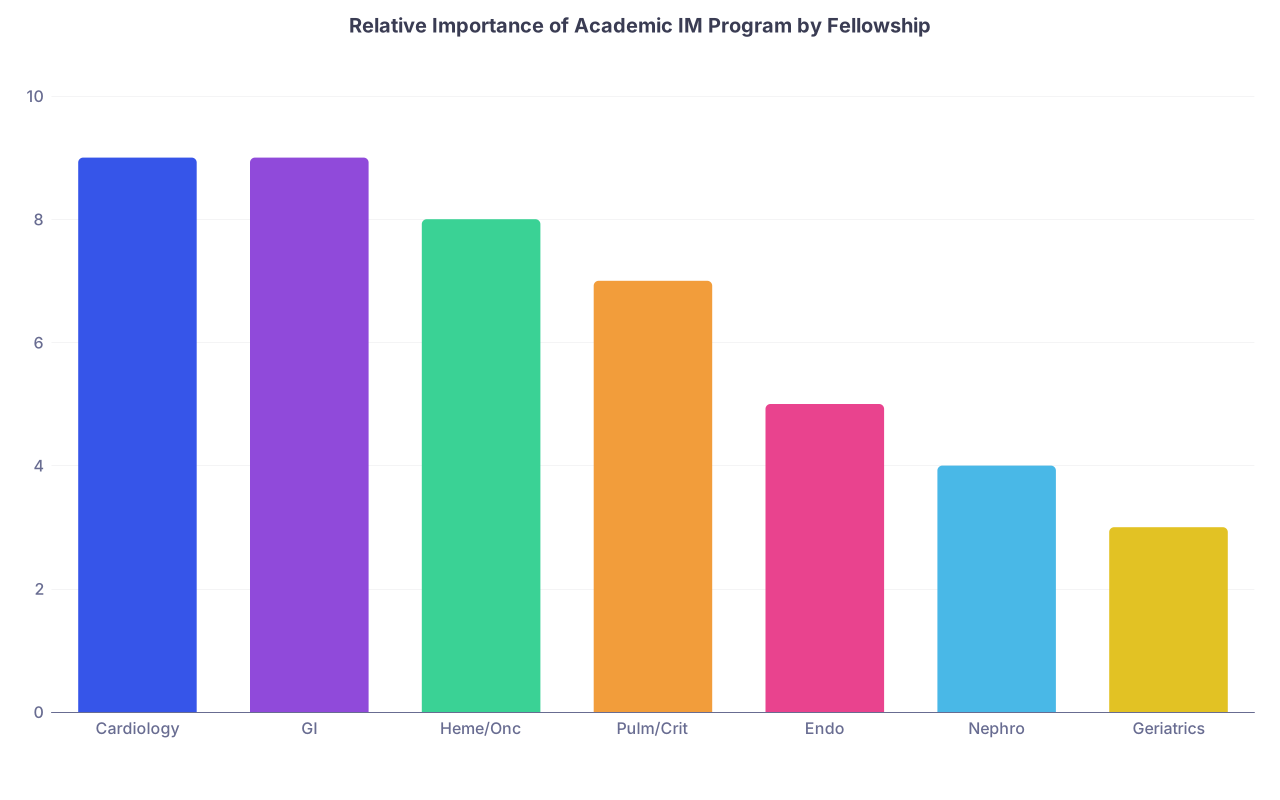
| Category | Value |
|---|---|
| Cardiology | 9 |
| GI | 9 |
| Heme/Onc | 8 |
| Pulm/Crit | 7 |
| Endo | 5 |
| Nephro | 4 |
| Geriatrics | 3 |
Scale 1–10: 10 = program type matters a lot, 1 = barely matters
High-stakes for program type
- Cardiology
- Gastroenterology
- Hematology/Oncology
These are saturated. Academic pedigree and letters from well-known subspecialists help a ton. University IM is a clear structural advantage here, especially for top-tier fellowships.
Medium impact
- Pulmonary/Critical Care
- Rheumatology
- Allergy/Immunology
You still need strong application components, but outstanding residents from community programs match these commonly, including at academic centers, if they have research and strong letters.
Lower impact
- Endocrinology
- Nephrology
- Geriatrics
- Infectious Disease (depending on region, this is getting more selective again)
Here, clinical performance, letters, and basic engagement in the field matter more than your residency address label. Match from community IM is extremely common.
How to Evaluate a Community IM Program If You Want a Competitive Fellowship
This is where people screw up. They look at “university vs community” as a yes/no checkbox instead of interrogating what the program actually produces.
Use this checklist.
Recent fellowship match list
Non-negotiable. Ask:- Where have residents matched in the last 3–5 years, and in what specialties?
- Any recent matches to cards, GI, heme/onc, pulm/crit?
If a program never sends people to the fellowship you want, believe that pattern.
Subspecialist depth on-site
You want:- At least a few cardiologists, gastroenterologists, oncologists, pulmonologists who are engaged teachers
- ICU run by intensivists, not just hospitalists with vents
Research reality (not brochure fluff)
Ask current residents:- “If I want 2–3 posters and maybe a paper in cards or GI, is that actually realistic here?”
- “Who are the few faculty who get stuff published regularly?”
- “How many residents present at national meetings each year?”
Protected time or flexibility for research
You don’t need a formal research track. But you do need:- An elective month you can devote to research
- Attendings who don’t freak out if you leave post-call to present a poster
External connections
Programs with strong pipelines tend to have:- Affiliation with a university or academic center
- Regular referrals to academic subspecialty clinics
- PD or APDs who trained at major centers and still know people there
If a “community” program checks most of these boxes, it can absolutely launch you into a competitive fellowship.

How to Compensate If You’re Not at a Big-Name University Program
Here’s the part everyone really wants: if you end up (or already are) at a community IM program, what do you do to still land a competitive fellowship?
1. Decide early what you’re aiming for
By mid-PGY1, you should have a working target: cards vs GI vs heme/onc vs something else. It can change, but early focus helps.
Why? Because you need to:
- Get on service with that subspecialty frequently
- Identify 1–2 mentors in that field
- Start one small research or QI project by late PGY1 / early PGY2
2. Manufacture academic credentials
At a community-heavy place, you can’t be passive. You need to:
- Ask: “Do you have any ongoing projects where a resident could help with data collection, chart review, or abstract writing?”
- Start small: retrospective chart reviews, simple registries, case series
- Aim for:
- 1–3 posters or abstracts at regional/national meetings
- Ideally 1 publication (even as middle author is fine)
If your program has nothing, consider:
- Collaborative projects with nearby university faculty
- Remote projects (yes, these happen—especially post-COVID)

| Step | Description |
|---|---|
| Step 1 | Start PGY1 |
| Step 2 | Identify 1 to 2 Mentors |
| Step 3 | Rotate Through Multiple Subspecialties |
| Step 4 | Join Small Research Project |
| Step 5 | Present Poster by Early PGY2 |
| Step 6 | Do Away Elective at Target Institution |
| Step 7 | Obtain Strong Letters |
| Step 8 | Apply to Broad Range of Fellowships |
| Step 9 | Choose Target Fellowship |
3. Optimize letters of recommendation
From a community program, letters matter even more. You want:
- Subspecialty letter from your desired field
- Ideally from someone known regionally or academically respected
- Letter that describes specific cases, consults, ICU situations where you performed at a high level
You make that happen by:
- Owning your patients on that service
- Reading and pre-rounding like a lunatic
- Proactively asking for feedback and improving
- Telling the attending early, “I’m aiming for GI fellowship; I’d love to be pushed and get your honest feedback”
4. Do an away elective (strategically)
If your program will let you:
- Do a 2–4 week elective at the institution or region where you eventually want to match
- Be the hardest working resident they’ve had all year
- Get at least 1 letter from that rotation
This is the closest you get to “auditioning” outside your home program. It works.
5. Make your application story coherent
From a community program, a scattered application kills you. You want a tight story:
- Repeated eval comments about strong work ethic and clinical skill
- Subspecialty rotations in your chosen field
- Some research/academic output there
- Letters all telling the same story: “This person is already functioning like a fellow in our specialty.”
Fellowships don’t expect you to have cured cancer. They expect a consistent signal you’re serious and capable.
When You Really Should Prefer a University IM Program
There are scenarios where choosing a community program over a university one is just shooting yourself in the foot.
If any of these are true for you, lean hard toward university IM if you can:
- You’re already dead-set on cards, GI, or heme/onc and want a shot at top-tier academic fellowships
- You care a lot about physician-scientist or research-heavy careers
- You want the option of niche fellowships (advanced HF, EP, transplant hepatology) in elite settings
- You have very average scores and feel you’ll need program name to compensate
The “hard truth” version:
If you have two solid options—one strong academic IM and one average community—and you want a hypercompetitive fellowship, picking the community program is usually a mistake.
Example Match Paths That Actually Happen
To make this concrete, here are common real-world scenarios I’ve seen:
Mid-tier university IM → Top 20 cards fellowship
- 2–3 cardiology abstracts
- 1 publication
- Letters from well-known cards faculty
- Strong ITE scores
This is the classic path. University made it smoother.
Strong community IM (university-affiliated) → Good academic GI fellowship
- Resident did 2 years of QI/research with local GI group
- Presented at ACG twice
- Did 1 away GI elective at the fellowship institution
- Letters from home GI and away-rotation faculty who really pushed for them
Program wasn’t famous. The resident hustled.
Small community IM with minimal research → Local cards fellowship at same hospital system
- Excellent clinical performance
- Essentially “apprentice-style” relationship with cardiology faculty
- Internal hire, because they knew and trusted the resident
This is common: your best shot may be your own system’s fellowship.
Quick Decision Framework: Do You “Need” a University IM Program?
Ask yourself three questions:
How competitive is the fellowship I want?
- Cards/GI/heme-onc at elite centers → university helps a lot
- Pulm/crit, rheum, A/I at solid academic places → community with hustle can be enough
- Endo/nephro/geri/ID → perfectly realistic from community, if program is decent
How strong is the specific community program?
- Do they have a documented track record sending people into your field?
- Do they have at least minimal research and good subspecialists?
How much do I trust myself to proactively chase research, mentors, and away rotations?
- If you’re self-starter, community can work.
- If you tend to go with the flow, university structure is safer.
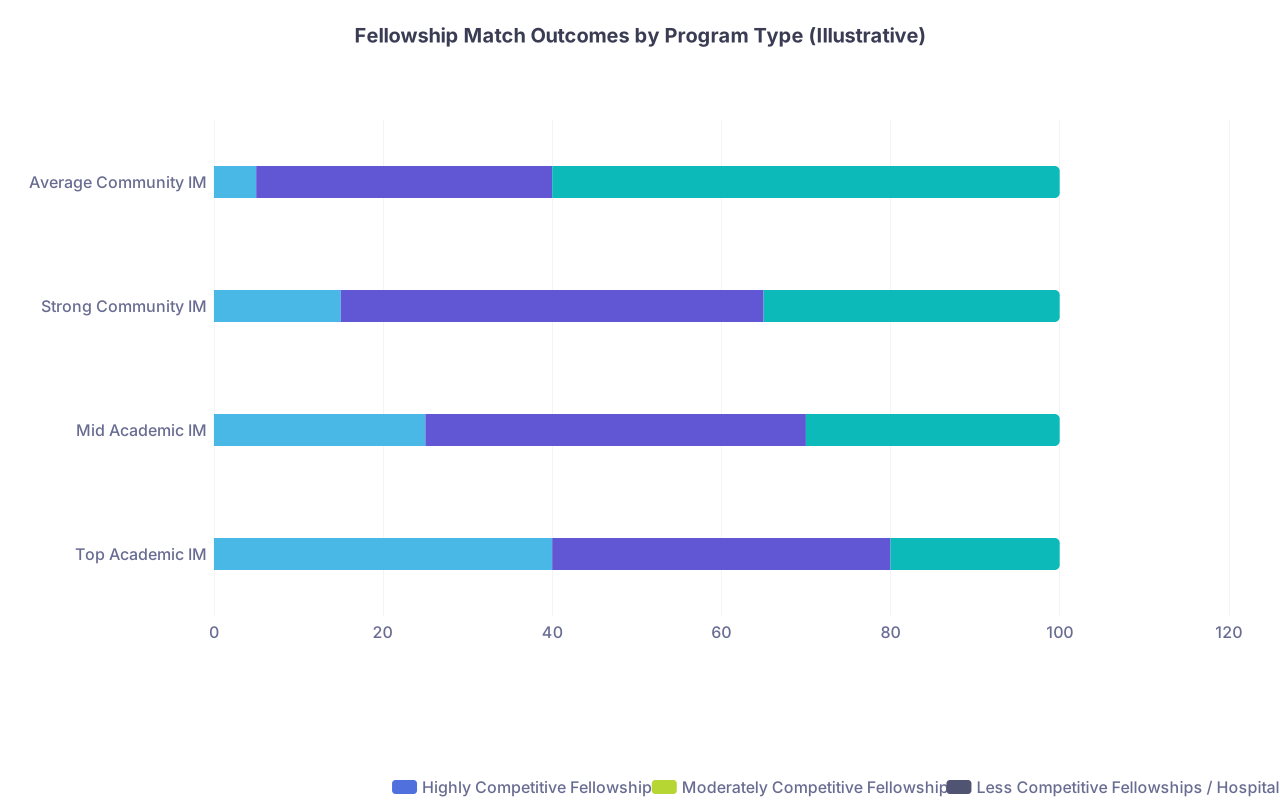
| Category | Highly Competitive Fellowships | Moderately Competitive Fellowships | Less Competitive Fellowships / Hospitalist |
|---|---|---|---|
| Top Academic IM | 40 | 40 | 20 |
| Mid Academic IM | 25 | 45 | 30 |
| Strong Community IM | 15 | 50 | 35 |
| Average Community IM | 5 | 35 | 60 |
(Not real data, but this mimics patterns I’ve seen across programs.)
FAQ (Exactly 7 Questions)
1. Can I match cardiology or GI from a pure community internal medicine program?
Yes, but it’s harder. You’ll need a community program with at least some subspecialty depth, a clear track record of sending people to those fellowships, and you must aggressively pursue research, strong letters, and possibly an away elective at your target institution. It’s not impossible, but the path is steeper than from a university IM.
2. How much does “program name” matter vs my own performance?
Both matter, but in different ways. Program name opens doors and creates baseline trust; your performance decides whether you walk through the door. A superstar from a strong community program can absolutely beat a mediocre resident from a big-name university. But when applications are stacked high, a known program’s name gives you an initial advantage.
3. Should I ever pick a weaker university program over a strong community program?
Sometimes yes, especially if the university program has robust subspecialty services, research, and a consistent fellowship match list. But if the “university” label is just a technicality, with poor mentorship and minimal research, and the community program is clearly stronger on outcomes and support, you go where people actually succeed—not where the logo looks nicer.
4. How many research projects do I need for a competitive fellowship?
For cards, GI, and heme/onc, I generally like to see at least 2–3 abstracts/posters and ideally 1 publication (even as co-author). For other fellowships, fewer may be fine, especially if your clinical and letters are stellar. Quality and relevance beat raw quantity; a single solid project with real work behind it is better than 6 meaningless case reports.
5. If my current program has almost no research, am I basically blocked from competitive fellowships?
No, but you’re handicapped. You can:
- Collaborate with external institutions (through contacts, prior schools, or conferences)
- Focus heavily on clinical excellence and letters
- Use away electives to build academic relationships elsewhere
You won’t match the most research-heavy fellowships easily, but many programs still care more about clinical performance plus a reasonable academic footprint.
6. Do away electives really help for fellowship?
Yes—when used correctly. An away elective at a realistic target program can:
- Put you directly in front of fellowship faculty
- Generate a letter from someone they already trust
- Convert you from “random applicant” to “the resident who crushed it on our service for a month”
They’re not magic, but they’re one of the most powerful tools for residents from less-known programs.
7. If I am undecided about fellowship, should I prioritize a university IM program?
If you have the option, yes. University IM keeps more doors open, especially for the highest-demand fellowships. If you’re truly unsure and have roughly equivalent options, the academic environment, mentorship, and research infrastructure at a university program give you more flexibility to choose later—without having to fight uphill against structural limitations.
Key takeaways:
You don’t need a university internal medicine program to match a competitive fellowship, but it makes the process easier and more predictable. A strong community program with a proven fellowship match record plus an aggressive, focused resident can absolutely get to cards, GI, or heme/onc. The real mistake is choosing based on labels alone instead of asking the only question that matters: “What has this program actually produced for residents like me in the last five years?”