
The belief that “more research time automatically makes a neurology program better” is wrong.
Mandatory research time can be a fantastic career accelerator… or a massive, frustrating time sink. Whether you should choose a neurology residency with built‑in research time depends on three things: your career goals, your actual interest in research, and how the program structures that time.
Let’s walk through this systematically so you don’t wake up PGY‑4 thinking: “I just burned a year doing busywork for someone else’s CV.”
The Core Question: Who Actually Benefits from Mandatory Research?
Here’s the blunt truth: mandatory research time in neurology is a big win for three groups of people:
- You want academic neurology (faculty job, major fellowship, research career).
- You’re aiming for a very competitive neurology subspecialty at a top institution (epilepsy at MGH, movement at UCSF, stroke at Columbia, etc.).
- You genuinely like asking questions, working with data, or building things (quality improvement, AI tools, education research).
If you’re planning community general neurology, want a sane life, and have zero interest in publications? A program that forces 6–12 months of research may feel like you’re being held hostage.
Let’s lay out the common structures so we’re talking about the same thing.
| Program Type | Typical Research Time | Style |
|---|---|---|
| No formal research time | 0–4 weeks total | Elective-based only |
| Minimal built-in time | 4–8 weeks | Usually PGY-3/4 block |
| Moderate mandatory block | 2–4 months | Protected research |
| Heavy research / research track | 6–12+ months | Often grant-supported |
Mandatory research time isn’t automatically good or bad. The details matter.
Step 1: Be Honest About Your Career Direction
Don’t overcomplicate this. Start with: What kind of neurologist do you think you want to be?
If you want academic neurology or a research career
If your dream is:
- Faculty at a university hospital
- Running trials in MS, epilepsy, stroke, neuromuscular, etc.
- Doing NIH grants, K awards, T32, R01
- Splitting time between clinic, wards, and a lab or data work
Then mandatory research time is almost always a net positive. Why?
- You need protected time to build a research portfolio. You will not magically squeeze this into nights/weekends during full ward months.
- Top fellowships care about trajectory: multiple projects, maybe a first‑author paper, letters from research mentors.
- You need skills: study design, basic stats, IRB, clinical trial workflow. You don’t get that from just seeing consults.
In this case, you should actively prefer programs with:
- At least 3–6 months of protected research time
- A clear research track or clinician‑scientist pathway
- Internal funding or T32 research slots
- Real mentorship (not just “you can email faculty if you want”)
If you want competitive subspecialty fellowships (but not pure research)
Think of things like:
- Vascular neurology at big academic centers
- Neurocritical care at high-volume ICUs
- Epilepsy, movement disorders, neuromuscular at name-brand programs
These fellowships want evidence you can contribute academically. They’re not all looking for future full‑time scientists, but:
- A couple of solid projects and one or two publications
- Maybe a poster at AAN or an international subspecialty conference
- A letter from a research or scholarly mentor
Mandatory research time can make this easy, if the program helps you plug into existing projects instead of leaving you to flail around alone. For this group, 2–4 months of research time is often the sweet spot. Enough to get something meaningful done. Not so long that you lose your clinical edge.
If you want community neurology or primarily clinical work
You’re envisioning:
- Private practice or employed group in a mid‑sized city
- Bread-and-butter neurology with maybe a niche (headache, EMG, stroke focus)
- Little to no ongoing research once you’re out
You have two options:
- Choose a program with minimal required research but some elective time, so you can do one or two projects and move on.
- If you land at a program with mandatory time, use it for practical, CV-boosting projects: quality improvement, workflow, resident education. Things that help you match to fellowship or first job without forcing you into bench science.
You do not need 6–12 months of lab time to be an outstanding clinician. In fact, for some people, that much research is just misery and lost clinical experience.
Step 2: Look Under the Hood – Not All “Research Time” Is Equal
The biggest mistake applicants make is assuming “3 months research” at every program means the same thing. It doesn’t.
Here’s what you absolutely need to ask current residents:
Is the research time truly protected?
Or are you covering clinic, backup call, or random admin during that block?How early do people connect with mentors?
PGY‑1? PGY‑2? Or does everyone scramble two weeks before research block starts?What’s the track record for residents actually producing something?
- Posters at AAN?
- Peer-reviewed papers?
- Case reports only?
Is there structure or are you on your own?
- Regular research meetings / works-in-progress sessions?
- Required check-ins or milestones?
- Help with statistics, IRB, and manuscript prep?
Can you choose what type of research?
- Clinical outcomes
- Trials
- Imaging
- Lab
- Education, QI, informatics
If residents say things like:
- “Most of us use it to catch up on sleep and Netflix, honestly”
- “I spent the whole block cleaning data for a fellow’s project I don’t care about”
- “There’s no real guidance; you sort of figure it out or you don’t”
That’s not a program with “research time.” That’s a program with a badly used elective block.
Step 3: Tradeoffs – What You Gain vs What You Lose
Mandatory research time always has a price. You’re paying with something.
What you gain
- A safer sandbox to learn research without the crushing pace of wards
- Time to write – which is the hardest part to do while on service
- Stronger application for academic jobs or competitive fellowships
- A clearer signal to future employers: you can produce scholarly work
What you lose
- Clinical exposure: 6–12 months of research is 6–12 months you’re not on wards/clinic
- Clinical confidence: Some people feel rusty when they come back after a long research block
- Flexibility: That time is fixed; you can’t pivot it into extra subspecialty rotations or away electives
- Emotional energy: Research can be slow, tedious, and full of dead ends
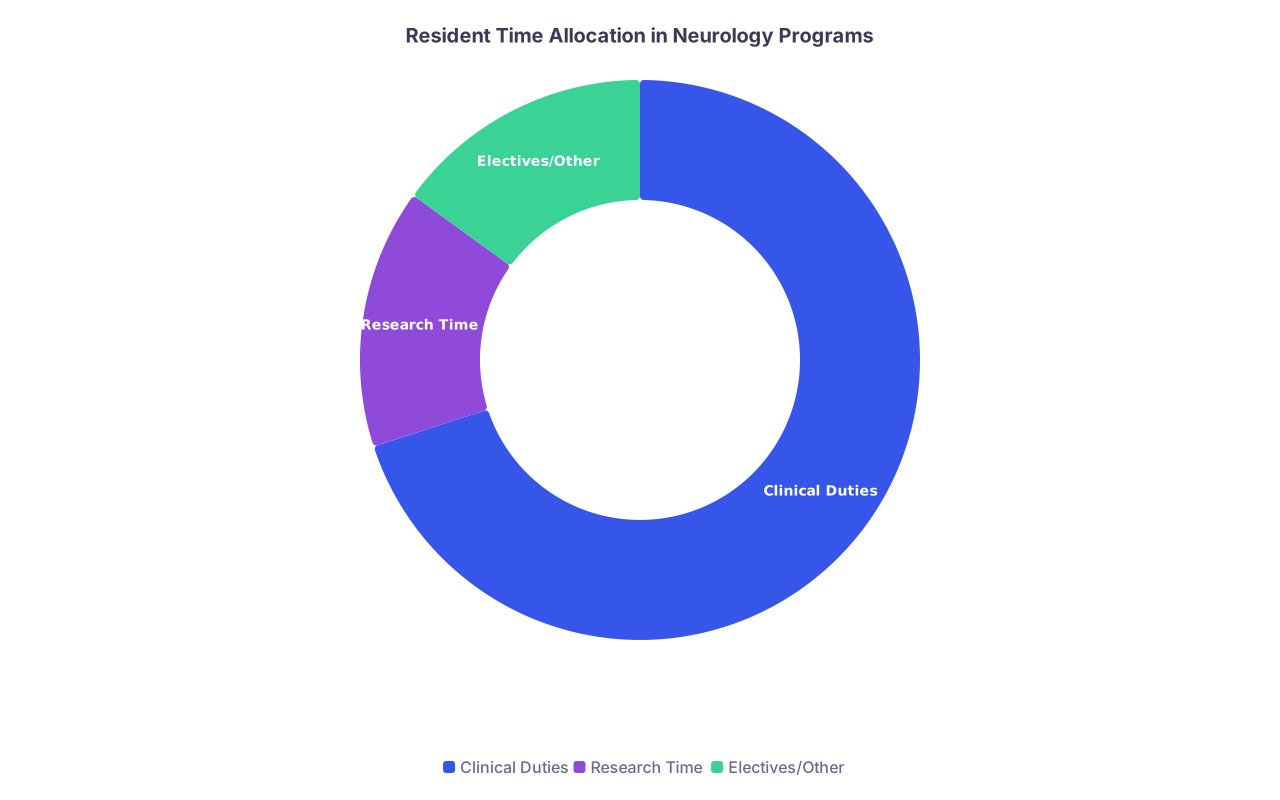
| Category | Value |
|---|---|
| Clinical Duties | 70 |
| Research Time | 15 |
| Electives/Other | 15 |
Here’s my threshold: if research time is more than 25% of your total residency, you’d better be at least moderately serious about academic work or a research-leaning career. Otherwise you’re overpaying.
Step 4: Red Flags and Green Flags in “Mandatory Research” Programs
Let’s be concrete.
Green flags
You hear residents saying things like:
- “Everyone finishes at least one first‑author project.”
- “We have a research director who helps match you with mentors PGY‑1 year.”
- “People present at AAN or ISC basically every year.”
- “We have biostatistics support built in; I didn’t have to learn SPSS alone at 2 a.m.”
- “You can use your research time for QI, education, or clinical projects – it doesn’t have to be bench work.”
Those are programs where mandatory research actually means opportunity, not obligation.
Red flags
You hear:
- “Most people don’t end up using their research time well.”
- “You’ll figure it out when you’re a PGY‑3.”
- “We have research… somewhere… I’m not really sure who to talk to.”
- “People mostly do case reports and call it a day.”
That’s dead weight on your training.
Step 5: How This Plays Out by Neurology Subspecialty
Some neurology niches care more about research than others. Broad strokes:
High research expectation:
- Movement disorders
- Epilepsy at major centers
- MS / neuroimmunology
- Behavioral / cognitive neurology
- Neuromuscular (especially if you want academic roles)
Moderate expectation:
- Vascular neurology
- Neurocritical care
- Headache medicine (academic centers)
- Clinical neurophysiology
Lower expectation (for community practice):
- General outpatient neurology
- Community stroke or hospital neurohospitalist roles
- Many community-based epilepsy/headache positions
If you’re even 50% sure you want to land in the “high research expectation” bucket at a big-name center, I’d strongly lean toward a program with at least a few months of real research time and a documented track record of placing people into those fellowships.
Quick Decision Framework: Should YOU Choose Mandatory Research?
Use this as a rough rule-of-thumb filter.

| Step | Description |
|---|---|
| Step 1 | Start |
| Step 2 | Choose program with 4-12 months research |
| Step 3 | Prefer 2-4 months protected time |
| Step 4 | Avoid heavy mandatory research |
| Step 5 | Neutral - pick balanced program |
| Step 6 | Want academic career? |
| Step 7 | Want top competitive fellowship? |
| Step 8 | Actively dislike research? |
To make it simpler:
Definitely yes to mandatory research time if:
- You want academic neurology or a research-heavy fellowship
- You’re excited by the idea of projects, not just doing them for the CV
Maybe if:
- You’re unsure but open to academics
- The program has a flexible, well-supported research block
- The time is limited (2–3 months) and doesn’t crush clinical training
Probably no if:
- You actively dislike research
- You’re set on community practice
- The “research time” at that program is poorly organized and low-yield
How to Compare Specific Programs on the Interview Trail
When you’re actually on interviews or second looks, ask targeted questions. Not fluffy ones.
Ask current residents:
- “How many residents in your last graduating class had at least one publication?”
- “Who runs resident research here? Is there a specific faculty point person?”
- “When do people usually start projects – PGY‑1, PGY‑2, or later?”
- “Is your research time 100% free of call/clinic, or are you still covering stuff?”
- “What do people actually do with their research time – what were the last few resident projects about?”
If you hear concrete, specific answers with named examples, good sign. If everything is vague (“Oh yeah, lots of people do stuff, I think?”), that tells you the real culture.
Bottom Line: So, Should You Choose a Neurology Program with Mandatory Research Time?
Here’s the straight answer:
If you’re serious or strongly leaning toward academic neurology or a research-heavy subspecialty, you should actively prefer programs with structured, supported, mandatory research time (at least 3–6 months). That time is hard to recreate later.
If you’re on the fence, a program with 2–3 months of flexible, well-supported research time is a good hedge. Enough to explore without overcommitting.
If you’re aiming for community practice and you honestly dislike research, do not let a long mandatory research block drive your rank list. Your happiness and clinical growth will matter more than an extra line on your CV.
The key isn’t “mandatory research: yes or no?”
The key is: “Does this program’s approach to research align with the neurologist I actually want to become?”
Today, write down three things:
- Your best guess at future career: academic vs community vs undecided.
- Your honest interest level in research: 0–10.
- How much time you’re realistically willing to spend on research during residency.
Then look at your neurology program list and mark which ones truly match that profile. If the numbers don’t line up, adjust your rank list, not your personality.
FAQ: Neurology Programs and Mandatory Research Time
1. Will not having mandatory research time hurt my chances for fellowship?
Not automatically. Plenty of residents at clinically heavy programs match excellent fellowships. What matters more is whether you complete at least a couple of meaningful projects. If your program doesn’t have built-in research blocks, you’ll just have to be more intentional about carving out time during electives, lighter rotations, or even off-hours. It’s harder, not impossible.
2. How many publications do I “need” for a good neurology fellowship?
There’s no magic number, but for competitive academic fellowships, I like seeing at least 1–2 first- or co-first-author papers plus a couple of abstracts/posters. For solid but not hyper-competitive fellowships, a handful of abstracts and one decent paper is often enough, especially if paired with strong letters and good clinical performance. Remember: quality and clear involvement matter more than padding with 10 case reports you barely touched.
3. What if I start residency thinking I love research and then hate it?
Happens all the time. If your program has mandatory research time, you can still redirect that block. Shift from basic science to clinical outcomes, then to QI, then to education research. You don’t have to remain stuck in a lab you hate. The earlier you realize the mismatch and talk to your program leadership or research director, the more they can help you pivot to something that feels useful instead of torturous.
4. Is a “research track” neurology residency only for future R01-level scientists?
No. Some research tracks are very hardcore (geared toward MD/PhDs and future NIH grantees), but others are basically “enhanced scholarly tracks” that offer extra mentorship, more protected research time, or integrated Master’s degrees. You don’t have to be committed to a 90% research career to benefit. Read the fine print: look at past graduates of that track and what they’re doing now.
5. Does doing a research year before residency (e.g., a gap year) mean I can skip research time in residency?
Program directors won’t usually “credit” pre-residency research in a way that changes formal requirements. But prior research makes it much easier to hit the ground running. You’ll know the basics of study design, IRB, and manuscript writing. That can let you be more efficient with whatever research time the program provides, sometimes turning one block into multiple concrete outputs instead of just one underpowered project.
6. If I hate statistics and coding, can I still benefit from a research-heavy program?
Yes, if the program has good support. Many neurology research projects are team-based; you don’t have to personally run every analysis or write code. You can focus on clinical phenotyping, data collection, patient recruitment, or manuscript writing while statisticians and data scientists handle the heavy math. The key is choosing mentors and projects that match your strengths, not forcing yourself into a role you’re not built for.
Now, open your current neurology program list and put a star next to every program with mandatory or substantial research time. For each starred program, write exactly how you’d use that time. If you can’t answer that in two specific sentences per program, you have some rethinking—and probably some emails to current residents—to do.