
The dirty secret is this: for most community-focused family medicine and pediatrics careers, “prestige” barely moves the needle compared with fit, training quality, and where you want to live and work.
Let me be more precise. Name-brand programs can help at the margins. But if your goal is to be a strong, community-oriented FP or pediatrician—not an academic chair or subspecialty superstar—then obsessing over prestige is usually a waste of energy and, frankly, a distraction from what actually matters.
Here’s how to think about it like a grown-up instead of like an anxious MS4 refreshing SDN.
1. What “Prestige” Actually Buys You in FM and Peds
Start with the honest upside. Prestige is not completely irrelevant. It’s just overrated for community-focused careers.
When people say “prestigious program” in FM or peds, they usually mean one or more of:
- Attached to a big-name university (Hopkins, UCSF, CHOP, etc.)
- Historically strong reputation among faculty and PDs
- High academic output (publications, fellowships, leadership roles)
- Strong fellowship placement
So what does that buy you?
- Slight brand recognition with some employers and fellowship PDs
- Easier access to research and academic mentors
- A network of graduates in leadership or academic positions
Notice what’s missing: guaranteed better training, better attendings, or better preparation for a normal community job. Those don’t automatically come with a big name. I’ve seen “no-name” community FM programs that crank out better, more independent clinicians than many university programs.
For community-focused FM and peds, prestige mainly helps if:
- You think you might want fellowship (peds heme/onc, NICU, sports med, OB, etc.)
- You want a future academic/leadership role at a large system
- You’re trying to land in highly competitive geographic markets with saturated job markets
If you know you want to be a community generalist—clinic, maybe small hospital, maybe FQHC—then prestige is a minor player.
2. What Actually Matters More Than Prestige
If you remember nothing else, remember this: your day-to-day training environment will shape you far more than the name at the top of your badge.
For community FM and peds, these matter more:
2.1 Breadth and autonomy of clinical training
You want to graduate feeling like: “I’ve seen this before. And if I haven’t, I know how to approach it.”
Look very closely at:
- Patient mix:
- FM: prenatal care? newborns? geriatrics? complex chronic disease? procedures?
- Peds: bread-and-butter general peds vs. mostly tertiary referral zebras?
- Inpatient vs. outpatient balance
- Procedural opportunities: skin biopsies, IUDs, vasectomies, joint injections, circumcisions, LPs, etc.
- Continuity clinic: Panel size, acuity, and how much you actually manage vs. turf to “specialists.”
Plenty of big-name programs are excellent. But some hyper-specialized tertiary centers are actually bad for community prep because everything mildly complex gets carved off to another subspecialty.
2.2 Graduates doing what you want to do
If most recent graduates are:
- Working in FQHCs or rural clinics
- Running busy community practices
- Doing exactly the kind of job you imagine for yourself
That program is “prestigious” for your goals, even if nobody on Reddit cares about its name.
Look at the program’s “Where our graduates go” page. Then cross-check that with talking to current residents.
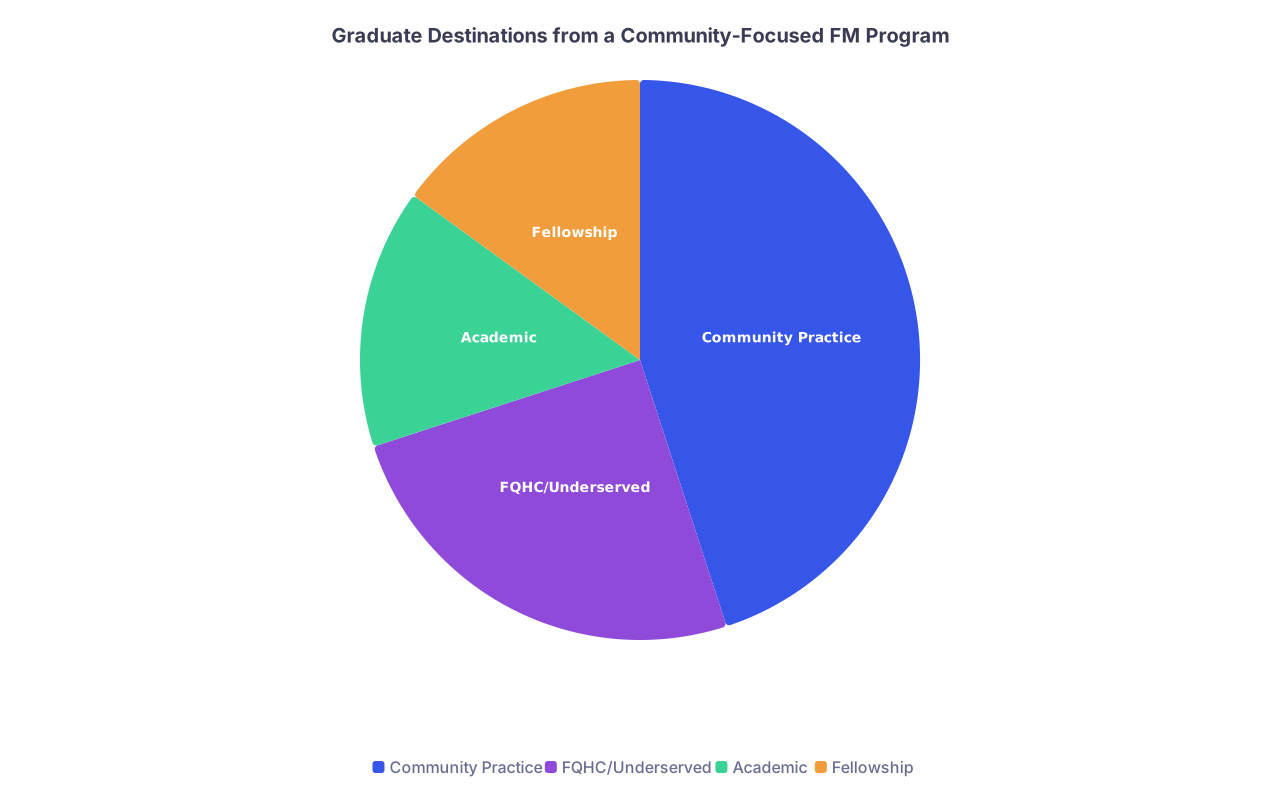
| Category | Value |
|---|---|
| Community Practice | 45 |
| FQHC/Underserved | 25 |
| Academic | 15 |
| Fellowship | 15 |
If a program proudly highlights that 60–70% of grads take community jobs, that’s a good sign if that’s what you want.
2.3 Culture and how you’re treated
You will be living there for three years while sleep-deprived and under pressure. A miserable “top” program can wreck your mental health. A solid mid-tier with supportive faculty can turn you into a confident, happy doc.
Talk to residents and listen for:
- “We’re like a family” vs. “People keep to themselves”
- “I feel comfortable asking questions” vs. “You’re expected to sink or swim”
- “They really support my interests” vs. “You must fit their mold”
I’ve watched residents at prestigious university programs burn out so hard that by PGY-3 they were counting the days to never see an EMR login again. Meanwhile, residents at modest community hospitals were teaching med students and running services confidently.
2.4 Location and job market
Where you train heavily influences where you end up. Hospital recruiters love “people who trained down the road and already know our system.”
For community FM and peds, it’s not dumb to prioritize:
- Training in a state where you want to practice
- Training near your support system
- Training in a region with the kind of jobs you want (rural, urban underserved, suburban)
Many community practices couldn’t care less whether your PD is well-known in Boston. They care that you’re licensed in their state, competent, and not a jerk.
3. Family Medicine: Does Prestige Matter?
In family medicine, program prestige is often the loudest online…and the least relevant in real life.
When prestige helps in FM
It has real value if:
- You want academic FM (residency faculty, research, medical education leadership)
- You’re eyeing competitive fellowships: sports med, OB, addiction, palliative, EM tracks
- You want a shot at large academic or integrated systems that care about pedigree
Big systems sometimes use “top program” as a lazy screening heuristic. Not always. But enough that it matters if you’re chasing these jobs in hypercompetitive cities.
When you can safely ignore prestige in FM
You can mostly ignore it if:
- You’re headed to community outpatient practice
- You want to work in FQHCs, rural health, or primary care clinics
- You value full-spectrum training (OB, procedures, inpatient) more than brand
A famously rigorous, unopposed community FM program with strong OB and inpatient can be better prep for rural or underserved practice than a tertiary-care giant where FM is a small cog.
| Factor | When Prestige Matters | When Training Quality Matters More |
|---|---|---|
| Academic career | High | Medium |
| Rural full-spectrum job | Low | Very High |
| FQHC / underserved | Low | Very High |
| Sports medicine fellowship | Medium-High | High |
| Lifestyle community job | Low | High |
In blunt terms: if you want to be the doc everyone in town trusts, a strong, busy, community FM program beats a shiny name with shallow continuity experience.
4. Pediatrics: Same Story, Different Details
Pediatrics lives a bit more in the academic world than FM, so program reputation can matter slightly more—especially for subspecialties.
When prestige really matters in peds
You should care more about program reputation if:
- You’re already serious about a competitive peds fellowship:
- NICU, cardiology, heme/onc, GI, etc.
- You want a research-heavy academic career
- You want to be at the national conversation table (guidelines, big multicenter trials)
Prestigious peds programs often:
- Have large subspecialty divisions
- Offer in-house fellowships that prefer their own residents
- Have brand recognition at major children’s hospitals
So if your dream is peds heme/onc at St. Jude, yes, a big-name peds residency is an asset.
Community general peds? Different game.
If your goal is:
- Bread-and-butter clinic pediatrics
- Community hospital peds
- Hospitalist roles outside the biggest academic centers
Then prestige is nice-to-have, not need-to-have.
You should prioritize:
- Solid inpatient peds volume
- ED exposure and common acute care
- NICU/PICU time that teaches you stabilization and when to transfer
- Strong outpatient continuity clinic with diverse pathology
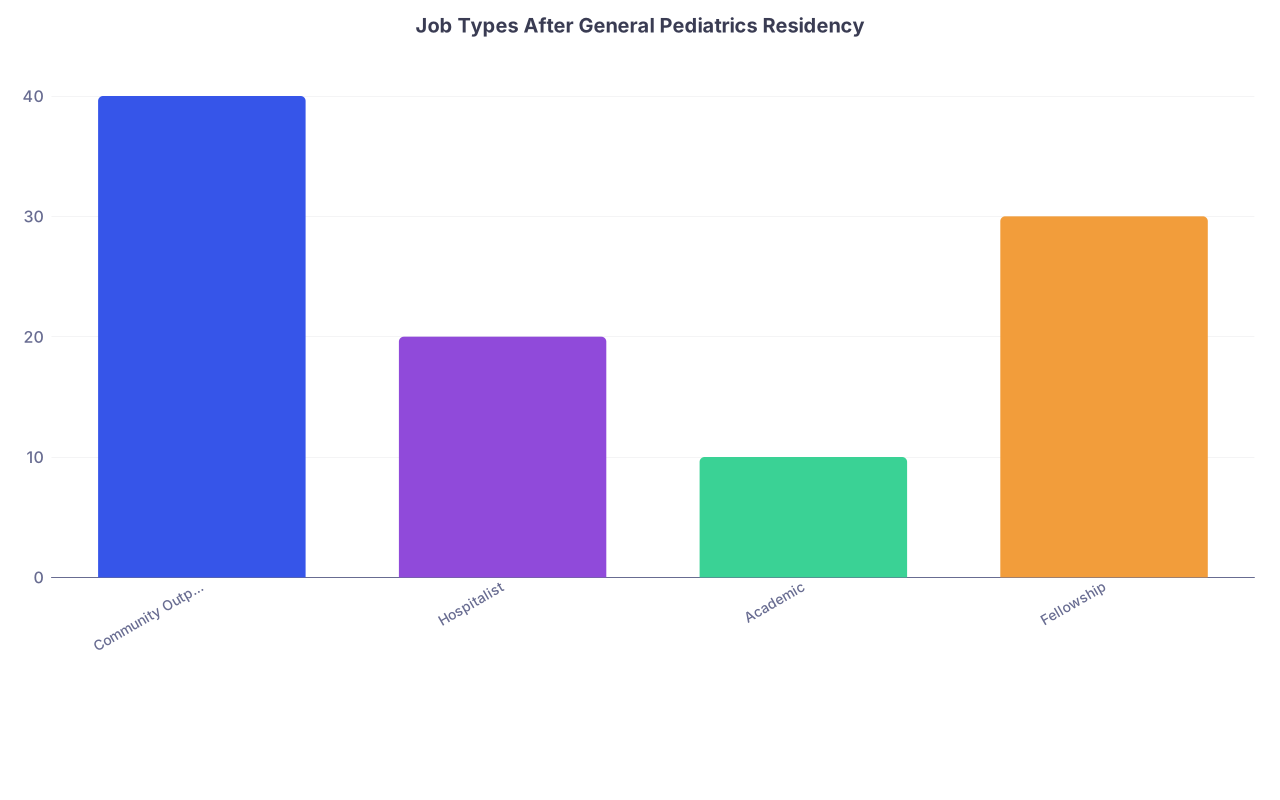
| Category | Value |
|---|---|
| Community Outpatient | 40 |
| Hospitalist | 20 |
| Academic | 10 |
| Fellowship | 30 |
Look carefully at how many residents go straight into general peds vs. fellowship. If everyone is gunning for subspecialties and outpatient clinic is an afterthought, you might not get the generalist experience you need.
5. How Employers Actually View Program Prestige
Here’s the part almost no one tells you plainly: most community employers cannot meaningfully distinguish between “top 10” and “top 50” residencies. Many rely on simpler signals:
- Did you complete an ACGME-accredited residency without red flags?
- Were your references strong?
- Did you interview well and seem like someone they’d trust with their patients?
- Do you want to live here, or are you going to bail after two years?
Yes, there are hospital systems and large groups that quietly prefer residents from certain “known” programs. But these differences shrink dramatically outside of a few hot markets (think: SF Bay, Manhattan, Boston, Seattle) and high-paying coastal systems.
For the majority of community FM and peds jobs:
- Any solid, reputable program → fine
- Good recommendations → more important
- Your personality and work ethic → absolutely decisive
I’ve watched a “no-name” community FM grad with glowing references beat a university-prestige candidate who gave off diva vibes in a single interview. Multiple times.
6. A Practical Framework: How You Should Choose
You’re not choosing a logo. You’re choosing who will train you to take care of kids and families when there’s no attending to bail you out.
Here’s a sane way to weigh things.
Step 1: Get honest about your likely path
Answer this as honestly as you can:
“I’m 80% sure my career will be…”
- A. Community outpatient FM or peds
- B. Community plus some inpatient or hospitalist work
- C. Fellowship-heavy or academic-leaning
If you’re clearly A or B, put a hard cap on how much mental energy you give to prestige. It’s just not the main variable. You should instead rank programs by training quality and personal fit.
If you’re C, prestige and academic resources matter more, but still share the stage with how well the program will actually teach you medicine.
Step 2: Weigh the factors
Rough weighting (you can tweak this):
- Training quality and case mix: 40%
- Culture and resident happiness: 25%
- Location and life outside work: 20%
- Program reputation/prestige: 15%
If you’re strongly academic/fellowship-bound, maybe prestige goes up to 25–30%. For a future community doc, it can comfortably be 10%.
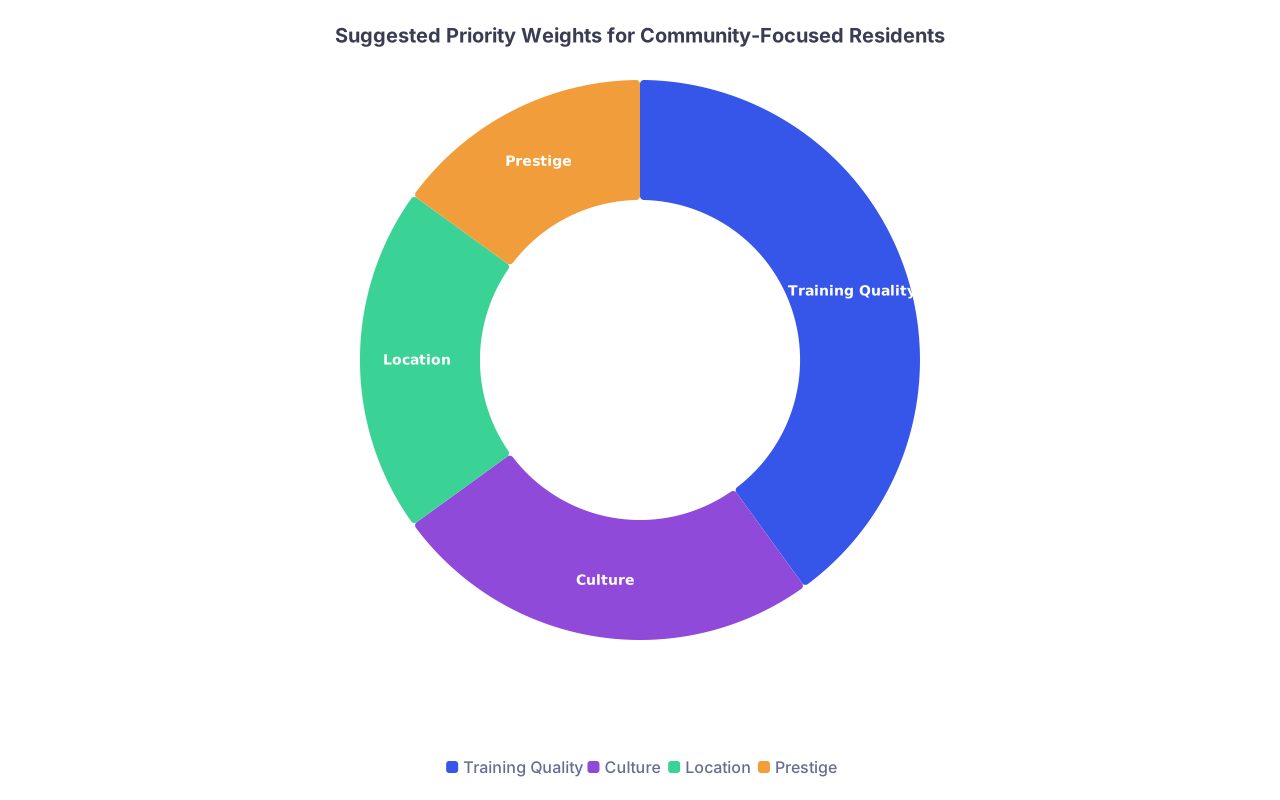
| Category | Value |
|---|---|
| Training Quality | 40 |
| Culture | 25 |
| Location | 20 |
| Prestige | 15 |
Step 3: Ask the right questions on interview day
Examples that cut through the sales pitch:
- “Where did your last five graduates in community practice end up?”
- “How independently do seniors run services?”
- “What are the weakest parts of your training right now?”
- “If I want to work in an FQHC/rural clinic/urban underserved setting, how well will this program prepare me?”
Watch how quickly and honestly people answer. That tells you more about your future than whether the program director gave a talk at the last national conference.
7. Red Flags and Overrated Signals
Last bit of tough love.
Signals people overrate:
- “Top 10” threads on forums
- NIH funding for your department (irrelevant if you’re not doing research)
- US News rankings of the med school (you’re entering residency)
- Shiny facilities without serious talk about education
Red flags that do matter:
- Residents who look exhausted and guarded during social time
- Hand-wavy answers about where grads go or how much autonomy you get
- Peds programs with almost no real general peds clinic
- FM programs where OB or inpatient is “optional” but you want full-spectrum practice
Prestige won’t save you from poor training or a toxic culture.
FAQ (exactly 5 questions)
1. Will training at a less well-known FM or peds program hurt my chances of getting a good community job?
Usually not. For most community practices and hospital systems, any solid, accredited residency with good references is enough. Your interview performance, teamwork reputation, and willingness to stay in the area typically matter more than the brand name on your diploma.
2. If I might want fellowship after peds or FM, do I need a prestigious residency?
You don’t strictly need one, but it helps more in pediatrics than in FM. For competitive peds fellowships (NICU, heme/onc, cards), training at a strong academic center with in-house fellowships and research access is a real advantage. In FM, for fellowships like sports med or OB, strong mentorship and program advocacy often matter as much as brand.
3. Are community-based residencies worse than university programs for training quality?
Not inherently. Many community FM and peds programs offer broader, more hands-on experience, especially for full-spectrum family medicine and bread-and-butter pediatrics. What matters is volume, diversity of cases, supervision quality, and graduated autonomy—not whether there’s an Ivy League logo on the hospital.
4. How can I tell if a program’s “prestige” is actually useful for my goals?
Look at outcomes, not marketing. Check where graduates go, what jobs they take, and how many end up in the type of role you want. If you see lots of grads in the exact community jobs you’re targeting, that program is “prestigious” in the way that matters to you, even if no one on rankings lists talks about it.
5. On my rank list, should I put a more prestigious program above a better-fit, mid-tier one?
If your goal is community-focused FM or peds, I’d usually rank the better-fit, stronger-training, mid-tier program higher—especially if the culture is healthier and the graduates look like the doctor you want to become. Only override that if you have clear academic or fellowship ambitions where the extra name recognition and research infrastructure at the prestigious program will truly open doors you care about.
Key takeaways: For community-focused FM and pediatrics, program prestige is a secondary factor. Strong, broad training and a sane, supportive culture will matter far more to the patients and communities you serve—and to your long-term career satisfaction.